Venezuelan pianist Gabriela Montero, born on 10 May 1970, has garnered critical acclaim and a devoted following on the world stage for her visionary interpretations and unique compositional gift.

Gabriela Montero © Anders Brogaard
She has come to be known, in particular, for her real-time improvisation of complex musical pieces on themes suggested by her audience.
Gabriela Montero improvises on a theme from Princess Chang-ping
A Voice of Protest
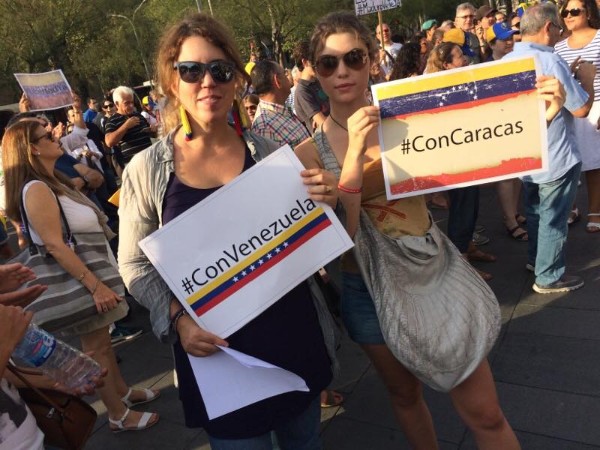
Gabriela Montero at a protest march
In addition, Montero is politically active, and she has composed musical protests against the political oppression under the regime of Hugo Chávez in her native Venezuela. Expatria became a musical photograph of Venezuela’s turmoil, and her Piano Concerto No. 1, subtitled “Latin,” celebrates the cultural richness of Latin America while confronting its darker realities.
Predating both compositions is her 2010 release of SoLatino, a recording that blends Latin American repertoire with her own improvisations. Montero takes us into Latin American culture with six different composers and some reflective improvisations.
Ernesto Lecuona: Danzas Afro-Cubanas (Gabriela Montero, piano)
A Cuban Voice

Gabriela Montero
While many listeners are familiar with the music of Argentine composer Alberto Ginastera, considered by many the most important classical composer of the Americas, Cuban composer Ernesto Lecuona is comparatively little known.
Lecuona was born into a musical family and wrote his first song at the age of 11. Graduating from the National Conservatory of Havana in 1913, he eventually made several tours of Latin America, Europe, and the USA as a composer, pianist, and leader of a dance band.
He lived in New York for a number of years and wrote for musicals, films, and the radio. His music combines film, pop and folk themes, which achieved great popularity. He was even nominated for an Oscar in 1942, but lost out to “White Christmas.”
Lecuona’s best-known work is his Suite Andalucía, combining the energetic feel of Latin music with traditional structures. I don’t know if this can be substantiated, but Maurice Ravel apparently said that “Malagueña is more melodic and beautiful than my own Bolero“.
Ernesto Lecuona: Andalucia, “Suite espagnola” (Gabriela Montero, piano)
Venezuelan Roots
Montero’s compatriot, Antonio Estévez, started his musical career as a saxophonist and oboist. A teacher at the National School of Music in Caracas, he collaborated on transcriptions and the restoration of Venezuelan colonial music.
Between 1945 and 1949, Estévez studied with Koussevitzky, Bernstein and others at Columbia University and Tanglewood. Once he returned to Venezuela, Estévez produced the Cantata Criolla, based on a popular legend in which the devil challenges a folk singer to a duel.
This work became immensely popular, but the composer became critical of his own musical language and went on to study electronic techniques in Paris. He did eventually return to Caracas and adopted a more eclectic musical style in later years.
Antonio Estévez: 17 piezas infantiles (Gabriela Montero, piano)
The Sounds of Rio

Gabriela Montero
Ernesto Nazareth hailed from Rio de Janeiro, and he began to compose in popular dance genres from an early age. A formidable pianist, Nazareth worked exclusively in light music, and he was employed by the publishing house of Carlos Gomes to perform scores for clients.
He also played on a daily basis at the famous Odeon cinema, where Villa-Lobos had worked only a few years earlier as a cellist. Nazareth was highly popular in the 1920s, and his tangos established him as the most influential Brazilian popular composer of the 20th century.
Villa-Lobos once called him the true incarnation of the Brazilian soul, and his waltzes and tangos were sources of inspiration for countless composers, including Milhaud, Villa-Lobos, and Mignone. To be sure, his music enjoyed great success in the late 20th century.
Ernesto Nazareth: Odeon (Gabriela Montero, piano)
Ernesto Nazareth: Brejeiro (Gabriela Montero, piano)
Ernesto Nazareth: Fon-fon (Gabriela Montero, piano)
Music as Testimony

Gabriela Montero
SoLatino also includes four improvisations by Gabriela Montero, providing a personal statement on her views on Latin American classical music and politics. Montero has been improvising for her whole career, combining her classical training with themes and melodies from her childhood and heritage.
In addition, Montero also offers her musical reflections on the social and political crisis in her native Venezuela. In “Mi Venezuela Llora” (My Venezuela Cries), she provides the essential statistics on murders and corruption in her native Venezuela.
Her music, written in exile, pays tribute to the personal loss and persistent turmoil and grief experienced in her homeland. Montero is based primarily in Europe and the United States and has not performed in Venezuela for many years.
For more of the best in classical music, sign up for our E-Newsletter
Gabriela Montero: Mi Venezuela Llora (Gabriela Montero, piano)