
Compared with Chopin, Debussy, and Ravel, the solo piano music by Gabriel Fauré (1845-1924) is comparatively neglected. I think there are several reasons for that. First, Fauré only gave titles to his works to please his publishers.
Although his piano music is full of emotions, it is essentially self-referential. That just means that it is free from any kind of pictorial or descriptive representation. And that’s clearly not the way to attract large audiences.
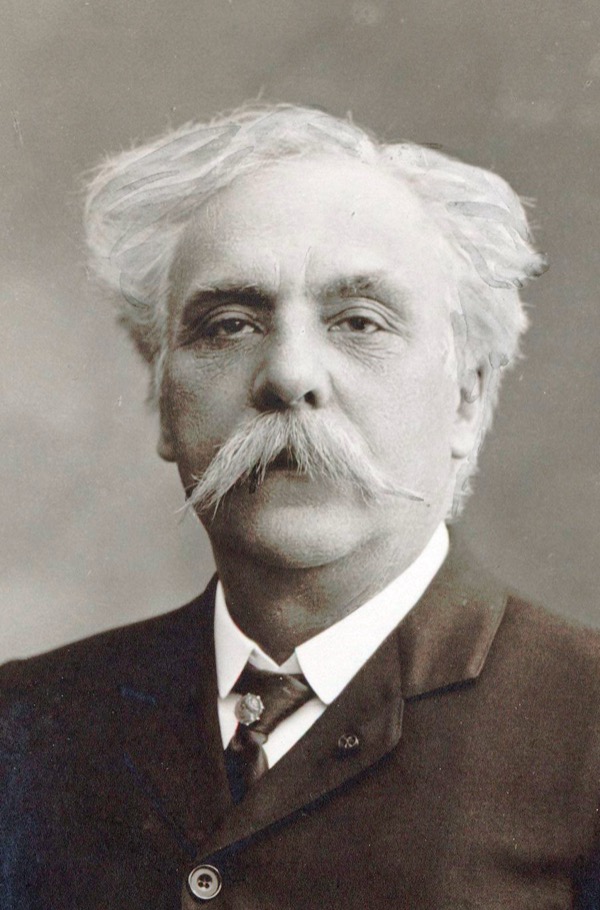
Gabriel Fauré, photographed by Pierre Petit, 1905
Fauré thought that writing piano music was one of the most difficult things imaginable, and I’ll tell you more about this later. In the meantime, let’s celebrate Fauré’s birthday on 12 May by featuring 10 piano pieces that you should know.
Gabriel Fauré: Nocturne No. 6 in D-flat Major, Op. 63
Serenity in Motion
Let’s start our countdown with the Nocturne No. 6, Op. 63. Just listen to the gorgeous opening melody sliding nonchalantly over a triplet accompaniment. And while the rhythm is straightforward, the harmony is beautifully embellished.
This is music written by a calm and serene master, whose musical style has fully matured. It unfolds in great clarity, with the contrasting middle part transporting us into the higher ranges of the piano.
It was that kind of clarity and natural simplicity that Fauré considered the most difficult part of writing for the piano. He writes to his wife, “There’s no place for padding in piano music; one has to pay in cash and make it consistently interesting. It is perhaps the most difficult genre of all, if one aims to be as good as possible, as I certainly do.” (Philippe Fauré-Fremiet, Gabriel Fauré: Lettres intimes, 1951)
Gabriel Fauré: Barcarolle No. 3 in G-flat Major, Op. 42
Elegance without Effort
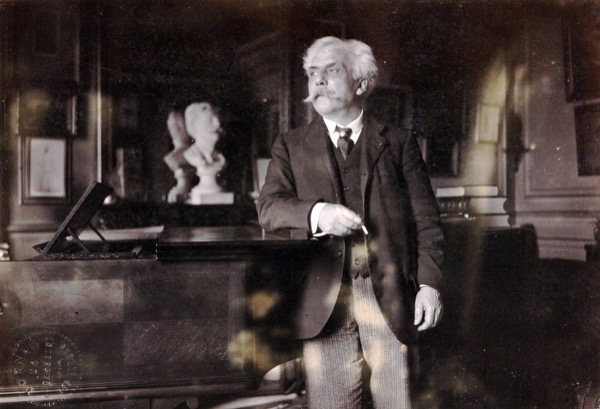
Gabriel Fauré at his piano in his apartment on Boulevard Malesherbes
Composing for the piano apparently gave the composer his greatest pleasures. And he certainly lavished as much attention on it as he did on his chamber music and on his songs.
Pianist Lucas Debargue, who recorded the complete solo piano music of Fauré, finds a body of works lasting some four and a half hours in performance, and all of it is of consistently high quality.
The gorgeous Barcarolle No. 3 almost starts like an improvisation. And while it is no “Boat Song” in the traditional sense, it does evoke a mysterious and seemingly exotic world in some delicious parallel universe.
Gabriel Fauré: Impromptu No. 2 in F minor, Op. 31
Dancing on the Edge of Change
For over sixty years, Gabriel Fauré explored the possibilities of the piano, and he developed his own distinct philosophy. Essentially, it is a blending of sensual and cerebral character.
While he is still writing with the aesthetics of Romanticism in mind, his musical language is already reaching out into the world of modernism. And somehow, it’s not a rejection of one or the other, but a highly satisfying middle ground.
In his Impromptus, Fauré writes technically challenging pieces, almost like major Romantic studies for the piano. Virtuosity aside, the No. 2 is simply a masterpiece of inspiration, with the tarantella-like episodes giving way to lyrical passages.
Gabriel Fauré: Nocturne No. 1, Op. 33 No. 1
Echoes Transformed
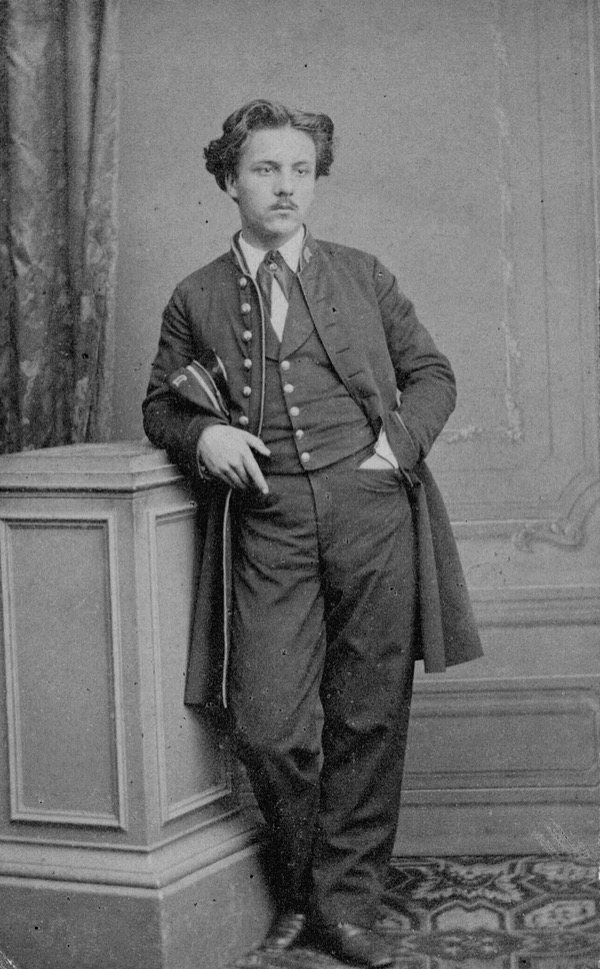
Gabriel Fauré in the uniform of the École Niedermeyer
In his youth, Fauré was greatly influenced by Mendelssohn, Schumann, and Chopin. He gradually moved away from their influence and pursued an increasingly personal style.
In all, Fauré composed thirteen “Nocturnes” during his life. The first dates from 1883, and the last was written in 1922. We certainly find a continuous stylistic evolution, and the composer found his own personal voice in these pieces.
In his Nocturnes, Fauré filters luscious melodies through a veil of emotions. No. 1 is rather sombre in mood, yet it is also emotionally charged. We find two main ideas connected by poetic originality, and these characteristics are part of his very first piano pieces and his final ones as well.
Gabriel Fauré: Barcarolle No. 5, Op. 66
Shadows in Motion
Some of these characteristics involve robust melodies and harmonic ambiguities. But we always sense that this harmonic colouring eventually yields to the composer’s taste for clarity and concision.
Lucas Debargue finds a paradoxical world, a world in which blurred outlines coexist with others that are much more clear-cut. The expressive rubs shoulders with the reserved, and violence with a sense of calm, sometimes even within a single measure of music.
When we talk about violence and drama, the Barcarolle No. 5 comes to mind immediately. It’s unique in Fauré’s output, as the rhythmic irregularity and a sense of gloom unfold within the space of a couple of minutes. There might be some calm in the ending, but the mood remains dire.
Gabriel Fauré: Prélude No. 3, Op. 103
Jewels in Disguise
When we listen to the piano music of Gabriel Fauré, we immediately notice the subtle shades and changes of tonality that underscore his gift for melody. These elements are combined with an understanding of the way contemporary innovations might be used.
I have included one of his Préludes in this list of 10 piano pieces you should know, as they are simply jewels that have been unjustly neglected by pianists. It is actually a set of nine pieces that forms a unity.
Pieces exploring remote harmonies, like the No. 3, alternate with pieces designed to allow pianists to practise mordents, polyrhythmic superimposition, and octaves and repeated notes. And we also find two highly polyphonic pieces in No. 4 and No. 6.
Gabriel Fauré: Thème et Variations op.73
Variation as Narrative
Among the longer pieces in Fauré’s catalogue for solo piano works we find a theme and variation set. The composer began this work in the summer of 1895, and we find its greatest influence in Robert Schumann‘s Symphonic Etudes.
It all builds on a march-like scale in C-sharp minor, which is harmonised in a simple and almost archaic manner. The theme immediately jumps to the bass in the first variation. The second variation is scherzo-like, and the energy keeps building.
The simple elements of the theme allow us to identify that melody through its transformations from one variation to the next. That is, until the highly virtuosic tenth variation, which remains sombre and serious. There is a surprise at the end, as the final variation is sounded in a major key.
Gabriel Fauré: Valse-caprice No. 2 in D-flat Major, Op. 38
Dancing on Air
Gabriel Fauré composed a total of four Valses-caprices, which we might almost call popular music. Here we find the composer reflecting on different engagements with the waltz, paired with the free form of the caprice.
He had some famous models to build on, including Liszt‘s Valse-Impromptu or the famous Valse-Caprice by Anton Rubinstein. All four pieces, however, are more caprice than waltz, as they also combine the worlds of Chopin and Saint-Saëns waltzes.
Fauré seemed to have had fun with these, as he seems to be mocking the flat-footed three beats per measure. However, there are plenty of aerial fireworks that sound almost improvisatory.
Gabriel Fauré: Romance sans paroles, Op. 17, No. 3
Between Tribute and Identity
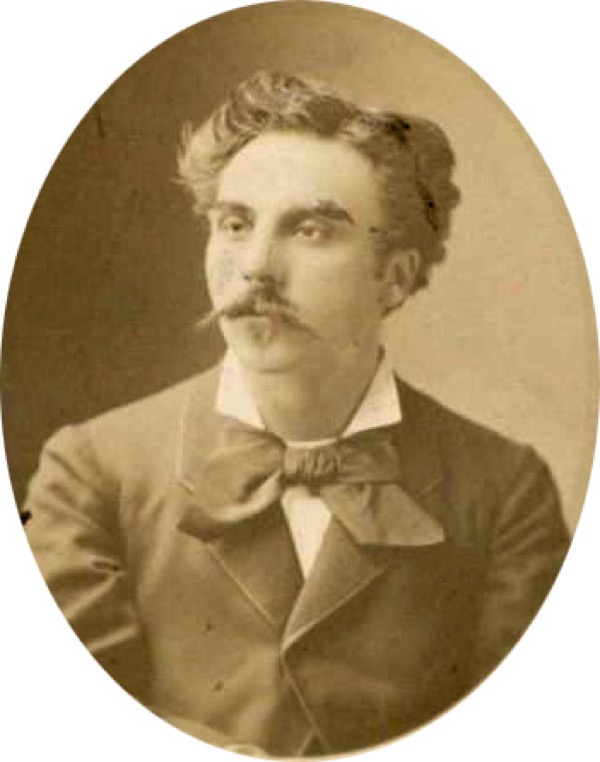
Gabriel Fauré in 1875
The Trois romances sans paroles of 1863 were Fauré’s first published composition. And as you can tell from the title, they form an affectionate but French tribute to Mendelssohn’s “Lieder ohne Worte.”
Fauré was introduced to the music of Mendelssohn and to the German Romantic repertory by his teacher Camille Saint-Saëns. Teacher and student also became close friends, with the friendship lasting almost sixty years.
We already sense Fauré’s distinctive style in the calmly unfolding first Romance, while the second is much more agitated. The Third Romance is based on a gentle rocking motion so typical of the composer. When the theme is restated, it is heard in canon, a technique he returned to during the final part of his career.
Gabriel Fauré: Nocturne No. 4 in E-flat Major, Op. 36
Controlled Passion
The Nocturne No. 4 in E-flat Major dates from 1884, and it displays all the charms that the young Fauré had on offer. The singing theme is offered almost nonchalantly, with a rather sombre atmosphere prevailing.
However, the accompaniment resembles the tolling of a bell that is constantly moving in the background. Combining lyricism with drama and passion, the lovely “cantando” episode reaches the heights of lyrical expression, yet the characteristic restraint of Fauré is always present.
The initial theme returns with a sense of growing calmness, and a coda brings this irresistible piece to a gentle conclusion. The stunning contrast between clearly-defined sections appears not only in their accompaniment, but also in distinct modulations and cadences.
Fauré Deserves Your Attention
What we really discovered in these 10 piano pieces by Fauré that you should know is that the composer does not advertise himself with grand gestures or vivid imagery. Instead, he always speaks in a refined language that rewards repeated listening.
In some sense, Fauré explored the piano from within by balancing clarity with ambiguity, and intimacy with structural integrity. His melodic genius is undisputed, as Fauré turns the virtuosity of the piano into an instrument of infinite colours.
I had to come up with a bonus track to prove my point. The Barcarolle No. 1 is nostalgic but tenderly naïve in its character. It sounds like a simple melody made up of conjunct notes, yet it explores the remotest harmonic regions.
The colours almost resemble a musical mirage, but none of the elements is overstated. Taken together, these pieces reveal a world of extraordinary subtlety that deserves a prominent place in the piano repertoire.
For more of the best in classical music, sign up for our E-Newsletter





I find the Pavane to be devine. Once again the gift of melody shining through subtle, delicious changes in color. Great article. I like your choices!