Charles Gounod, born on 17 June 1818, composed twelve operas, with Faust and Roméo et Juliette being his most popular. Between these blockbusters, we find Mireille, an 1864 opera in five acts to a libretto by Michel Carré after Frédéric Mistral’s poem Mirèio.
As we celebrate Gounod’s birthday, let’s take a closer look at Mireille, an opera that was highly successful in Paris, with over 800 performances at the Opéra-Comique, but was never popular outside France.
Charles Gounod: Mireille, “Farandole”
Spirit of Provence
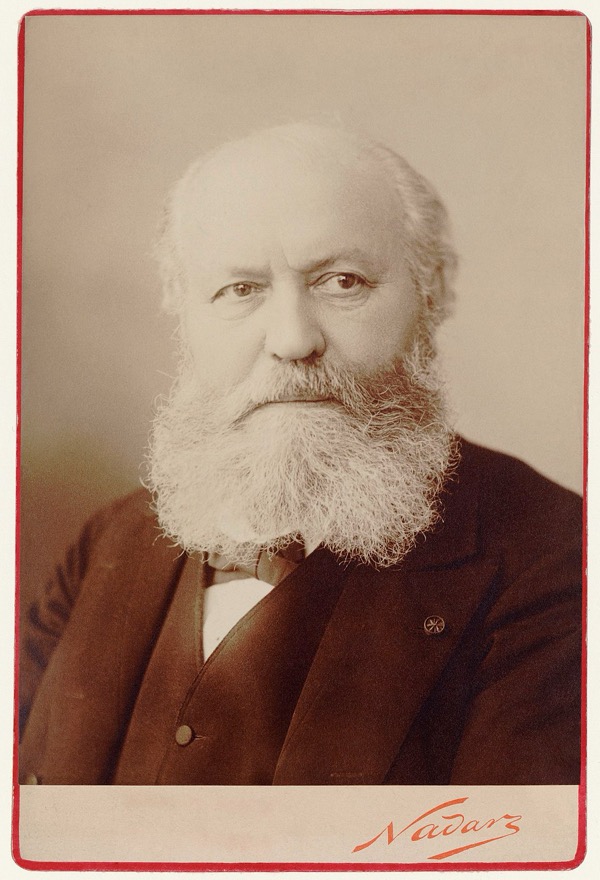
Charles Gounod, photographed by Nadar, 1890
The Parisian literary establishment first took note of the Provençal poet Frédéric Mistral in 1859, when his epic Mirèio was printed in a bilingual edition featuring the Provençal text matched by a French prose translation.
It has been suggested that Gounod probably knew the epic by the end of 1861 and, after receiving permission from the poet, began working on an operatic adaptation at the beginning of 1863.
What probably attracted Gounod to this extended lyric poem was not so much the story, but the tapestry of Provençal traditions and customs. In fact, Gounod spent much time in Provence, meeting Mistral on several occasions and visited the sites of the action.
While the operatic stage forced the elimination of much local detail, Mistral’s plot is faithfully reproduced by the librettist Michel Carré. However, we do find some subtle re-ordering of events.
Charles Gounod: Mireille, (excerpt)
The Plot
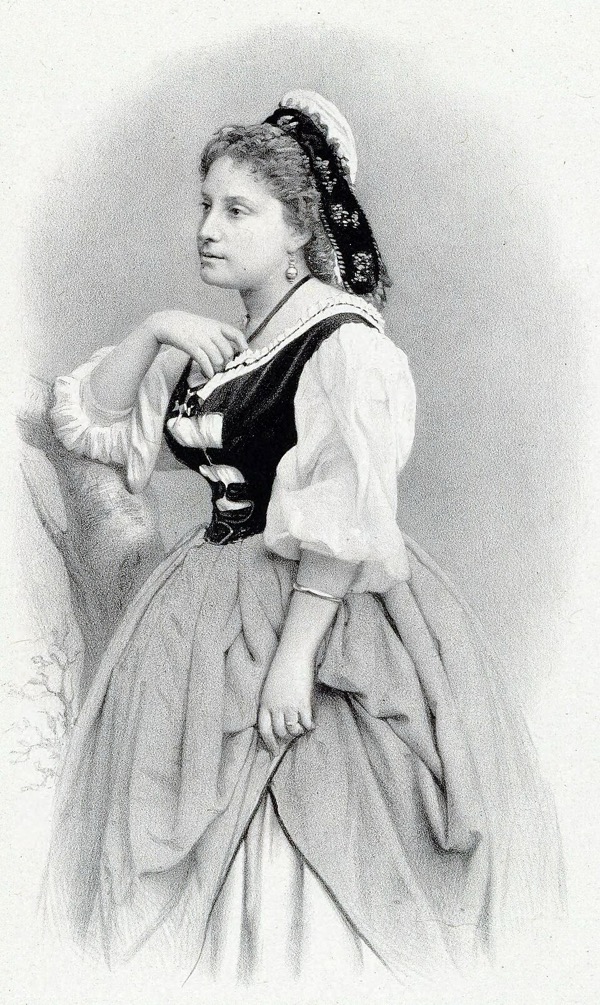
Caroline Carvalho as Mireille (Gallica / BnF)
Mireille, an only child and country heiress, has fallen in love with Vincent, a poor basket-weaver. Working in a mulberry orchard, Mireille is playfully mocked by her friends, and she tells the good sorceress Taven that the rumours of her love for Vincent are true.
Taven warns her that wealth and poverty are ill-matched. Vincent passes by and flirts with Mireille, and they agree that if misfortune should befall either of them, they will meet at the shrine of the Saintes-Maries.
Charles Gounod: Mireille (excerpt)
A Father’s Fury
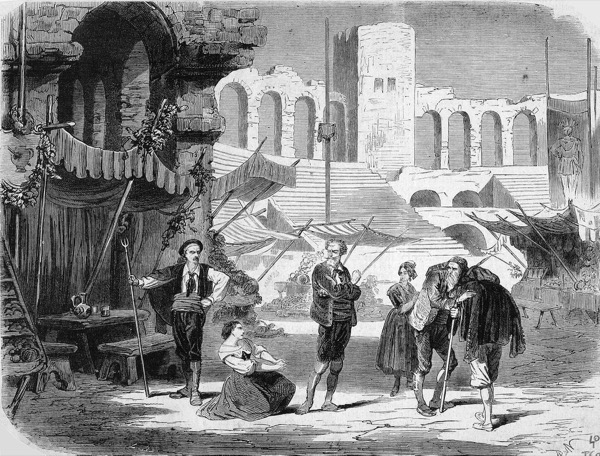
Mireille, 1864: Act II finale (Gallica / BnF)
Act II is set at the entry to the arena at Arles, and Mireille and Vincent sing a love song among the revellers. Taven predicts that Mireille will be approached by other suitors, and the bull-tamer Ourrias declares his love for Mireille but is rebuffed. He complains to her father, the wealthy farmer Maître Ramon, and Mireille declares her love for Vincent.
Ramon is outraged and declares that Mireille will never see Vincent again. Mireille and Vincent assert that any attempt to separate them is in vain, and the assembled crowd deplores Ramon’s insensitivity.
Revenge and Retribution
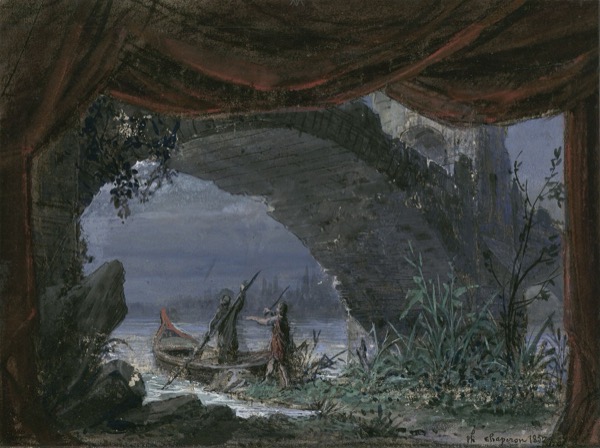
Mireille, 1864: Act III, scene 2 (Gallica / BnF)
Ourrias is very distressed by Mireille’s rejection, and he is determined to take revenge upon Vincent. Vincent suddenly appears, and accuses him of having used sorcery to obtain Mireille’s affection. Ourrias strikes and wounds the unarmed Vincent and is cursed by Taven.
As Taven ministers to Vincent’s wounds, Ourrias is plagued by remorse and fear and calls on the ferryman to transport him to the opposite bank. A ghostly figure suddenly appears and the waters become agitated. The boat sinks and Ourrias drowns.
Charles Gounod: Mireille, Act III: Anges du paradis (Alain Vanzo, tenor; Giancarlo Amati, cond.)
Sunstroke and Salvation
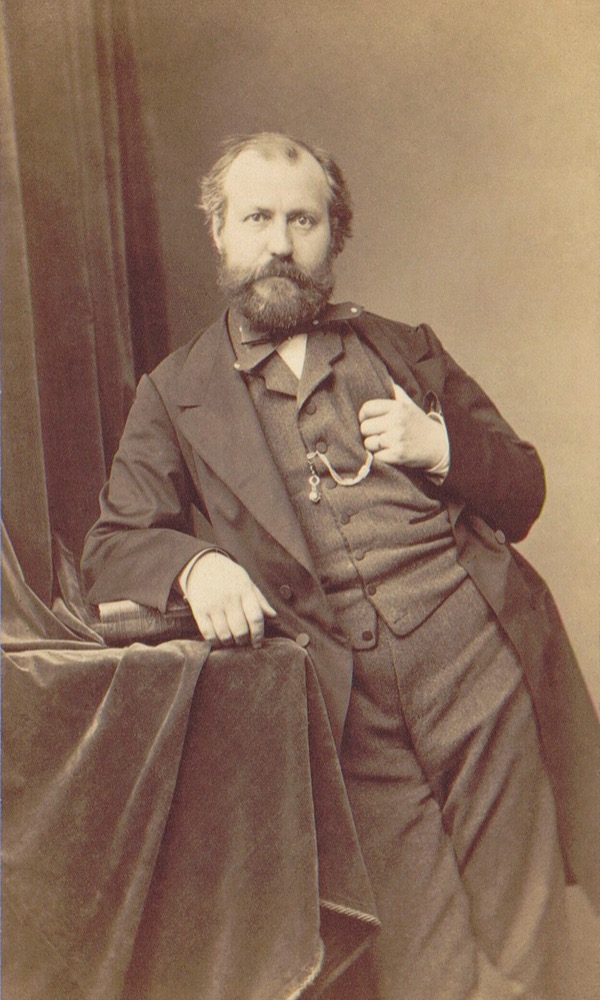
Charles Gounod, photograph by Bayard & Bertall (Gallica / BnF)
Ramon and his hands celebrate the harvest, and Mireille learns that Vincent has been wounded. Despite assurances that Vincent is safe, Mireille decides to undertake the journey across the Crau desert to the Saintes Maries.
Crossing the wilderness, Mireille is exhausted and disoriented. She sees a mirage of a city on the edge of a lake. When it disappears, Mireille collapses in despair, but the shepherd’s pipes in the distance revive her, and she pushes on to her destination.
The final act takes place outside the chapel of the Saintes-Maries, and Vincent appears and looks for Mireille. As he prays for her safety, Mireille stumbles in, close to death. She is ecstatic at being reunited with Vincent and has a vision of the sky opening to receive her. With Ramon and others rushing in, Mireille dies of sunstroke, but her soul is summoned upward by a celestial voice.
Charles Gounod: Mireille, Act V: Mon cœur est plein d’un noir souci … Anges du paradis (Kevin Amiel, tenor; Orchestra Sinfonica G. Rossini; Frédéric Chaslin, cond.)
The Many Lives of Mireille
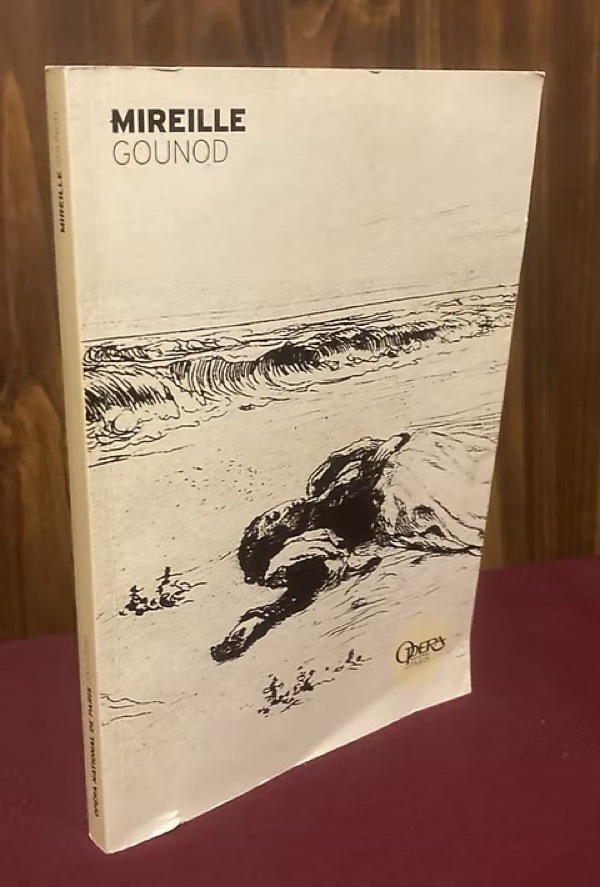
Mireille, Opéra National de Paris programme
Mireille premiered on 19 March 1864 at the Théâtre Lyrique in Paris, but it was poorly received. Gounod made major changes in the order of events in Acts III and IV, but the audience was still not convinced.
For a performance at Covent Garden in July 1864, Gounod used recitatives instead of the original spoken dialogue, and he even created a happy ending. Several additional changes were implemented, and the opera was finally well received in a new production in 1889.
Given the number of revisions and versions, Reynaldo Hahn and Henri Büsser mounted a new production at the Opéra-Comique in 1939 that sought to revert to Gounod’s original intentions.
Büsser edited the music and provided orchestrations for some passages that had been lost. It seems doubtful that Büsser’s edition is a true reflection of the original score, as the premiere almost certainly used spoken dialogue.
Charles Gounod: Mireille, “O legere hirondelle”
Music, Criticism, and Provençal Colour
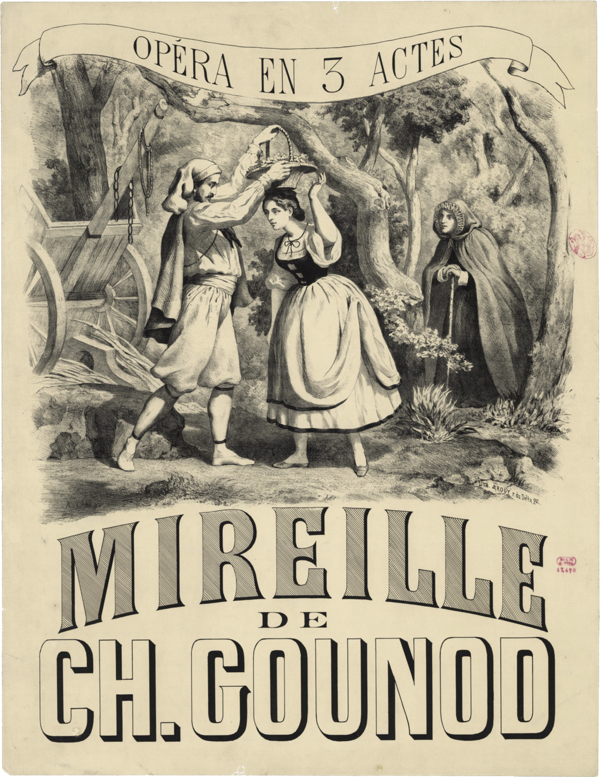
Mireille de Ch. Gounod, original poster
For some commentators, Mireille “has everything that modern audiences find hard to take in 19th-century French opera. It’s revoltingly wholesome with a bit of the supernatural, some patriarchal nastiness and a whole lot of Catholic schmaltz thrown in, culminating in a final scene where the dying heroine is carried off to heaven by angels while everybody else is suitably pious.”
In musical terms, accusations that Gounod had tried to combine Wagner with Mozart plagued the work from its first performance. Despite working with a thin storyline, the second act is filled with great musical numbers from start to finish. It also contains some great arias and act finales.
There are some clashes, notably in the solo scene for Mireille as she wanders across the desert. The scene is inherently undramatic, and the music doesn’t ring true against the characters’ shy and humble nature. The strongest part of Gounod’s score might well lie in his depiction of Provençal culture, as set-piece songs and dances provide the musical colour.
For more of the best in classical music, sign up for our E-Newsletter