Great composers are often placed on pedestals, and it can be easy to forget that they spent their careers working alongside talented composer colleagues.
Johannes Brahms was no exception. Today, we’re looking at the lives and music of five of his composer friends: Julius Röntgen and his wife Amanda Röntgen-Maier, David Popper, Ignaz Brüll, and Karl Goldmark.
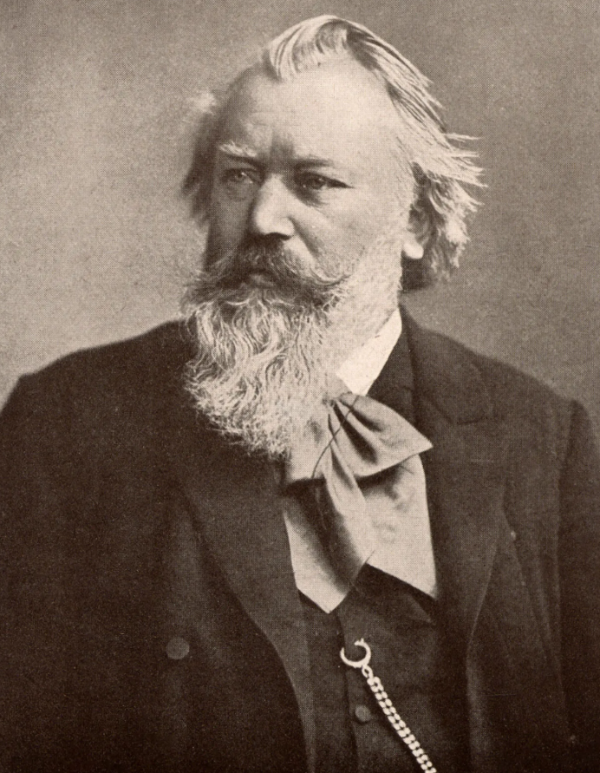
Johannes Brahms
Their friendship, support, and even criticism all helped to shape Brahms into the towering icon that he eventually became…and their music provides an invaluable wider context in which to hear and appreciate Brahms’s.
Julius Röntgen
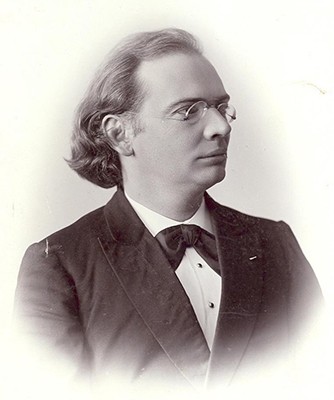
Julius Röntgen
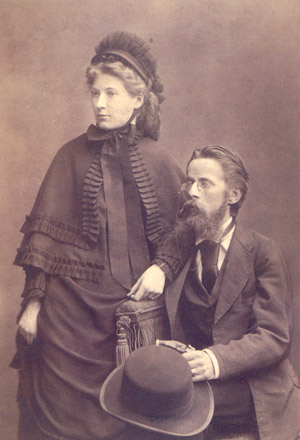
Julius Röntgen was born into a musical family in Leipzig in 1855.
His father, Engelbert, was the concertmaster of the renowned Gewandhaus Orchestra, and his mother was a pianist (and also the daughter of the Orchestra’s principal cellist).
Not surprisingly, given that background, Julius was a musically talented child. When he was fourteen, his mother took him to Weimar to play piano for Liszt.
Back in Leipzig, he and his parents befriended the composer couple Heinrich and Elisabeth von Herzogenberg. The Herzogenbergs’ home is where Julius met Brahms for the first time.
In 1880, when he was twenty-five, he married a Swedish composer and violinist named Amanda Maier. The couple settled in Amsterdam, where he taught music. When Brahms came to Amsterdam, he would visit the Röntgens.
In 1887, Julius performed Brahms’s second piano concerto under Brahms’s direction. The performance as a whole wasn’t up to Brahms’s technical standards, but Brahms liked him and didn’t hold it against him.
Brahms’s second piano concerto
In 1895, Brahms wrote of Röntgen, “He has always remained a child, so innocent, so pure, open, enthusiastic and with his particular naive and nervous manner.”
One can hear suggestions of that good-natured character in Röntgen’s second piano concerto, composed in 1879. It opens with a friendly passage in the solo piano, marked “molto tranquillo e dolce”, or “very calm and sweet.”
It’s interesting to compare the opening mood of Röntgen’s 1879 concerto with Brahms’s 1881 concerto.
Röntgen’s second piano concerto
Amanda Röntgen-Maier
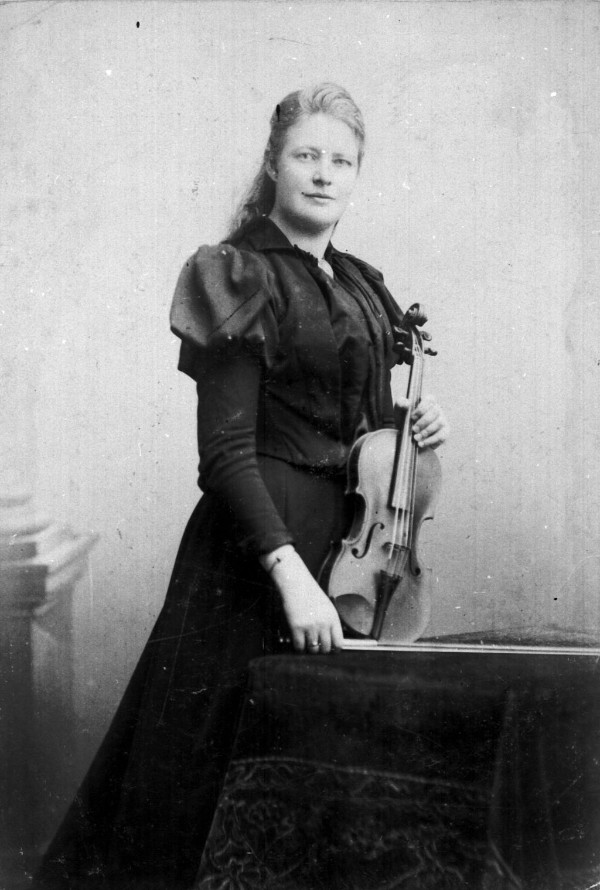
Amanda Röntgen
In 1879, the same year that Julius Röntgen wrote his second piano concerto, his future wife Amanda Maier published her violin sonata.
Amanda Maier’s violin sonata
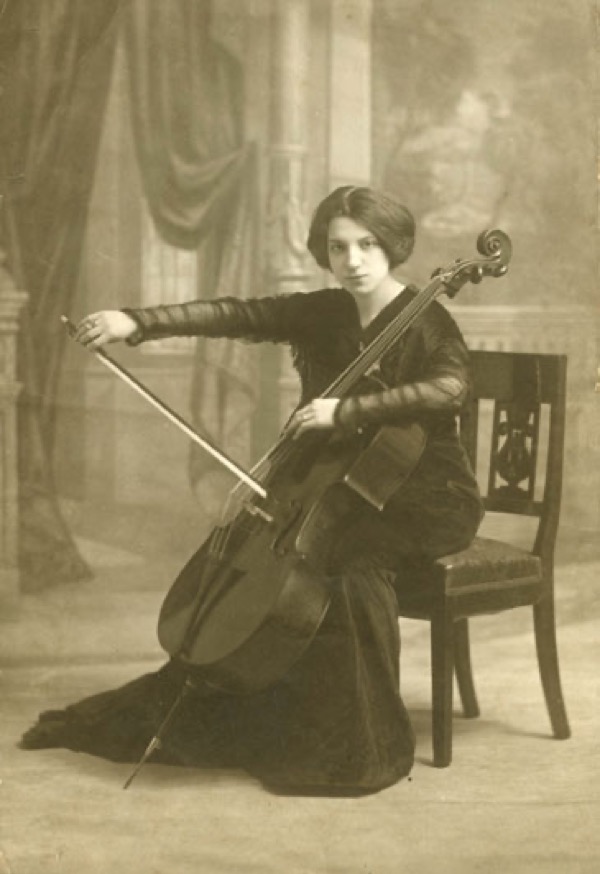
Amanda Maier was born to a musical family in Stockholm in 1853.
As a teenager, she studied violin and composition at the Royal College of Music in Stockholm, becoming the institution’s first female graduate to earn the prestigious title Musikdirektor.
In 1873, she moved to Leipzig to study violin with Engelbert Röntgen. While there, she fell in love with her teacher’s son Julius.
They were engaged in 1876, married in Sweden in 1880, and then moved to Amsterdam.
Over the course of her marriage, Amanda became pregnant at least five times. Two sons survived, born in 1881 and 1886. (Both became influential professional musicians in their own right.) The pregnancies were hard on her health. She developed pleurisy, as well as issues with her vision.
In 1888, their mutual friend, pianist Elisabeth von Herzogenberg, memorised the third Brahms violin sonata and played it through with Amanda. They suggested a number of tweaks to the composer (characteristically, he only accepted some). In 1889, she played the sonata again, this time with Clara Schumann, who “was very pleased with her,” according to Elisabeth.
Amanda died in 1894. She was 41 years old.
Brahms’s third violin sonata
David Popper
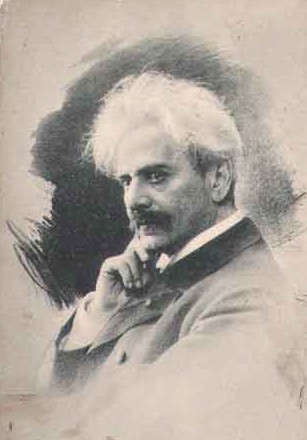
David Popper
David Popper was born in Prague in June 1843. He studied cello at the Prague Conservatory and began his career touring in 1863, at the age of twenty.
In 1867, he played in Vienna for the first time. The following year, he was hired as the principal cellist of the prestigious Vienna Court Opera orchestra.
He later resigned so that he could focus on solo appearances and tour with his wife, pianist Sophie Menter. (The talented couple would separate in 1886.)
After the dissolution of the marriage, Liszt recommended that Popper join the faculty of the conservatory in Budapest. He had an impressive career there as a teacher.
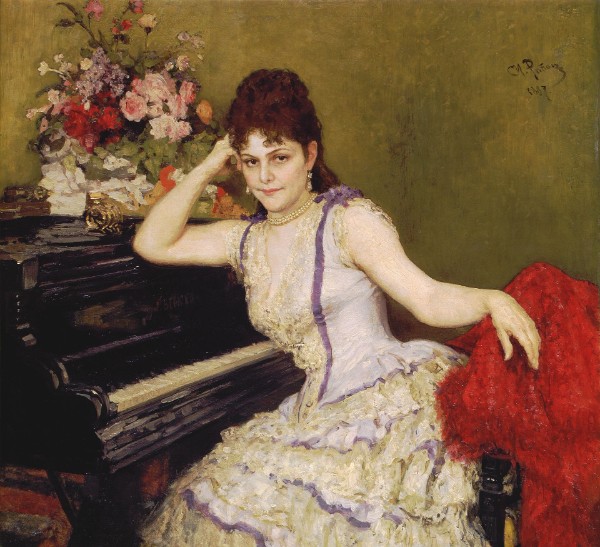
Sophie Menter
Also in 1886, one of the most noteworthy premieres of his career took place: Brahms’s third piano trio, with Jenő Hubay on violin and Johannes Brahms himself on piano. At the same concert, Popper gave the second-ever performance of Brahms’s second cello sonata.
Brahms’s third piano trio
In 1888, Popper published his third cello concerto. As we noted in our article about Popper’s cello concertos.
It is possible that Popper’s Concerto No. 3 was composed for a private event as the dedication reads to “His Excellency, the Imperial Russian Councillor von Ogarev.” Scored in a single movement, the orchestral size is much reduced. Even experts know little about the circumstances of composition, but we do know that the concerto was premiered by the Budapest Philharmonic under Karl Goldmark on 9 March 1888. At that time, Popper had already started his career in Budapest.
David Popper: Cello Concerto No. 3, Op. 59
Ignaz Brüll
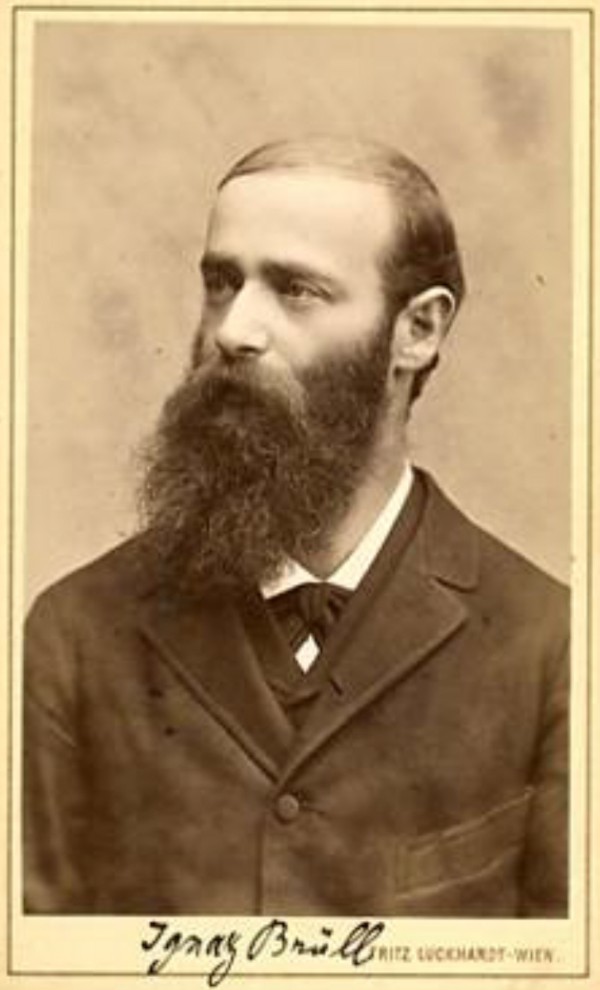
Ignaz Brüll
Ignaz Brüll was born in Moravia in November 1846. His parents were amateur musicians and began teaching him music at an early age.
The Brülls moved to Vienna in 1854, and by the age of ten, Ignaz was studying with Vienna Conservatory professor Julius Epstein, a Brahms friend who also taught Elisabeth von Herzogenberg.
In addition to piano, Brüll also studied composition, and as a teenager had several works performed publicly. His breakout hit was his second opera, Das goldene Kreuz (The Golden Cross), which premiered in 1875, shortly after the composer’s nineteenth birthday.
In 1882, he married a banker’s daughter and began focusing less on piano performance and more on composition. The Brüll home in Vienna became a gathering spot for Brahms’s circle of friends.
When Brahms shared four-hand piano arrangements of his new orchestral works in private gatherings with friends, he often chose Brüll as his collaborator.
Brahms’s four-hand piano arrangement of his first symphony, dating from 1877
Brüll wasn’t above being subjected to Brahms’s mockery. Brüll lived in a houseful of family members, and the single Brahms once teased him about that and his conservative composing style:
One day, Nazy really intended to write a modulation from F major to B minor, but the whole family objected, so he gave it up.
Brüll died in 1907. Das goldene Kreuz continued to be mounted in Vienna until the 1930s. At that point, Brüll’s Jewish heritage meant the Nazis banned the work, and it has never returned to the position in the repertoire it once enjoyed.
During his career, he composed seven operas, two piano concertos, a violin concerto, a piano trio, four piano suites, and many assorted piano pieces.
Here are three piano pieces from his 1879 Albumblätter:
Selections from Ignaz Brüll’s Albumblätter, Op. 33
Karl Goldmark
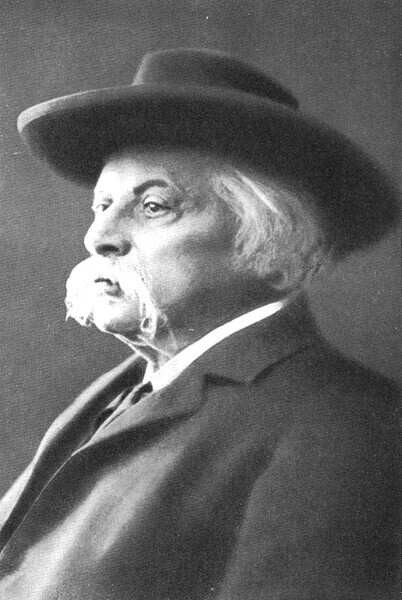
Karl Goldmark
Like Brüll, Goldmark came from a Jewish family. He was born in 1830 in Keszthely in present-day Hungary.
He went to Vienna to study music in 1846, but the Revolution of 1848 interrupted his studies. While in Vienna, he scraped together a living as an orchestral violinist, teacher, and music critic.
Interestingly, Goldmark was one of the few prominent musicians who refused to take a side in the War of the Romantics, promoting both Wagner and Brahms.
In 1875, his opera The Queen of Sheba was a major success. The following year, so was his Rustic Wedding Symphony. Goldmark had arrived.
Karl Goldmark’s Rustic Wedding Symphony
Brahms, who was three years away from premiering his own first symphony, said to Goldmark about the Rustic Wedding, “That is the best thing you have done; clear-cut and faultless, it sprang into being a finished thing, like Minerva from the head of Jupiter.”
This was an interesting comparison, given that twenty years earlier, at the start of his career, Robert Schumann had once used the same metaphor to describe Brahms’s talent.
The two men eventually drifted apart, due at least in part to Brahms’s social tactlessness. Biographer Jan Swafford writes in his Brahms biography:
One evening, when Brahms was in an evil humour, he went beyond teasing. At a dinner at Brüll’s house the guests were complimenting Goldmark’s setting of a psalm in Luther’s translation, when Brahms broke in angrily, “Don’t you think it’s extraordinary that a Jew should set Martin Luther’s words!” Goldmark went pale, and probably the rest of the company with him. Brahms would not let it go, pontificating on and on about the impropriety of setting things outside one’s own faith and experience, until the dinner came to an abrupt end. It was the only time on record that Brahms sounded an antisemitic note. If he had explained himself, he might have said that it was intended as a statement about authenticity. That was not how the company took it. Certainly, he could see that, and certainly the implication did not reflect his real sentiments. As usual, Brahms never apologised.
As the historical record proves, it wasn’t always easy being colleagues with Brahms!
For more of the best in classical music, sign up for our E-Newsletter