Baroque music – composed roughly between 1600 and 1750 – is some of the most recognisable and beloved music ever written.
You almost certainly know more of it than you think. The driving pulse of Bach’s Brandenburg Concertos, the soaring melody of Vivaldi’s Four Seasons, the thunderous chorus of Handel’s Messiah: all of it is Baroque music.
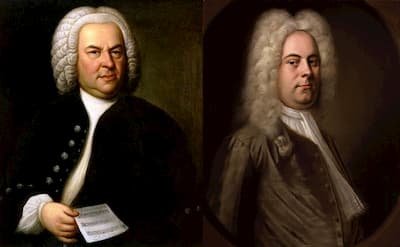
J.S. Bach and Handel © CMUSE
But what exactly is Baroque music? What does it sound like, and why did it sound that way? Who made it, and who paid for it – and why does any of it still matter today?
This is your guide to one of the most important and fascinating eras in the history of Western music.
What Does the Term “Baroque” Mean?
Scholars believe that the word Baroque may have come from the Portuguese word “barroco,” meaning “flawed pearl.”
It is also possible that the origins of the term date back to the Latin word baroco, a term that had originated in the field of Aristotelian logic, but eventually came to be a derogatory term for anything overly complex.
Bach’s Crab Canon
Regardless of the exact etymology, the word “Baroque” has come to refer to the style of art, architecture, writing, music, and the like created between 1600 and 1750.
The word “baroque” was essentially a mild insult – meaning overwrought, too complicated – and yet the music (and art) that got labelled that way turned out to be some of the most magnificent ever written.
We wrote an article tracing the fascinating connections between music and the other arts during this time: https://interlude.hk/the-age-of-the-baroque-in-music-and-the-arts/
When Was the Baroque Era?
The Baroque era is commonly described as lasting from 1600 to 1750, although the styles of the surrounding eras bled into early and late Baroque works.
It’s also worth remembering that the era was named after it happened – i.e., nobody was going around in the 1600s and calling themselves a “Baroque composer.”
Why are those dates the ones that scholars have settled on?
The first answer is that 1600 was the year that opera was invented.
The oldest surviving opera, Euridice, composed by Jacopo Peri, was premiered in Florence in October 1600, as part of the wedding celebrations between King Henry IV of France and Maria de Medici.
Opera would become a major subgenre of Baroque music over the next 150 years.
Excerpt from Peri’s Euridice
Meanwhile, the year 1750 marks the death of Johann Sebastian Bach.
For many, Bach’s death is a natural endpoint to use to mark the end of the era, since his compositions marked the intellectual and emotional high-water mark of the Baroque.
J.S. Bach’s composer sons all wrote in a markedly different, more modern style than their father did, signalling an evolution in style.
Bach’s towering legacy, and the impossibility of writing works in a Baroque style that would live up to his, make 1750 feel like the most logical endpoint.
We tracked the fates of Bach’s twenty children – including all of his composer sons – here: https://interlude.hk/what-happened-to-bachs-twenty-children/
What Does Baroque Music Sound Like?
At the heart of most Baroque music is a driving, almost mechanical pulse.
This pulse is created by rapid repeated notes in the cellos, basses, or instruments with similar ranges. They create a foundation for everything else: the harmonies, the melodies, the sudden shifts in dynamics, the moments where the instrumentation drops away or surges forward.
Bach’s Brandenburg Concerto No. 3
Sometimes this pulse is provided by a line called the basso continuo, or “continuous bass.” A basso continuo consists of a lower bass line and chords that fill in the texture of the music and provide a bass for the instruments playing melody.
The details of the basso continuo were often left to individual performers and improvisers, providing space for a certain amount of creativity within certain rules and conventions.
Baroque music is also famous for its reliance on improvisation and ornamentations such as trills, turns, and other embellishments – all of which combine to give the music its distinctive decorative quality.
Arguably, the style of these decorations helped lead to Baroque music’s later reputation as being “too complex” or even “a flawed pearl.”
Who Paid For Baroque Music?
Put bluntly, the famous Baroque composers didn’t write for themselves. They all had bosses, and those bosses impacted what – and even how – these composers wrote music.
The Church – especially the Catholic Church – was employing music as part of the Counter-Reformation and its aftermath. Music was seen as a tool of spiritual persuasion, as well as an assertion of institutional and political power.
Bach is an interesting counterpoint here since he worked within the Lutheran tradition rather than the Catholic one. But the basic dynamic – composer as servant within a religious institution – still holds.
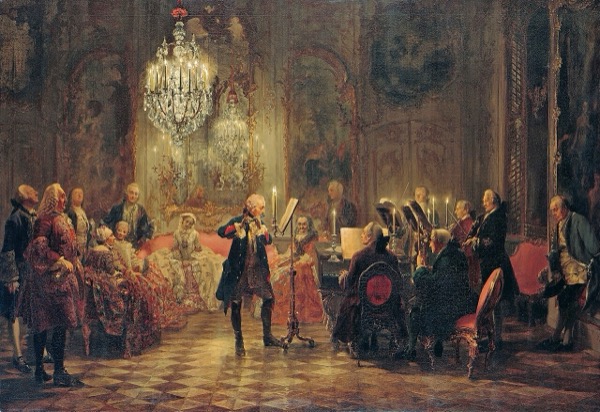
The Flute Concert of Sanssouci
The other category of bosses is leaders of the courts. Kings, princes, and other wealthy European aristocrats employed composers the way they employed painters or architects. Music was used as a status symbol. Having a brilliant court composer demonstrated a ruler’s power, culture, and wealth.
One interesting tension is that these two patrons tended to want slightly different things. For instance, the Church was especially interested in continuing and evolving its long choral music tradition, while the courts became increasingly interested in cultivating innovative instrumental virtuosity.
Yet despite these opposing purposes, somehow the best of the Baroque era composers managed to produce music for both traditions – and in the process, they created work that outlasted all of their bosses.
The Giants of the Baroque Composers
Today, we’ll look at three of the most famous Baroque era composers.
Johann Sebastian Bach (1685–1750). Over the course of his career, he worked for both the church and the court, so he made major contributions to both sacred and secular music.
Bach’s music is complex, planned out in patterns. Some would call it mathematical.
But there’s also always a great humanity to it, and his gift for melody was second to none. Everyone will recognise the melody to Air on the G-string or Jesu, Joy of Man’s Desiring.
Bach’s Jesus bleibet meine Freude from Cantata BWV 147
George Frideric Handel (1685–1759). He’s a fascinating contrast to Bach because they were born the same year, in the same region of Germany, but they never met and ended up in completely different worlds.
Bach stayed close to home his whole life, rooted in the Lutheran church tradition. By contrast, Handel’s life was more cosmopolitan. He lived in Italy, then London, writing opera and oratorios for public audiences and royal patrons.
Unlike nearly all of his Baroque colleagues, Handel by and large managed to become his own boss, presenting entrepreneurial performances of his own works.
In the process, he basically invented the form of English language oratorio: a cheaper method to make money during Lent, when fully staged operas weren’t performed. The “Hallelujah Chorus” from his oratorio Messiah is one of the best-known pieces of Baroque music.
Handel’s “Hallelujah Chorus” from Messiah
Antonio Vivaldi (1678–1741). There is an old joke about Vivaldi: he wrote the same piece 500 times. There’s some truth to it insofar as his music uses similar forms, styles, and conventions, much like pop songwriters today. But that doesn’t mean he wasn’t inventive within the structural boundaries he observed.
His Four Seasons is a set of four violin concertos, each one depicting a different season in music. After their rediscovery in the early 20th century, they became hugely popular and are now among the most popular pieces of classical music ever written.
Plus, Bach was notoriously fascinated by him, choosing to rearrange some of Vivaldi’s violin works for harpsichord and orchestra – and if Bach was a fan, he can’t have been all that boring.
Vivaldi spent much of his career in Venice, writing for and directing an orchestra of orphaned and illegitimate girls at the Ospedale della Pietà – one of the most unusual and remarkable musical institutions of the era. We wrote about it here: https://interlude.hk/vivaldis-internationally-renowned-orphanage-orchestra/
Vivaldi’s Four Seasons
Why Does Baroque Music Still Matter?
People love Baroque music: its vigour, its structure, its inventiveness within stylistic confines.
But it’s also historically important. The Baroque era invented the infrastructure of Western music. It saw the development of the standardisation of the orchestra – the emergence of new genres like the opera, the oratorio, the concerto, and more – and created the language that composers still use to write music today.
It did all that under conditions of institutional constraint and patronage that are foreign to us today.
The miracle isn’t just that the music is beautiful (although, of course, it is that), or that it continues to speak to us long after its composers ever dreamed it would.
The miracle is that so much great Baroque music was made at all, given that it was written so quickly and prolifically by people working on short deadlines, for powerful bosses – who, ironically, are often most famous today for their appearances in the footnotes of music history textbooks.
For more of the best in classical music, sign up for our E-Newsletter