One would be hard pressed to argue that the harp is not one of the most unique – and beguiling – of the instruments currently still in frequent use in the Western classical canon. Although you can find one in pretty much every professional orchestra, many people are still somewhat nonplussed by the instrument. Even classically-trained professional composers may have gaps in their knowledge about how to write for certain instruments, due to their peculiar anatomy, notational requirements, or both. In this clan of the sometimes misunderstood or underutilised musical instruments, we often find the acoustic guitar, double bass, viola, and harp, among others.
Such was the motivation for acclaimed harpist Olivia Jageurs’ incredibly popular project, 15 Second Harp, which she began in 2016 as a way to help composers get to grips with the instrument and bring out its incredibly varied sonic potential. This project allowed composers to send in short sketches of written material for harp – around fifteen seconds or so – which Olivia would then record herself playing, allowing composers to try out unusual extended techniques, practice using idiomatic pedalling notation (essential for the harp), and see how ideas translated from paper to physicality. The over five hundred miniatures that Jageurs recorded are still available to view here, and the project as a whole was shortlisted for a Royal Philharmonic Society Award for excellence in live classical music in the UK, presented in association with BBC Radio 3. To my knowledge and research, never before has an instrumentalist of such calibre made themselves so readily available to curious composers, with Jageurs posting the clips by 5pm the next day, allowing hundreds of composers an invaluable learning opportunity with no barrier to entry.
Siri Livingston, “nescience”, 2019 — Olivia Jageurs, harp
I had the privilege of writing a three-minute commission, nescience, for Olivia Jageurs in 2019, which was premiered at the Cambridge Zoology Museum as part of a concert organised by the Cambridge New Music Group. In this piece, I explored harp harmonics, the harp’s special ability to easily span gaping intervals that would be the stuff of dreams for a pianist, the “thundering” quality of palm hits in the very bottom register, and much more. Once you’ve listened to a range of solo harp repertoire from different centuries, grasped the most common extended techniques, and understood how pedalling works to change the range of available notes (unlike a piano, where all notes are always available), the harp rewards you with an irreplaceable timbral profile, adding subtlety, mystique, and unexpected power to any instrumental lineup.
In light of her success with 15 Second Harp, Jageurs subsequently created the smash hit online concert series, Harpy Hour, partially as a way to maintain live classical music performance and its associated community during Covid, and later as bona fide live concerts with her Bachn & Eggs musical brunches. She continues to perform at the highest level, championing the harp and its repertoire, from established canon to playful arrangements of other genres, and cutting-edge new music.
The harp is a truly ancient instrument, commonly used in the Mediterranean and the Middle East and less often found in Ancient Greece and Rome. Depictions from Egypt and Mesopotamia of harp use date to about 3,000 BCE. A beautiful painted wood statue is on display at the British Museum: a young woman with dark eyeliner stands holding an angular harp that threatens to dwarf her, the artwork well preserved despite dating from 1085–525 BCE.
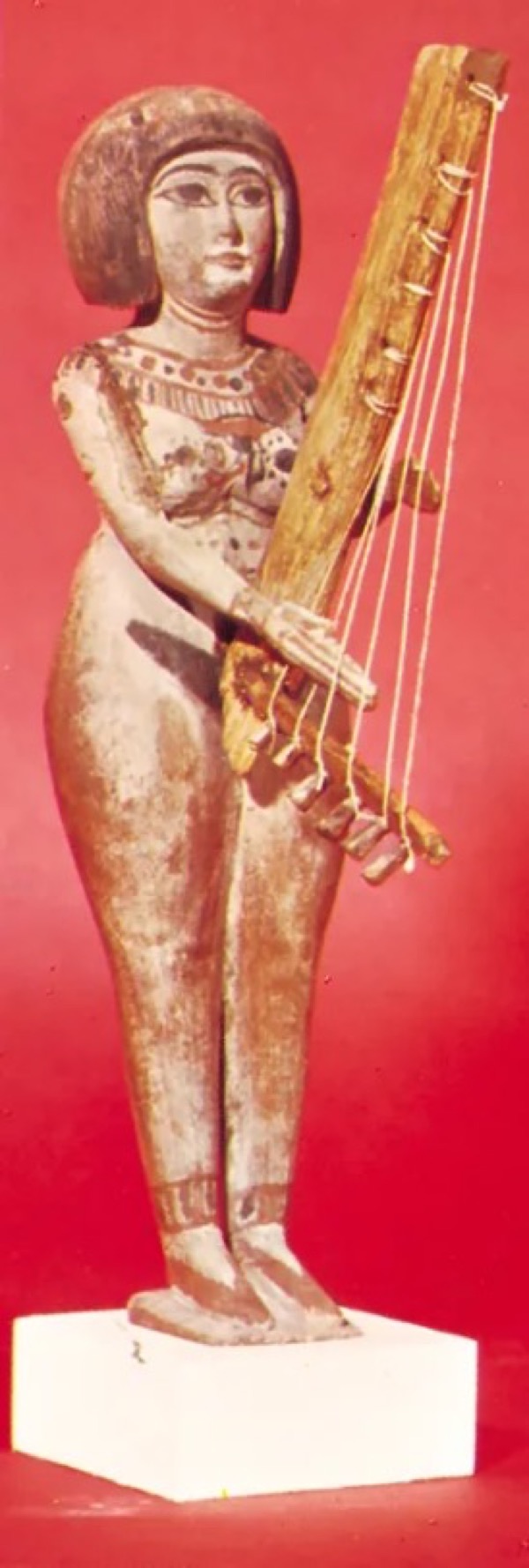
Photo credit: Encyclopedia Britannica
Harps were initially not chromatic, rather than containing all twelve tones at modern tuning, they had their own modal or unique tunings. As such, tuning shifts were unnecessary – it was only as musical tastes changed in the 17th century that demand necessitated twelve strings per octave and pedalling or hook mechanisms to set different notes mid-performance. With these changes, harps gradually became larger, vertical, and less often handheld – in other words, increasingly like the harp we know of today.
Claude Debussy: Danse profane (Karel Patras, harp; Czech Philharmonic Orchestra; Serge Baudo, cond.)
Unlike many other instruments, the harp can stand alone, its statuesque curved shape making it almost into a displayable objet d’art in its own right. Clearly, the makers of ancient harps thought so too: see this lovely wooden bull-statue-lyre-hybrid from 2600BC, also part of the British Museum’s permanent collection. Made of incredibly valuable materials, including shell, limestone, the rare blue stone lapis lazuli, gold, and bitumen, this harp was undoubtedly an object of great pride for its owner, an item of functional beauty and a signifier of wealth and resources.
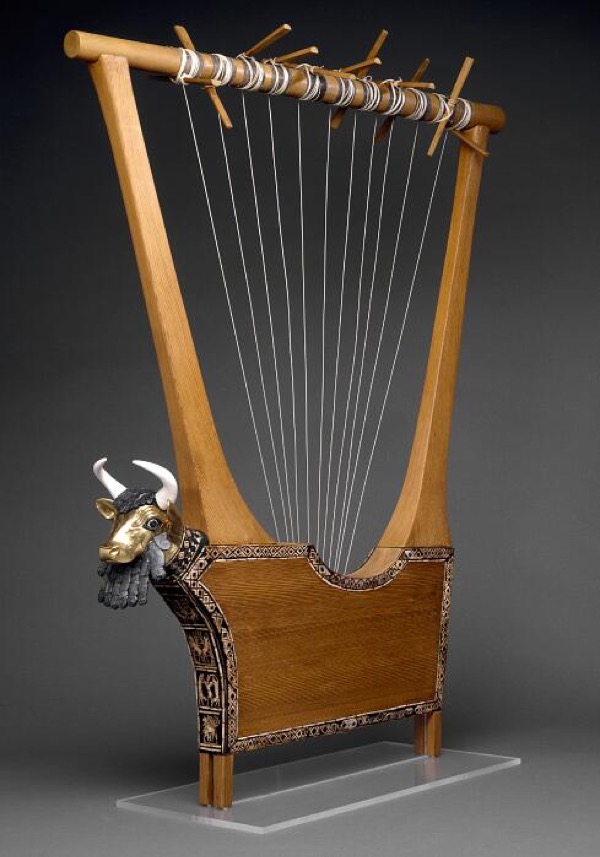
Photo credit: Trustees of the British Museum
Harps also have an unusually international heritage. Relics of harps have been found in India, China, Africa, and the Americas, as well as Europe and the Middle East; in Latin America, the Andean harp and its varietals are essential in folk music traditions in Peru, Bolivia, and Ecuador. Celtic cultures, such as those in Ireland and Wales, hold the harp as a symbol of folkloric identity and make great use of it in their musical traditions.
Today, the harp has a much higher profile thanks to the work of Jageurs and others like her; composers today are especially poised to use the instrument to create and enhance truly fascinating sonic profiles, should they simply invest the worthwhile effort to understand its workings.
For more of the best in classical music, sign up for our E-Newsletter