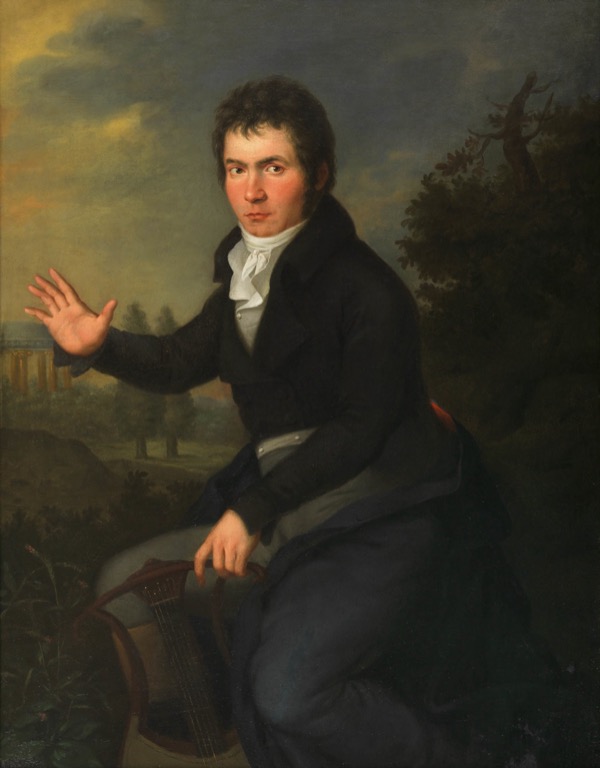
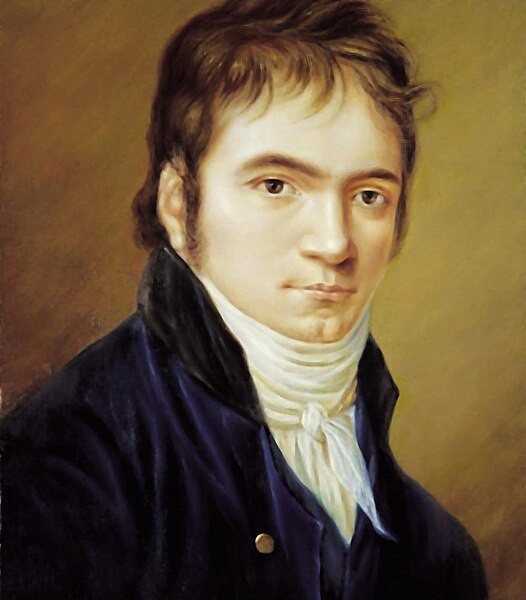
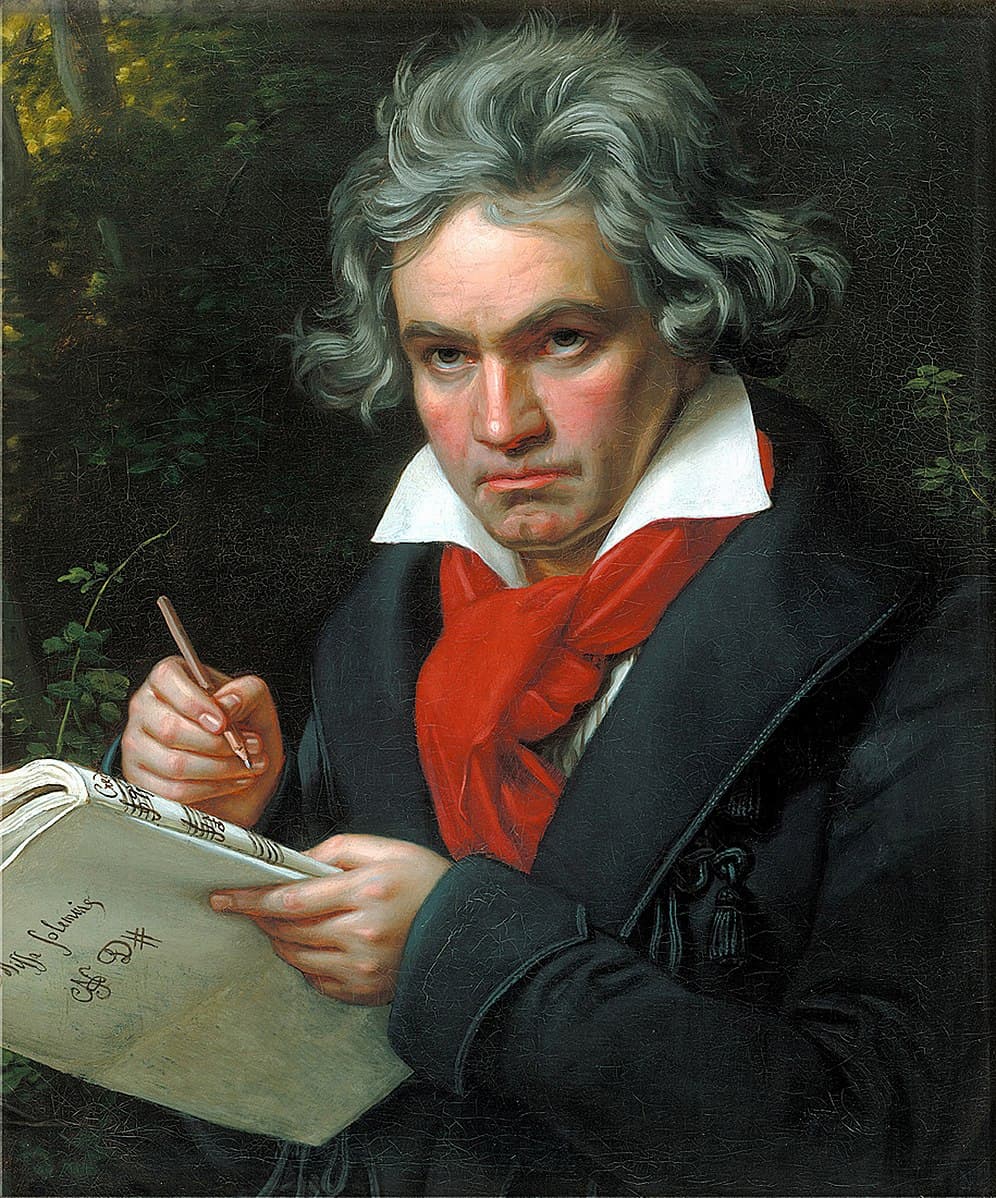
Beethoven’s middle period piano sonatas consist of the sonatas from Op. 31 through Op. 90, twelve piano works composed between 1801 and 1814.
This is Beethoven at his most recognisable, writing iconic sonatas like the Waldstein, the Appassionata, and the Tempest.
It’s also the period when his deafness went from a private fear to an inescapable reality, and when his sonatas began metabolising his emotional struggles.
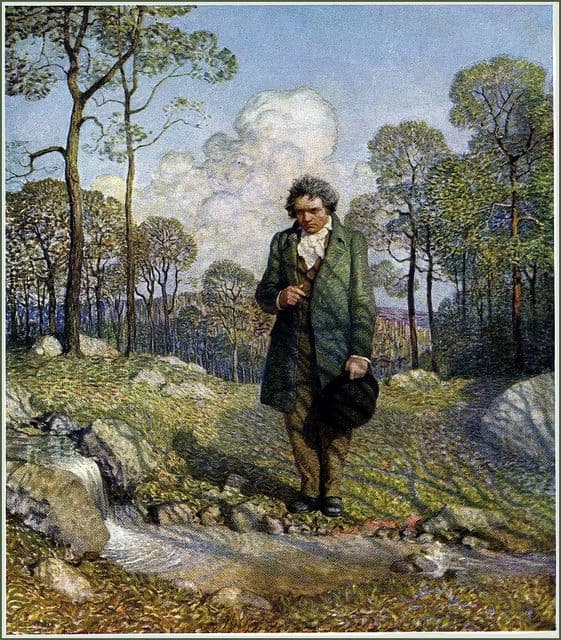
N.C. Wyeth: Beethoven and Nature, 1921
These twelve sonatas cover more emotional ground than any other stretch of his output. There’s humour here – jokes about pianists who can’t sync their hands, parodies of Italian opera – alongside some of the most turbulent, psychologically probing music he ever wrote.
Today we’re looking at the stories behind Beethoven’s middle-period piano sonatas.
Piano Sonata No. 16 in G major, Op. 31, No. 1
Nathalia Milstein
Year written: 1801–1802, when Beethoven was 30–31
Dedicated to: No formal dedication
- This sonata marks the beginning of Beethoven’s middle period, a time of both mastery and experimentation.
- In the first movement, Beethoven humorously plays with rhythm, with both hands struggling to sync.
- Some pianists believe the second movement, Adagio grazioso, with its gaudy trills and ornamentation, is a parody of over-the-top Italian opera. If it was indeed meant to be a joke, it was a long one: it’s one of the longest slow movements that Beethoven ever wrote.
Piano Sonata No. 17 in D minor, Op. 31, No. 2
Nickname: “Tempest”
Year written: 1801–1802, when Beethoven was 30–31
Dedicated to: No formal dedication
- This sonata is nicknamed the “Tempest” because Beethoven’s secretary Anton Schindler once asked him how to interpret the work, and Beethoven told him to read Shakespeare’s play. However, the subtitle was never used in Beethoven’s lifetime, and Schindler often made things up, so take the nickname with a grain of salt.
- During this time, Beethoven was struggling with depression while coming to terms with his hearing loss, as well as squabbling with his brothers – conflicts that may have shown up in the music.
- Throughout the first movement, there are many quick changes of character.
- The perpetual motion finale is a dramatic cascade of notes in D minor.
- We told the story behind this sonata here: https://interlude.hk/beethoven-piano-sonata-no-17-in-d-minor-op-31-no-2-tempest/.
Piano Sonata No. 18 in E-flat major, Op. 31, No. 3
Nickname: The Hunt
Year written: 1802, when Beethoven was 31
Dedicated to: No formal dedication
- In some countries, the sonata is nicknamed “The Hunt” due to the finale’s similarity to a hunting call, but, as with nearly all of his sonatas’ nicknames, Beethoven never approved it or used it.
- In the first movement, Beethoven plays with tempo and harmony in surprising ways, lending the music a dance-like, improvisatory quality.
- The bustling second movement scherzo is unusual for being in 2/4 time instead of 3/4.
- The third movement Menuetto feels more like a slow movement than a dance.
- The bubbly finale uses the rhythm of a tarantella – an Italian folk dance.
Piano Sonata No. 19 in G minor, Op. 49, No. 1
Kit Armstrong
Year written: c. 1797, when Beethoven was in his mid-twenties
Dedicated to: No formal dedication
- Here, Beethoven’s output takes a detour into the past. The 19th and 20th sonatas were originally composed ten years before publication.
- They share several similarities, including that they are both only two movements long.
- They were not meant for publication; they were submitted against the composer’s will by his brother Kaspar, who, for a time, served as Beethoven’s prickly secretary.
- The 19th features a wistful opening and bouncy finale.
Piano Sonata No. 20 in G major, Op. 49, No. 2
Boris Giltburg
Year written: ca. 1797, when Beethoven was in his mid-twenties
Dedicated to: No formal dedication
- This sonata is the easiest to play of all 32.
- The second movement minuet melody also appears in Beethoven’s Septet of 1800. Some have wondered whether he initially held back these works because he reused this melody in the Septet.
Piano Sonata No. 21 in C major, Op. 53
Su Yeon Kim
Nickname: Waldstein
Year written: 1804, when Beethoven was 33
Dedicated to: Count Ferdinand Ernst Gabriel von Waldstein
- Beethoven followed his two easiest sonatas up with one of his most difficult.
- The sonata begins with repeated notes in the bass; their energy carries throughout the movement.
- The slow movement serves as a prelude for the finale and flows into it without a break.
- The sonata is nicknamed for its dedicatee, Beethoven’s friend and patron Count Waldstein. He had championed Beethoven since Beethoven was seventeen. Interestingly, Beethoven even ghostwrote ballet music for him.
Piano Sonata No. 22 in F major, Op. 54
Year written: 1804, when Beethoven was 33
Dedicated to: No formal dedication
- Beethoven was writing this around the same time he was sketching his fifth symphony.
- This sonata opens with a minuet: an unusual choice. It begins very primly and properly, then turns gruff and wild. Pianist András Schiff has labelled these two opposing characters “Beauty and the Beast.”
- The second movement is a moto perpetuo.
- This sonata only has two movements in all.
Piano Sonata No. 23 in F minor, Op. 57
Nickname: Appassionata
Year written: 1804–1805, when Beethoven was 33–34
Dedicated to: Count Franz Brunswick
- This sonata was nicknamed “Appassionata” for its passionate nature. Although the name originated with his publisher, Beethoven did write “La Passionata” on the cover of its score.
- The second movement is an unusual set of variations that focuses less on a melody and more on the thick textures of chords.
- Like the 22nd sonata, the finale is a moto perpetuo – and it builds up to a devastating flurry of a finish in a minor key, one of the few times Beethoven made that decision in a major work.
Piano Sonata No. 24 in F-sharp major, Op. 78
András Schiff
Nickname: À Thérèse
Year written: 1809, when Beethoven was 38
Dedicated to: Thérèse von Brunswick
- This sonata was dedicated to his student Countess Thérèse von Brunswick, who went on to become an influential advocate for early childhood education in Hungary.
- Another Beethoven student, Carl Czerny, claimed that this was one of Beethoven’s favourite middle period sonatas he ever wrote, along with the Appassionata. (He also had a soft spot for the Hammerklavier sonata – but that was written toward the end of his life.)
- The sonata is only two movements and lasts for around 12 minutes.
- If the finale sounds familiar, that’s because its opening echoes the ending of the popular tune “Rule, Britannia!”
Piano Sonata No. 25 in G major, Op. 79
Minsoo Sohn
Nickname: Cuckoo
Year written: 1809, when Beethoven was 38
Dedicated to: No formal dedication
- Beethoven’s 25th sonata is one of his shortest sonatas, only lasting around nine minutes. Despite this, there are three distinct movements.
- The sonata is nicknamed “Cuckoo” for the descending third you can hear through all three movements.
- The middle Andante movement is in 9/8 time: a rare time signature to hear Beethoven compose in.
Piano Sonata No. 26 in E-flat major, Op. 81a
Nickname: Les Adieux
Year written: 1809–1810, when Beethoven was 38–39
Dedicated to: Archduke Rudolph
- In 1809, Napoleon attacked Vienna, and many of Beethoven’s noble patrons, including Archduke Rudolph, fled. Beethoven wrote this piece with those emotions in mind.
- The first movement is titled The Farewell; the second movement, The Absence; and the third movement, The Reunion.
- This is one of the most psychologically and emotionally probing piano sonatas of Beethoven’s career.
- The ending of The Absence and beginning of The Reunion is sudden and unexpected – just like opening the door and seeing a loved one you never expected to see.
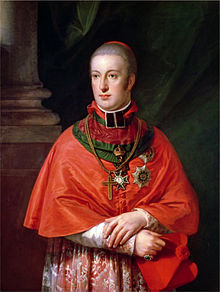
Archduke Rudolph of Austria
Piano Sonata No. 27 in E minor, Op. 90
Year written: 1814, when Beethoven was 43
Dedicated to: Prince Moritz von Lichnowsky
- This work was meant for Beethoven’s friend and patron Prince Moritz von Lichnowsky.
- Beethoven’s secretary Anton Schindler claimed that this sonata’s two movements were originally called “A Contest Between Head and Heart” and “Conversation with the Beloved.” He even edited Beethoven’s conversation books, the notebooks he kept to communicate with others as his deafness worsened, to give his story credence. However, modern scholars have determined that this was a partial or even total falsehood – but it does go to show how Beethoven was mythologised even in his own lifetime.
- The first movement has been described as passionate by multiple commentators.
- The second, and final movement, contains one of Beethoven’s most beautiful melodies, which looks ahead to Beethoven’s heir: Schubert.
- Beethoven’s middle period was drawing to a close. His late period was just on the horizon.

Count Moritz Lichnowsky
Conclusion
By 1814, something in Beethoven’s music had started to change again. Op. 90 typifies the tension and drive that defined the middle period but also hints at the spareness and Schubertian lyricism that would come to define his final years. The sonatas ahead would be stranger, more inward, and less interested in pleasing audiences.
His late period was about to begin.
For more of the best in classical music, sign up for our E-Newsletter