Over his career, Beethoven wrote thirty-two piano sonatas. The first fifteen – covering Op. 2 through Op. 28 – were composed between 1795 and 1801, a time known as his early period.
These early period sonatas tell a story. His first are dedicated to Joseph Haydn, whom he studied under and to whom he was deeply indebted creatively. By the end of the period, however, he was writing sonatas that were boldly original, in his own unique voice.
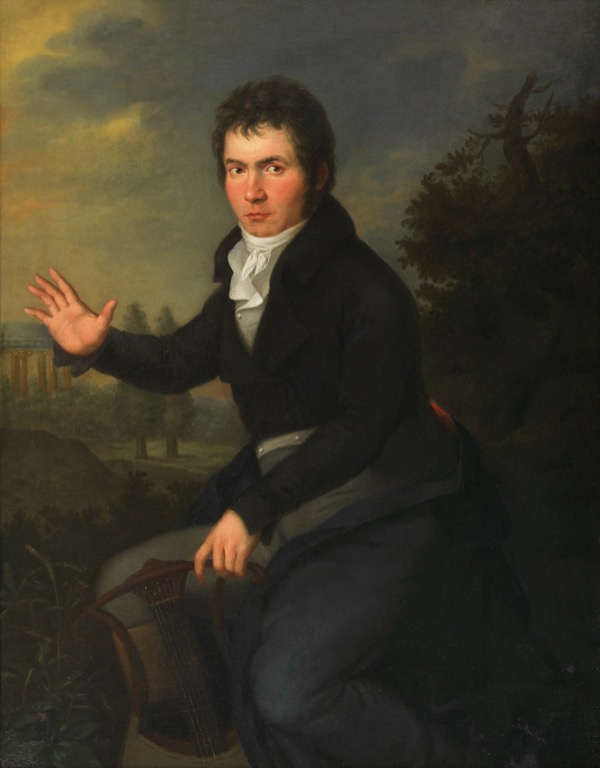
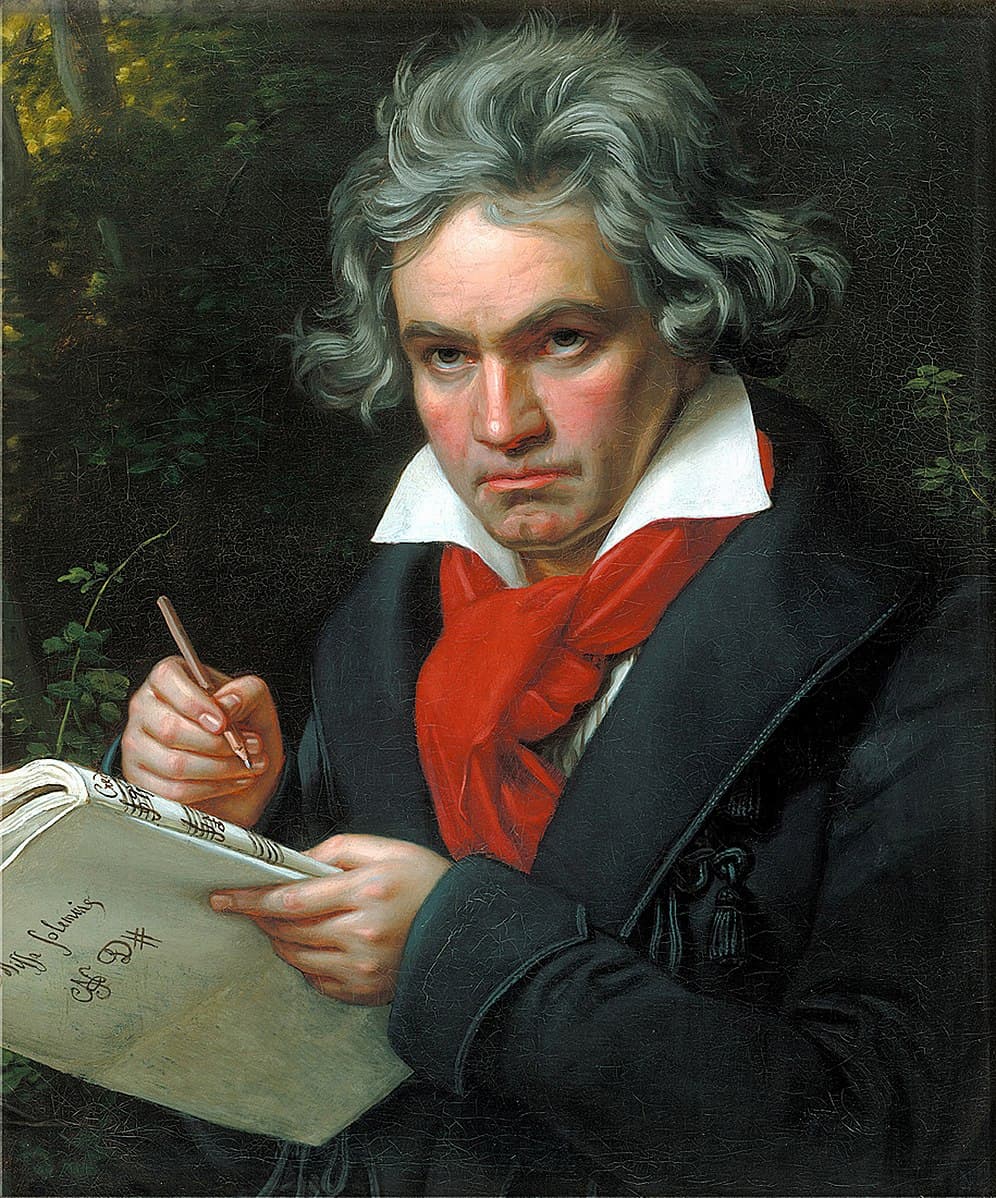
Joseph Willibrord Mähler: Beethoven age 33, 1804 (Wien Museum)
Along the way, these fifteen sonatas tell other extramusical stories too: aristocratic patrons and their wives, publisher-issued nicknames, and even the soundtrack of Beethoven’s own funeral.
Today we’re looking at the stories behind Beethoven’s early-period piano sonatas.
Piano Sonata No. 1 in F minor, Op. 2, No. 1
Daniel Barenboim
Year written: 1795, when Beethoven was 24
Dedicated to: Joseph Haydn
- This sonata was published in a set with the second and third piano sonatas.
- This work echoes the language of Mozart, Haydn, and Classical-era giants.
- It opens with an upward arpeggio known as a “Mannheim rocket” – a gesture popularised in the mid-18th century by the virtuosic court orchestra in Mannheim, which you’ll start hearing everywhere in Classical-era music once you start looking for it.
- The theme in the slow movement adagio dates from ten years earlier, in 1785, when Beethoven was 14.
- The three sonatas in the Op. 2 set are not actually Beethoven’s first piano sonatas, but they’re the first ones he wrote as an adult.
Piano Sonata No. 2 in A major, Op. 2, No. 2
Igor Levit
Year written: 1795, when Beethoven was 24
Dedicated to: Joseph Haydn
- This sonata is more modern than his first piano sonata, employing unusual key modulations for the era and sharp, sudden dynamic changes.
- Musicologist Donald Tovey called it “entirely beyond the range of Haydn and Mozart in harmonic and dramatic thought.”
- Its slow movement is labelled “largo” – among the slowest tempo markings Beethoven ever used.
Piano Sonata No. 3 in C major, Op. 2, No. 3
Claudio Arrau
Year written: 1795, when Beethoven was 24
Dedicated to: Joseph Haydn
- This sonata continues to build on the advances Beethoven made in his second sonata; it is larger and longer than its two predecessors.
- In fact, it is the second-longest sonata of Beethoven’s early period (the longest is his next, his fourth).
- The piano writing is virtuosic, serving as a kind of advertisement for Beethoven’s dazzling improvisations in aristocratic Viennese salons. (At the time these works were published, he was better known as a performer than a composer.)
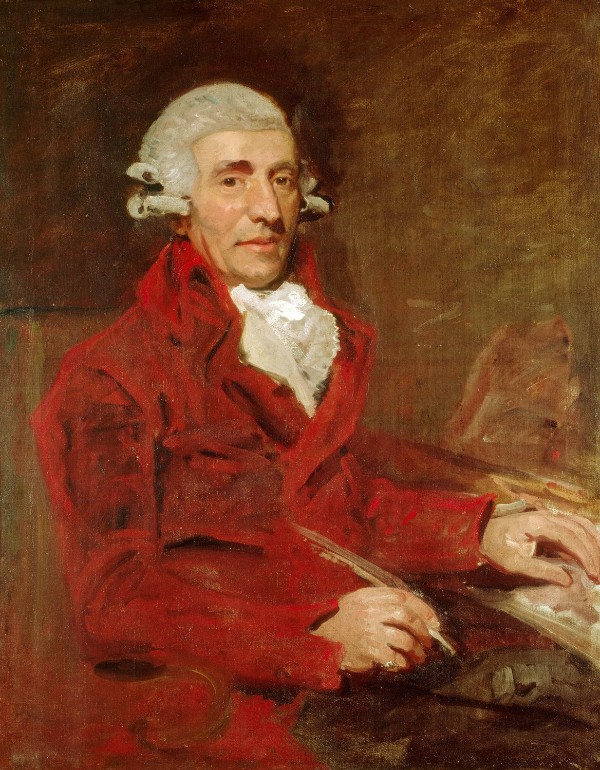
John Hoppner: Franz Joseph Haydn
Piano Sonata No. 4 in E-flat major, Op. 7
Daniel Barenboim
Nickname: Grand Sonata
Year written: 1796, when Beethoven was 25
Dedicated to: Countess Anna Luise Barbara Keglević (nicknamed “Babette”)
- This sonata has been nicknamed the “Grand Sonata” for its length; it is nearly half an hour long. This makes it one of the longest piano sonatas in Beethoven’s oeuvre, especially among his early sonatas.
- Unlike his first collection of sonatas, and underlining its ambitious size and scope, this sonata made up the entirety of his Op. 7.
- He wrote it while visiting Keglevich Palace in Bratislava in present-day Slovakia, where he had travelled to give the teenage Countess Keglević piano lessons. He then dedicated the work to her.
- We wrote about the countess here: https://interlude.hk/beethoven-maiden-love/.
Piano Sonata No. 5 in C minor, Op. 10, No. 1
Daniel Barenboim
Year written: ca. 1796–98, when Beethoven was in his mid-twenties
Dedicated to: Countess Anna Margarete von Browne, the wife of a patron
- Beethoven dedicated this sonata to the wife of a patron. He later dedicated his eleventh piano sonata to her husband.
- It uses unusual time signatures for a piano sonata. The first movement is in 3/4 time; the second in 2/4 time; and the third in 2/2 time.
- The opening theme employs dotted eighth notes, which, combined with the 3/4 time signature, gives the work a jagged, off-kilter feeling.
- That jagged, off-kilter feeling returns in the fast finale.
Piano Sonata No. 6 in F major, Op. 10, No. 2
Rudolf Buchbinder
Year written: ca. 1796–98, when Beethoven was in his mid-twenties
Dedicated to: Countess Anna Margarete von Browne
- Beethoven dedicated this sonata to the same patron’s wife as his fifth sonata.
- The sonata is cheery and genial, with only occasional minor-key shadows for depth.
- The middle movement has a striking centre section in D-flat major.
- All three movements – even the fugal passages in the final movement, which are traditionally dense and heavy – have a buoyant, dancelike quality.
Piano Sonata No. 7 in D major, Op. 10, No. 3
Sviatoslav Richter
Year written: 1798, when Beethoven was 27
Dedicated to: Countess Anna Margarete von Browne
- This is the final piano sonata in the set of three dedicated to the Countess.
- It is the longest sonata of the three, clocking in at around 24 minutes.
- This sonata included notes for keys too low and too high for 1790s pianos to play – but modern 88-key ones can.
- The slow movement in D minor is heartrendingly tragic. (It starts at 7:12 in the performance above.)
Piano Sonata No. 8 in C minor, Op. 13
Daniel Barenboim
Nickname: “Pathétique”
Year written: 1798, when Beethoven was 27
Dedicated to: Prince Karl von Lichnowsky
- This sonata begins with an introductory theme marked “grave” before exploding into a keyboard-rattling allegro.
- The second movement is one of the most famous Beethoven slow movements ever written, with a songful melody interwoven through multiple voices of accompaniment.
- Beethoven’s publisher subtitled it “Grande sonate pathétique.” Although Beethoven didn’t come up with the nickname, he did approve of it – which didn’t always happen with the nicknames attached to his piano sonatas.
- The sonata was a major commercial success and helped to cement Beethoven’s reputation. Today it is one of the best-known sonatas he ever wrote.
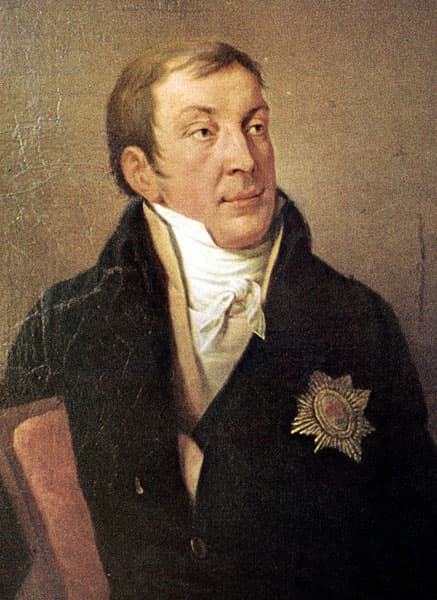
Prince Karl Lichnowsky, 1800
Piano Sonata No. 9 in E major, Op. 14, No. 1
Boris Giltburg
Year written: 1798, when Beethoven was 27
Dedicated to: Baroness Josefa von Braun
- Beethoven’s secretary Anton Schindler testified that when Beethoven would play this work, he’d play the first movement’s second E minor section furiously. Then, when the key turned to E major, he would become calmer, leaning into the contrasts he’d written into the work. Schindler was infamous for making up stories about his time with the composer, but compared to some of his more outlandish stories, this one has an air of truth.
- Instead of a slow movement, this sonata has a minor-key allegretto that his student Carl Czerny described as having “sad humour.” It starts at 7:07 in the performance above.
- In 1801, a few years after composing the sonata, Beethoven made a string quartet arrangement of it.
Ludwig van Beethoven: String Quartet in F Major, Hess 34 (arr. of Piano Sonata in E Major, Op. 14, No. 1) (Artemis Quartet)
Piano Sonata No. 10 in G major, Op. 14, No. 2
Maroussia Gentet
Year written: 1798–1799, when Beethoven was 27–28
Dedicated to: Baroness Josefa von Braun
- The first movement of this sonata is full of surprising harmonies. The development is particularly chromatic.
- The second movement is a set of variations and is the only movement in the sonata to end with a loud chord.
- The final movement ends with a quiet F# and G deep in the bass – the lowest possible ending at the time, given the shorter keyboards.
Piano Sonata No. 11 in B-flat major, Op. 22
Marta Czech
Year written: 1800, when Beethoven was 29
Dedicated to: Count Georg von Browne
- This was Beethoven’s favourite of his early period piano sonatas.
- It was dedicated to the husband of Countess Anna Margarete von Browne, who had been the dedicatee of his three Op. 10 piano sonatas.
- This sonata perfects the conventions associated with Classical-era piano sonatas. From here, Beethoven’s sonatas become more experimental. As a result, some people view this sonata as a culmination of a certain style of composition.
- The theme of the slow movement bears a similarity to the writing of Chopin, who wouldn’t even be born for ten more years.
Piano Sonata No. 12 in A-flat major, Op. 26
Arturo Michelangeli
Year written: 1800–1801, when Beethoven was 29–30
Dedicated to: Prince Karl von Lichnowsky
- This sonata was composed around the same time as Beethoven was writing his first symphony.
- The third movement is a funeral march, marked “Funeral March, relating to the death of a hero” – hinting at the large funeral march that would anchor his third symphony in a few years.
- Beethoven orchestrated the third movement in 1815 to be used as a piece of incidental music – the only time he ever orchestrated any of his piano sonatas. This version was played at his funeral in 1827.
Ludwig van Beethoven: Leonore Prohaska, WoO 96: Trauermarsch (Turku Philharmonic Orchestra; Leif Segerstam, cond.)
- This is the only Beethoven sonata that Chopin played; in fact, he modelled his second sonata on it.
Piano Sonata No. 13 in E-flat major, Op. 27, No. 1
Claudio Arrau
Nickname: Sonata quasi una fantasia
Year written: 1800–1801, when Beethoven was 29–30
Dedicated to: Princess Josephine Sophie von Liechtenstein
- The two piano sonatas from Beethoven’s Op. 27 are both subtitled “Sonata quasi una fantasia” – i.e., “sonata in the manner of a fantasy”, because neither follows the traditional structural conventions of piano sonatas.
- To start, the opening movement alone is changeable, including Andante, Allegro, and Andante tempo markings.
- Meanwhile, the finale is in sonata rondo form. Pianist and critic Charles Rosen wrote that in this movement, Beethoven experimented with “displacing some of the weight of the work from the opening movement to the finale.”
Piano Sonata No. 14 in C sharp minor, Op. 27, No. 2
Valentina Lisitsa
Nicknames: “Sonata quasi una fantasia” and “Moonlight”
Year written: 1801, when Beethoven was 30
Dedicated to: Countess Julie “Giulietta” Guicciardi
- Beethoven did not nickname this sonata “Moonlight”; rather, a poet and music critic named Ludwig Rellstab gave it that name in 1832.
- It is believed that Beethoven was in love with its dedicatee, his 17-year-old piano student, Countess Julie Guicciardi – but, contrary to the romantic myth, he bestowed the dedication after the sonata had been written.
- Its central movement is a brief two-minute interlude before a volatile, virtuosic finale.
- We wrote about the history of this sonata here: https://interlude.hk/beethovens-moonlight-sonata-the-true-story-behind-its-many-myths/.
Piano Sonata No. 15 in D major, Op. 28
Andras Schiff
Nickname: Pastoral
Year written: 1801, when Beethoven was 30
Dedicated to: Count Joseph von Sonnenfels
- The nickname “Pastoral” was bestowed upon the sonata by a British publisher – not Beethoven.
- The opening movement features a repeating note in the bass. This droning effect is used throughout the sonata.
- The second movement, Andante, employs a staccato bass that sounds like the ticking of a clock.
- The final movement has a left-hand rhythm that calls to mind a Baroque-era gigue.
- This sonata’s conclusion was a quiet way to end his early period. From here on out, Beethoven would enter his more experimental middle period.
Conclusion
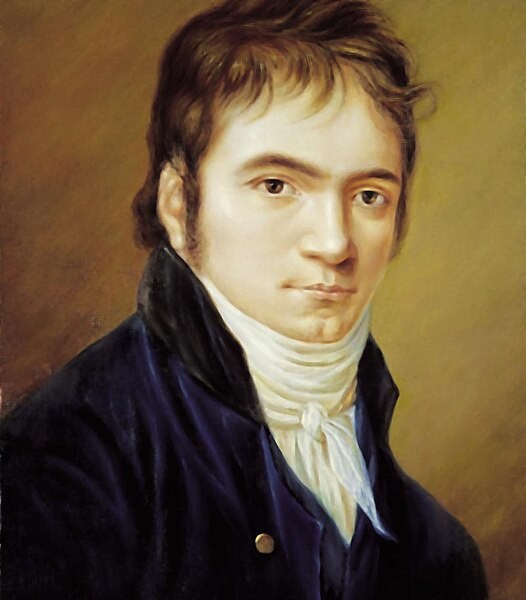
Christian Honeman: Ludwig van Beethoven, 1803 (Beethovenhaus Bonn)
By 1801, Beethoven had exhausted what the Classical piano sonata could do. He’d perfected the conventions with his beloved eleventh piano sonata, then spent its sequels experimenting. The Pastoral Sonata closes out this period quietly, almost as if to catch its breath.
The great piano sonatas of his middle period were right around the corner.
For more of the best in classical music, sign up for our E-Newsletter