As an aspiring young pianist, I played several Chopin compositions with varying degrees of success. I remember tackling a few Preludes and Nocturnes, but my teacher was never completely happy with my playing. Mind you, in the hands of experts, this music sounds completely effortless, floating through the air with burning passion.
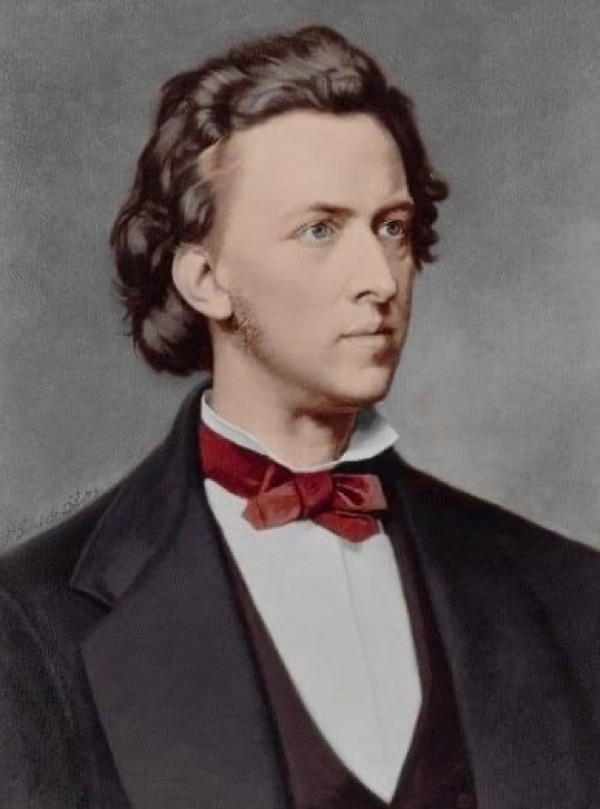
Frédéric Chopin
The genre of Chopin compositions that I probably felt most comfortable with was the waltz. And that’s hardly surprising, since his waltzes are among his best-known and most beloved works.
The Chopin waltzes don’t reproduce particular models, but basically give us music that is recognisable from the very first bars. They are full of elegance, charm, and brilliance, and frequently marked by profound expression. Robert Schumann called them “aristocratic from the first note to the last.”
Frédéric Chopin died on 17 October 1849, having suffered from serious and chronic health problems throughout his short life. As we commemorate his passing, let’s celebrate ten of his most magnificent waltzes and remind ourselves why Chopin was one of the greatest pianist-composers the world has ever known.
Frédéric Chopin: Waltz in D-flat Major, Op. 64, No. 1 “Minute Waltz”
The Waltzes We Have Lost

Portrait of Frédéric Chopin
Frédéric Chopin wrote twenty-five or so waltzes for piano, but only eighteen, plus one waltz of uncertain authenticity, have actually survived. Of all these beautiful compositions, Chopin intended only eight for publication.
And over time, we have also lost several treasures. At least seven waltzes have been destroyed in fires and accidents, and three more are lost. Two further waltzes are currently in private hands, but are unavailable to researchers and pianists. Finally, we know of three waltzes that once existed, but whose manuscripts are unknown.
So, let’s get started with Chopin’s most popular waltz, Op. 64, No. 1, affectionately known as the “Minute Waltz.” Composed in 1847, it was dedicated to the Countess Delfina Potocka and published as the first of the three waltzes in Op. 64.
The famous nickname was meant to mean “miniature”, not the playing time, but playing the piece as fast as possible is still very popular. The inspiration for this gem, as a biographer tells us, might actually have come from Chopin watching a small dog chasing its tail.
Frédéric Chopin: Waltz in E-flat Major, Op. 18
A Ballroom Hit
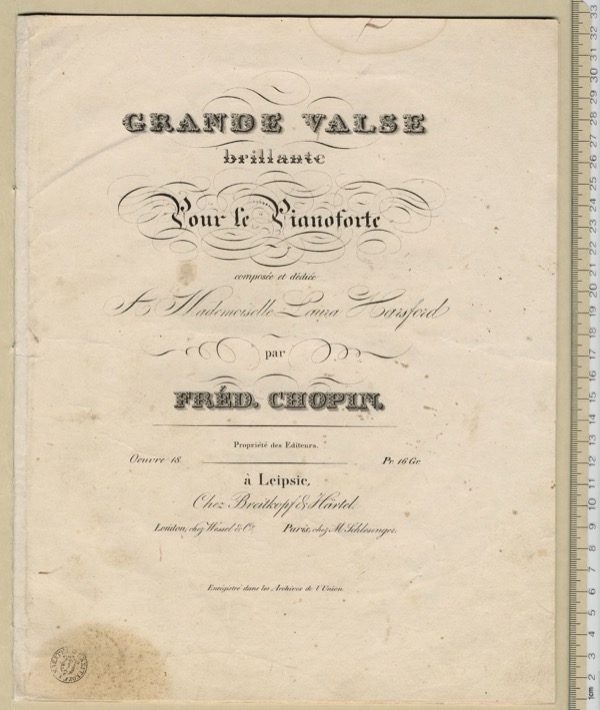
Chopin, Op. 18 title page
The “Grande valse brillante” Op. 18 is not of the sentimental Viennese variety. Rather, it comes from the Parisian ballroom, and thus consists of a succession of dance themes. In total, it has seven dance themes, each with a different melodic character and movement.
This waltz in E-flat major, the first of Chopin’s Parisian waltzes, was dedicated to his student Miss Laura Horsford, and published as Op. 18.
A reviewer in the Gazette musicale de Paris wrote, “Although particularly suitable for dancing, this waltz is among the most brillantes, and it deserves to hasten its way onto pianos whose rests are not in the least bit accustomed to holding vulgar music.”
Frédéric Chopin: Waltz in A minor, Op. 34, No. 2
Quiet Poetry
Many Chopin waltzes are glittering showpieces, but Op. 34, No. 2 is different. This delightful gem is a far gentler affair, and it’s easy to be swept up in the dance’s flowing rhythm.
We might well call this waltz melancholic, and it fits well into the “valse triste” or “valse lente” genre that was highly popular in the second half of the century; you only have to think of Tchaikovsky and Sibelius.
I’ve read that Chopin especially enjoyed playing the A-minor Waltz. There is even a funny anecdote involving the pianist Stephen Heller. When Heller met Chopin on a walk, he told him it was his favourite of all Chopin’s waltzes. Chopin was overjoyed and immediately invited Heller for lunch.
Frédéric Chopin: Waltz in F Major, Op. 34, No. 3
Dancing While Dreaming
Chopin wrote the F-major Waltz of Op. 34, No. 3 in 1838, when, after trying and failing to win the hand of Maria Wodzińska, he had become the lover of George Sand. This work is a typical “Valse Brillante,” full of sparkling bravura.
Essentially, we know this type as a concert waltz, intended not for dancing but for displaying virtuosity. Generally, this type of composition begins with a distinctive introduction and ends with a virtuosic coda, serving as the work’s climax.
Robert Schumann was rather enthusiastic about the entire Op. 34 in general. As he wrote in 1839, “The three waltzes, in particular, will be appreciated, since they sound so different from ordinary waltzes, in a genre mastered solely by Chopin, when he observes the dancers with the eyes of an artist, carrying them along with his playing, while thinking about something else entirely. Such a vitality flows through them that it really does seem as though they were improvised in the drawing room.”
Frédéric Chopin: Waltz in A-flat Major, Op. 42
One Waltz, Two Rhythms
The Waltz in A-flat Major, Op. 42, is popularly known as “the two-four waltz” because of its intriguing combination of duple rhythm in the right hand with the traditional bass-chord-chord triplets of the waltz in the left.
This is clearly a different kind of beast, and Chopin even published it as a separate work. He offers up five intertwining themes that unfold as a coherent and intriguing whole. Just listen to that opening trill lasting a full eight measures.
The first theme is clearly the shocker, with the left hand beating in triple time and the right playing a little melody in duple rhythm. The second theme is pure figuration, and the refrain actually sounds like two episodes.
Frédéric Chopin: Waltz in C-sharp minor, Op. 64, No. 2
Between Stillness and Motion
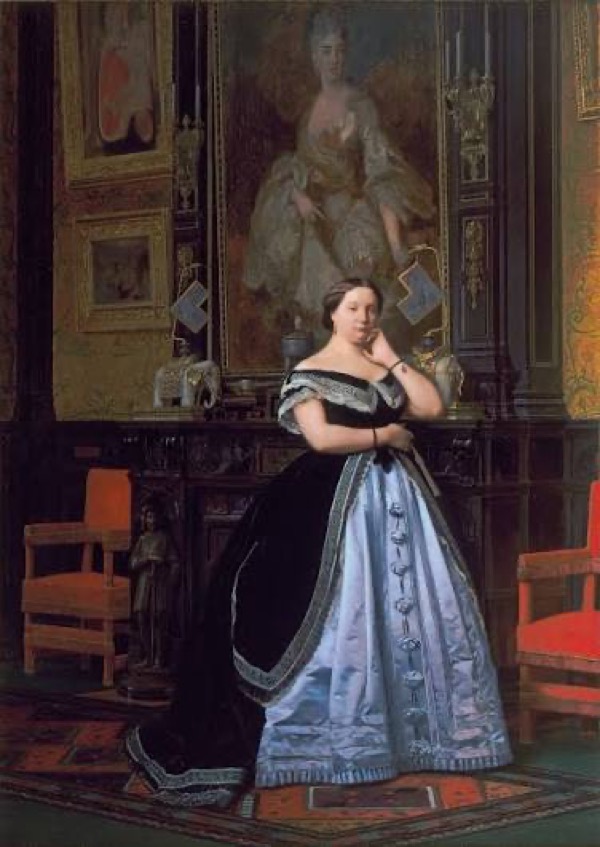
Charlotte de Rothschild
A masterpiece of musical poetry, Op. 64, No. 2 is dedicated to the Baroness Charlotte de Rothschild. Chopin had become her piano teacher in 1841, and the Baroness, wife of the famous banker, hosted lavish salons, entertaining musicians like Bizet and Saint-Saëns, as well as the writer Heinrich Heine.
Here we find a waltz clothed in the form of a ternary dance miniature, essentially a dance with a trio. The opening theme is unforgettable, abounding in sweetness and melancholy. The trio’s melody is slower and scored in the enharmonic minor key.
This music has a wonderful, elusive beauty, with pure emotion caught between stillness and movement. The melody never really settles, but eventually slips away. It has been described as dreamlike in its shifting moods, and that ambiguity is what makes it special.
Frédéric Chopin: Waltz in A-flat Major, Op. 69, No. 1
Farewell and Heartbreak
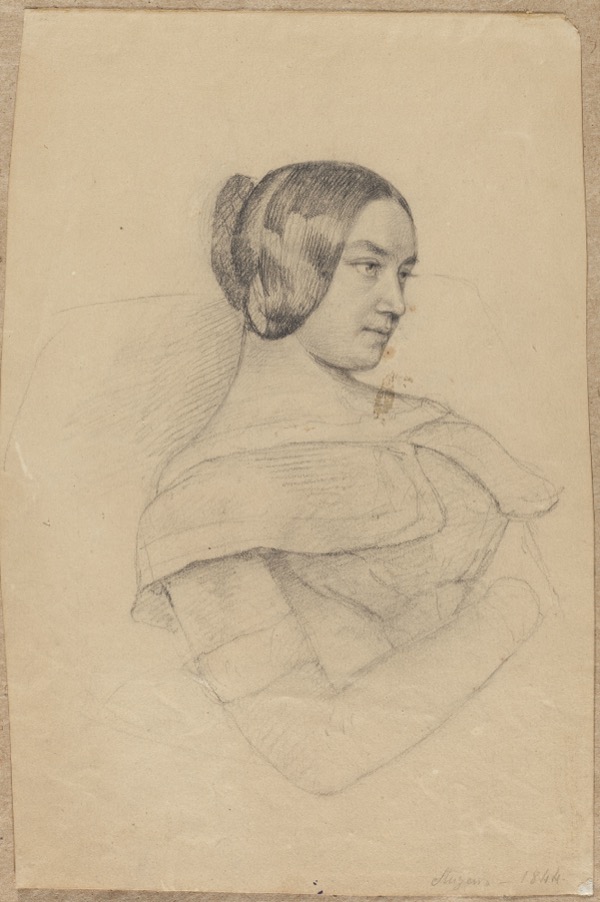
Maria Wodzińska, portrait of Józefa Kościelska
Frédéric Chopin was twenty-five when he fell passionately and hopelessly in love with sixteen-year-old Maria Wodzińska. He had known her as a child, and when he saw her again in Dresden in 1835, she had blossomed into a dark-eyed Polish beauty.
She was also a highly talented painter and a capable pianist. Chopin stayed in the Wodzińska household for two weeks, and in exchange for the hospitality, he agreed to give Maria piano lessons every afternoon.
Chopin actually proposed to her in 1836, and while Maria was thrilled, her parents were less enthusiastic. In the event, Chopin received a “Dear Fryderyk” letter from Maria in the spring of 1837. It didn’t explain anything, and Chopin was completely taken by surprise. He bundled up Maria’s correspondence and labelled it “My Sorrows.” He thus dedicated the “Farewell Waltz” to “Mademoiselle Maria.”
Frédéric Chopin: Waltz in B minor, Op. 69, No. 2
Saved from Oblivion
Chopin’s Waltz in B minor, Op. 69, No. 2 is a gentle dance, with a melody that offers flowing phrases and lyrical lines. It features subtle shifts in dynamics and delicate accents, and the rubato should sound like natural breathing.
This one dates from 1829, and it was composed in Warsaw. Neither of the waltzes in Op. 69 was published during Chopin’s lifetime, and he even requested that they be destroyed after his death.
Fortunately, his friend Julian Fontana ignored Chopin’s wishes and published these waltzes in 1855, six years after the composer’s death. It’s a lovely little waltz featuring three main themes, and as expected, we also find a trio in the parallel major key. Although technically less challenging than other Chopin works, the piece loses its charm if played mechanically.
Frédéric Chopin: Waltz in G-flat Major, Op. 70, No. 1
A Waltz of Contrasts
Chopin composed the Waltz in G-flat major in Paris, and the two surviving manuscripts bear the dates 1832 and 1833, respectively. Apparently, this waltz was supposed to be printed together with the “Grand” Waltz in E-flat major, but Chopin changed his mind.
Here, Chopin once more uses the form of a dance with a trio. The opening theme is a sparkling Parisian waltz, quick and lively. The second theme is equally dazzling, while the trio spins out an unforgettable tune.
That trio tune unfolds in parallel thirds, sounding tender and harmonious, and as the tempo slows, it suggests a completely different character. The music sways gently, and the harmonies shimmer. While the opening theme is pure dancing amusement, the contrasting trio is all lyrical tenderness.
Frédéric Chopin: Waltz in F minor, Op. 70, No. 2
From a Private World
Its F-minor companion contrasts with the gaiety of Op. 70, No. 1. Composed around 1842, the latter’s exact date of composition is unclear. It was also published posthumously in 1855.
This is one of Chopin’s most introspective waltzes, far removed from the dazzling virtuosity and sparkling brilliance associated with his concert pieces. Predictably, it is in triple metre, but the music itself is somewhat unpredictable.
It was probably never intended for public performance, as Chopin asked the pianist Anna Caroline Oury to keep that little waltz to herself. We can sense this special intimacy in the music, a gem from Chopin’s private musical world.
Melody of Mystery and Melancholy
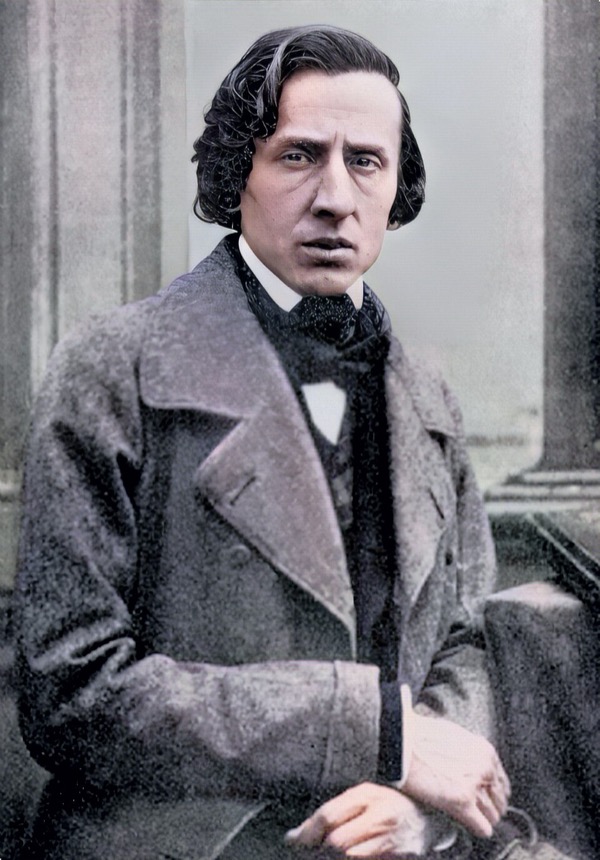
Frédéric Chopin, 1849
Chopin died at such an early age that he never prepared many pieces for publication himself. As I mentioned before, many of his manuscripts were discovered after his death and subsequently passed on to publishers.
One such treasure, and our bonus selection for this feature, is the Waltz in E minor. The steady accompaniment supports a beautifully flowing lyrical melody, carrying all the expected emotional intensity.
Since this waltz was discovered only after Chopin’s death, it carries an extra sense of quiet mystery. Nothing in this dance is dazzling, as Chopin imbues it with a melancholic quality that feels entirely personal.
While some of the Chopin waltzes invite us onto the ballroom floor and the concert stage, others draw us into a private and confessional space. Of course, plenty of glittering passagework and graceful turns appear on the surface. Still, just below it we discover an entire world of emotions, from youthful exuberance and wistful tenderness to bittersweet memories.
For more of the best in classical music, sign up for our E-Newsletter