In 1953, Leonard Bernstein became the first American to conduct an opera at La Scala. At the time, Bernstein was on a concert tour in Italy when conductor Victor de Sabata had to cancel his engagement in Milan.
Bernstein was under the weather, suffering from severe bronchitis. In the event, he had five days to learn Medea, an opera he had never conducted before. Apparently, the ancient and tattered 1797 score aggravated Bernstein’s allergy, causing him to sneeze incessantly throughout rehearsals.
The 10 December 1953 performance would prove a breakthrough for Bernstein and another triumph for Maria Callas. To commemorate Bernstein’s death on 14 October, let us revisit this remarkable artistic relationship between conductor and soprano.
Luigi Cherubini: Medea, Act III: Recitative: Numi, venite a me (Maria Callas, soprano; Fedora Barbieri, mezzo-soprano; Milan La Scala Orchestra; Leonard Bernstein, cond.)
Luigi Cherubini: Medea, Act III: Aria: Del fiero duol (Maria Callas, soprano; Milan La Scala Orchestra; Leonard Bernstein, cond.)
A Rocky Start at La Scala
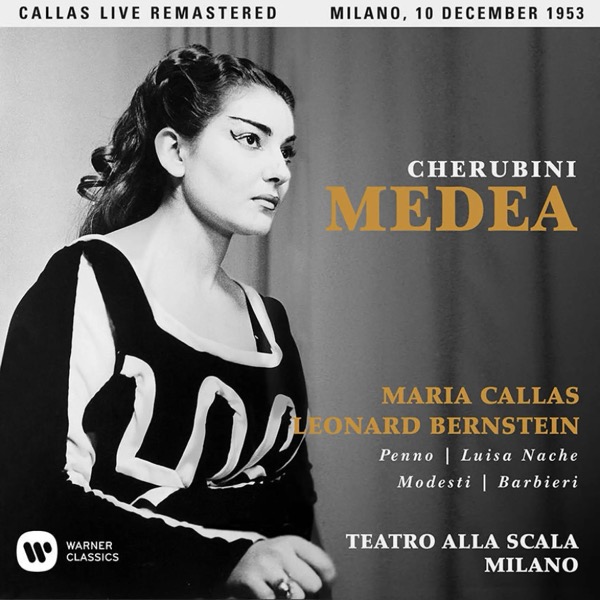
Leonard Bernstein and Maria Callas, Medea
Medea was not Callas’s first appearance at La Scala. As early as 1950, she had stepped in for Renata Tebaldi as Aida, a role she didn’t particularly like. In the next two years, she sang at La Scala as Lady Macbeth, Gioconda, and Leonora in Il Trovatore, but she still hadn’t conquered the city.
When she arrived in 1953, a Milanese journalist asked her about her impressions of the opera house. The local newspaper published her answer, and it didn’t immediately ingratiate her either. “La Scala,” she said, “is a great theatre, but I’m nearsighted. That’s why all theatres look the same to me.”
Luigi Cherubini: Medea, Act I Scene 1: Dei tuoi figli la madre (Maria Callas, soprano; Milan La Scala Orchestra; Leonard Bernstein, cond.)
A Meeting of Musical Equals
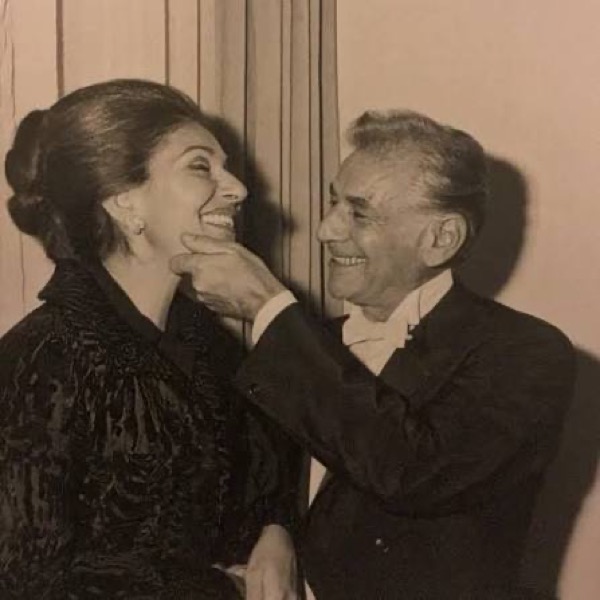
Maria Callas and Leonard Bernstein
The historical-artistic archive director of the La Scala archive, Andrea Vitalini, suggests that Bernstein and Callas had an immediate, strong rapport, even during rehearsal. Callas and Bernstein approached each other as equals, and since Bernstein was conducting Medea for the first time, he was receptive to her musical input. After all, Callas had recently had a major success with that opera in Florence.
Bernstein allowed Callas considerable space in the musical preparation. Yet he also made his own cuts and rearranged some material. The performance became a major triumph, with conductor and singer feeding off each other’s energy. Bernstein later summed up the effect by stating, “On stage she is pure electricity. In Medea she is a power station.”
Luigi Cherubini: Medea, Act III: Finale: E che? Io son Medea! (Maria Callas, soprano; Gino Penno, tenor; Fedora Barbieri, mezzo-soprano; Milan La Scala Chorus; Milan La Scala Orchestra; Leonard Bernstein, cond.)
A New Callas
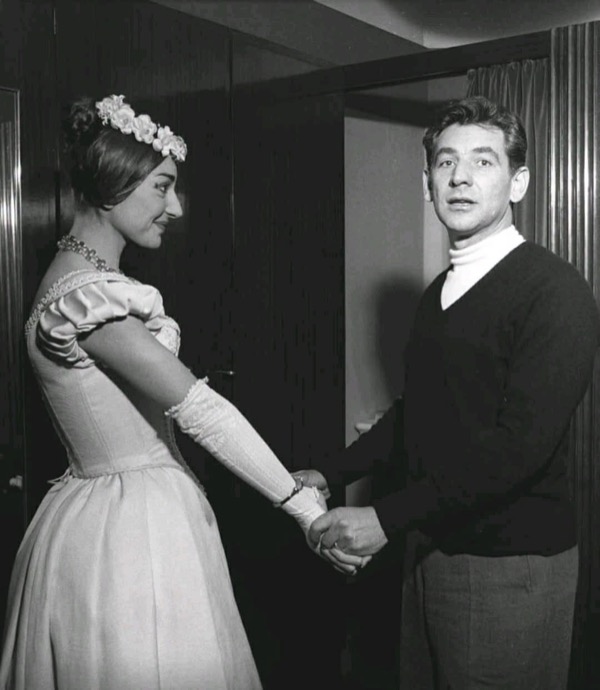
Maria Callas and Leonard Bernstein
Two years later, Bernstein and Callas met again, in what would be their final collaboration at La Scala. This time, the opera was Vincenzo Bellini’s La sonnambula. To be sure, the vocal lead could not be more different, as the role calls for a sweet, lovely sleepwalker, not a sorceress who kills her children.
Luchino Visconti, the stage director, was an important element of this production. He did not attempt to stage a realistic Swiss village literally. Rather, he attempted to evoke an atmosphere of early nineteenth-century Romantic theatre and ballet.
Vincenzo Bellini: La sonnambula, Act I Scene 1: Come per me sereno … Sempre, o felice Amina (Maria Callas, soprano; Giuseppe Modesti, bass; Gabriella Carturan, mezzo-soprano; Cesare Valletti, tenor; Eugenia Ratti, soprano; Pier Luigi Latinucci, bass; Giuseppe Nessi, tenor; Milan La Scala Chorus; Milan La Scala Orchestra; Leonard Bernstein, cond.)
More Than Bel Canto
In addition, set and costume designer Piero Tosi dressed Callas in a corset faithful to 1830s style, creating an appearance in keeping with the ballerina ideals of earlier times. Although the role of “Amina” had become a vehicle for vocal display, Callas genuinely portrayed the drama in her voice.
Bernstein was still a relatively young conductor, and together with Callas, they were working within a carefully conceived theatrical production, essentially a kind of Romantic dream world. Yet he did not treat La sonnambula as mere decorative bel canto; he gave the opera momentum and dramatic shape.
Vincenzo Bellini: La sonnambula, Act II Scene 2: Ah, non credea mirarti (Maria Callas, soprano; Cesare Valletti, tenor; Milan La Scala Orchestra; Leonard Bernstein, cond.)
In Perfect Sympathy
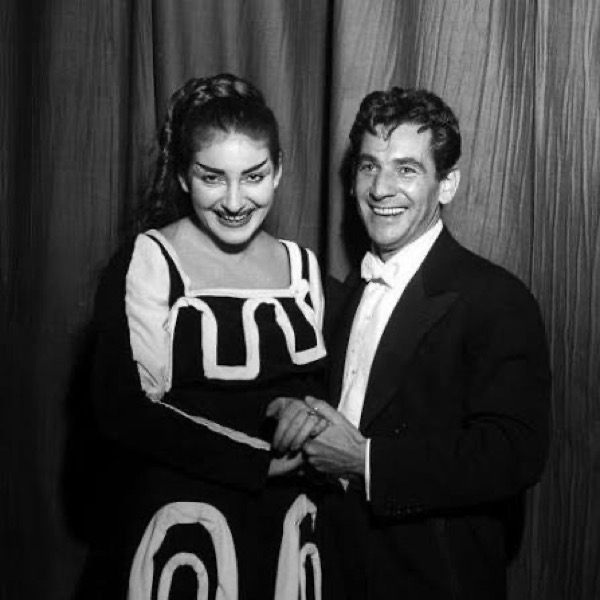
Maria Callas and Leonard Bernstein
According to contemporary reports, he was unafraid to let Callas breathe, approaching tempo with great flexibility. In this performance, Bernstein creates an active orchestral framework around Callas.
Callas responds beautifully in the “Sleepwalking Scene.” Her voice becomes veiled, giving the impression of someone who isn’t fully aware of her surroundings. Bernstein reduces the orchestral presence to achieve a “hushed” and “other-worldly” character.
Bernstein and Callas appeared to be personally fond of one another, without having been lifelong friends. Bernstein, in his later recollections, was genuinely fond of the Callas collaborations, suggesting that “coping with Callas was pure joy.”
For more of the best in classical music, sign up for our E-Newsletter
Vincenzo Bellini: La sonnambula, Act III Scene 2: Ah! non giunge uman pensiero (Maria Callas, soprano; Giuseppe Modesti, bass; Gabriella Carturan, mezzo-soprano; Cesare Valletti, tenor; Eugenia Ratti, soprano; Pier Luigi Latinucci, bass; Giuseppe Nessi, tenor; Milan La Scala Chorus; Milan La Scala Orchestra; Leonard Bernstein, cond.)