“Play always as if in the presence of a master.”
At first glance, Schumann’s advice can sound intimidating. It conjures the image of a formidable teacher, standing or sitting beside the piano, listening closely and ready to pounce on every wrong note, inconsistent rhythm or careless phrase. But I don’t think that is what Schumann meant, nor is it the most useful way to understand his words. For me, the key idea here is not judgement but attention.
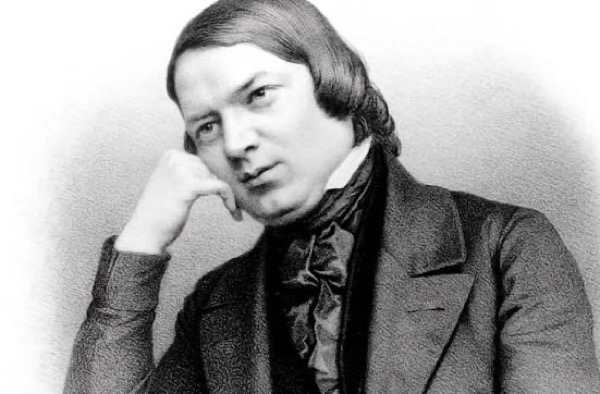
Robert Schumann
Play as if someone is listening.
Most musicians spend far more time playing alone than in front of other people. Hours in the practice room, working through passages, repeating awkward sections, trying different fingerings, refining pedalling, and solving technical problems. This private work is necessary, of course, but its very familiarity may encourage carelessness. Repetition becomes mechanical; we stop listening properly; and the fingers carry on while the mind wanders elsewhere.
Robert Schumann: Album für die Jugend (Album for the Young), Op. 68, Part I: No. 11. Sizilianisch (Siciliana) (Alessandro Deljavan, piano)
Schumann’s imaginary ‘master’ offers a useful corrective. What if someone whose musical judgement you really respected were sitting quietly in the room while you practised? Might you listen more carefully? Would you pay closer attention to the quality of the sound, or notice that you were rushing the same transition yet again? Would you finish the phrase rather than stopping the moment you had negotiated the difficult notes?
You probably would, wouldn’t you?
This doesn’t mean every moment of practice has to resemble a concert performance or a masterclass with a renowned pianist-teacher. Practice is necessarily experimental and often messy. We need to take things apart, slow them down, isolate a handful of notes, try something that may not work, and sometimes make an awful noise in the process. Much of it is unglamorous. Yet even the most mundane repetition can have a musical intention.
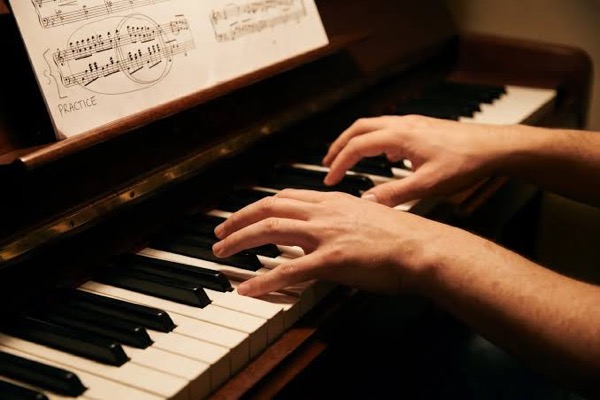
Practising the piano
Leopold Godowsky: 53 Studies on the Chopin Études: No. 1 in C Major (1st version after Chopin’s Op. 10, No. 1) (Boris Berezovsky, piano)
If we play the same four bars twenty times, what exactly are we practising? Are we simply getting the notes into our fingers, or are we also practising the shape of the phrase, the balance between the hands, the particular sound we want, and how those four bars lead into what comes next?
Whatever we do repeatedly in the practice room is what we become good at. And if we practise without listening, we become very proficient at playing without listening.
This is one reason I have never particularly liked the idea of practising merely ‘putting in the hours’. The number of hours tells us very little about the quality of the work done within them. Twenty minutes of concentrated, attentive, deep practising may be more useful than an hour or more of mindless repetition.
Good practising requires curiosity. Why did that happen? What did I hear? What could I change? What happens if I try it this way? It is an active conversation – a feedback loop, if you will – between what we intend and what actually comes out of the instrument. Hearing the difference is one of the most important skills a musician develops.
Wolfgang Amadeus Mozart: Piano Concerto No. 23 in A Major, K. 488: II. Adagio (Maria João Pires, piano; Salzburg Mozarteum Orchestra; Frans Brüggen, cond.)
When we are young or relatively inexperienced, the ‘master’ in Schumann’s aphorism may literally be our teacher. The teacher hears what we cannot yet hear for ourselves: unevenness, a poorly balanced chord, a phrase that has lost its direction. They suggest alternatives and encourage us to listen differently. And a good teacher does more than tell us what is wrong: they teach us how to notice.
Gradually, something interesting happens. We begin to carry the teacher’s voice into the practice room. Most musicians know this experience: you play a passage and can almost hear a former teacher making a familiar observation. You anticipate what they would say before they have the chance to say it. Eventually, you no longer need to summon the teacher at all, because the habit of listening they encouraged has become your own.
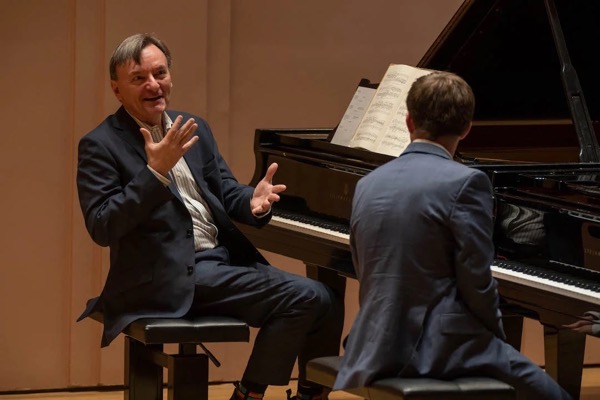
Stephen Hough in masterclass with a student
This is surely one purpose of musical education: not to create musicians who remain dependent on a teacher’s approval, but to develop independent musicians capable of making informed judgements.
Johann Sebastian Bach: Partita No. 2 in C Minor, BWV 826: IV. Sarabande (Murray Perahia, piano)
At this point, the ‘master’ becomes internalised. This also changes what self-criticism means. There is a kind of practice that consists largely of telling ourselves off: That was terrible. I always miss that. Why can’t I play this? Such commentary is rarely useful because it offers no information about what actually happened or what to do next.
Critical, attentive listening is different. It is specific and curious, not negative. That chord was too prominent. The tempo moved forward there. I lost the melodic line in the left hand. What could I do differently? That is the voice of an attentive musician rather than an angry examiner!
Another reason Schumann’s advice appeals to me. It suggests that the distinction between practising and performing is not as clear-cut as we sometimes imagine. We tend to think of practice as preparation for the real thing: the lesson, examination, concert or other occasion when somebody will finally be listening. Yet if we reserve our musical imagination for those occasions, we ask a lot of ourselves. We cannot spend weeks practising mechanically and then expect inspiration and communication to appear when we suddenly walk onto a stage. We need to practise those things too.
We can practise listening and communicating a phrase; we can practise character, imagination and expression; we can practise recovering when things go wrong. We can even practise the particular quality of attention that performance demands. In that sense, every time we sit down at the instrument, we are rehearsing not simply the notes but the kind of musician we want to be.
What are we trying to say? Why is this phrase shaped as it is? Why this harmony, this articulation, this silence? What does the music ask of us? The answers will not always be the same, nor should they be. Interpretation involves imagination and choice. But those choices are more convincing when they come from close attention than from habit. Ultimately, though, I think the most valuable ‘master’ is oneself.
As we gain experience, we accumulate teachers, performances, recordings, conversations, books, scores, and countless hours of listening and playing. All of these experiences shape our musical judgement. We develop a clearer sense of what we value and who we want to be as musicians. That does not mean we stop needing teachers or other musicians, far from it. Another pair of ears can always reveal something we have missed. But musical maturity also involves learning to trust our own ears.
So Schumann’s advice need not make us feel watched. “Play always as if in the presence of a master” might simply mean giving the music your full attention, even when nobody else is there. Listen carefully. Be curious. Have standards, but do not use them to punish yourself. Practise with the same musical intention you hope to bring to performance. Eventually, you may discover that the master you imagined sitting beside you has quietly disappeared because you have learned to listen for yourself.
For more of the best in classical music, sign up for our E-Newsletter