“I am currently reading the Dao De Jing; its ideas about the path (Dao) resonated with the journey in Winterreise.” Mark Padmore thought aloud, while leafing through his worn notebook. The verses of T.S. Eliot, Thomas Hardy, and William Blake seemed to have long been woven into his everyday vocabulary.
Beckett’s absurdist theatre and Britten’s Winter Words also serve as important references, as Padmore shaped his own Schubertian wanderer—a lone traveller journeying through the bleak mid-winter. While his pianist partner Imogen Cooper was rehearsing next door, we sat and chatted about Padmore’s world of art songs, including his luminous collaboration with Hans Zender, Thomas Larcher, Christian Gerhaher, Paul Lewis, and Kristian Bezuidenhout.
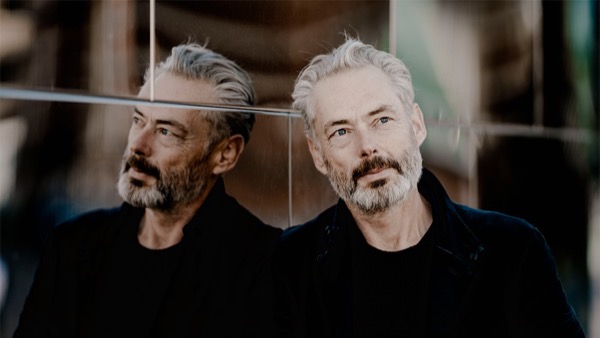
Mark Padmore (Photo by Marco Borggreve)
Having attended six of your recitals, I was moved by your gestures, for example, to embrace yourself when singing “wann halt’ ich mein Liebchen im Arm”. Were these gestures designed or spontaneous?
It developed over the years. I didn’t start that way; when I first sang Lieder, I kept my hands quite still. But one of my key interests is how you communicate with an audience. I want them to be involved, not just passive. Gesture helps, particularly when you are singing in a language they don’t necessarily speak. But it would also be excessive to gesture toward my heart every time I sing the German word “Herz.”
Franz Schubert: Winterreise, D. 911: No. 11. Frühlingstraum (Mark Padmore, tenor; Paul Lewis, piano)
Body language should never be distracting; it is organic. As a Lieder singer, I try not to think too much about the technicality of vocal production. I focus on the words: having the image already in my mind as I take a breath. When I teach singing, I talk about “inspiration”: it means both taking a breath and taking in an idea, and they happen at the same time.
Our vocal, visual, and physical expressions are naturally connected. My friend, the choreographer Wayne McGregor, says that gesture plays a significant role in our communication—more than fifty per cent. Musicians sometimes forget that. If an orchestra plays without energy, the audience reads it; when they are visibly excited, it makes a difference.
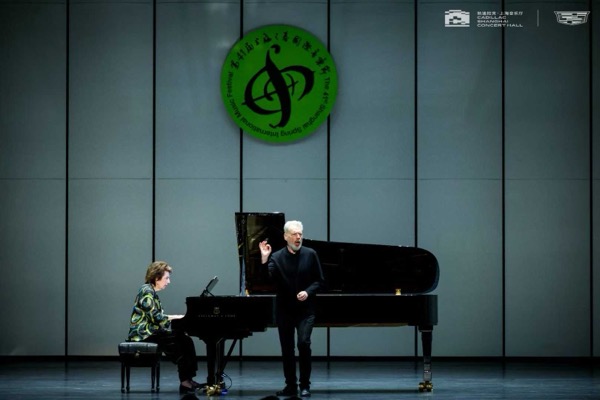
Imogen Cooper and Mark Padmore’s Winterreise Recital at Shanghai Concert Hall
Are there any pieces that you focus on rehearsing?
Pianistically, there are certain challenging passages. For example, the rapid runs in Rückblick and the repeated-note patterns in Die Post require adjustments depending on the instrument. For the singer, the first song, Gute Nacht, is always a challenge. It is the longest piece in the cycle; its rhythm, made of quaver notes, is relatively uniform. You have to create a sense of continuous forward movement; otherwise, it can be difficult for the audience to get immersed. After all, Winterreise itself is a profoundly difficult, existential journey.
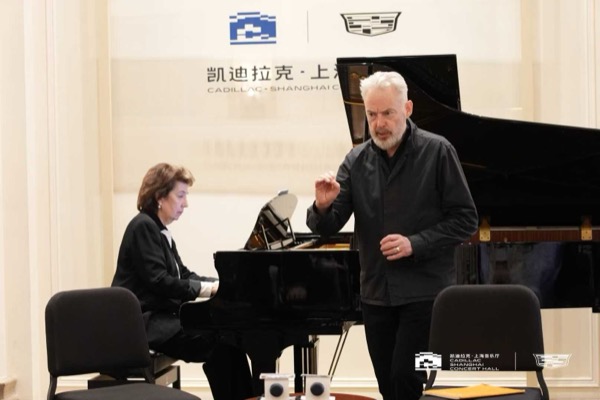
Pre-Concert Demonstration at Shanghai Concert Hall
Can you recommend a few less recognised songs?
In the pre-concert introduction, we would talk about Letzte Hoffnung. Its opening feels like modern music: the rhythm and tonality are unclear. Then suddenly, it moves into a clear—and even somewhat conventional—cadence in E-flat major. The playfulness is remarkably bold.
Franz Schubert: Winterreise, D. 911: No. 16. Letzte Hoffnung (Mark Padmore, tenor; Paul Lewis, piano)
Another example is Irrlicht. The music vividly portrays a strange light that leads one astray in the darkness. Then there is Der Leiermann, where the piano’s left hand maintains the same open fifth chord throughout. Today we may take these things for granted, but at the time, they were completely unprecedented. That is precisely what makes Schubert so great.
Franz Schubert: Winterreise, D. 911: No. 9. Irrlicht (Mark Padmore, tenor; Paul Lewis, piano)
In the BBC Soul Music program from 2011, you said Winterreise might even be the last music you would like to hear. Really?!
That was a wonderful program. I would also recommend listening to the episode on Jacques Brel. Naturally, people change their minds. There are certain pieces of music that I would not mind hearing again at the very end of my life—perhaps the slow movement of Schubert’s final Piano Sonata in B-flat major, or Beethoven’s late string quartets. Or, like the renowned British Sinologist and translator of Dao De Jing, Arthur Waley, one might choose Haydn’s string quartets: works that are full of good humour and warmth.
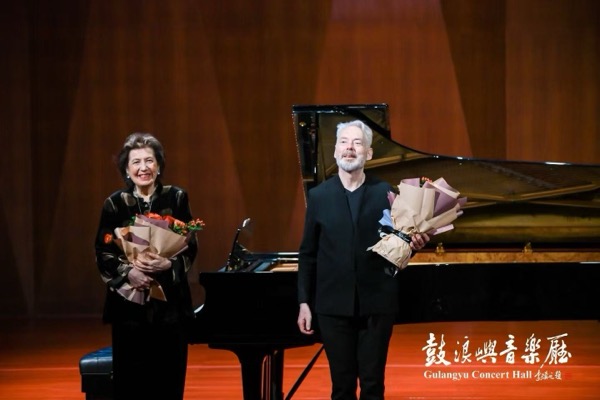
Winterreise Recital at Gulangyu Concert Hall
Can you talk about your performance of Winterreise featuring Samuel Beckett’s poetry?
This idea came from my long-term collaborator, director Katie Mitchell. The entire performance was titled One Evening, drawing from an unpublished essay by Beckett. We sang using an English translation of the text and incorporated Foley sound effects, such as footsteps, wind, and water. It helped us explore the fundamental elements of theatre-making.
As for Beckett himself, he played the piano and had a deep fascination with Schubert. His writing on modern loneliness resonated with the solo Romantic wanderer, depicted in the paintings of Caspar David Friedrich. In his later years, Beckett also adapted Schubert’s Nacht und Träume, and I took part in a recording of that work. One of my major projects this year is adapting his one-act play Krapp’s Last Tape into an opera, which will tour in several cities, including Dublin and Los Angeles.
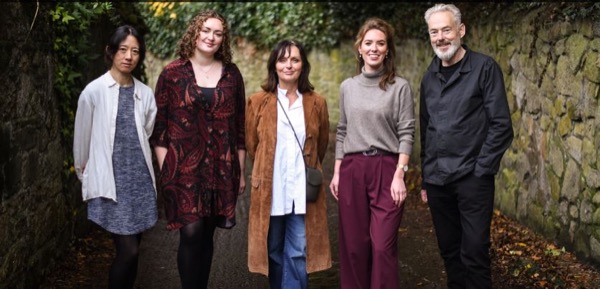
Krapp’s Last Tape Production Team (Photo by RTÉ Ireland’s National Public Service Media)
Krapp’s Last Tape Production Team (Photo by RTÉ Ireland’s National Public Service Media)
What insights did you gain from taking part in Hans Zender’s version of Winterreise?
Hans Zender was a very fine musician who knew the Austro-German repertoire incredibly well. Shortly before his death, he also wrote a work for voice and piano for Till Fellner and me, based on texts by the German poet Jean Paul.
Zender’s arrangement of Winterreise is theatrical and stimulating for the audience. At times, instruments such as the accordion make shocking sounds; at other moments, performers enter the stage from different positions. There are even instances of deliberate distortion. For example, in Die Nebensonnen, several out-of-sync musical lines move at different paces, altering the listener’s perception.
For an orchestra, performing art songs is less familiar than playing their instrumental repertoire. The difficulty also lies in being flexible while maintaining unity in pacing. This is very different from working with a pianist, who can respond to you directly. I was fortunate to work with Simon Rattle, and it was a wonderful experience.
Sir Simon Rattle, Ensemble Connect, Mark Padmore: Winterreise (Schubert/Zender)
Maybe these two adaptations can help to renew and promote Lieder as a genre?
Classical audiences often encounter great works first through recordings, which can create expectations of wanting to hear the same interpretation in concerts. Performers may also bear some responsibility. We pursue perfection to such an extent that we become reluctant to disturb the audience. Yet my motivation for music-making has always been one of exploration.
T. S. Eliot wrote in Four Quartets: “We shall not cease from exploration, and the end of all our exploring will be to arrive where we started and know the place for the first time.” Whether it is Bach’s Passions or Schubert’s Winterreise, we can’t contain these pieces. The piece is neither the score nor the recording. Music is what happens in the act of live performance. Therefore, the audience is also part of the energy.
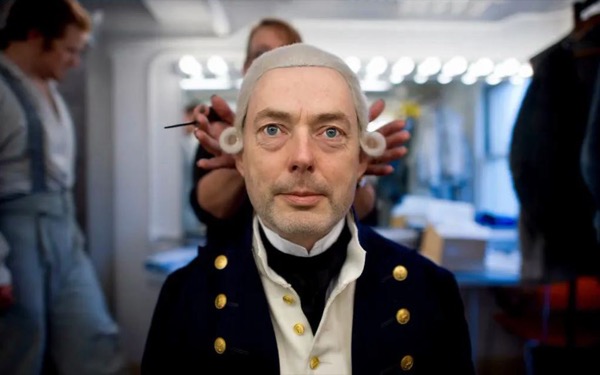
Mark Padmore in Benjamin Britten’s opera Billy Budd (Photo by The New York Times)
Can you talk about your experience recording Winterreise with fortepiano?
Fortepianos were the instruments of Schubert’s time, and they differed enormously from one another. A Viennese Graf and an English Broadwood have completely different personalities. Modern pianos, such as Steinways, are undoubtedly excellent, but using only one brand is a little like everyone driving a luxurious Rolls-Royce—it leaves less room for individuality and surprises.
Franz Schubert: Winterreise, D. 911: No. 15. Die Krähe (Mark Padmore, tenor; Kristian Bezuidenhout, fortepiano)
My collaborator Kristian Bezuidenhout is an exceptional specialist. I love the sound of fortepiano: the treble had a silvery brilliance, the bass a more woody quality, and the middle register possessed a transparent, speech-like element. Vocal adjustments depend largely on the space. Early pianos work best in smaller venues, but in larger halls their sound can become less prominent. The key question is still how to reach and move the audience.
Franz Schubert: Winterreise, D. 911: No. 24. Der Leiermann (Mark Padmore, tenor; Kristian Bezuidenhout, fortepiano)
In Schubert’s time, public song recitals had not yet emerged. Writing songs was more like compiling a poetry anthology, and music was mostly shared in private settings. In Thomas Mann’s Doctor Faustus, there is a scene in which Wendell Kretzschmar brings Beethoven’s symphonies to rural communities. Performing on an early piano feels like returning to that original context, and that sense of intimacy is especially precious.
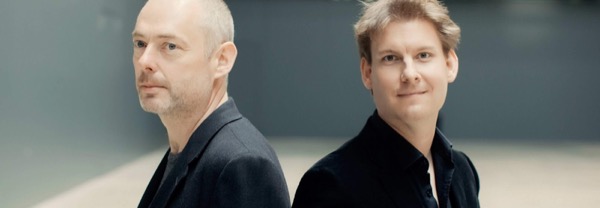
Mark Padmore and Kristian Bezuidenhout (Photo by Marco Borggreve)
Benjamin Britten shared this artistic philosophy. You have performed his works extensively. Why was Britten also drawn to Schubert?
Schubert was a very personal composer. When you enter his musical world, he shows his vulnerability; he becomes a trusted friend who understands you. Beethoven, by contrast, seemed to spend his days openly fighting the gods and the universe—at times angry, at times humorous—but he rarely became a confidant in the way Schubert did.
Schubert enjoyed singing in the male choirs and loved writing inner voices. In his music, you often hear passages moving in thirds and sixths, as if two voices are going together, hand in hand. It is neither sexual nor argumentative; rather, it is companionship—a dialogue between intimate friends.
Benjamin Britten and Peter Pears on Winterreise in 1968
I am pretty sure this is what Britten heard in Schubert’s music. Britten wanted his own music to be “useful”. He wanted to compose music that ordinary people could sing and play. In the twentieth century, when Britten lived, composition tended to make aggressive, elitist, and demanding statements; some proved valuable, while others seemed simply unfriendly. Britten was different: like Schubert, he valued music as a form of direct and human communication.
Britten himself was a deeply complex figure. He was always impeccably dressed and would invite the Queen to attend his music festivals; he was, in many ways, a part of the British establishment. Yet, he was homosexual, pacifist, with left-wing socialist ideas at odds with the mainstream. His inner world was far more conflicted than his outward appearance suggested.
In Britten’s works, the tension between “innocence and corruption” is a central theme. He probed into troubling aspects of human existence in imaginative ways. Britten shared Schubert’s uncanny play between major and minor keys. He also frequently used rhythms that merge duple and triple meters, creating subtle distortions within his music.
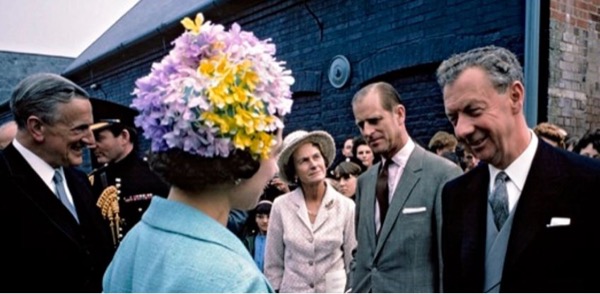
Benjamin Britten met with the Royal Family (Photo by Britten Pears Arts)
A few years ago, you paired Schubert’s seasonal songs with Britten’s Winter Words.
The title of Britten’s Winter Words is taken from the last collection by the poet Thomas Hardy; here, winter does not necessarily refer to a season, but symbolises the later stages of life. Hardy was known for storytelling, and the eight poems selected by Britten each have their own distinct character.
For example, the second song depicts a boy on a late-night train, travelling alone with his suitcase. The poet asks: does he know where this journey of life will take him? Britten was very self-conscious as a child. Like an angelic Peter Pan, he had once been adored as “the beloved Benji”, yet he had to shed his innocence and grow up.
Benjamin Britten: Winter Words, Op. 52: No. 2. Midnight on the Great Western (Mark Padmore, tenor; Roger Vignoles, piano)
During the Second World War, as Britten was preparing to leave America and return to England, his friend, the poet W. H. Auden, wrote a powerful farewell letter. In it, Auden directly pointed out that Britten longed to be adored and approved, but at some point he had to learn “how to be a shit”, no longer the angelic child.
Benjamin Britten: Winter Words, Op. 52: No. 3. Wagtail and Baby (Mark Padmore, tenor; Roger Vignoles, piano)
Winter Words has a song called “Wagtail and Baby.” The ending takes a fascinating turn: in the very last chord, the minor key shifts into major, as if the infant has suddenly come to a realisation. The last song, Before Life and After, is even more disturbing. The line “a time there was” evokes a world “before the birth of consciousness, when all went well.” But towards the end of the poem, “nescience shall be reaffirmed.” It speaks to an existential angst: the development of self-reflection is both an enlightenment and a burden.
Benjamin Britten: Winter Words, Op. 52: No. 8. Before Life and After (Mark Padmore, tenor; Roger Vignoles, piano)
Talking about self-reflection, does it lead to self-centred obsession in Winterreise?
In Die schöne Müllerin, the protagonist’s unrequited love is an extreme form of narcissism, ultimately leading to his destruction. Winterreise, however, is different. Although the wanderer is also self-obsessed, he has a sense of humour and irony. That’s why Beckett responded to it. This is not just self-indulgent mourning about lost love.
Franz Schubert: Die schöne Müllerin, D. 795: No. 19. Der Müller und der Bach (Mark Padmore, tenor; Paul Lewis, piano)
Winterreise may also allude to an early death, given the era’s shorter life expectancy. In Die Nebensonnen, the “two suns” that have set may symbolise closed eyes. As Dante’s lifelong meditation on Beatrice’s early death suggests, loss offers another way to read Winterreise: not as mere self-pity, but as a journey through the inferno.
Franz Schubert: Winterreise, D. 911: No. 23. Die Nebensonnen (Mark Padmore, tenor; Paul Lewis, piano)
In any case, we should not attempt to fix the interpretation. Is the linden tree a harbour of refuge or a threat? Is the hurdy-gurdy player the figure of Death? If there were a single correct answer, it would be like a taxidermist pinning a butterfly to a board. As the poet Blake suggested, art should remain alive and ever-changing.
Turning to ever-renewing music, you also work with living composers such as Thomas Larcher, who wrote A Padmore Cycle.
Thomas is a friend and also an outstanding pianist. We performed Schwanengesang together. A Padmore Cycle exists in piano, trio and orchestral versions. The vocal writing is often restrained rather than outwardly expressive, as in a traditional song. As the voice ages, the piece can become even more demanding.
Thomas Larcher talks about A Padmore Cycle
I have been very fortunate that many contemporary composers have dedicated works, and I have premiered more than thirty such pieces. One example is Alec Roth, whose music is simple yet beautiful. He is interested in diverse tuning systems and musical traditions, such as Indonesian gamelan. One of our albums, Songs in Time of War, draws on the Tang dynasty poet Du Fu’s The Ballad of the Army Carts.
Alec Roth: Songs in Time of War: No. 11. Ballad of the Army Carts (Mark Padmore, tenor; Philippe Honoré, violin; Alison Nicholls, harp; Morgan Szymanski, guitar)
Staying on the topic of art songs, Paul Lewis has been an important collaborator, recording Schubert’s song cycles with you.
Paul is one of the least egotistical musicians I have ever met. He walks onto the stage, sits at the piano, and engages thoughtfully with the music. Rather than showing off his virtuosity, Paul places his faith in hard work and a solid understanding of the score. My partner on this tour, Imogen Cooper, comes from a similar school.
When Paul and I work together, we rarely discuss music, spending our time instead talking about family and current events. Paul is a man of strong principles, which I deeply admire. During performances, we listen to one another without any need for over-analysis—the kind of academic forensic study that Paul’s teacher, Alfred Brendel, was quite adept at.
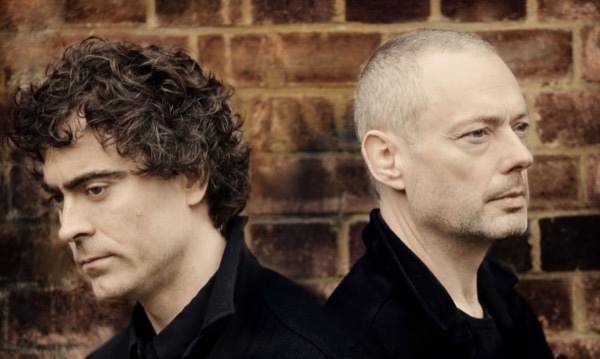
Paul Lewis and Mark Padmore (Photo by Marco Borggreve)
Another one of your colleagues, Christian Gerhaher, performed Schumann in China in 2025. What do you admire most about his singing?
We have performed works such as Bach’s Passions and War Requiem together. Christian is an exceptionally thoughtful person—perhaps too serious at times (laughs). You can’t even compliment him, because he will always push back. He believes Schumann to be the composer who best expresses the human condition. His new autobiographical book Lyrical Diary: Lieder from Franz Schubert to Wolfgang Rihm has just received a positive review in The London Review of Books.
Gerhaher approaches each work with great seriousness. But returning to Winterreise, a certain degree of irony and spontaneity is essential. Take Der Lindenbaum, for example: the protagonist’s hat is blown away, yet he does not bother retrieving it—a Chaplin-esque moment. Winterreise contains both humour and tragedy. In Im Dorfe, the protagonist sees others dreaming but finds himself unable to share in their Biedermeier gemütlich illusion. This feeling of being an outsider remains relevant today.
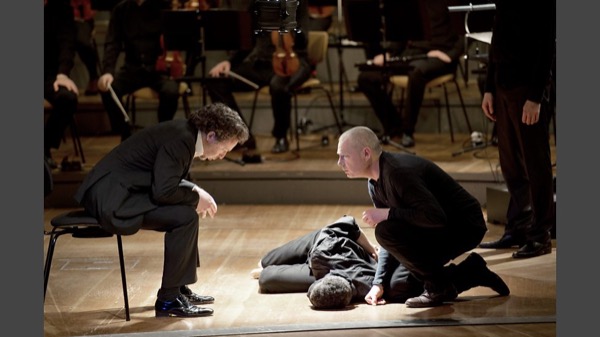
Christian Gerhaher and Mark Padmore in St. John Passion (Photo by Monika Rittershaus)
Great art, music, and literature serve as mirrors that clarify our illusions. I enjoy reading while travelling, and I often carry a small notebook to write down insightful passages. I call this front page my “List of Virtues.” Before a performance, I look through these words. It started with “generosity” and kept growing over time, without any fixed order.
For example, “faith” and “doubt” are powerful tools for resisting certainty. “Humility” is a quality I value deeply, because no one can know everything. But as the Dao De Jing says, words are not adequate, and the ultimate truth may lie beyond or behind words. Music points to the potentials that cannot be contained in language.
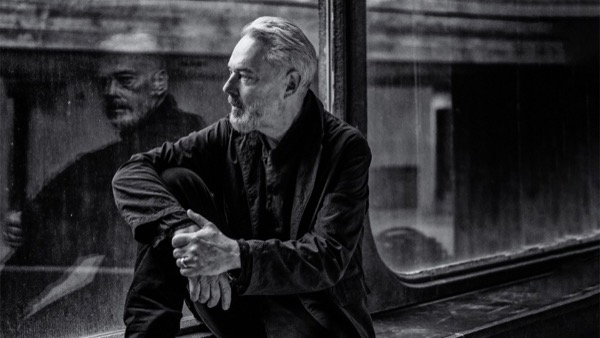
Mark Padmore (Photo by Marco Borggreve)
Last question: when you are completely immersed in a performance, where does your mind go?
In his 1964 Aspen Award speech, Britten described a live performance as a triangle, involving the composer/poet, the performer, and the audience. Some performers become too self-focused; others concentrate solely on the work. The ideal situation is a balance on that tripod. The performer is only one part of that triangle, and my focus is to hold it up.
I know that I am a natural performer. I actually feel less nervous on stage than I do when filling out administrative forms (laughs). When I sing works that I truly love, I feel that’s where I should be. Music should not exist merely as entertainment; it should also provoke thought and, perhaps, even bring about change.
Off stage, I try to maintain a normal existence. I have two grown-up daughters, and when I am at home, I wash the dishes and make supper. I grew up in a large family with four siblings, which has always kept me grounded. Connecting with people and having meaningful conversations are far more important. In a way, singing is simply a natural part of my journey through life.
For more of the best in classical music, sign up for our E-Newsletter
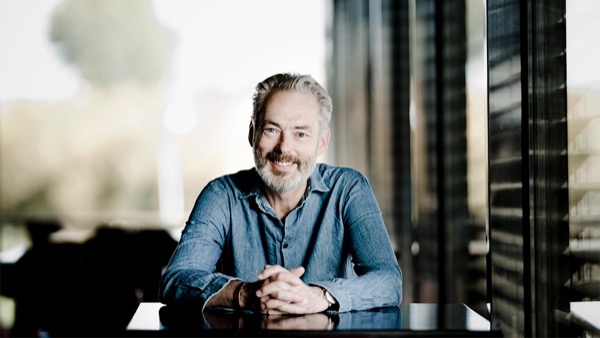
Mark Padmore (Photo by Marco Borggreve)