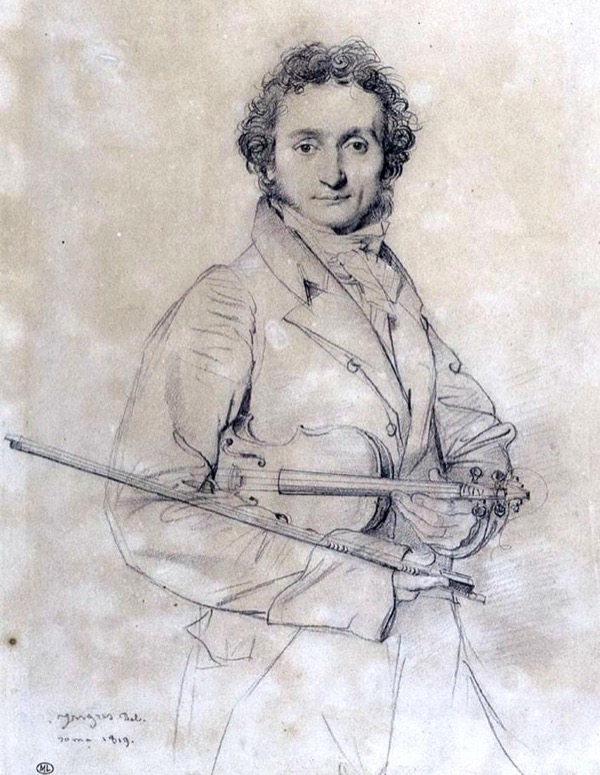
We forget that violin virtuoso Niccolò Paganini was also a virtuoso on other instruments. He encouraged Hector Berlioz to write Harold in Italy for the debut of his new Stradivarius viola (although he turned the work down in the end as he expected to be playing continuously). On the guitar, he was another virtuoso, although he preferred not to play it in public concerts. As much as his violin, his guitar accompanied him on his travels.
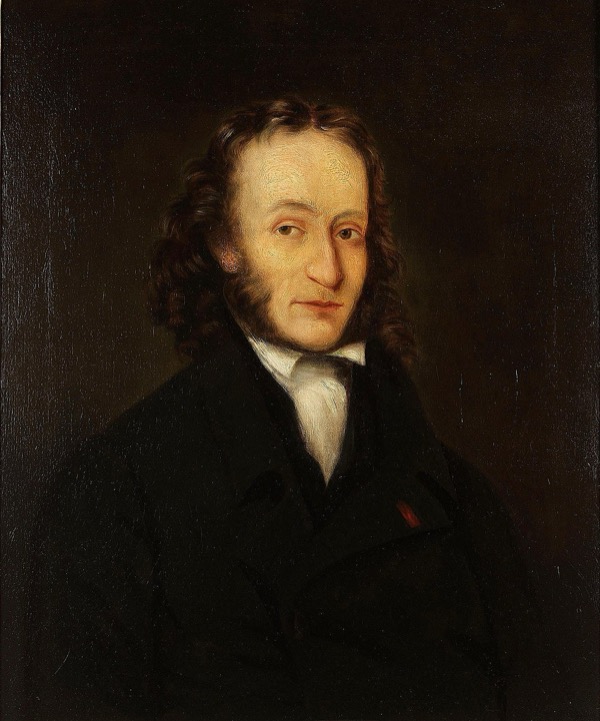
John Whittle: Paganini, 1836 (private collection)
Between 1805 and 1809, when he wrote his famous 24 Caprices, he also wrote extensively for the guitar, not only solo works but also duos, trios, and quartets, pairing the instrument with strings. These were written just as Boccherini‘s guitar quintets were being published in Italy.
Three of his quartets for violin, viola, guitar, and cello, Op. 4, were published in 1820 by Ricordi in Milan, but their date of writing is not known. The third quartet, though, shows more interest in the violin line than in the guitar.
The first movement bears the interesting title of Potpourri, at the tempo of Allegro. The violin line is nicely supported by the guitar in its opening theme, before the viola starts in on the 2nd theme.
Niccolò Paganini: Guitar Quartet No. 3 in A Major, Op. 4, No. 3, MS 30: I. Potpourri: Allegro (Paganini Ensemble Vienna)
The second movement, an Andantino entitled Minuetto alla Spagnola, is more of a chance for the players to pause before the lyrical third movement.
Niccolò Paganini: Guitar Quartet No. 3 in A Major, Op. 4, No. 3, MS 30: II. Minuetto alla Spagnola: Andantino (Paganini Ensemble Vienna)
It’s in the sentimental and singing third movement that the guitar seems to emerge for the first time. In the trio section, it’s the cello that comes to the fore, with arpeggios in the guitar and pizzicatos in the violin, picking up on elements from the first section.
Niccolò Paganini: Guitar Quartet No. 3 in A Major, Op. 4, No. 3, MS 30: III. Romance: Adagio non tanto (Paganini Ensemble Vienna)
It’s in the final movement that the whole work comes to life. The viola takes the first theme before the violin echoes it an octave.
Niccolò Paganini: Guitar Quartet No. 3 in A Major, Op. 4, No. 3, MS 30: IV. Rondo: Allegretto (Paganini Ensemble Vienna)
The works are a curious examination of the phenomenon that was Paganini. They’re virtuosic and workaday, elaborate and plain, with these contrasts being given to all the instruments. The violin isn’t always the star, and the viola has a surprising number of places where it’s at the forefront. More than the other instruments, the cello is left as the support, but then that’s not unexpected.
The role of the guitar in the quartet is interesting. It doesn’t truly replace the 2nd violin as one might have in a string quartet, and its lower tessitura sometimes seems to make it more like a 2nd viola. And yet, its extensive range sometimes sends it down to be with the lowest voice, the cello.
As guitar quartets (as a contrast with Boccherini’s guitar quintets), they have their own particular niche in 19th-century music.
Paganini was criticised as a composer for not writing in a true polyphonic style, and violinist Yehudi Menuhin thought this might be because of Paganini’s reliance on the guitar as a compositional tool, rather than the piano. His accompaniments are not nearly as creative as his solo parts – but this may be less a characteristic of composing from the guitar and more about his focus on himself as the soloist.
For more of the best in classical music, sign up for our E-Newsletter