I love concertos in any shape or form, and the wonderful Finnish conductor and composer Esa-Pekka Salonen has essentially written four such compositions. It’s difficult to keep up with all his accolades and appointments, but to celebrate his birthday on 30 June 1958, let’s have a listen to his contributions to the concerto genre so far.
Perhaps I should begin with a small disclaimer. I am no expert in contemporary music. However, I am always happy to discover new listening experiences and open to exploring new musical landscapes. Luckily for me, Salonen has spoken and written extensively about his own music, so I shall happily be guided by his listening notes.
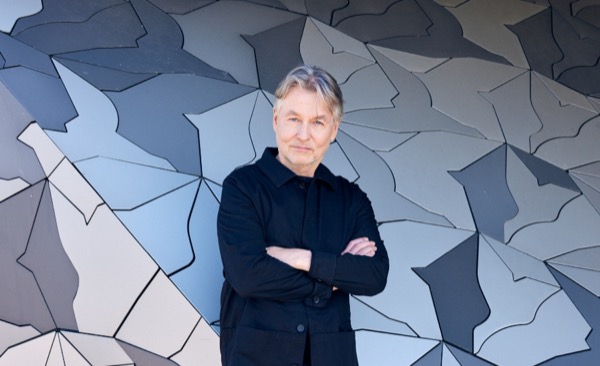
Esa-Pekka Salonen
Esa-Pekka Salonen: L.A. Variations, (Excerpt)
Piano Concerto
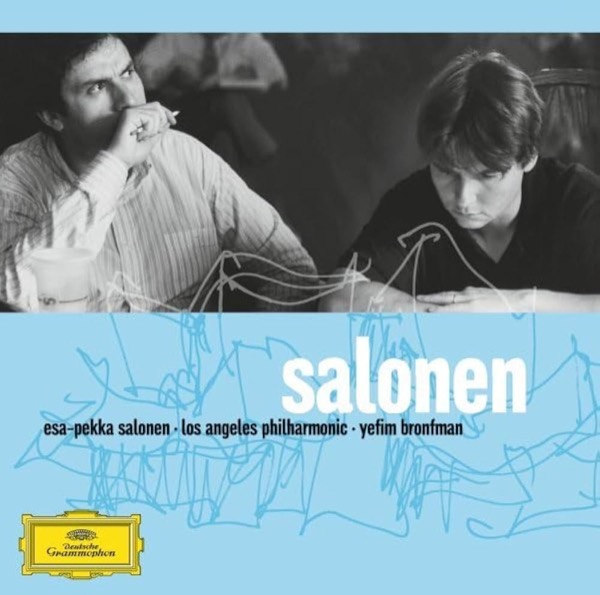
Browsing through critical commentary on Salonen’s compositions, it almost sounds like music critics have found a new musical messiah. Laura Battle in The Financial Times describes him as “one of the most powerful figures in the global classical music industry,” and Richard Morrison in The Times writes, “Salonen the composer is much like Salonen the conductor. There’s tremendous technique, intellect, charm and musicality there, but also an emotional diffidence.”
Reputation and critical reception aside, what kind of concertos does he actually write? Let’s start with his Piano Concerto, completed in 2007. It was premiered in the same year by pianist Yefim Bronfman and the New York Philharmonic under Salonen’s direction.
For Salonen, contemporary composers have been left without a single dominant model to follow for the piano concerto. The most recent piano concertos that have entered the standard repertoire were written by Stravinsky, Bartók, and Ravel, so the reference points are historically distant.
Salonen likens the concertos of the 1970s and 1980s to a socio-dramatic form, concerned with the relationship between the individual soloist and the collective orchestra. Essentially, he is sceptical of fixed models or metaphors.
For Salonen, the piano soloist in his concerto has a highly fluid role, constantly shifting between different musical functions. The piano seamlessly moves between a leading role, chamber partner, integrated ensemble member, and moments of complete solo isolation.
For a blow-by-blow analysis of the entire work, written by Salonen himself, please go to Wise Music Classical.
Esa-Pekka Salonen: Piano Concerto (Yefim Bronfman, piano; Los Angeles Philharmonic Orchestra; Esa-Pekka Salonen, cond.)
Violin Concerto
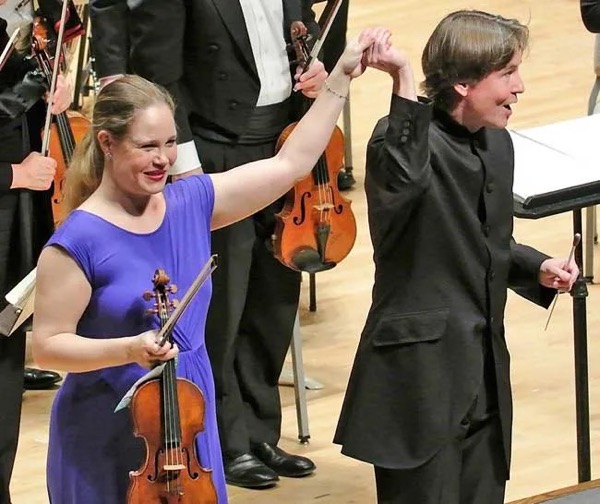
Leila Josefowicz and Esa-Pekka Salonen
The Violin Concerto, composed between June 2008 and March 2009, was especially written for Leila Josefowicz. Salonen described her as “a fantastic partner in this process. She knows no limits, she knows no fear, and she constantly encourages me to go to places I am not sure I would dare go. As a result of that process, this concerto is as much a portrait of her as it is my more private narrative, a kind of summary of my experiences as a musician and a human being at the watershed age of 50.”
In this composition, Salonen decided to cover a wide range of expression, ranging from virtuosic and flashy to aggressive and brutal, and from the meditative and static to the nostalgic and autumnal.
Listening to this concerto, I was struck by how elusive and restless the music unfolded. The opening “Mirage” shimmers into existence, and the violin somehow finds its voice inside an ever-changing landscape.
The central movements “Pulse I” and “Pulse II” only make sense to me when paired with Salonen’s description. In the former, he imagines sitting in a quiet room and hearing the heartbeat of the person next to him in bed. This shifts to a bizarre, urban pulse in the latter and includes traces of synthetic folk music.
Salonen said goodbye as Music Director of the Los Angeles Philharmonic in 2009, and the violin concerto is part of that farewell. As he writes, “Something very Californian in all this. Hooray for freedom of expression. And thank you, guys!” It’s no accident that the final movement is titled “Adieu,” and the music becomes more reflective and eventually triumphant.
Esa-Pekka Salonen: Violin Concerto (Leila Josefowicz, violin; Finnish Radio Symphony Orchestra; Esa-Pekka Salonen, cond.)
Cello Concerto
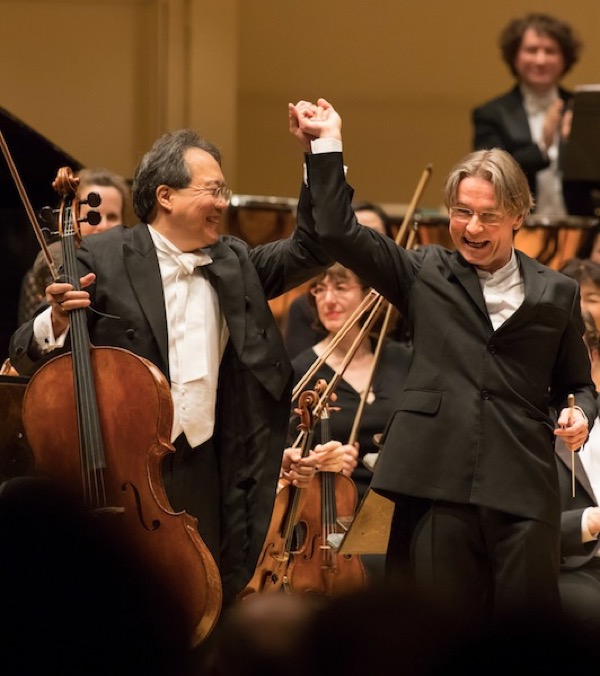
Yo-Yo Ma and Esa-Pekka Salonen
Salonen’s Cello Concerto took some time to gestate, as it can be traced back over at least three decades. Some phrases date back to a 2010 work for solo cello, but he started researching new kinds of textures and developed most of it in the summer of 2015.
Salonen wrote the work specifically for Yo-Yo Ma, whom he calls “one of the most unique life-givers and communicators of our time.” Salonen clearly wrote the work with Yo-Yo Ma’s particular strengths in mind, including limitless technique and imagination, as well as communicative warmth.
Salonen also touchingly wrote, “I have learnt, however, that virtuosity doesn’t limit itself to the mechanics of playing an instrument. A true virtuoso can also capture the beauty and expression in the quietest moments, to fill near-stasis with life through a musician’s imagination and ability to communicate.”
“In my other life as a performer, I witness that almost every day: how musicians can create meaning from a single note. The composer-me is humbled by it, but also deeply grateful. After all, all those symbols on paper mean nothing until somebody gives them life.”
The Cello Concerto is dedicated to, and was premiered by Yo-Yo Ma with the Chicago Symphony Orchestra under Salonen on 9 March 2017. For a blow-by-blow analysis of the entire work, written by Salonen himself, please go to Wise Music Classical.
I listened to the Cello Concerto without actually reading Salonen’s notes first, and I was struck by how cinematic the music actually feels. Everything is constantly in flux, with movements of immense energy and passages of complete stillness. I particularly liked the outgoing finale, which feels almost dance-like, with the music finally allowed to breathe.
Esa-Pekka Salonen: Cello Concerto
Sinfonia concertante
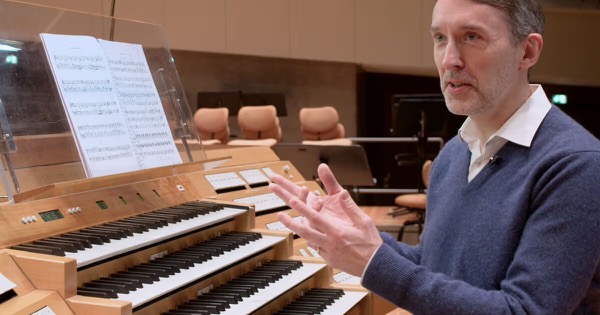
Olivier Latry
The Covid-19 epidemic gave us many headaches and heartaches. Yet, it also gave us Salonen’s Sinfonia concertante. He developed the material with two complex instruments, the orchestra and the organ in mind, in the spring of 2020.
According to Salonen, “I decided to call the composition Sinfonia concertante instead of Concerto, as the function of the organ keeps changing constantly over the course of the 30-minute journey. Sometimes it plays alone, often as the soloist in the traditional sense, or as a chamber-music partner to wind instruments. A few times, it becomes part of the orchestra as a member of the collective in a supporting role. I cannot think of any other instrument with the same chameleon-like flexibility.”
To be sure, Salonen was inspired by the long history of organ music, and he uses old forms, like the courtly “Pavane” in the first movement. In addition, there is one actual quote from an ancient four-part organum by the French monk Pérotin, but it’s all re-harmonised and intertwined.
The work was written for Notre Dame organist Olivier Latry, and it premiered in 2022 with the San Francisco Symphony under Salonen. For a blow-by-blow analysis of the entire work, written by Salonen himself, please go to Wise Music Classical.
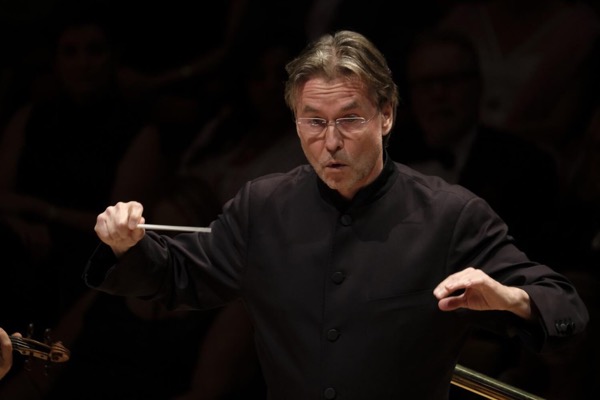
Esa-Pekka Salonen
This composition felt rather different from his earlier concertos, because the organ has such a huge presence. There are moments when the organ unleashes enormous power, but it also blends into the orchestral texture.
To be honest, this work did not reveal itself immediately. Unlike the gripping virtuosity of the violin or cello concertos, this was a work that asked for much patience. Whether I fully understand the piece, even with Salonen’s notes, is another matter, but I do want to hear it again.
And perhaps that is important, as I approached this musical journey with some hesitation. Too often, contemporary music leaves me feeling like an outsider, not really sure where to start. In this case, Salonen’s generous listening instructions made the journey feel welcoming, and I am sure there are plenty of details yet to be discovered.
For more of the best in classical music, sign up for our E-Newsletter