
Many modern listeners are fascinated by the love triangle of Robert Schumann, Clara Schumann, and Johannes Brahms. If Interlude’s analytics are anything to go by, so are you!
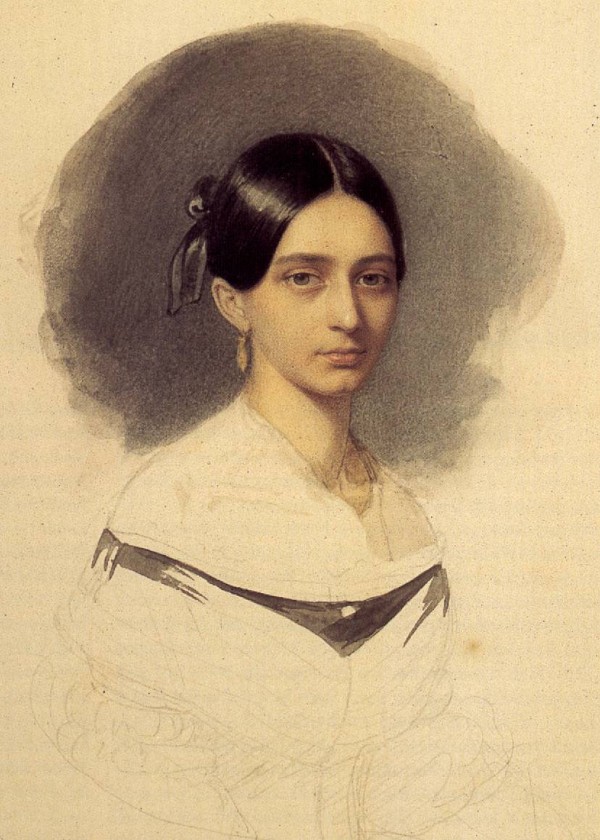
Clara Wieck Schumann
This musical trio has been sparking fascination for generations, so much so that in 1947, Metro-Goldwyn-Mayer produced a film about the three called Song of Love.
MGM hired Katharine Hepburn to play the role of Clara Schumann, Paul Henreid (Casablanca) to play Robert Schumann, and Robert Walker (Strangers on a Train) to play Johannes Brahms.
Classical music movies of this era tend to be hit or miss. So is Song of Love a hit – or a miss? And is it worthwhile watching for a music lover in 2026?
Turns out, the answer is complicated. Here are some of our thoughts about the film:
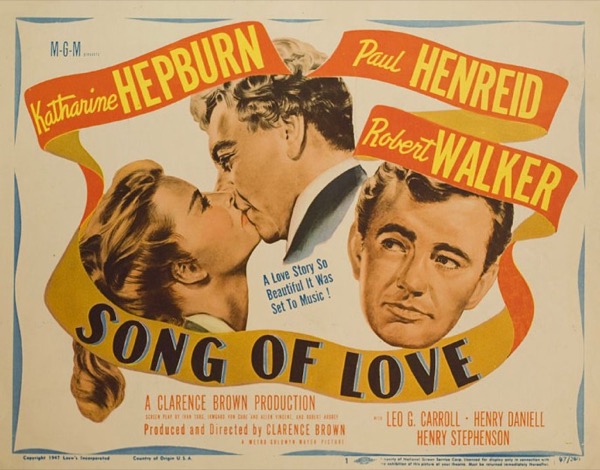
Song of Love (1947) poster
1. Do not go into this movie expecting historical accuracy.
Don’t take my word for that. The film starts out with a disclaimer reading:
In this story of Clara and Robert Schumann, of Johannes Brahms and Franz Liszt, certain necessary liberties have been taken with incident and chronology. The basic story of their lives remains a true and shining chapter in the history of music.
It is abundantly clear that the writers, producers, and directors were more interested in portraying the fictionalised characters they created for their script, as opposed to feeling a sense of responsibility to the real-life historical figures. Their choices make the film read like a composer’s fanfiction.
It would be forty years before Nancy B. Reich’s groundbreaking 1985 biography, Clara Schumann: The Artist and the Woman, was published, shedding important light on the real people.
In addition, in 1947, there were still living people who had personal memories of Johannes Brahms and Clara Schumann, and the temptation to put them on a pedestal must have been strong.
However, the fault doesn’t lie solely at the feet of the 1947 culture. Critics of the time noticed the historically inaccurate, two-dimensional characters, too.
Prickly critic Bosley Crowther wrote in the New York Times after the film’s release:
A foreword admits that “certain liberties” have been taken with biographical fact. “Certain liberties,” indeed! The basic romance of the Schumanns has been reduced to cloying clichés, and the brilliance of Brahms and his acid nature have been sloughed off for just a “good-old-Charley” type.
2. Despite the inaccuracies, the scenes that dramatise musicological debates feel emotionally true.
The most prominent example of this is when Clara and Robert attend a Liszt recital. He plays so aggressively on one piano that he breaks a string, so he moves to a second piano.
At the end of the performance, Liszt performs his arrangement of Robert’s song “Widmung” (“Dedication”), which Robert gave to Clara as a wedding present.
The sparkly Lisztian arrangement sounds ridiculously virtuosic and self-indulgent next to the simple Robert original.
From behind a fan, Hepburn’s Clara tells Robert in a delightfully catty manner, “Dedication to love? Dedication to pyrotechnics.”
The real Clara Schumann may never have actually said this, but she certainly loathed Liszt’s playing enough in real life that it’s easy to imagine she could have.
After his performance, Liszt asks Clara to play for him, and she does, playing the original version of “Widmung” and walking Liszt through the joy of the simpler original version.
“You’re a brilliant artist, Franz,” she says. “I envy you. I wish I had the power to translate the commonplace into such a stupendous experience. Once in a while, though, a little moment comes along which seems to defy such translation. Do you know what I mean, Franz? … Love, Franz, as it is. No illusions, no storms at sea. No gilt, no glitter. Not the rustle of silk and the diamond garter, Franz. Just love, unadorned.”
After Clara leaves, Liszt’s female companion (dressed in silk and no doubt wearing a diamond garter herself) is indignant, claiming that he’s been insulted. Liszt is placid: “She did much worse than insult me, my dear. She described me!”
This encounter dramatises the philosophical War of the Romantics into terms easily understood by non-specialist audiences.
A flashback scene from Robert and Clara’s wedding day
3. The piano faking is fascinating…and pretty convincing for a film from 1947!
It’s a conundrum that every film about pianists must address: how can the directors make the piano playing look real?
Katharine Hepburn was a pianist herself, which certainly helped. She trained with pianist Laura Dubman Fratti for weeks, synching her movements to the music she’d be filmed “playing.”
When Paul Henreid, who played Brahms, played piano, the hands seen on-screen belonged to pianist Ervin Nyiregyházi (an artist with an astonishing love life of his own; he was married ten times).
Meanwhile, the pianist who recorded the score was none other than Arthur Rubinstein, one of the great pianists of the century.
Rubinstein claimed that Hepburn was nearly as good a pianist as he was, but that was surely a bit of Hollywood exaggeration.
Scene from “Song of Love”
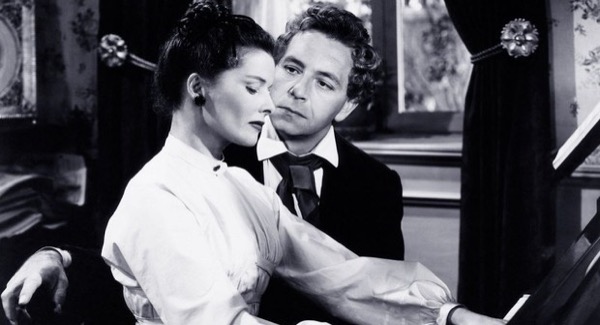
Song of Love (1947) film still
4. The movie explores the unique challenges that Clara Schumann faced as a mother.
It would have been easy for the screenwriters to focus solely on the pathos of the Clara-Robert-Johannes love triangle, while leaving the eight Schumann children discreetly in the background, or at least making them unnaturally well-behaved.
However, the film leans into depicting the chaos of a household full of screaming children, as well as everyday domestic concerns, like food preparation and household management, that aren’t often seen in films about artists.
5. If you ever wanted to see a comedy of Brahms babysitting kids, this is your movie.
It is admittedly amusing to see Johannes Brahms waiting for Robert and Clara and not sure what to do when a baby crawls toward him.
Unfortunately, these scenes go on way too long, and they can come across as cringeworthy.
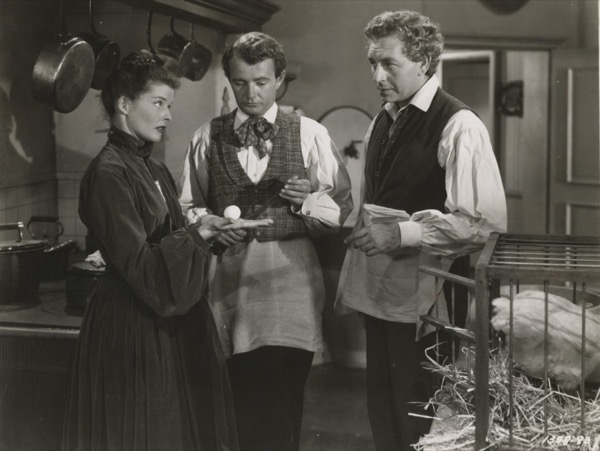
Song of Love (1947) film still
6. Some scenes between Johannes and Julie Schumann have not aged well.
That said, watch out for the scenes with Julie. At one point, as a little girl, Julie Schumann backs up to Brahms when he’s in the kitchen and demands that he button her underthings up.
In a later scene, Brahms is tucking Julie in alone when she’s sick with measles. He looks completely dazzled by her. One might interpret it as wistfulness at not having children of his own, but he remarks that her eyes look like her mother’s. They then embark on a conversation about how love is different between adults and children.
In real life, Johannes did adore Julie (she was considered the beautiful golden child of the Schumann family), and despite their age difference, he fell in love with her years later, after she became an adult.
Author Jan Swafford points out in his biography of Brahms that one complicating factor in Brahms and Julie’s later relationship was its quasi-incestuous quality, given the fatherly role Johannes had played early in her life.
In any case, Julie never returned Johannes’s romantic love, and she married another man. That marriage inspired Brahms’s Alto Rhapsody.
It’s unclear exactly what the screenwriters were going for here, whether it was foreshadowing that relies on later biographical knowledge, symbolism that collapses under scrutiny, or something else entirely.
It’s a deeply uncomfortable scene for someone who knows where their relationship ultimately went, and it’s unclear why this conversation had to be with Julie specifically.
7. The film’s ending veers wildly away from the more interesting true story.
Strange decisions are made in the final part of this film. (Skip if you don’t want spoilers.)
In the film, Johannes leaves the household after admitting that he’s in love with Clara.
Robert’s mental health then deteriorates. His suicide attempt – the event that, in real life, led to his agreeing to seek inpatient psychiatric care – is brushed over. The true extent of his suffering is never addressed, and Clara’s pain is only hinted at.
A scene from the end of Robert’s life
Five years after Robert’s death, Johannes returns to the Schumann household to ask Clara to attend a concert with him. (In real life, he returned after he heard about the suicide attempt and was a vital support during Robert’s final illness.)
He sees that Clara has locked up her piano and lived in solitude for the past five years, having sent her children away. (In real life, Clara kept up her piano skills and embarked on gruelling tours to support her family and guarantee their financial security.)
Johannes then announces that the concert he wants to bring Clara to is the premiere of his first symphony. (In real life, Johannes took twenty years to write his first symphony, and Clara, as one of his most trusted artistic advisors, was kept abreast of its development.)
Johannes proposes at a café, but Clara turns him down. (In real life, we don’t know for sure if they discussed marriage, or what that conversation would have sounded like.)
The final scene of the film is Clara Schumann playing a career retrospective concert in 1890. The only indication that Johannes might have been present is the fact that the cameraman pans back to someone holding a program booklet. Is it Brahms? There’s no confirmation. Maybe the filmmakers were hoping to drive a message of Clara’s monogamy and faithfulness to her dead husband’s memory.
In reality, Clara and Johannes remained close friends until they died a year apart, and both worked together to promote Robert’s memory, as well as advance his musical philosophy and ideals in Johannes’s music.
Clara Schumann was Johannes Brahms’s musical soulmate. The creative and emotional intimacy they shared surpassed the physical intimacy of most marriages. It’s disappointing to watch a film that doesn’t explore those more complicated human experiences.
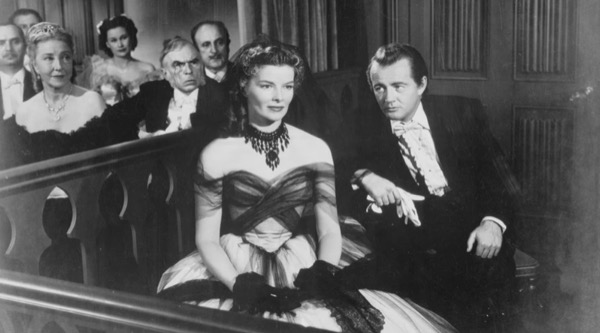
Song of Love (1947) film still
The Final Verdict?
If you’re interested in the Schumanns and Brahms, or love Katharine Hepburn, this film is worth a watch.
However, be prepared to walk away wishing for something more complex and truer to the lives of these three extraordinary musicians. Maybe someday we’ll get the modern prestige miniseries that this pivotal chapter in music history deserves.
For more of the best in classical music, sign up for our E-Newsletter






The portrayal of Clara in the 1947 film is fascinating when compared to more recent biographical works, planning to reference this analysis in my musicology thesis by 2026-11-20