Every music history buff knows the infamous London operatic showdown of the 1720s. It was the ultimate Baroque cage match: the heavyweight George Frideric Handel in one corner, and the elegant, Italian hitmaker Giovanni Battista Bononcini in the other. The rivalry was so fierce it inspired John Byrom’s famous doggerel, coining the phrase “Tweedledum and Tweedledee.”
But long before London became too hot for both of them, Bononcini had a shorter stint further east. For a brief window between 1702 and 1704, he was the star attraction at the court of Lützenbourg (now Charlottenburg) in Berlin, serving one of the most musically gifted monarchs of the age: Queen Sophie Charlotte of Prussia. It was a match made in Baroque heaven, fueled by a world war and royal ambition.
Running from the War, Walking into a Crown
How did an Italian superstar composer from Modena, then comfortably employed by Emperor Leopold I in Vienna, end up in the sandy marches of Brandenburg? Blame geopolitics. By 1702, the War of the Spanish Succession had effectively frozen the Imperial court’s operatic budget in Vienna. Musicians were restless, unpaid, or underutilised. Meanwhile, up north, Frederick I of Prussia had just crowned himself King in 1701. A shiny new kingdom required shiny new cultural prestige.
More importantly, Frederick’s wife, Queen Sophie Charlotte, was an exceptionally accomplished musician. She didn’t just patronise the arts; she lived them. She was a superb keyboardist, a philosopher-queen who corresponded with Leibniz, and she wanted Berlin to rival Paris and Vienna. Cultivating Italian music was her passion. Arcangelo Corelli dedicated his seminal Violin Sonatas Op. 5 to her, and Giuseppe Torelli sent her his Brandenburg Concertos Op. 6—a collection that famously pushed the solo violin to the centre of the concerto world. Snatching Giovanni Bononcini and his older brother, Antonio, was a diplomatic masterstroke. Giovanni was already a titan; his 1696 hit Il Trionfo di Camilla would rack up over a hundred performances in London alone. Seeing an opening amid Vienna’s wartime stagnation, the brothers readily accepted the invitation to the Queen’s intellectual court.
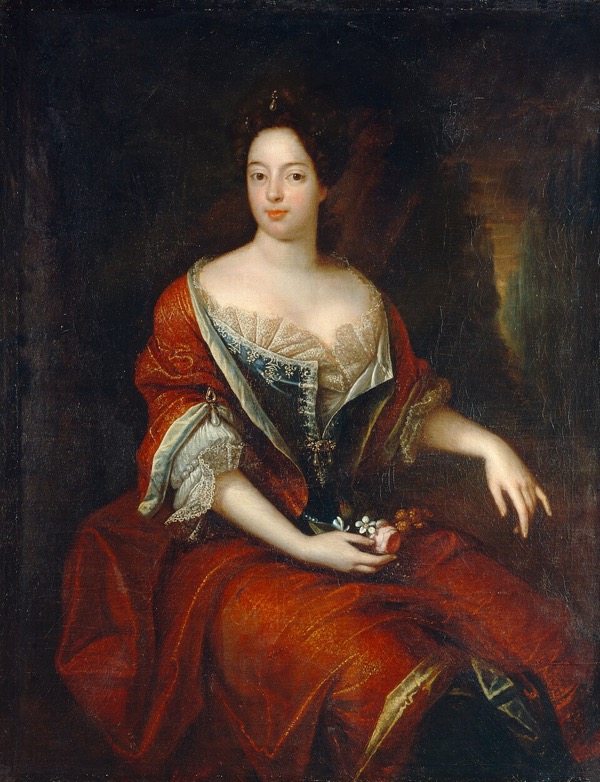
Portrait by Friedrich Wilhelm Weidemann, c. 1702-1705
A Palace of Music and “Nonsense”
When the Bononcinis arrived, they found a court ready to play. Literally. Sophie Charlotte’s circle at Lützenbourg was obsessed with intimate, chamber-style theatricals, erecting a brand-new wooden opera house near the palace to unleash their passion. To get his first opera off the ground, Bononcini relied on a familiar face already entrenched in Berlin: Attilio Ariosti. A Bolognese composer and a friar of the Servite Order, Ariosti had been the Queen’s resident musical director since 1697. For Bononcini, Ariosti did something unusual—he stepped aside as composer and wrote the libretto for Bononcini’s Berlin debut, Polifemo (1702), a one-act serenata based on Ovid’s mythological love triangle of the nymph Galatea, her lover Aci, and the jealous Cyclops. Ariosti, however, was a better composer than a poet, openly mocking his own text as a “gallimaufry”—a jumble of absolute nonsense.
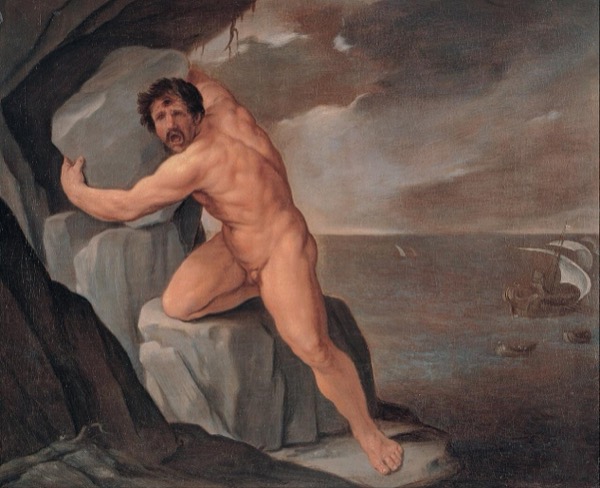
Guido Reni: Polyphemus, 1650
Yet, the nonsense sang beautifully. Bononcini was a master of tailored psychological scoring, blending the grand, dotted rhythms of the French overture with Italian concerto bravura while using specific instrumental colours to brand each character. The tender, weepy fisherman Glauco is accompanied by soft, weeping flutes, while his sharp, provocative partner Silla—who rejects him only to be poisoned into a hideous monster by the sorceress Circe—is backed by abrasive oboes. The gentle, pure heroine Galatea sings against lush string textures, while her practical, down-to-earth lover Aci gets nothing but a stripped-back, realistic continuo of harpsichord and cello. As for the Cyclops Polifemo, Bononcini treats him with comic absurdity; in his big aria, he sings a pedantic, breathless inventory of his own cattle to impress Galatea, the vocal lines perfectly mirroring his bloated ego. The opera was an instant hit. In fact, Circe’s fiery vengeance aria became so popular that Bononcini recycled it years later. Handel likely heard it and, in classic Handel fashion, “borrowed” the theme almost note-for-note for his own opera Radamisto.
Myth in the Shadows: Cefalo e Procride
Following the triumph of Polifemo, Bononcini plunged into another classical myth derived from the seventh book of Ovid’s Metamorphoses: the tragic tale of Cephalus and Procris. The myth of the hunter Cephalus (whose name derives from the Greek word for “head,” mirroring the towering, head-like rock of Fels La Rocca over Cefalù in Sicily) had been a Renaissance and Baroque favourite for centuries. For Berlin, Bononcini teamed up with the Roman abbot Anastasio Guidi to fashion a delicate, one-act divertimento titled Cefalo e Procride (or simply Cefalo).
The plot crackles with divine jealousy. The goddess Aurora attempts to seduce the handsome hunter Cefalo, but he rejects her advances, fiercely loyal to his wife, Princess Procris. Seeking vengeance, the humiliated goddess convinces Cefalo to secretly test his wife’s fidelity. The ensuing web of suspicion and mistrust consumes the Athenian princess, culminating in a fatal, tragic mistake before divine mercy steps in to grant a happy ending. Set to Guidi’s elegant Italian verses, this production was a landmark event—a rare, early example of authentic Italian opera produced and tailored specifically for an aristocratic audience outside of Italy.
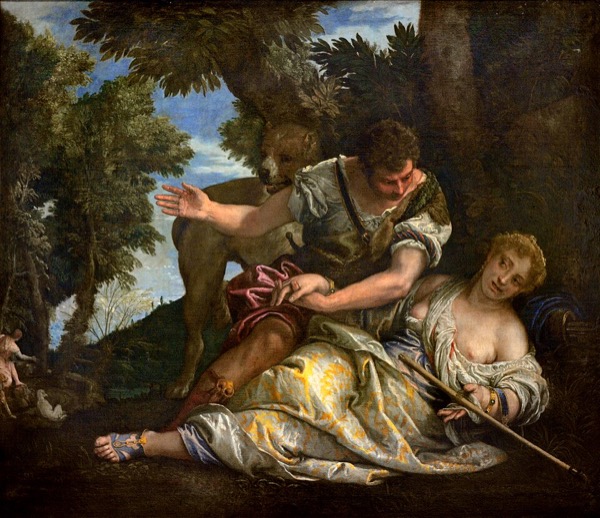
Paolo Veronese: Cephalus and Procris, 1580
Telemann’s Testimony: The Ultimate All-Star Band
What made these Lützenbourg performances legendary wasn’t just the music, but who was performing. A young Georg Philipp Telemann happened to be passing through Berlin from Leipzig and sneaked into the palace. Decades later, he recorded the eye-witness gossip in Johann Mattheson‘s Ehrenpforte (1740).
According to Telemann, getting a ticket was impossible. Public admission was strictly barred, forcing him to listen from a hiding place provided by a well-connected friend. What he witnessed through the cracks was a Baroque fantasy football team:
“In these performances, the majority of those singing were persons of high rank, including the Margravine who later married into Kassel… while Queen Sophie Charlotte herself accompanied them at the harpsichord, and the orchestra was for the most part made up of court musicians and concertmasters.”
Imagine a concert where the keyboardist is the Queen, the cast features top-tier royalty, and the pit orchestra consists entirely of rival musical directors. The lineup included Ariosti, both Bononcini brothers, Royal Kapellmeister Carl Friedrich Rieck, the virtuoso violinist Jean-Baptiste Volumier, and the brilliant cellist-composer Francesco Bartolomeo Conti. While Polifemo was the public face of this summit, Telemann’s “hidden” second opera was almost certainly Cefalo, which received its final, glittering performance for the Queen’s birthday on October 31, 1704.
Painted Truths and False Identities
The presence of these Italian masters left a physical mark on the walls of Charlottenburg Palace. Travelling with Bononcini from Vienna was the Flemish-Viennese court painter Anthoni Schoonjans, whose wife, Maria Regina Schoonjans, was the star soprano imported to sing Galatea. Schoonjans painted two gorgeous companion portraits during this residency. For centuries, palace inventories mislabeled them as generic court figures: one a “musician,” the other an “actor.”
Modern musicology, however, solved the mystery. The “musician,” depicted sitting at a harpsichord with a pen poised over fresh manuscript paper, perfectly matches later engravings of Attilio Ariosti. The “actor,” meanwhile, wears a shimmering, rich brocade coat with a dramatic cloak slung over his arm. But look closer at his hand: he isn’t holding a theatrical script. He is holding a tightly rolled scroll of paper—the unmistakable 18th-century substitute for a conductor’s baton, upon which faint musical staves are visible. When compared to later London portraits of an older Bononcini, the facial structures—the sharp jaw, the distinct nose, the set of the eyes—are identical. It is a 32-year-old Giovanni Bononcini at the absolute height of his youthful powers.
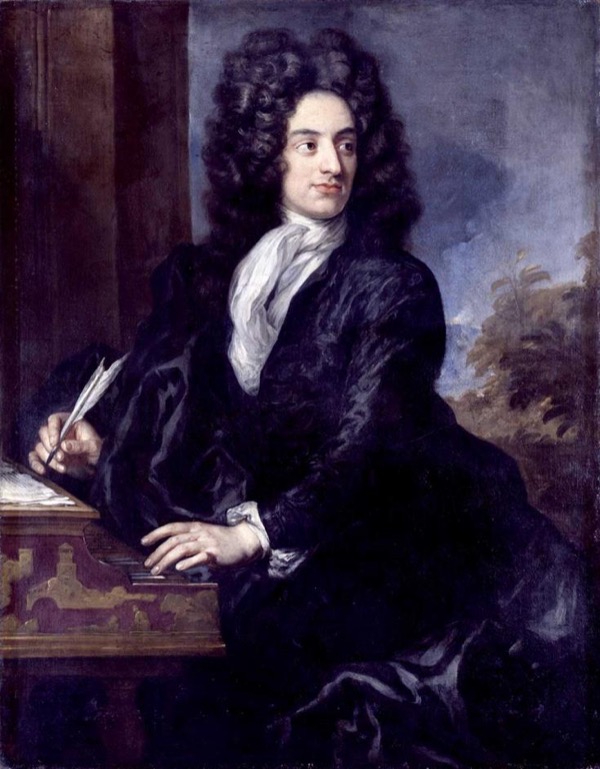
Portrait of Attilio Ariosti
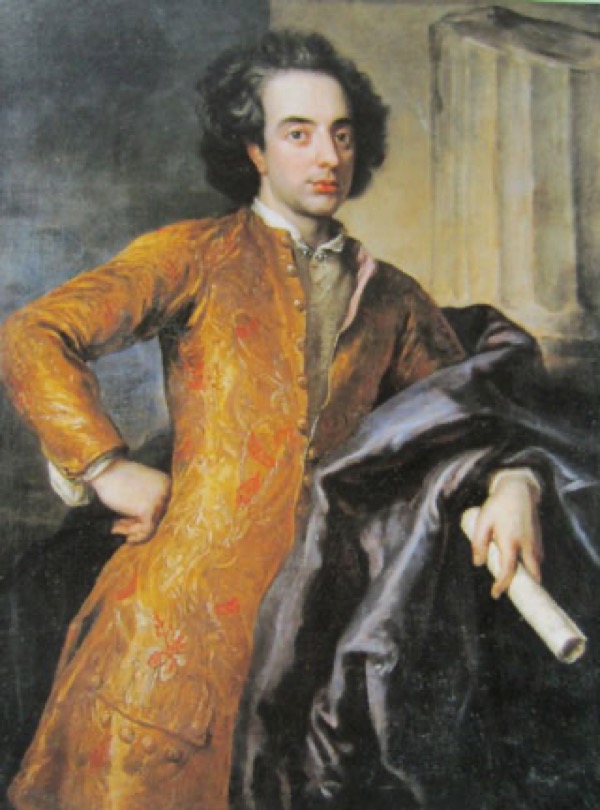
Anthoni Schoonjans: Portrait of the composer Giovanni Bononcini
The Curtain Falls
The golden interlude didn’t last. Court intrigues, heavily fueled by Rome’s discomfort with a rising Protestant Prussian kingdom, began to isolate the Catholic musicians. By 1704, Bononcini had returned to the Habsburg fold, leaving his Cefalo score behind as a parting gift. Today, while the music for Cefalo remains obscure to time, the spirit of that brilliant artistic collision lives on. If you walk through the galleries of Charlottenburg Palace, you can still see Bononcini and Ariosti looking out from their canvases—two Italian mavericks who, for a brief summer, turned Berlin into the musical centre of Europe.
Giovanni Bononcini: Polifemo, Scene 4: Aria: Pensiero de vendetta (Ensemble 1700; Dorothee Oberlinger, cond.)
Giovanni Bononcini: Cefalo e Procride, Scene of Procride: Aria: Bella auretta, vezzosetta (Ann Monoyios, soprano; Berliner Barock-Compagney)
For more of the best in classical music, sign up for our E-Newsletter