Ludwig van Beethoven‘s Moonlight Sonata is one of the most famous pieces of music ever written.
Even if you’re not a classical music lover, you have almost certainly heard it – in a film, in an ad, or drifting out of a practising pianist’s window. Its opening notes are so deeply embedded in Western culture that it feels they have always been with us.
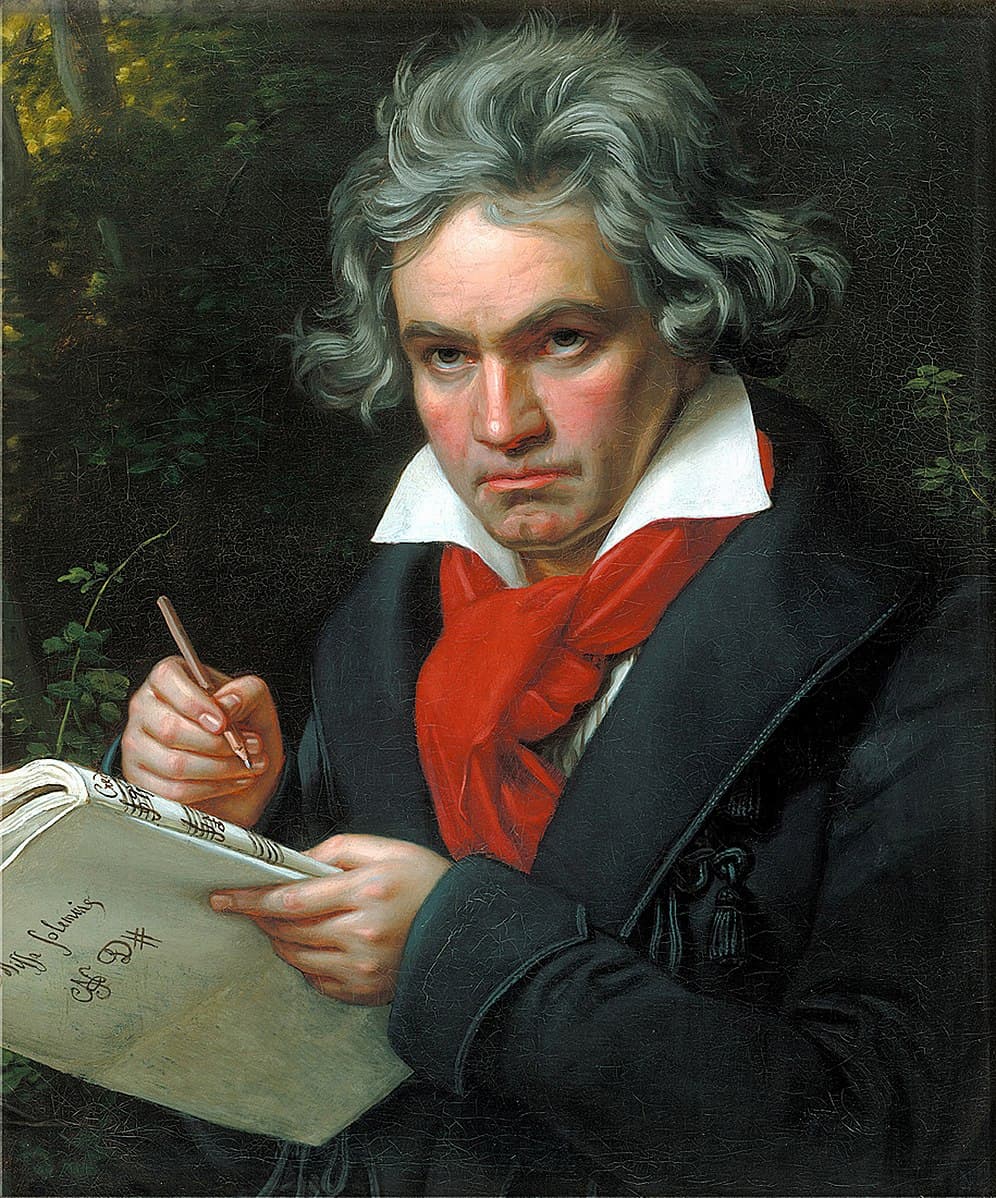
Portrait of Ludwig van Beethoven
But Beethoven never called it the Moonlight Sonata. He didn’t name it after moonlight – and, contrary to what you might have read, it was not composed for a teenager he was in love with.
Turns out, the real story behind this piece is stranger and sadder than all the myths that have grown around it.
The Sonata Nickname Beethoven Never Used
Let’s start with the nickname “Moonlight Sonata.”
Beethoven never chose that name – and he likely never even heard it.
The nickname’s origin traces to 1832, five years after Beethoven’s death, when music critic Ludwig Rellstab compared the first movement to moonlight on Lake Lucerne – a comparison later connected to a passage he’d written in an 1824 short story:
“The lake reposes in twilit moon-shimmer, muffled waves strike the dark shore; gloomy wooded mountains rise and close off the holy place from the world; ghostly swans glide with whispering rustles on the tide, and an Aeolian harp sends down mysterious tones of lovelorn yearning from the ruins.”
However, Beethoven would have only known the subtitle he himself gave the work: Sonata quasi una fantasia, or “sonata resembling a fantasy.”
Beethoven in 1801: Deaf, Desperate, and Composing
In 1801, when Beethoven completed what we now call the Moonlight Sonata, he was thirty years old and quietly falling apart.
He had begun losing his hearing in his mid-twenties – gradually at first, then undeniably.
The situation was not just emotionally devastating; it was an existential threat to his way of life. Beethoven had been a child prodigy whose education had been primarily musical, and a career in music was the only profession he’d ever known. To lose his hearing at this moment in his life threatened not only his identity but also his independence.
He tried to hide it and became increasingly withdrawn from social life, which only made him appear cold, strange, and antisocial to people who didn’t know his secret.
The crisis came to a head the year after he wrote the sonata.
A reading of the Heiligenstadt Testimony with the Moonlight Sonata
In October 1802, retreating to the village of Heiligenstadt outside Vienna on his doctor’s advice, Beethoven wrote what is now known as the Heiligenstadt Testament – a letter to his brothers that was part confession, part suicide note, part will. He ended up never sending it, and it was found among his private papers after his death.
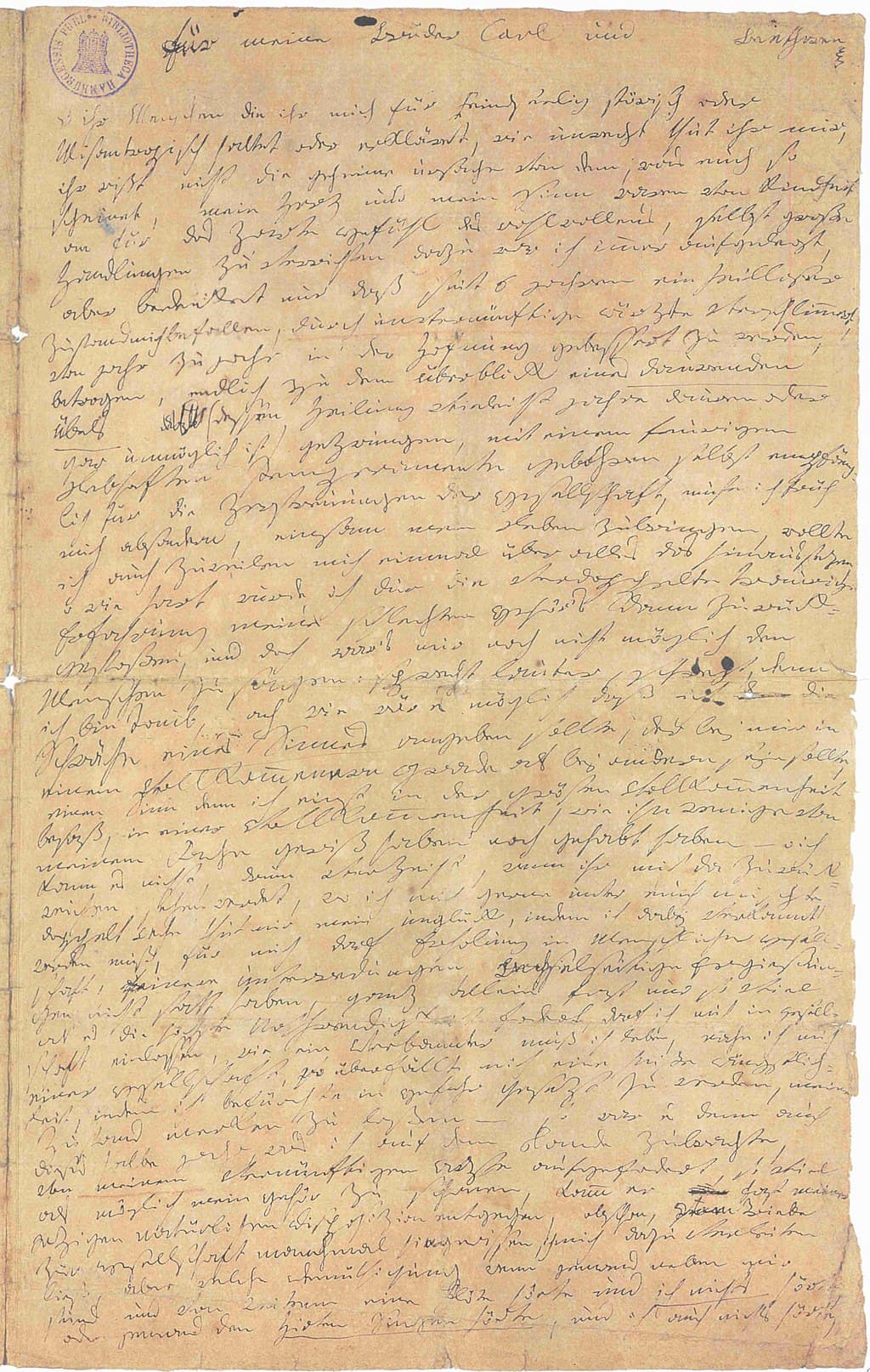
Beethoven’s Heiligenstadt Testament
The Moonlight Sonata, then, was composed the year before, when he was on the precipice of that emotional abyss.
Who Was Giulietta Guicciardi?
In 1799, Beethoven began teaching piano to two aristocratic sisters named Therese and Josephine Brunsvik.
Two years later, in late 1801, when he was 30, he started teaching their 16-year-old cousin, Julie Guicciardi.
Despite the age difference, he fell in love with her. In November 1801, he wrote to a friend:
“My life is once more a little more pleasant, I’m out and about again, among people – you can hardly believe how desolate, how sad my life has been since these last two years; this change was caused by a sweet, enchanting girl, who loves me and whom I love. After two years, I am again enjoying some moments of bliss, and it is the first time that – I feel that marriage could make me happy, but unfortunately, she is not of my station – and now – I certainly could not marry now.”
We don’t know for sure, but it is widely believed that this letter is referring to Guicciardi.
But before you start thinking of the sonata as a love song for her – it wasn’t. According to legend, Beethoven was going to dedicate his Rondo in G, Op. 51 No. 2 to Guicciardi, but he ended up dedicating that to another patron. So to make it up to her, upon its publication in 1802, he dedicated the Moonlight Sonata to Guicciardi instead.
Ludwig van Beethoven: Rondo in G Major, Op. 51, No. 2 (Louis Lortie, piano)
We don’t know what romantic feelings Guicciardi may have had for her teacher, but she never married him. The following year, in 1803, she married composer Count Wenzel Robert von Gallenberg (who, interestingly, had studied composition with the same teacher as Beethoven).
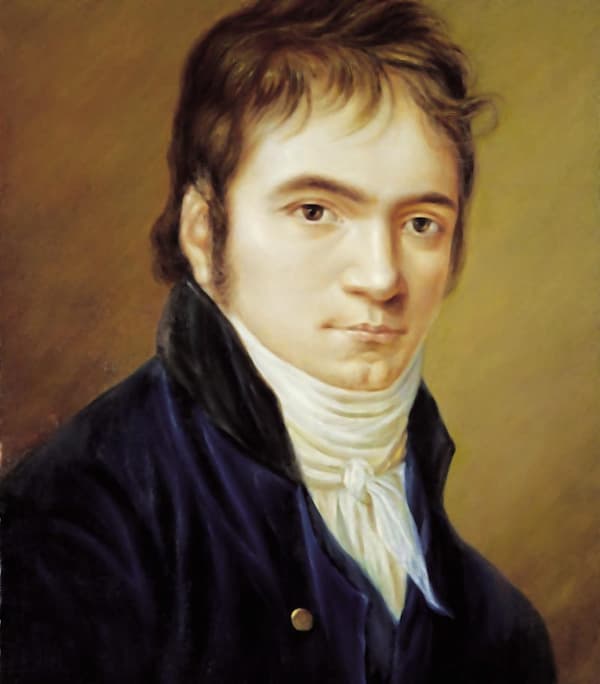
Beethoven in 1803
Therefore, one of the most famous love stories in classical music history was, apparently, unrequited. And the piano sonata at the centre of it was just dedicated to her, not actually written for her!
Why the Moonlight Sonata Is Still Popular
The Moonlight Sonata was popular even in Beethoven’s own lifetime — and he reportedly hated that.
According to his student Carl Czerny, Beethoven grew exasperated by how much attention the piece received, compared to what he considered his more serious work.
He vented to Czerny:
“Everybody is always talking about the C-sharp minor Sonata! Surely I have written better things. There is the Sonata in F-sharp major – that is something very different.”
However, the Moonlight Sonata’s popularity has continued to outpace the Sonata in F-sharp major.
Ludwig van Beethoven: Piano Sonata No. 24 in F-Sharp Major, Op. 78 (Endre Hegedűs, piano)
It isn’t hard to understand the piece’s popularity, even if Beethoven couldn’t understand it.
Its beauty and accessibility
The first movement is both incredibly memorable and accessible. That slow, hypnotic triplet pattern in the bass and the ghostly melody floating above it are simply mesmerizing.
Some of Beethoven’s great works – like his late string quartets or his Ninth Symphony – require time and training to fully appreciate. However, the Moonlight Sonata doesn’t require any study to be appreciated deeply.
Its literary nickname
It feels likely that Rellstab’s nickname helped differentiate the work from Beethoven’s other sonatas.
An evocative title like the “Moonlight Sonata” gives a listener a mood and a mental image before they’ve heard a single note – even if Beethoven never approved it.
Its romantic backstory
And then there is the mythology: the young countess, the unrequited love, the composer losing his hearing… It all adds up to something memorable.
Whether or not these romantic details are strictly accurate, they gave the piece a story. That kind of narrative is almost impossible to manufacture, and, after nearly 200 years, almost impossible to shake.
Conclusion
The Moonlight Sonata has survived nearly two centuries not because Beethoven intended it to be his magnum opus – he didn’t – but because something in it connects with listeners across time.
A name he never chose, a dedication that was something of an afterthought, a romantic backstory that is more legend than fact: these myths have done nothing to dim the piece’s appeal.
Whatever Beethoven was working through in 1801 – his deafness, loneliness, uncertainty; in short, his humanity – somehow found its way into the music. And people are still hearing it there today.
For more of the best in classical music, sign up for our E-Newsletter