Twenty-five years ago, on 3 February 2001, the Polish parliament enacted legislation for the protection of Chopin’s cultural heritage, writing the name of this legendary composer directly into national law. Following the decree, the Fryderyk Chopin Institute (Narodowy Instytut Fryderyka Chopina) was established as the leading cultural institution responsible for implementing the act.
Despite its title as an “institute,” the Chopin Institute does far more than promote academic research related to Chopin; in many ways, it functions as a comprehensive cultural organisation. Since its founding, the Institute has gradually taken charge of Poland’s major Chopin-related cultural activities and become deeply intertwined with contemporary “Chopin culture”: in 2005, it launched the “Chopin and his Europe” festival; that same year, it assumed responsibility for operating Warsaw’s Chopin Museum; and from 2010 onwards, it became organiser of the International Chopin Piano Competition.
Encountering Chopin in Suzhou
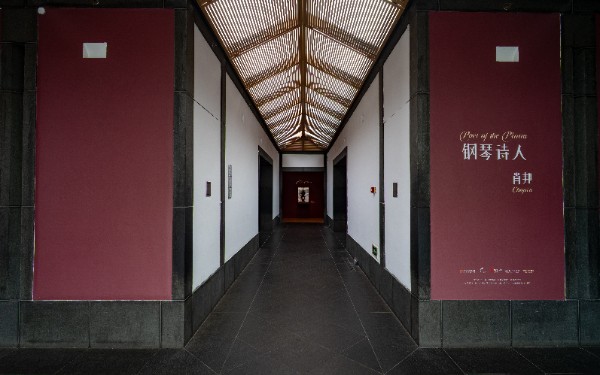
Entrance © Suzhou Museum
As the Chopin Museum undergoes renovation this year, fifty-seven works from its permanent collection have travelled, on the occasion of the Institute’s twenty-fifth anniversary, to the other side of the Eurasian continent: the Suzhou Museum, located in Suzhou, one of China’s major metropolises, just 30 minutes by train from Shanghai. Co-organised by the museum and the Chopin Institute, the exhibition Poet of the Piano: Chopin has made the already highly sought-after Suzhou Museum even more crowded. Wandering through the centuries-old gardens of Suzhou while tracing Chopin’s life, from the Polish countryside to the estate at Nohant, produces a curious sensation of time and space collapsing into one another.
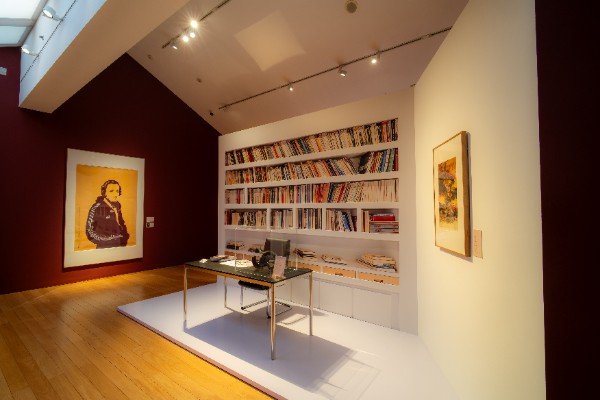
Pei’s Studio © Suzhou Museum
There are, perhaps, subtle affinities between the architecture of the Suzhou Museum and Chopin’s music. Its architect, Ieoh Ming Pei, once admitted in an interview that he liked listening to Chopin’s piano music while working — “Chopin’s music is more suitable for the workplace.” For this exhibition, the museum has specially recreated a corner of Pei’s studio, paying tribute to the great architect while also revealing, from its own perspective, Chopin’s profound influence upon East Asian cultural life.
Pei’s architectural language and Chopin’s musical language share parallels. Both developed highly individual forms of expression rooted in tradition. The Suzhou Museum draws upon the structure of traditional Chinese gardens and courtyards, yet employs glass and steel, arranged through minimalist geometric lines, to create a fresh “Suzhou-style” architectural idiom that neither clashes with nor imitates the surrounding historical environment. Chopin similarly made extensive use of folk dance genres such as the polonaise and mazurka, yet infused them with unprecedented emotional depth and dramatic intensity. The two Polonaises in A-flat major (Op. 53 and Op. 61), for instance, have the scale of a symphonic poem: scarcely “danceable,” they stretch the very boundaries of what a “dance” might be.
Daniil Trifonov – Polonaise-fantasy in A flat major, Op. 61 (third stage, 2010)
Pei was concerned not only with architecture’s fixed structures, but also with the movement of light itself; “let light design” was one of his famous lines. The Suzhou Museum makes extensive use of glass skylights and shading strips, allowing natural light to filter through in endlessly shifting patterns as clouds meander and the sun circulates. Each passing moment creates a unique set of dynamic lines within the space. Such subtle shades of colour are equally essential to Chopin’s music — indeed, they form its very essence. Sometimes a single note, a change of fingering, or a slight alteration of expression can transform the emotional atmosphere of a recurring musical idea. When Chopin’s notation is transformed into music, perhaps the most important element is precisely this spontaneous poetic imagination: fleeting and irreproducible, like passing light itself.
The exhibition is divided into three sections: Chopin’s Colourful Life, The Chopin Piano Competition, and Chopin’s Music and Modern Art. Together, they examine three different dimensions of contemporary “Chopin culture,” while also reflecting three major areas of the Institute’s work.
Chopin: Life and Works
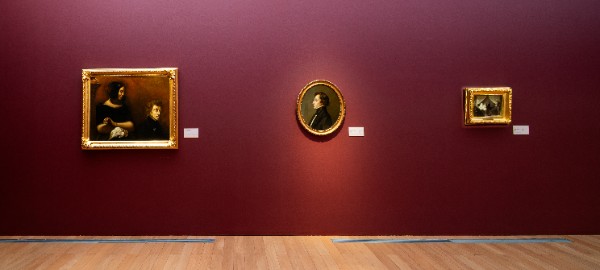
Paintings © Suzhou Museum
For me, the most fascinating section is undoubtedly The Colourful Life of Chopin. The objects displayed here, all now housed in the Chopin Museum, allow us to glimpse the details of Chopin’s daily existence, retrace the composer’s extraordinary thirty-nine years, and observe something of the social world of his era.
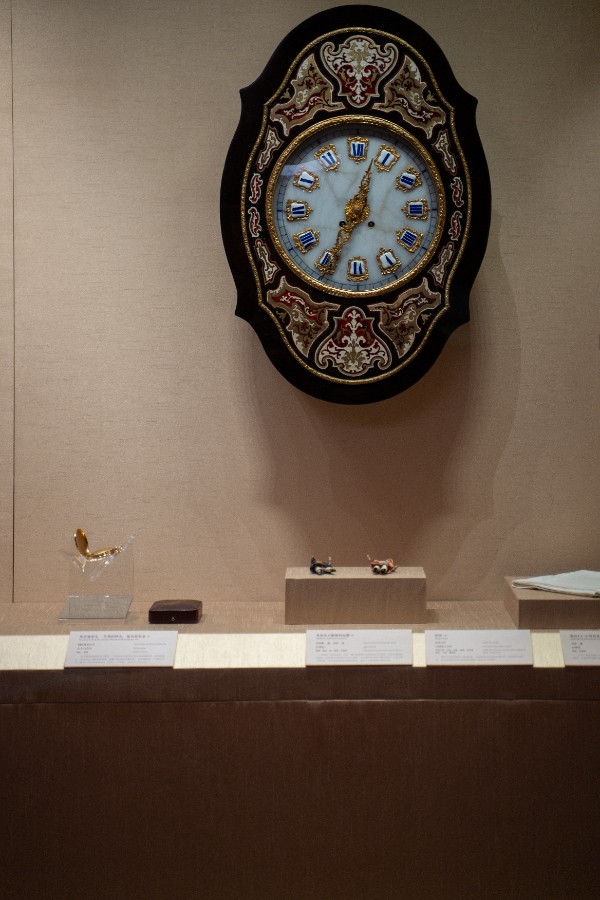
Artefacts used by Chopin © Suzhou Museum
The exhibition begins with paintings depicting Chopin’s early years. Born in the Polish village of Żelazowa Wola, Chopin’s father was French and worked as a French teacher in Poland. Before the composer had even reached his first birthday, the family moved to the outskirts of Kraków in Warsaw; later, they briefly lived in what is now the Kazimierz Palace, then home to the Warsaw Lyceum and the Royal University of Warsaw. Chopin spent the first half of his life in Warsaw, and the Polish capital remained forever his spiritual homeland. After his death in Paris, his heart — in accordance with the custom of the time — was transported across Europe and placed within a pillar of the Holy Cross Church, returning to its roots.
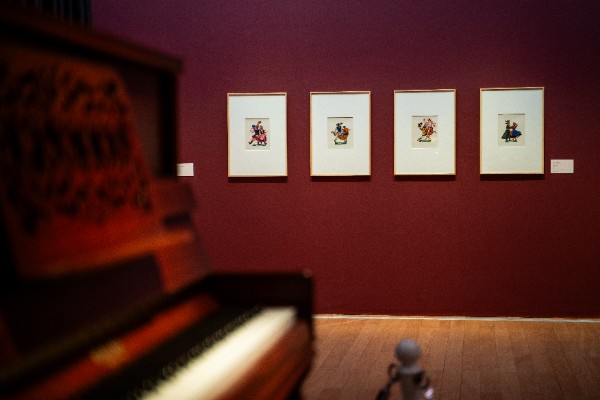
Painting of Polish Dances © Suzhou Museum
Chopin’s music is inevitably connected to Poland’s history, literature, and folk traditions. Immersed from childhood in a deeply Polish cultural environment, the rhythms of Polish dances became embedded within his artistic gene. The exhibition includes paintings depicting four national dances — the polonaise, mazurka, krakowiak, and oberek — their dancers dressed in vivid colours and with energetic movement. It is often said that Chopin developed an interest in Polish folk music from an early age. The finale of his Piano Concerto No. 1 in E minor, for instance, is steeped in the character of the krakowiak, radiating youthful energy and exuberance.
Chopin: Piano Concerto No. 1 in E minor, Op. 11 (Live) – Hayato Sumino
Later, Chopin increasingly focused on the polonaise and mazurka, dramatically expanding their expressive range and elevating them into genres embraced by later composers. Both Karol Szymanowski and Alexander Scriabin would go on to compose no fewer than twenty mazurkas each, infusing the form with far more modernised harmonic languages.
As is well known, Chopin displayed extraordinary talent from an early age, giving public performances at seven and quickly gaining a reputation as a prodigy. In 1820, the celebrated opera singer Angelica Catalani heard the not-yet ten-year-old Chopin perform in Warsaw, and was so captivated that she presented him with a gold pocket watch inscribed: “Madame Catalani to ten-year-old Fryderyk Chopin — Warsaw, 3 January 1820.” Clearly, the watch became one of Chopin’s treasured possessions, preserved throughout his life and surviving today as testimony to this meeting. Chopin’s later vocalised compositional style reflected his lifelong fascination with Italian opera — one wonders whether Catalani’s gift further intensified the young composer’s admiration for bel canto.
By adolescence, Chopin’s reputation had spread throughout Poland and beyond. In autumn 1830, he left Poland for the wider artistic world of Western Europe, eventually arriving in Paris the following year; in 1835, he became a French citizen. There, he met numerous leading cultural figures, including his famous lover, the writer George Sand. Six years older than Chopin, with countless past lovers and two children, Sand possessed a unique charisma. The pair became lovers in 1838, living together unmarried — something rather scandalous for the period. Naturally, this legendary relationship has fascinated both gossipmongers and artists alike ever since, and it occupies a central place within the exhibition.
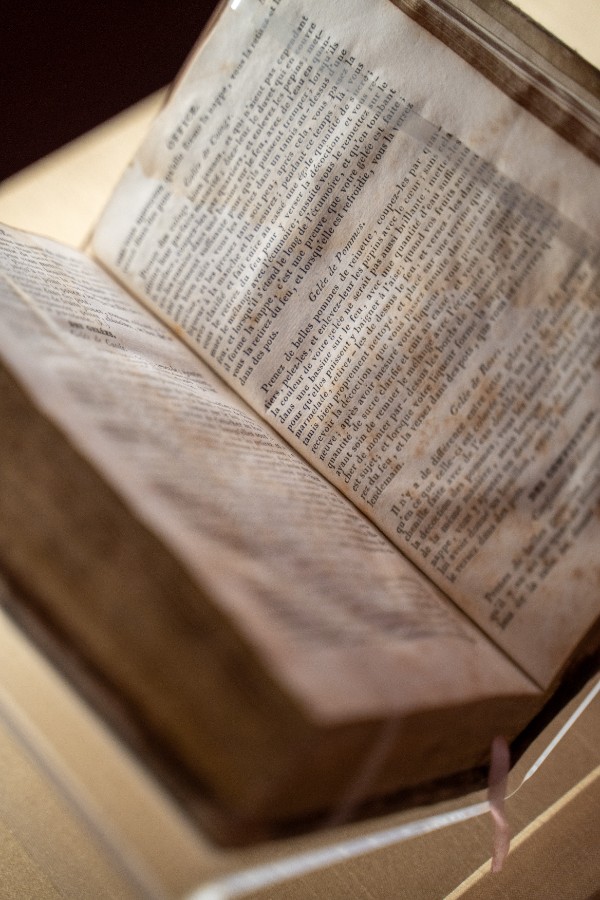
George Sand’s Recipe Book © Suzhou Museum
We learn that between 1839 and 1846 (excepting 1840), the couple spent tranquil summers at Sand’s estate in Nohant, inherited from her grandmother. Although accounts often emphasise the tensions between Chopin and Sand’s children, the exhibition also presents warmer aspects of this improvised family life — including puppets belonging to Sand’s son Maurice. Chopin, frail and chronically ill, was carefully looked after by Sand, who was also an accomplished cook; her recipe book is displayed. Even the tablecloths at Nohant were embroidered with Chopin’s initials “FC.” Eugène Delacroix’s celebrated portraits of Chopin and George Sand are well known; the original painting, in fact, was a double portrait, which was later split into two separate portraits by an art dealer hoping to maximise profits. The exhibition includes a reconstructed version by the Polish painter Ludwik Wawrynkiewicz, restoring this intimate image of the couple.
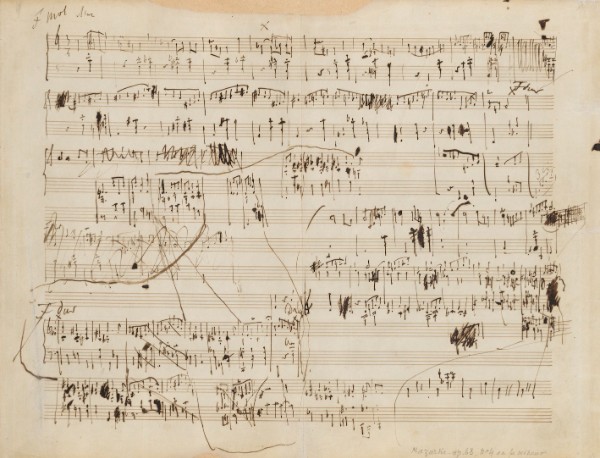
Chopin’s Manuscript – Mazurka Op. 64 No. 4
Yet Chopin and Sand ultimately separated two years before the composer’s death — Sand did not even attend his funeral. Emotional turmoil and worsening illness dealt Chopin a devastating blow. The sombre Cello Sonata in G minor belongs to this late period and became the final work published during his lifetime. The exhibition displays the manuscript of its second movement, where delicate handwriting and violent crossings-out seem almost to reflect Chopin’s psychological anguish. His letters reinforce this impression. In one message to his family, he wrote: “At one moment I am satisfied with my cello sonata, at another I am not. I throw it aside and then pick it up again… Time is the best critic, and patience the finest teacher.”
Chopin Cello Sonata op 65 Yuja Wang piano, Gautier Capuçon cello
The original Chopin manuscripts and letters — exhibited in China for the first time — are undoubtedly the treasures of this exhibition. To preserve these fragile artefacts, they will not be publicly displayed again for another five years. Besides the Cello Sonata, three additional manuscripts reveal different facets of Chopin’s artistic personality. The manuscript of the Étude in F minor, Op. 10 No. 9, copied neatly before publication, is elegant and refined; another work in F minor, the Mazurka in F minor, Op. 68 No. 4 — often regarded as one of Chopin’s final musical utterances — is covered with rough handwriting and drastic revisions, deeply moving in its vulnerability, perhaps like the piece itself. Most astonishing of all is the draft of the Polonaise-Fantaisie in A-flat major: it resembles an abstract twentieth-century painting, scarcely recognisable as music at all. Was this merely Chopin testing his pen and ink, or a direct trace of his racing imagination?
Chopin Mazurka in F minor, Op.68 No.4 (live) – Josh Wright
The exhibition also reveals the final years of Chopin’s life after Sand’s departure. We see profile portraits from around 1847, as well as the famous photograph taken by Louis-Auguste Bisson that same year — far more revealing than painted images in showing the composer’s illness-ridden appearance. Chopin’s friend Teofil Kwiatkowski’s painting Chopin on His Deathbed depicts the composer surrounded by his sister and friends, clothed in white as if already preparing to depart this world. Returning finally to the exhibition entrance, visitors encounter the posthumous sculpture by Jean-Baptiste Auguste Clésinger. At that moment, these scattered fragments coalesce into a continuous line: the multi-coloured life of Chopin, filled alike with light and shadow.
After Chopin: Contemporary Chopin Culture
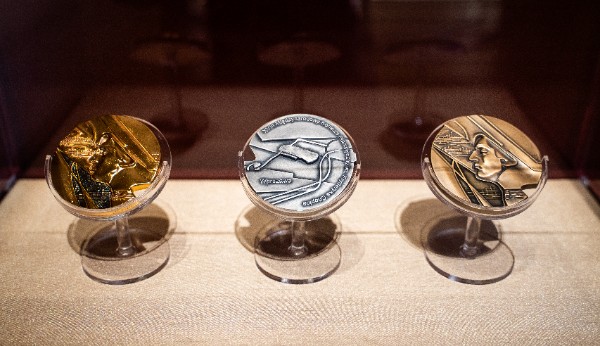
Chopin Competition Medals © Suzhou Museum
Beyond Chopin’s Colourful Life, the sections devoted to the Chopin Competition and contemporary art are equally compelling. Preserving and studying Chopin’s historical artefacts is only one aspect of the Institute’s mission; another is ensuring that Chopin’s life and music continue to be interpreted, reimagined, and recreated within contemporary cultural contexts.
The International Chopin Piano Competition is clearly one of the central pillars of modern “Chopin culture.” Since its first competition in Warsaw ninety-nine years ago, it has grown into perhaps the most influential classical music competition in the world. Controversial though it has often been, it remains inseparable from Chopin’s musical legacy, together forming a cultural phenomenon of enormous global reach. To some extent, the authority and prestige of the competition have themselves been shaped by laureates such as Martha Argerich, Maurizio Pollini, and Krystian Zimerman. The exhibition includes medals and laureates’ memorabilia from multiple editions of the competition, bearing witness to nearly a century of its history.
The Chopin Competition has undoubtedly exerted enormous influence upon the musical culture of China and East Asia more broadly. At the 2025 edition, the number of Chinese and Asian contestants reached a new peak: not only were the top three prizewinners all Chinese-speaking, but six of the eight prizewinners were ethnically Chinese, alongside one Japanese pianist. The exhibition dedicates a special area to all Chinese prizewinners in the competition’s history – behind them stand countless young piano students who have spent day after day practising Chopin.
Eric Lu (1st prize) performance at the 2025 Chopin Piano Competition Final
Compared with competition, Chopin’s Music and Contemporary Art returns to the pleasures of art itself, bringing together visual works inspired by Chopin and his music. Both the composer Olivier Messiaen and the painter Wassily Kandinsky were famous synesthetes, capable of associating sound and colour. Among the selected works are two paintings inspired by the Fantaisie-Impromptu — hardly surprising, perhaps, for such a universally beloved piano piece, one capable of awakening vivid colours within the imagination.
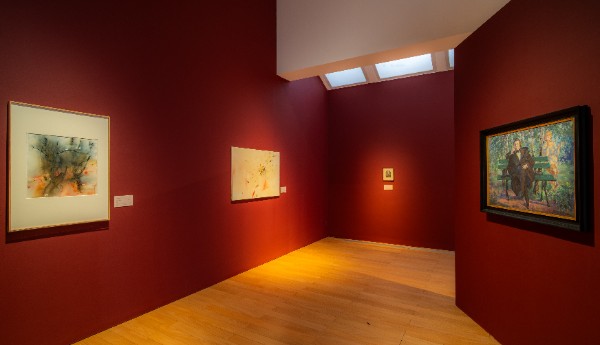
Modern Art inspired by Chopin © Suzhou Museum
What lingers, as one leaves the exhibition, is not merely the image of Chopin himself, but the centuries-long journey of a legacy that continues to resonate across time and geography. From the Polish countryside to Parisian salons, from Warsaw museums to Suzhou gardens, “Chopin culture” has transcended national borders, continually reimagined by performers, institutions, artists, and audiences of different generations. The exhibition itself is both a testament to and an embodiment of how “Chopin culture” remains vibrantly alive.
For more of the best in classical music, sign up for our E-Newsletter