
From intimate Classical Era salon instruments to modern concert grands, the piano has continually grown alongside composers’ ambitions and builders’ ingenuity.
While most concert halls are designed for instruments around nine feet long, a handful of piano makers have pushed far beyond those limits.
These largest and longest pianos in history were built for many reasons: to expand tonal range, replicate the power of an organ, commemorate royal jubilees, or simply to push boundaries.
Today, we’re counting down seven of the biggest pianos ever built, from extended concert grands to colossal one-of-a-kind instruments that border on architectural installations.
#7: Bösendorfer Imperial Concert Grand
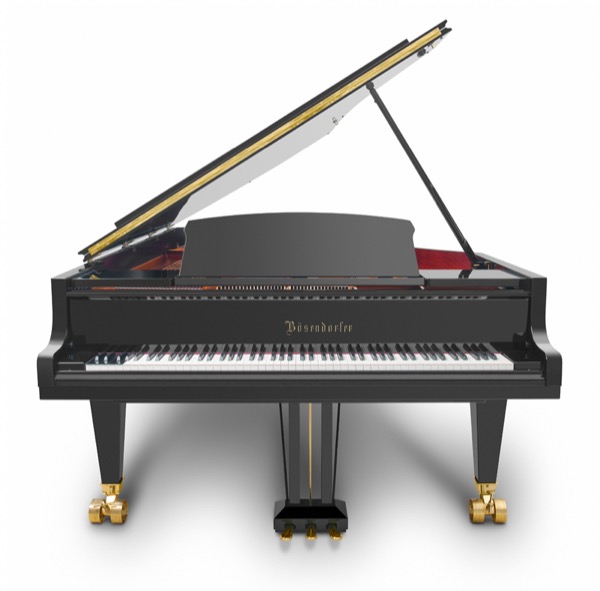
Bösendorfer Imperial Concert Grand
Bosendorfer Imperial (Why the extra notes, and what do they sound like). 290
In the late nineteenth century, composer and pianist Ferruccio Busoni transcribed Bach‘s organ works for piano. He dreamed about having a piano with an increased range that would better replicate the range of an organ.
To realise those dreams, the Bösendorfer piano building company came up with the Imperial Concert Grand piano design. This model consists of eight octaves over 97 keys, and it is 9 feet, 6 inches long (2.9 meters).
As the official Bösendorfer website points out, there are works by Bartók, Debussy, and Ravel that can employ these newly available pitches.
It’s unclear whether those composers expected – or even wanted – those notes to be physically played, but it’s interesting trivia to know that this instrument can handle them.
#6: Fazioli F-308
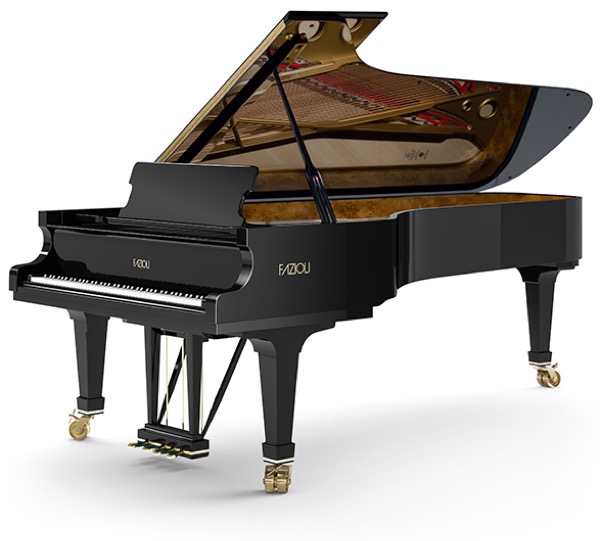
Fazioli F-308
In Search of the World’s Greatest Pianos, Part 41: Fazioli F308
Fazioli is a high-end Italian piano company founded in 1981 and based in Sacile, Italy. They are well known for building only 140 pianos a year.
Their F-308 model is 10 feet, 2 inches (3.1 meters) long and weighs a whopping 1550 pounds (or 703 kilograms).
Interestingly, it also has a fourth pedal in addition to the traditional three. That pedal is used to create a pianissimo effect.
Fazioli claims that the F-308 is the largest piano in production. Over the years, only twenty have been made.
#5 and #4: Charles H. Challen Grand Pianos
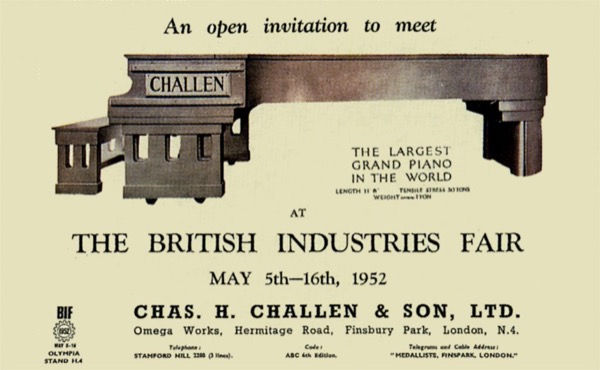
Charles H. Challen Grand Piano
Charles H. Challen and Sons was an English piano manufacturing firm founded in 1804.
In 1935, they constructed the world’s largest grand piano to honour the Silver Jubilee of King George V and Queen Mary (Queen Elizabeth II’s grandparents).
The company built two big instruments for the big event. Each one measured 11 feet, 8 inches (3.6 meters) long.
The first one made its debut at the British Industries Fair, the most visited attraction in England at the time, where it made a big splash.
For a while after the Fair ended, it kept popping up in various exhibitions, as well as posh department stores like Selfridges and Harrods.
Sadly, this giant appears to have met its demise in 1959, when it was purportedly brought to a garden party, left outdoors, and left to sink into the dirt. However, that story has never been officially confirmed, and apparently, nobody knows for sure where this landmark instrument ended up.
Its twin was far luckier. “Piano-2” also popped up at a variety of venues, including the British Industries Fair.
It found a permanent home in 1969, when it was bought by the owners of Gwrych Castle in Wales. It was later sold again and ended up in France.
In 2020, piano restorer Andrew Giller brought it back to the United Kingdom, and he and his team spent two years restoring it.
#3: Rubenstein R-371
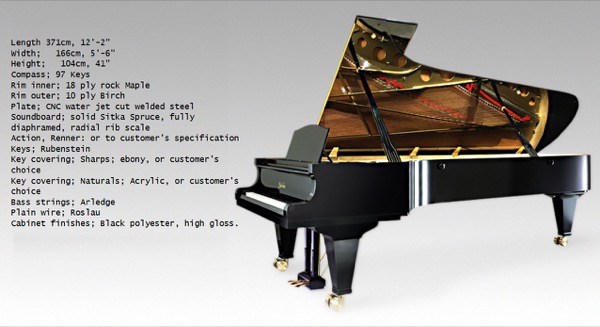
Rubenstein R-371
R-371: 12 foot 2 inch Rubenstein piano – Scriabin
This piano was built by American David Rubenstein, owner of Rubenstein Pianos in El Segundo, California. He had never built a piano before attempting to build this one.
As he said in a 2009 interview, “I built it ‘just because.’ It was a highly organised, well-thought-out whim.”
Rubenstein said of the process of building the piano: “Sometimes I was happy and sometimes I was miserable. When you’re making something this big, you forget its final use – the fact that you can play this – and only think about the thing in front of you right now. At the end, it dawns on you that you’ve done something.”
One pianist who played it reported, “You would think a bigger piano would sound louder, but that is not the case. This piano has been built with such refinement that it is very responsive to touch and allows hundreds of gradations of loud and soft.”
This model is 12 feet, 2 inches (3.7 meters) long. Like the Bösendorfer Imperial, it has 97 keys.
#2: Alexander Piano
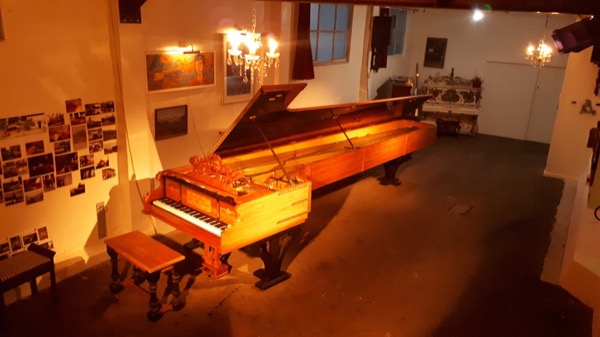
The Alexander Piano
Hyperion Knight plays the Maple Leaf Rag on the Alexander Piano
In 2004, Adrian Alexander Mann was a fourteen-year-old piano student in New Zealand.
He learned from his teacher about how copper wires are wrapped around modern pianos’ lower strings, giving them a deeper tone without necessitating excessive length.
Mann asked his teacher how long a theoretical piano would have to be to not need the copper wire. His teacher wasn’t sure, so Mann ran some experiments and started building his own in a neighbour’s empty garage.
Five years later, at the age of twenty, he emerged with the Alexander Piano. The end product was a staggering 18 feet, 9 inches (5.7 meters) long.
Mann dubbed his creation the “Alexander Piano” in honour of his grandfather. The Alexander Piano has become a destination for curious pianists traveling through New Zealand, and Mann is always at hand to document his visitors’ music-making.
Not surprisingly, Mann grew up to become a piano technician. After sending his jaw-dropping invention to various showcases around the world, he brought it home.
In 2017, he told Atlas Obscura that he wants to build another one.
#1 Stolëmowi Klawér (“Giant Piano”)
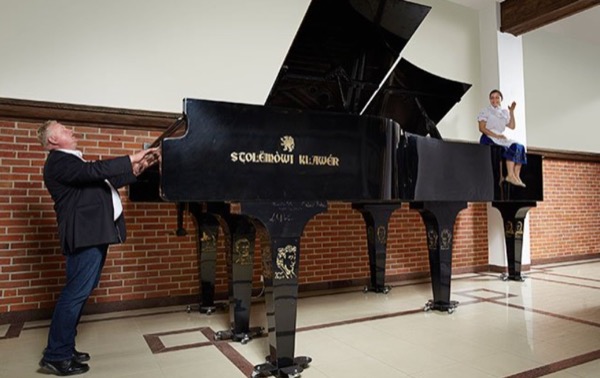
Stolëmowi Klawér (“Giant Piano”)
Katarzyna Borek: Guiness World Record in “the world’s largest piano” concert (F.Chopin)
The Stolëmowi Klawér (“Giant Piano” in Polish) pushes the concept of a piano to its absolute extreme. It was built by Daniel Czapiewski in Poland in honour of the bicentenary of Chopin‘s birth in 2010.
Huge doesn’t begin to describe this instrument:
- It is nineteen feet, eleven inches (6.1 meters) long.
- It is six feet (1.8 meters) tall and requires a special raised area for the pianist to place their bench on.
- It has 156 keys – and two keyboards.
Czapiewski died in 2013, but he certainly left a massive legacy in the piano building world.
Conclusion
Many of these giants are impractical for everyday performance, and some were never meant to be widely replicated. All have quirky origin stories. Yet they’ve left a lasting imprint on music history.
Even if they’re rarely played, their sheer existence has reshaped how we think about resonance, scale, and the piano’s potential. All seven of these largest pianos ever built stand as inspiring monuments to pianistic creativity and craftsmanship.
For more of the best in classical music, sign up for our E-Newsletter







About biggests pianos in my opinión is important to talk about the steinway & sons, model D, which is a great quality piano, best regards from my country Ecuador.