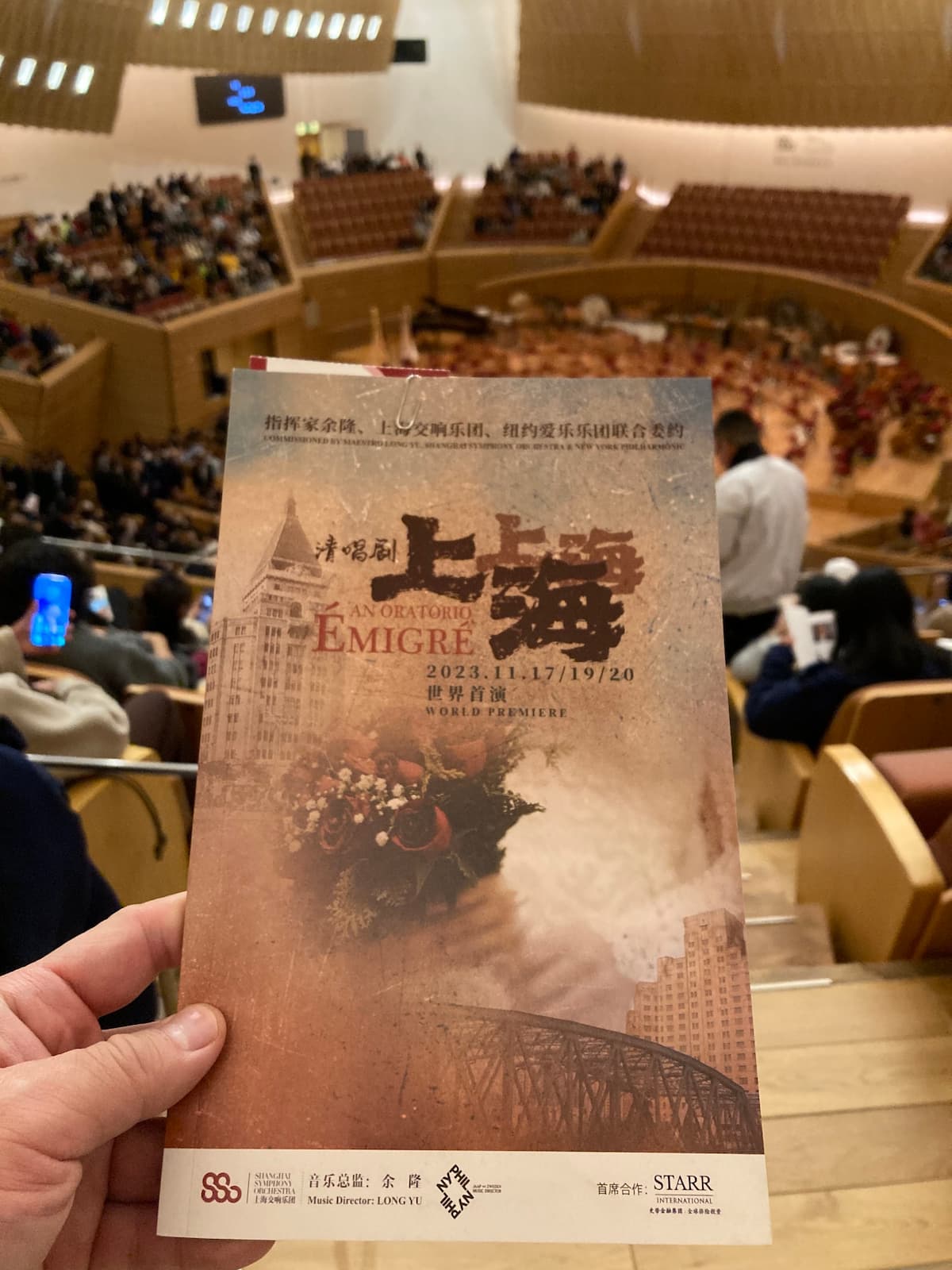
A little-known chapter of the Second World War is the subject of the recently premiered and stunning new work Émigré. It’s an oratorio about the thousands of Jewish refugees who fled Nazi Germany seeking a haven in Shanghai in the 1930s, when they were barred from entry to other countries. In our last article, I delved into some of the personal stories. Émigré probes themes of cultural identity, bridging cultures, and love and loss, and has graced stages in New York, Berlin, Hong Kong, and Shanghai, as well as the recording studios of Deutsche Grammophon.
A project five years in the making, conductor Long Yu, himself a Shanghainese, sought out collaborators to bring these stories to audiences with the goal of “doing something for our own time.”
Co-commissioned by Yu, the Shanghai Symphony Orchestra, and the New York Philharmonic, the 90-minute production in two acts tells the story of two German Jewish refugees, brothers Otto and Josef Bader, who travel thousands of miles by boat on a 3-month journey to Shanghai. The city, still reeling from the atrocities of the Nanjing Massacre, nonetheless opened its doors to the refugees. As the refugees try to navigate their new lives while worrying about those they left behind, the brothers both find love: Otto within the city’s Jewish community. But Josef’s love interest is an illicit union with the daughter of a Chinese herbalist, Lina, who is still recovering from the death of her mother during the Nanjing Massacre. The cross-cultural couple causes deep divisions and opposition. Moreover, both peoples are persecuted in their own countries and must look for ways to unite and to support a better future. But spoiler alert: tragedy strikes. Their grief unites them, and the drama closes with hope and pleas for a better future.
To tell the story, composer Aaron Zigman, Pulitzer Prize-winning librettist Mark Campbell, and lyricist Brock Walsh created a lush, colourful, and rich score incorporating several musical styles, including classical, jazz, and dance forms and engaging themes that are relevant today. The semi-staged musical drama features Jewish, Buddhist, and Christian prayers and was presented with an international cast. Zigman told The New York Times, “Our project is really about bridging cultures and humanity and love, hope, loss and tragedy.”
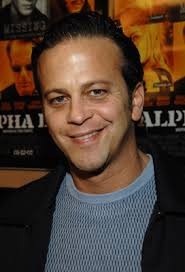
Aaron Zigman
Composer Aaron Zigman is a classically trained American composer, producer, arranger, songwriter, and musician who has scored music for films including “The Notebook,” “The Company Men,” “For Colored Girls,” “Sex and the City”, and many more. Zigman describes how he absolutely had to say yes to this project.
Composer Aaron Zigman about Émigré (Interview pt. 3)
Yu, the artistic director of Beijing’s China Philharmonic Orchestra and music director of the Shanghai Symphony Orchestra, knows this history well, and he comes by his flair honestly. Yu’s grandfather was the prominent composer Ding Shande, who worked closely with European Jewish refugees, many of whom were musicians. Shande, a composer, pianist, and music educator, studied composition with composer Wolfgang Frankel, Nadia Boulanger, Honegger, and Messiaen.
Émigré, an operatic drama and musical, with full orchestra, chorus, and seven soloists, had its world premiere in Shanghai in November 2023. The US premiere took place February 29-March 1st, 2024, in New York. The Public Broadcasting Service (PBS) filmed the premiere, and the entire video was made available on Great Performances in October. Additional performances took place in Beijing and Berlin, and in 2025 in Hong Kong and London. Deutsche Grammophon has released a recording of the complete work.
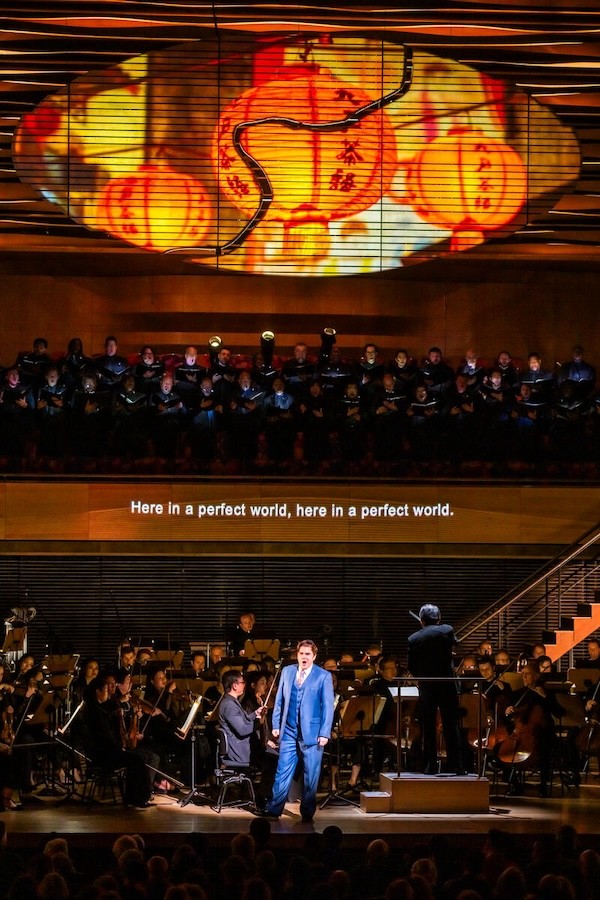
Long Yu conducts Aaron Zigman’s oratorio with tenor Arnold Livingston Geis and the New York Philharmonic. David Geffen Hall. Photo: Chris Lee
This touching tale of love and loss is beautifully brought to life by Mary Birnbaum, who has directed opera and musical theatre productions around the world. Prior to this oratorio, she had no idea of this history and “was blown away” by the story. She admitted to some challenges—the plot is about migration and displacement and, “on stage there are not a lot of places to go.” Yet with subtle imagination, she shaped the illusion of dislocation onstage. Some of the action takes place in the choir loft, where the large chorus is placed, and some movement is in the audience. A staircase descends onto the stage from the choir loft that offers the protagonists pathways through the orchestra itself. Here’s a little further background.
The Real Story Behind “Émigré” | Émigré: A Musical Drama with the NY Phil | GP on PBS
With lovely costumes designed by Oana Botez and poignant props from Birnbaum as well as the projections of historic footage by projection designer Joshua Higgason, the story of “citizens who protect each other when our governments fail to do so” is a riveting tale.
We are fortunate that the work appears in its entirety on Naxos and is available on the DG recording. Some of you will be able to access the entire video on PBS. The artists include:
Meigui Zhang and Diana Newman, Sopranos
Huiling Zhu, Mezzo-Soprano
Matthew White and Arnold Livingston Geis, Tenors
Andrew Dwan, Bass-Baritone
Shenyang, Bass
And the New York Philharmonic, with several musicians from the Shanghai Symphony.

Meigui Zhang

Shenyang © Gaoqiang Xia
Since the entire work is 90 minutes, I would like to highlight several of the movements that I found especially poignant. Sometimes the dialogue is not as clear as we would like without the stage drama and supertitles. Hence, I have included some of the lyrics.
The Prologue begins atmospherically, mysterious and tender with a full orchestra of brass and woodwinds, including contrabassoon and saxophone, a large percussion section, piano, two harps, and a huge chorus. Onstage, we see two small tables on either side of the stage, upon which are placed a candle and a photo of loves lost or missing, which represent the two cultures. The clarinet plays a Klezmer-like passage, and there are effective glissandos in the strings capped by a violin solo. The music builds until the chorus enters, singing prayers in Hebrew, followed by the entrance of the two male protagonists. The brothers, fresh off the ship, sing a powerful melody, “Shanghai out of the darkness you rise… Shanghai answer these desperate cries…One place answers our every prayer, Shanghai…” The projection above the stage is cut in two, I would say metaphorically indicating cultures divided, and shows a backdrop of a skyline, and photos of the busy and chaotic streets. Here is the opening of the oratorio. Act I Prologue.
Long Yu & New York Philharmonic – Zigman: Émigré, Act I: Shanghai
Look Ahead: This movement begins with a dramatic orchestral interlude before the brothers enter with, “I see mother’s face when we left…We must go on with our lives; we must look ahead…” It’s urgent rhythmically, with snare drum and castanet punctuations, and sweeping lines in the strings.
Aaron Zigman: Émigré – Act I: Look Ahead (Arnold Livingston Geis, tenor; Matthew White, counter-tenor; members New York Philharmonic Chorus; Lanzhou Concert Hall Choir; Shanghai Symphony Orchestra; Long Yu, cond.)
After we are introduced to the two Chinese sisters, in the next movement, The House We Share: Dr Josef and Lina meet in the herbalist store and are immediately attracted to each other. The music introduces Chinese intervals and style and remains very lush. The protagonists compare the world to a big house with room for everyone, perhaps naively. “This house we share…The world is one big house with many rooms.” Lina offers to show Josef the city, but her father enters having just been assaulted in the street, and he declares, “for no reason.” Still bereft at the loss of his wife during the Nanjing Massacre, he rejects Josef’s offer of medical treatment and anything to do with Josef.
Aaron Zigman: Émigré – Act I: This House We Share (Mei Gui Zhang, soprano; Arnold Livingston Geis, tenor; Huiling Zhu, mezzo-soprano; Shenyang, bass-baritone; members New York Philharmonic Chorus; Lanzhou Concert Hall Choir; Shanghai Symphony Orchestra; Long Yu, cond.)
My City: This movement illustrates the massacre that took place in Shanghai musically. The terror of the attack is depicted by the dramatic snare drum, the cross rhythms and the up and down restlessness of the strings. The projections sweep across the city, showing the poverty and destruction of the streets. The father sings, “My broken city, my people…broken, degraded…on every corner there is fear, fear fear…”
Aaron Zigman: Émigré – Act I: My City (Shenyang, bass-baritone; members New York Philharmonic Chorus; Lanzhou Concert Hall Choir; Shanghai Symphony Orchestra; Long Yu, cond.)
No Word From Home: This is such an effective movement depicting the agitation of not knowing the fate of loved ones who were left behind. It’s a Scherzo-like death march, and it begins with dissonance, with strident and agitated brass, throbbing timpani, and several cymbal crashes, “No word from home not a shred of news… are they alive?” The cellos drive with a pulsating rhythm below livid trumpets, piccolo and cymbals.
Aaron Zigman: Émigré – Act I: No Word from Home (Diana Newman, soprano; Matthew White, counter-tenor; members New York Philharmonic Chorus; Lanzhou Concert Hall Choir; Shanghai Symphony Orchestra; Long Yu, cond.)
A Woman’s Hands, the next movement, is a tango, the lighter mood introducing some humour. In a Perfect World and One Magical Night, we pursue the love story. The writing reminds me of Bernstein’s West Side Story, which is of course also about star-crossed lovers. Here the composer writes very much in a jazzy, dance band style.
Aaron Zigman: Émigré – Act I: One Magical Night (members New York Philharmonic Chorus; Lanzhou Concert Hall Choir; Shanghai Symphony Orchestra; Long Yu, cond.)
Our People: The buoyancy is short-lived. The two couples are in open conflict. Josef is reprimanded by Otto, “How dare you bring her here… Our people should only be with our people… Lines we do not cross” The drama and agitation build, and the low string rhythm is adopted by the percussion snapping with fury. The push and pull of conflicting approaches are evident in the orchestra—depicting those who feel that this is the time to look forward, to break free of rules, while the traditionalists are stuck, pulling backwards, struggling to maintain the status quo.
Aaron Zigman: Émigré – Act I: Our People (Mei Gui Zhang, soprano; Diana Newman, soprano; Arnold Livingston Geis, tenor; Matthew White, counter-tenor; Shenyang, bass-baritone; members New York Philharmonic Chorus; Lanzhou Concert Hall Choir; Shanghai Symphony Orchestra; Long Yu, cond.)
Act II
The opening of Act II continues the agitation—brass and percussion stridently entering, but it’s quickly disarmed by a lovely violin solo that reminds me of Korngold’s concertos. It melds into a heartfelt rendering of Zigman’s arrangement of Avinu Malekeinu, Our Father Our King, a traditional and poignant Jewish prayer that is sung during the annual High Holidays. It’s a plea for mercy, repentance and forgiveness, and asks for a blessing. It is beautifully rendered by the solo cello accompanied by harp and hushed strings. At this moment in the drama, this melody addresses the larger and worldly plea for co-existence.
Light A Flame continues the introspective mood. “Will we ever find a home for all those lives displaced…” The Japanese occupiers push the Jews into a ghetto in Hongkou. Their status as stateless refugees haunts them. The projection shows us signage in Shanghai from those times—the overcrowding and the deprivation. There’s lovely lyricism undulating in the strings and a moving duo from the protagonists and a full chorus.
Both cultures light candles to remember those who have died or are lost, and as the drama proceeds, the actors light flames that traverse the entire stage. It’s very effective and a touching moment of pause to remember the many cultures experiencing loss and displacement today.
Aaron Zigman: Émigré – Act II: Entr’acte (Shanghai Symphony Orchestra; Long Yu, cond.)
Aaron Zigman: Émigré – Act II: Light a Flame (Mei Gui Zhang, soprano; Diana Newman, soprano; Arnold Livingston Geis, tenor; Matthew White, counter-tenor; Huiling Zhu, mezzo-soprano; Andrew Dwan, baritone; Shenyang, bass-baritone; members New York Philharmonic Chorus; Lanzhou Concert Hall Choir; Shanghai Symphony Orchestra; Long Yu, cond.)
The oratorio continues with The Song of Home, and You Cannot Deny My Love. The mood remains mysterious, although instruments such as the celeste lend a tenderness to the lyrical tunes. Josef proposes, but Lina’s father refuses to give his consent.
And Another Day: The strings, celeste, and horns introduce the chorus, which enters with the entreaty, “Bombs ignite in the air…children run for their lives….” The menacing snare drum and cymbals interject repeatedly. A huge crescendo in the brass peaks followed by a moment of indecision with pleading tremolo strings, of nebulous horns and woodwinds, before the chorus reenters with even more dramatic interruptions from the percussion and brass. It boldly renders the fear and uncertainty.

Facing History: The Nanjing Atrocities: Crimes of War
Aaron Zigman: Émigré – Act II: And Another Day (members New York Philharmonic Chorus; Lanzhou Concert Hall Choir; Shanghai Symphony Orchestra; Long Yu, cond.)
Lina and Josef defy their families and marry. For a moment, there is brightness. The couple are dressed in white—the bride in a wedding gown, the groom in an all-white suit—and they walk slowly down either side of the aisles onto the stage.
The strife escalates, and the couple, fearing for their lives, plead to be hidden, but they are refused by Lina’s father. Lina’s sister, the mezzo soprano, sings a gorgeous rendition of Where Is My Father, the father whom she doesn’t recognise anymore.
The next movement we hear from Otto, Josef’s brother. “Why did you come here. We could be arrested for harbouring one of them here…” They have Nowhere to Go. They ask, “What if it were you?… Shanghai after all gave us refuge.” The bitterness has turned people against each other. Lina enters with the aria, soaring beautifully upwards in the high registers, accompanied by high strings and chorus, and the segment ends suspended in a unique cluster of notes played by the high woodwinds.
The finale Through A Window is a riveting movement. The atmosphere is enhanced by hushed, muted strings entering with the mood of tragedy. There is resignation. The plaintive and andante melody begins with the bass soloist Shenyang singing exquisitely, beginning on an E which soars up a seventh dropping, to the major sixth C# and then stretches to an octave E before resolving from D to C# again. It’s captivating and lovely writing. This melody is traded between the solo male voice, the other soloists, the oboe, and the chorus. It’s gorgeous.
A sorrowful solo oboe enters, and then the tutti all sing, all pray for a future where hearts can heal and fly. There is hope, through a window. It ends with Amen and fades out.
Aaron Zigman: Émigré – Act II: The Yeshiva in the Ghetto (Arnold Livingston Geis, tenor; Andrew Dwan, baritone; Shanghai Symphony Orchestra; Long Yu, cond.)
Aaron Zigman: Émigré – Act II: Nowhere to Go (Diana Newman, soprano; members New York Philharmonic Chorus; Lanzhou Concert Hall Choir; Shanghai Symphony Orchestra; Long Yu, cond.)
Aaron Zigman: Émigré – Act II: Through a Window (Mei Gui Zhang, soprano; Arnold Livingston Geis, tenor; Matthew White, counter-tenor; Shenyang, bass-baritone; members New York Philharmonic Chorus; Lanzhou Concert Hall Choir; Shanghai Symphony Orchestra; Long Yu, cond.)
There are several places in the imaginative score where one hears the influence of Shostakovich, modal scales, jazz idioms, and even a Carmen-like tango.
The lyrics rhyme throughout, and it might surprise you to know that some of the music was written prior to the words and some after throughout this wonderful collaboration between the librettists and composer. Several movements of the oratorio are enormous and powerful, but others make their impact much more quietly and subtly and reinforce our belief that music can inspire strong emotions and shape us cross-culturally, beyond mere words.
The composer hoped Émigré would represent a love letter from the Jews to the people of Shanghai who protected them and stepped forward to save them, and he aspired to leave audiences with a sense of hope and a promise for a better world. The collective experience of hearing this piece together might just do that.
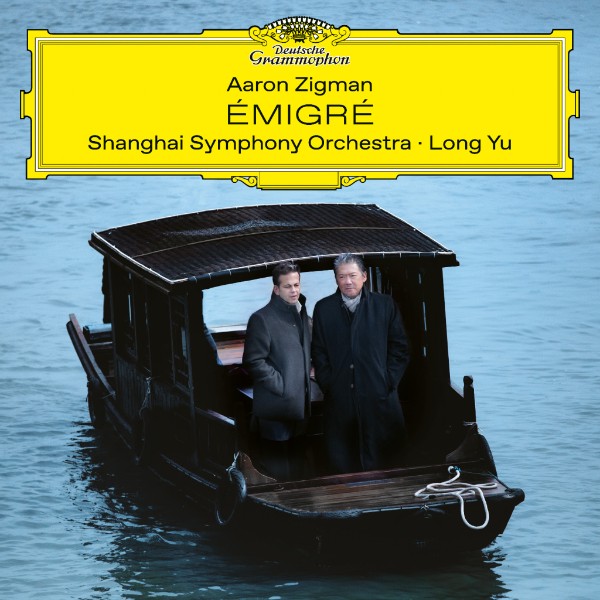
Behind-the-scenes video on WQXR one hour interview about the making of Émigré and the relationship of the NY Phil with the Shanghai Symphony. WQXR’s Chief Content Officer Ed Yim hosts this conversation with creative team about the making of this semi-staged musical drama.
For more of the best in classical music, sign up for our E-Newsletter