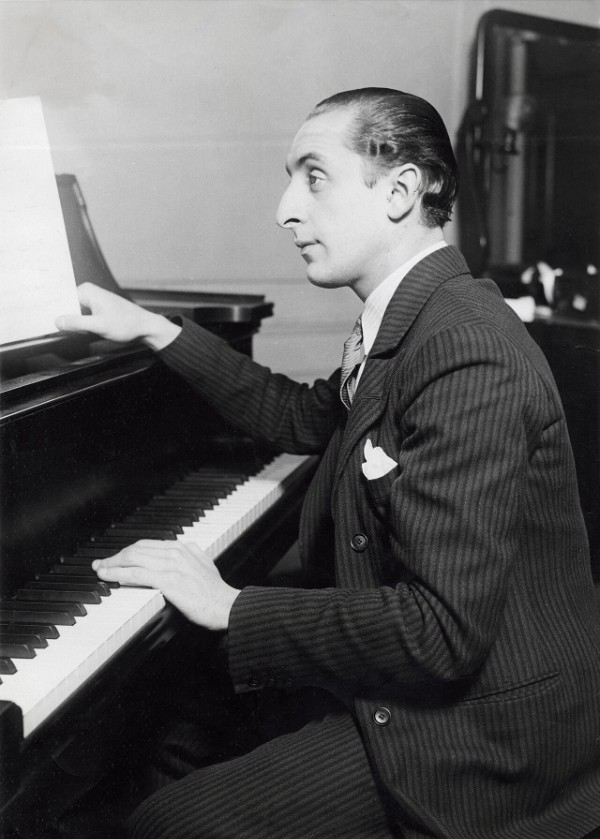
Today, the classical music canon is extremely well-established. In fact, it can sometimes feel like it has been set in stone and passed down from a pantheon of gods.
However, it’s important to remember that many of the works we consider masterpieces today once shocked, offended, or even enraged their original audiences.
From Beethoven’s Grosse Fuge (once dismissed as “incomprehensible”) to Wagner’s scandalously sensual Tristan und Isolde (and beyond), these pieces pushed boundaries of taste, harmony, and even morality.
In this list, we’re looking at what people said about some of the most controversial works in classical music history before they became staples of the canon.
Beethoven – Grosse Fuge (1825)
Initially, pretty much everyone hated the Grosse Fuge, which was originally written to be the finale of Beethoven’s thirteenth string quartet.
- In 1826, a reviewer from the Allgemeine musikalische Zeitung called it “incomprehensible, like Chinese” and “a confusion of Babel.”
- Composer Louis Spohr called it and the other late Beethoven quartets “an indecipherable, uncorrected horror.”
- The pushback was so severe that Beethoven’s publisher was forced to ask him – delicately – if he could perhaps write a replacement movement. (He did.)
- Scepticism continued well into the twentieth century, with American critic Joseph Kerman writing that it “stands out as the most problematic single work in Beethoven’s output and…doubtless in the entire literature of music.”
Eventually, though, the fugue gained fans.
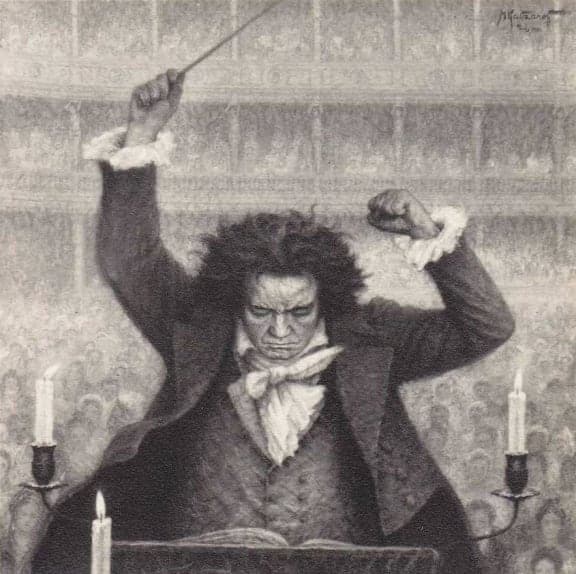
Beethoven conducting
- One fan? Beethoven himself, who, when he heard that the middle movements of the quartet had been encored, grumbled, “Why didn’t they encore the Fugue? That alone should have been repeated! Cattle! Asses!”
- A century later, no less an authority than composer Igor Stravinsky called it “an absolutely contemporary piece of music that will be contemporary forever.”
- Twentieth-century pianist Glenn Gould called it “not only the greatest work Beethoven ever wrote but just about the most astonishing piece in musical literature.”
It seems that some great fugues just take time to appreciate!
Find out why it’s not surprising Grosse Fuge covers the emotional ground that it does.
Wagner – Tristan und Isolde (1865)
The end of Act III of Tristan und Isolde
Wagner’s lush, erotically charged opera Tristan und Isolde (inspired by his own steamy affair with a married patron) was, predictably, controversial in its early days.
- Pianist and composer Clara Wieck Schumann, wife of Robert, famously wrote about Tristan that it was “the most repugnant thing I have ever seen or heard in all my life.”
- In 1865, a reporter for the Allgemeine musikalische Zeitung wrote, “We think that the stage presentation of the poem Tristan und Isolde amounts to an act of indecency. Wagner does not show us the life of heroes of Nordic sagas, which would edify and strengthen the spirit of his German audiences. What he does present is the ruination of the life of heroes through sensuality.”
- In 1868, Viennese critic Eduard Hanslick remarked that the Prelude “reminds one of the old Italian painting of a martyr whose intestines are slowly unwound from his body on a reel.”
- Richard Strauss remarked that Wagner’s music “would kill a cat and would turn rocks into scrambled eggs from fear of [its] hideous discords.”
Many, however, were impressed.
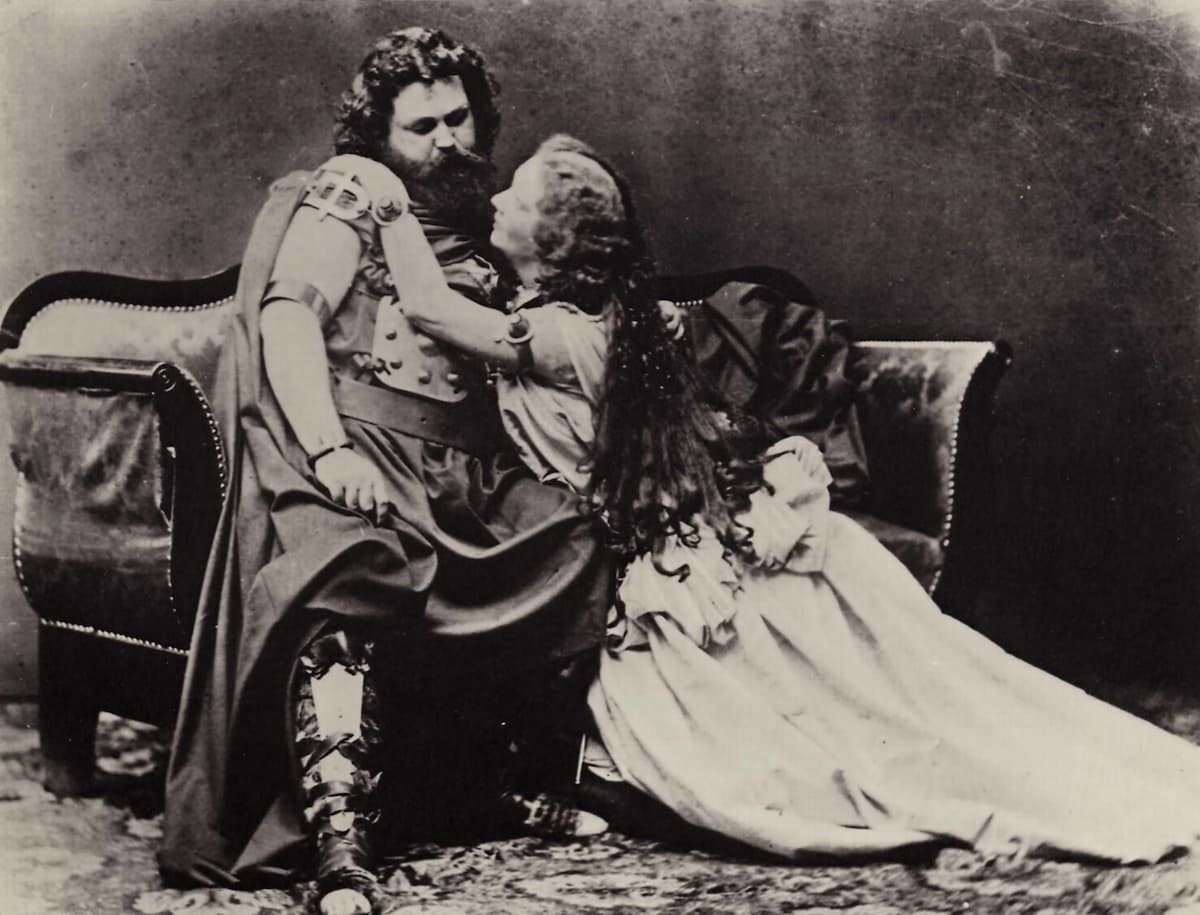
Ludwig and Malwine Schnorr von Carolsfeld in the title roles of the original production of Richard Wagner’s Tristan und Isolde in 1865.
- Giuseppe Verdi said that he “stood in wonder and terror” before Tristan.
- Bruno Walter wrote of attending a Tristan performance in 1889: “A new epoch had begun: Wagner was my god, and I wanted to become his prophet.”
- Even Richard Strauss came around eventually, writing in 1892: “I have conducted my first Tristan. It was the most wonderful day of my life.”
Learn more about the shocking love affair that inspired Wagner’s Tristan und Isolde.
Bizet – Carmen (1875)
An excerpt from Carmen
Nowadays it’s one of the most beloved operas ever written…but it sure didn’t start out that way!
Upon its 1875 debut, critics and conservative patrons were shocked that an opera-comique would feature a free-spirited woman who smokes, seduces, and is murdered on stage.
Multiple voices expressed their disgust.
- Critic Paul de Saint-Victor wrote in Le moniteur: “The role of Carmen is not a success for Mme Galli-Marié. She is trivial and brutal; she turns this feline girl into a cynical harlot.”
- Librettist Jean Henri Dupin wrote to his colleague Henri Meilhac, who had written the Carmen libretto: “I won’t mince words. Your Carmen is a flop, a disaster! It will never play more than twenty times. The music goes on and on. It never stops. There’s not even time to applaud. That’s not music!”
Others, however, were much more generous.
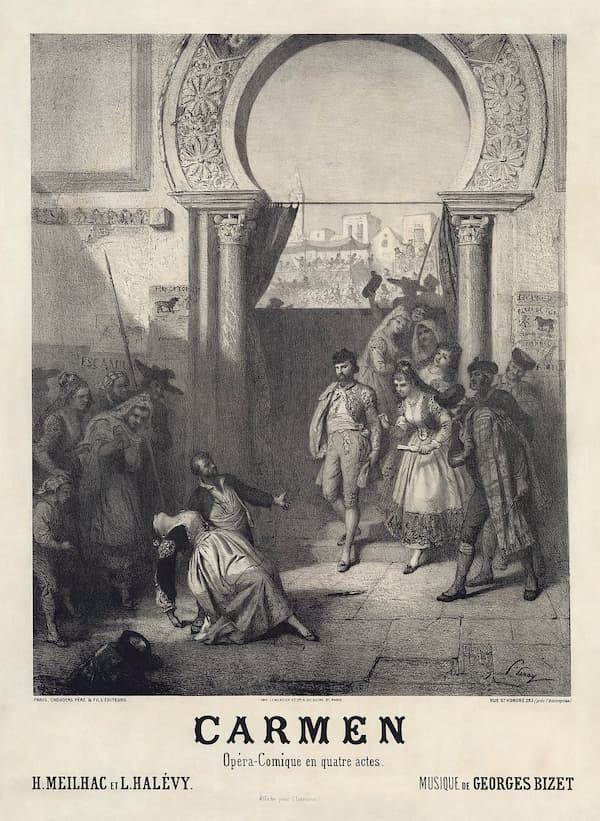
1875 lithographic poster for the première of Georges Bizet’s Carmen, Published by Choudens Pére et Fils and Imp. Lemercier et Cie.
- Friedrich Nietzsche declared, “This music seems to me to be perfect… this music is wicked, subtle, and fatalistic; it remains popular at the same time… it builds, it organises, it completes; it is thus the antithesis to the polypus in music, infinite melody.”
- Tchaikovsky wrote that it was “a masterpiece in every sense of the word.”
Posterity ended up siding with Nietzsche and Tchaikovsky. Unfortunately, Georges Bizet died of a heart attack just a few months after the premiere, long before he had a chance to see attitudes about the work change.
In fact, Bizet’s shocking death was part of the reason that operagoers took another look at Carmen.
Learn more about the rocky premiere of Carmen.
Bruckner – Symphony No. 7 (1881–1883)
During his life (and sometimes after it), Anton Bruckner was a favourite punching bag for many composers and music lovers. He was seen as being too overtly Catholic, too in thrall to his hero Wagner, too hickish.
- In 1886, critic Eduard Hanslick wrote of the Viennese premiere, “The music is antipathetic to me and appears to be exaggerated, sick, and perverted.” He also compared it to a snake.
- Critic Gustav Dompke wrote, “We recoil with horror before this rotting odour which rushes into our nostrils from the disharmonies of this decomposing counterpoint.”
- Pianist and composer Clara Schumann wrote, “It is a horrible piece of music, nothing more than a medley of scraps strung together with a heap of bombast and, moreover, scandalously long.”
But there were some who loved it, including many in the audience in Vienna.
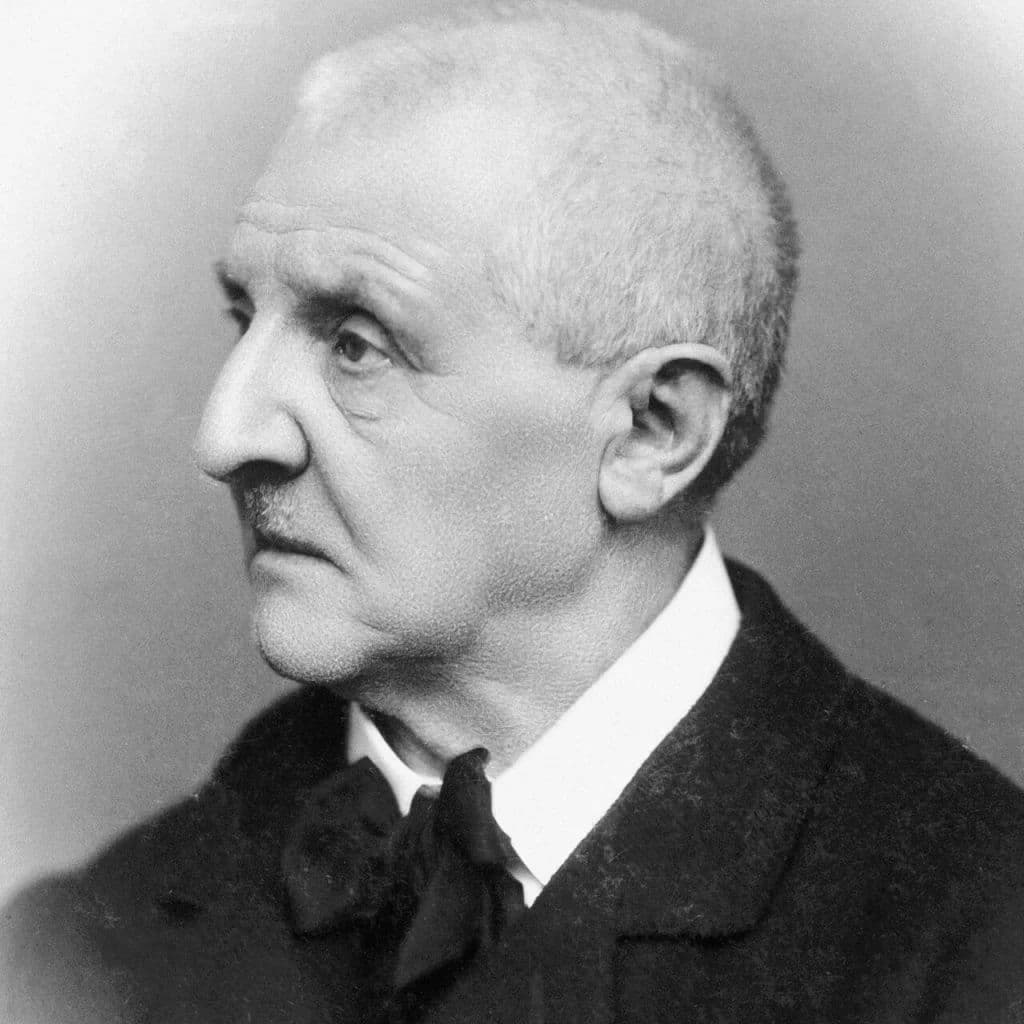
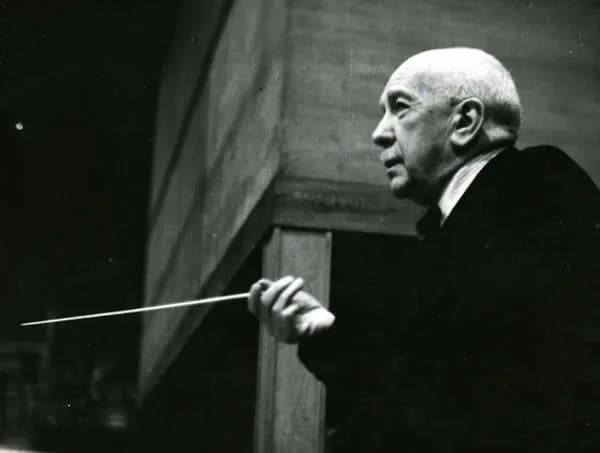
Anton Bruckner
- Composer Hugo Wolf wrote, “One single cymbal clash by Bruckner is worth all four symphonies of Brahms, with the serenades thrown in.”
- In 2018, BBC Music Magazine listed Bruckner’s Seventh as the twentieth position in its list of the twenty greatest symphonies of all time.
- It has since become his most frequently played symphony.
Debussy – Pelléas et Mélisande (1902)
An excerpt from Pelléas et Mélisande
Claude Debussy’s opera Pelléas et Mélisande astonished Paris in 1902 with its subtlety and innovative musical language.
But at first, lots of listeners didn’t get any of it.
- Maurice Maeterlinck, who had written the play the opera is based on, told Le Figaro before the premiere that it was “a work that is strange and hostile to me… I can only wish for its immediate and decided failure.”
- Composer Gabriel Fauré said during the intermission, “If that’s music, then I never understood what music is.”
- Composer Camille Saint-Saëns felt so threatened by it that he reportedly canceled his summer holidays to stay in Paris to bad-talk Pelléas.
- Some students from the Paris Conservatoire were forbidden from attending, for fear their compositions would be corrupted by Debussy’s.
- The Musical Courier wrote, “In Debussy’s opera Pelléas, consecutive fifths, octaves, ninths, and sevenths abound in flocks, and not only by pairs, but in whole passages of such in harmonious chords. Such progressions sound awful, as when the dentist touches the nerve of a sensitive tooth.”
Not everyone hated it, though.
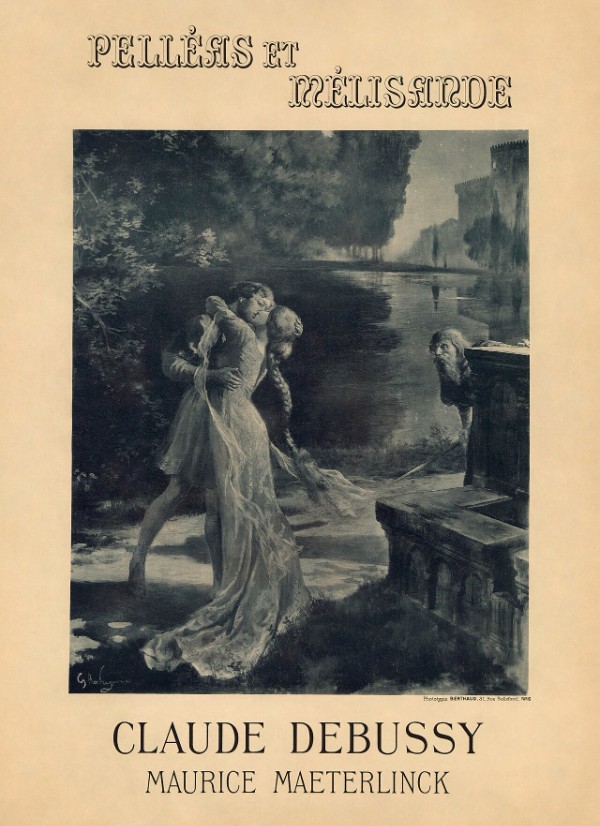
Poster for the prèmiere of Claude Debussy’s Pelléas et Mélisande at the Théâtre de l’Opéra-Comique on 30 April 1902
- Composer Vincent d’Indy wrote a positive review.
- Soprano Mary Garden later remembered that by the fifth performance, the opera was a “triumph.”
- Among those changing his mind was Maeterlinck. He wrote in 1920 after finally seeing it, “In this affair I was entirely wrong, and he was a thousand times right.” Unfortunately, by that point, Debussy was dead.
Learn more about some of the shocking criticism that was leveled at Debussy during his lifetime.
Conclusion
Works once condemned as “noise” or “indecent” now rank among the most celebrated ever written.
Beethoven’s Grosse Fuge, Wagner’s Tristan und Isolde, Bizet’s Carmen, Bruckner’s Seventh Symphony, and Debussy’s Pelléas et Mélisande all remind us that when it comes to classical music, new ideas often take time to be understood.
For more of the best in classical music, sign up for our E-Newsletter