Some of the most interesting works in classical music history were the result of collaboration, when composers joined forces to create something they couldn’t have made on their own.
Today, we’re exploring six of the best composer collaborations in the chamber music repertoire, from Beethoven’s towering Diabelli Variations to a gift sonata for violinist Joseph Joachim.
If you’re interested in classical music history and want to discover new chamber works that were shaped by friendship, family love, or even professional rivalry, you’ll want to check these works out!
Anton Diabelli, Franz Schubert, Franz Liszt, Ludwig van Beethoven, and Others: Diabelli Variations (1819)
Beethoven’s Diabelli Variations
In 1819, savvy music publisher Anton Diabelli invited dozens of Austrian composers to write a variation on a waltz melody he’d composed.
The resulting anthology, Vaterländischer Künstlerverein (Patriotic Artists’ Association), would showcase national musical talent.
Most composers – 51 in all – submitted a single variation, including Franz Schubert, Carl Czerny, Johann Nepomuk Hummel, and an eight-year-old Franz Liszt.
But Beethoven didn’t just submit one variation: he wrote 33. The result became known as his Diabelli Variations, one of the most renowned works in the entire solo piano repertoire.
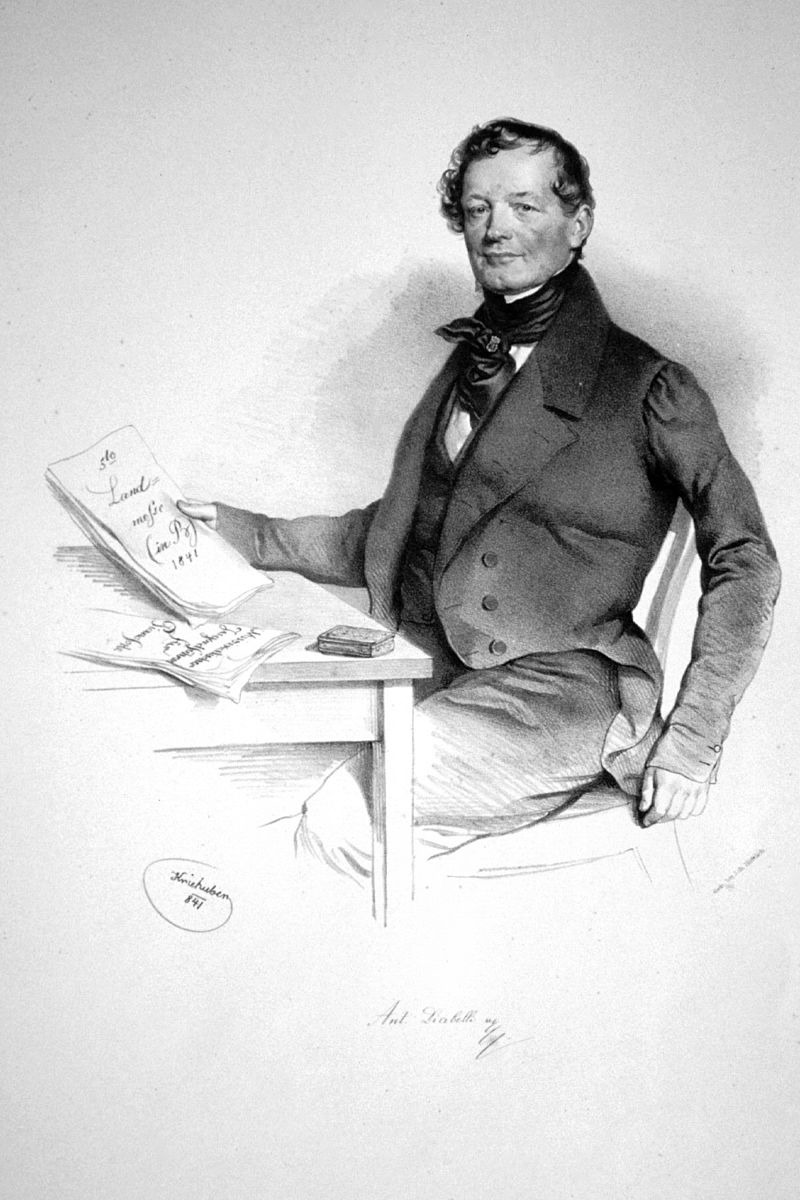
Anton Diabelli
Beethoven’s portion was published as Part I of the anthology, with everyone else’s combining to make up Part II.
We wrote a whole article about the fascinating composers who contributed to Part II of the Diabelli Variations.
Do you have a favourite? This video includes all of the contributors to Part II, with their portraits:
Diabelli Variations (Part 2) Vaterländischer Künstlerverein
Felix Mendelssohn and Fanny Mendelssohn: 12 Gesänge (1824–1827)
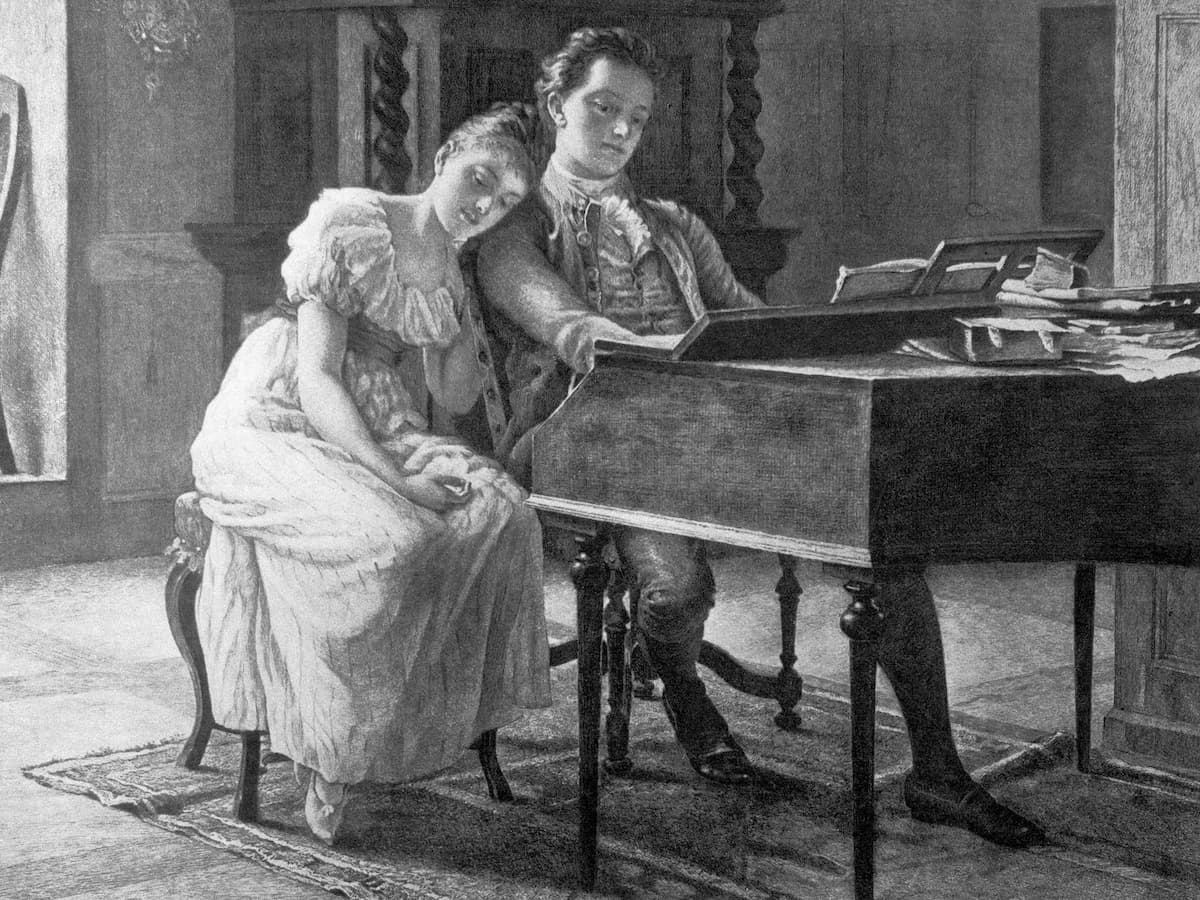
Fanny and Felix Mendelssohn © Bettmann/Corbis
The sibling bond between Felix and Fanny Mendelssohn was vitally important to both of them, emotionally, intellectually, and especially musically.
Although she was discouraged from publishing her work, Fanny was a prolific composer whose musical talent rivaled her brother’s. The two prodigies deeply influenced each other’s musical development, especially as children and young adults.
In the early 1830s, Felix published two sets of songs: 12 Gesänge (Songs), Opp. 8 and 9. Each set included three songs by Fanny…but Felix’s name was the only one on the published cover.
During one of his English tours, Felix met with Queen Victoria, who was an enthusiastic amateur singer. The queen’s favourite song in the collection was “Italien” from Op. 8, and she sang it for him. When she finished, Felix had to confess that “Italien” had actually been written by his sister.
Fanny Mendelssohn’s “Italien”
Frédéric Chopin and Auguste Franchomme: Grand Duo Concertant for Cello and Piano (1832)
This work originated with Meyerbeer’s Robert le diable, a blockbuster five-act grand opera dating from 1831.
Chopin was impressed by the opera. So were other composers. A number of his colleagues wrote fantasies based on its themes.
Chopin was actually under contract with his publisher to write a work based on the opera’s themes, but he didn’t feel particularly inspired to write anything for piano solo.
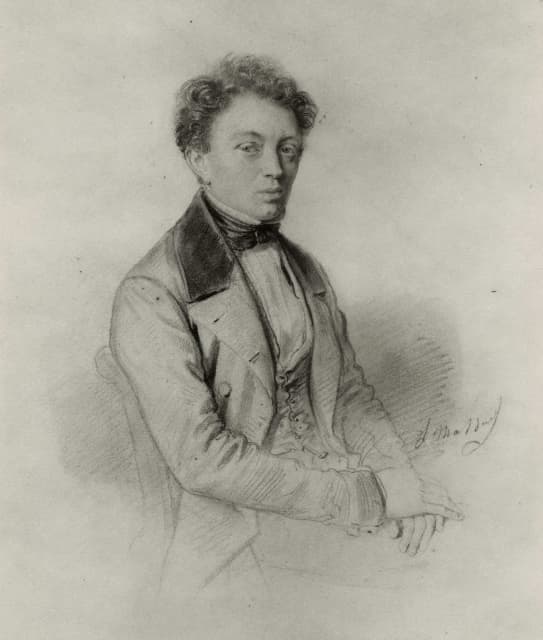
Auguste Franchomme
However, he ended up collaborating with one of his closest friends, cellist Auguste Franchomme, to create a Robert-inspired duo for cello and piano.
Chopin created the structure of the piece and notated the piano part, while Franchomme wrote the cello part.
When the work was published, both of their names appeared on the score.
They continued being friends for years to come. Franchomme actually ended up being one of Chopin’s pallbearers in 1849.
Read more about Frédéric Chopin and Auguste Franchomme’s intense friendship and collaboration.
Franz Liszt, Frédéric Chopin, Carl Czerny, and More: Hexameron (1837)
We’re sticking with the Chopin-and-opera theme for our next selection: Hexameron, a composition that has been arranged for all sorts of instrumentations, including solo piano, six pianos, piano with orchestra, and more.
Hexameron consists of six variations on a theme from Bellini’s 1835 opera I puritani.
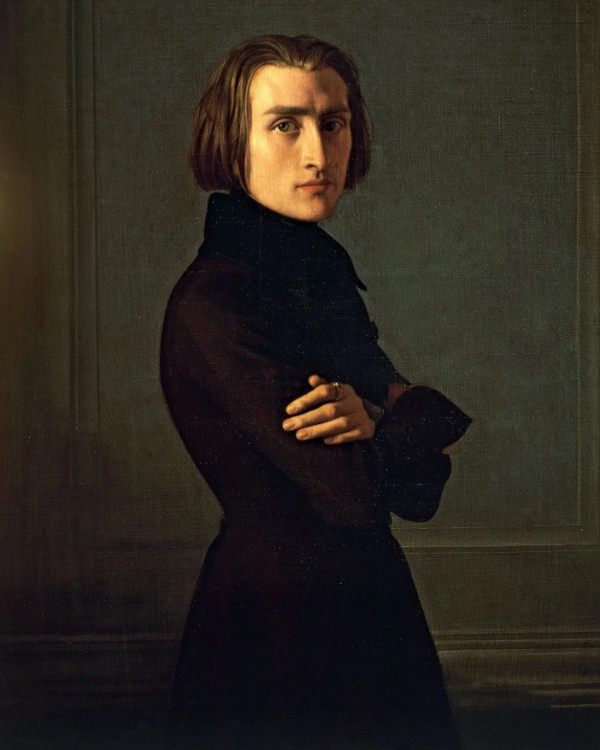
Franz Liszt
The beginning and the ending of the work were arranged by Liszt. In between are variations by Liszt’s rival Sigismond Thalberg, Liszt himself, Johann Peter Pixis, Henri Herz, Carl Czerny, and Frédéric Chopin.
The work was commissioned by Princess Cristina Trivulzio Belgiojoso, an Italian noblewoman, activist, and author who was holding a fundraising event for Italian refugees in her salon.
In the end, the composers weren’t able to finish their piece before the event date, but the fundraiser went ahead anyway.
Instead of debuting Hexameron, Liszt and Thalberg held a piano duel to determine who between them was the greatest pianist. (The result was a draw.)
As for Hexameron, it was finally published in 1839.
Hexameron for solo piano
It has also been rearranged for six pianos and orchestra, in the collaborative, virtuosic spirit of the original:
Liszt’s arrangement of Hexameron for six pianos and orchestra
Robert Schumann and Clara Schumann: Gedichte aus ‘Liebesfrühling (1840)
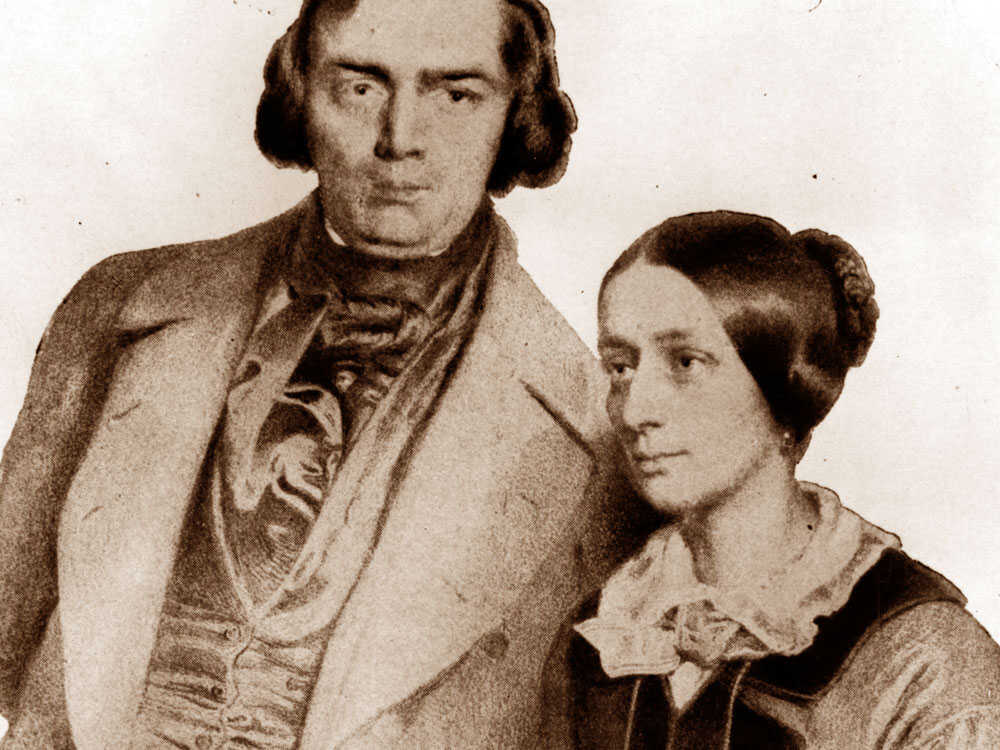
Robert and Clara Schumann
Clara Schumann: 12 Gedichte aus Liebesfrühling, Op. 37 (Olaf Bär, baritone; Juliane Banse, soprano; Helmut Deutsch, piano)
After a multi-year engagement (and her father doing everything in his power to break them up), Robert Schumann and Clara Wieck finally married in 1840.
He was one of the most talented composers of his generation, and she was one of the most talented pianists…and a great composer in her own right.
Robert had a tendency to dive into specific genres over a period of months, and around the time of their marriage, he was focusing especially intensely on composing songs.
One of the works he published was a twelve-song cycle called Gedichte aus Liebesfrühling (“Poems from the Spring of Love”), which was published as his Op. 37.
However, he didn’t write all of them. Clara actually wrote three of the songs: Numbers 2, 4, and 11. However, just like during Fanny Mendelssohn’s collaboration with her brother, Clara wasn’t initially credited.
Happily, when Clara catalogued her own compositions, she took them back and published them as her Op. 12.
Albert Dietrich, Robert Schumann, and Johannes Brahms: FAE Sonata (1853)
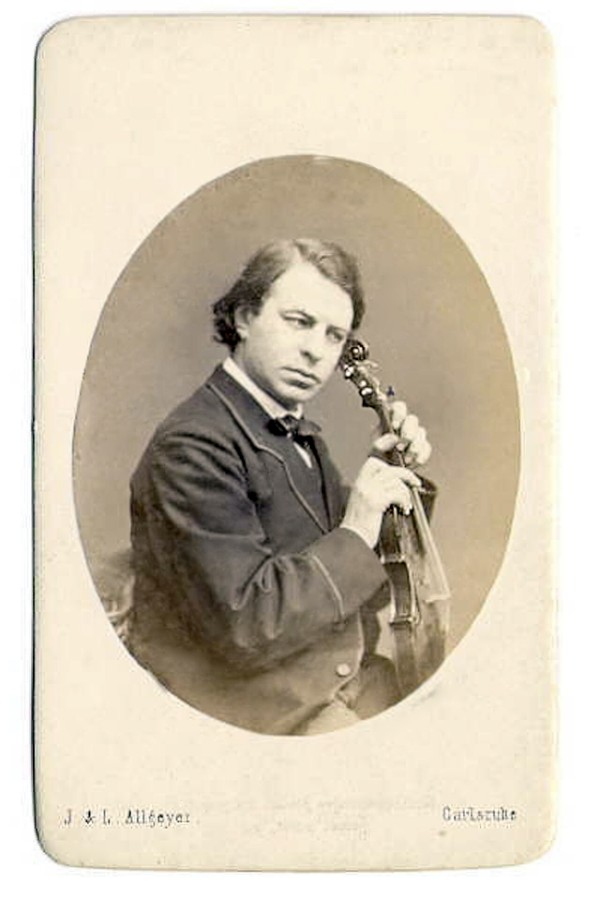
Joseph Joachim (Photo by Julius Allgeyer
This four-movement sonata for violin and piano was a gift for violinist Joseph Joachim.
The abbreviation F-A-E stands for 22-year-old Joachim’s personal motto about his romantic life: Frei aber einsam (“Free but lonely”). The three-note motif runs throughout the piece.
The collaborators were friends and colleagues Albert Dietrich, Robert Schumann, and Johannes Brahms. Dietrich composed the first movement, Schumann the second and fourth, and Brahms the third.
When the trio of composers presented it to Joachim at a party at Robert and Clara Schumann’s house in October 1853, they made him guess which composer had written which movement. Joachim, of course, knew the answers immediately.
Today, a 20-year-old Brahms’s contribution – the Scherzo – is sometimes played by itself on violin recitals.
Maxim Vengerov – Scherzo de la sonate FAE – Brahms
As for Joachim, he didn’t take the “free but lonely” motto seriously forever: he ended up marrying in 1863.
Conclusions
These six chamber music composer collaborations remind us that classical music isn’t – and never has been – composed by one sole solitary genius. Plus, they’re just fun to think about!
Which of these collaborations surprised you most? Let us know in the comments.
For more of the best in classical music, sign up for our E-Newsletter