Frédéric Chopin, arguably the most famous pianist in classical music history, suffered from stage fright and performance anxiety.
In March 1830, when he was twenty years old and preparing to leave his beloved hometown to make his name beyond Poland, he appeared in Warsaw, a sight that pleased the audience and organisers. They floated the idea of arranging another performance.
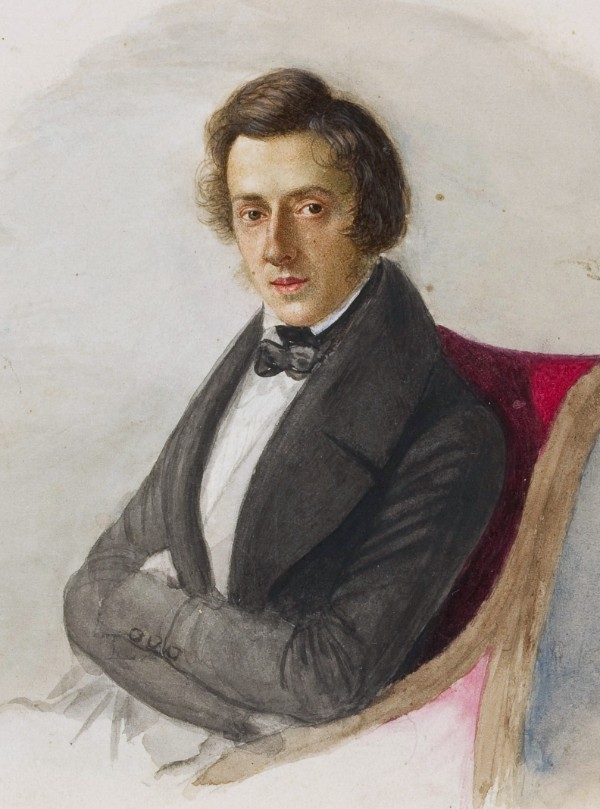
Maria Wodzińska: Frédéric Chopin, 1836 (Wasaw: National Museum)
But the offer wasn’t so easy for Chopin to accept. He confessed in a letter to his best friend Tytus Woyciechowski on March 27, 1830:
“You cannot imagine what a torture the three days before a public appearance are to me.”
In the end, he did give more concerts, and many were triumphs. But it seems that his performance anxiety never fully went away – and this was one of the reasons why Chopin gave only around thirty public performances over the course of his career.
Today we’re looking at the answer to the question: why did Chopin give so few public concerts – yet still go on to become one of the most important pianists of the nineteenth century?
Was It Stage Fright – Or Something Else?
Chopin may not have given many concerts, but that doesn’t mean he didn’t perform for others.
On the contrary, especially after he moved to Paris in the early 1830s, he gave regular informal salon performances.
At these salons, wealthy aristocrats would mix with writers, painters, and musicians.
So why did Chopin prefer the salon so decisively? There are a few reasons.
Stage Fright and Performance Anxiety
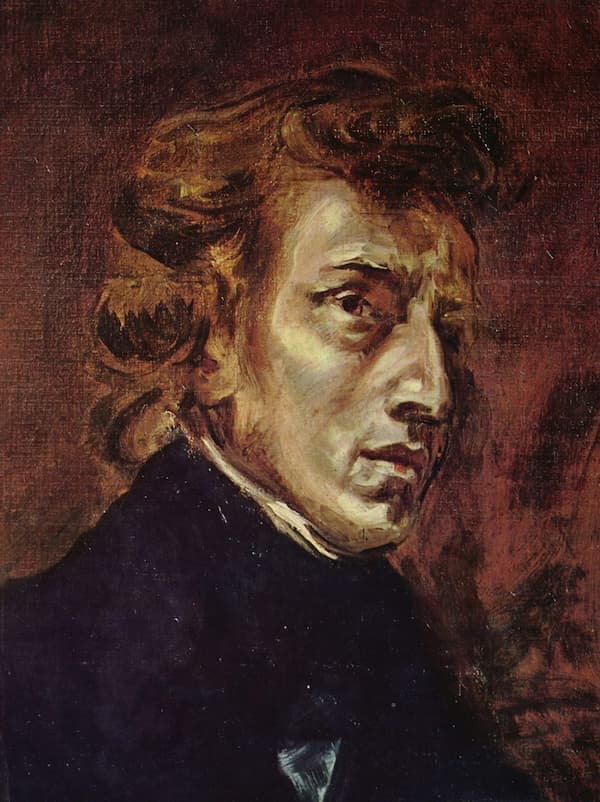
Portrait of Frédéric Chopin by Eugène Delacroix, 1838
We’ve already covered the first reason: his stage fright and performance anxiety.
To play in a well-appointed salon in front of friends or acquaintances who you know respect you – no matter how wealthy they are – is a fundamentally different experience from playing in a hall full of strangers.
Aesthetics and His Soft Touch
But there are other reasons, too. For one, Chopin’s touch was famously subtle. He was obsessed with opera and the human voice, preferring to focus on cultivating a singing tone over sheer flash-bang Lisztian virtuosity.
That kind of touch carries much better in a smaller space like a salon than in a full-scale concert hall built for hundreds.
He was very aware that people had this impression of his playing. In 1829, when he was on tour in Vienna, he wrote to his family:
“…It is being said everywhere that I played too softly, or rather, too delicately for people used to the piano-pounding of the artists here. I expect to find this reproach in the paper, especially as the editor’s daughter thumps frightfully. It doesn’t matter, there has always got to be a but somewhere, and I should rather it were that one than have people say I played too loud.”
Chopin’s Nocturne No. 2 in E-flat major, Op. 9, No. 2
His Health
Chopin’s chronic tuberculosis became symptomatic sometime around 1830, when he was in his early twenties.
In addition to racking coughs, patients suffered from persistent low-grade fevers, unbearable chronic fatigue, and susceptibility to other infections.
It was not a disease that was conducive to performing publicly – especially if you already had a touch of nerves to begin with.
His Philosophy
Chopin was deeply sceptical of virtuosity for its own sake. Unlike Liszt, who built his reputation on feats of almost superhuman technical display, Chopin believed that technique should be invisible: a means to an end, not the end itself.
You can hear this philosophy in his nocturnes, mazurkas, and the Ballades, pieces of enormous technical complexity that nonetheless should sound effortless.
Even his Études, ostensibly technical exercises, are among the most emotionally searching pieces in the piano repertoire.
For Chopin, the concert hall – with its pressure to dazzle, to project, to perform – ran counter to his priorities as an artist.
Chopin’s Etude in E major, Op. 10, No. 3
What Chopin’s Last Tour Suggests About the Road Not Taken
For most of his adult life, Chopin had the luxury of avoiding concert halls. His compositions sold, and his salon appearances had attracted a full roster of wealthy Parisian students willing to pay handsomely for an hour of his time.
Then, in 1847, everything fell apart at once.
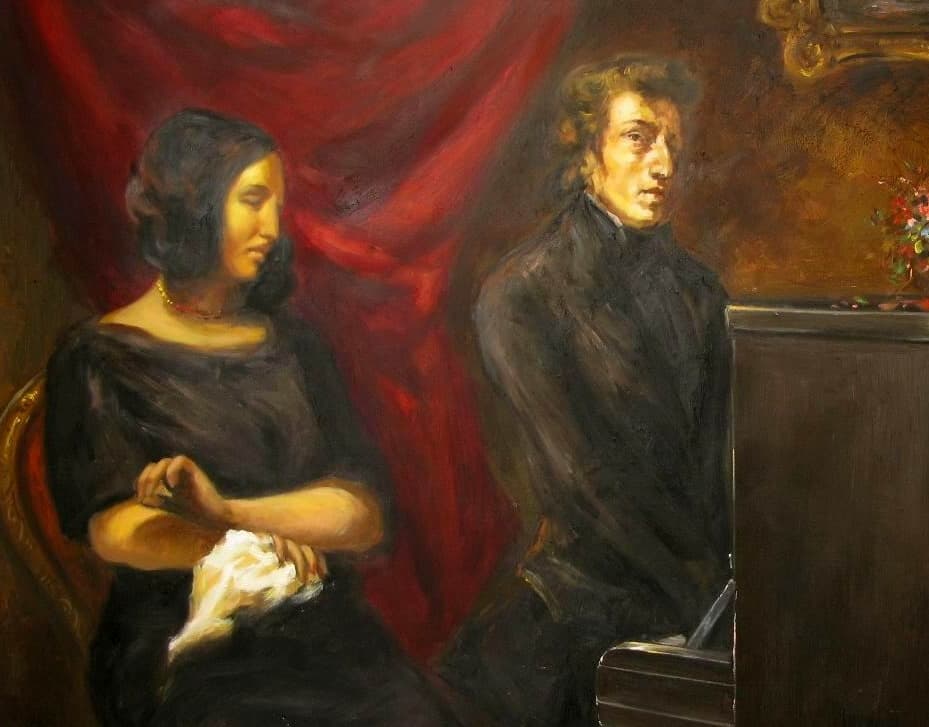
Portrait of Frédéric Chopin and George Sand by Eugène Delacroix
His relationship with George Sand – nine years long, tempestuous, and in many ways the emotional centre of his life – ended bitterly. His health, never good, deteriorated sharply in the aftermath of their breakup. And the following year, revolution swept Paris, drying up his teaching income almost overnight.
He was 38 years old, dying, sad, and suddenly broke. So, out of necessity, he did something he’d always been loath to do: go on tour.
His Scottish pupil and friend Jane Stirling arranged a tour of England and Scotland to shore up his finances, and Chopin – who had spent nearly two decades carefully limiting his public appearances – found himself giving concerts in London, Manchester, Edinburgh, and Glasgow in rapid succession.
Ironically, the greatest honour of the trip came when he played for Queen Victoria and Prince Albert not at a public concert, but at a private party.
Chopin’s Mazurka, Op. 63, No. 3
Through it all, he kept playing, even when he had trouble standing or had to cut his programs because his physical stamina was so low. But demand for tickets was inconsistent, and Stirling ended up buying many and giving them out for free.
Chopin’s letters from this period are harrowing. In one, he described stopping while in Edinburgh to write out his will.
He returned to Paris in November 1848, having given his last ever public concert in London, and died in October 1849.
The tour made one thing clear: whatever his exact reasons for staying off the concert platform, Chopin made the right choice.
Conclusion
Chopin’s stage fright was real, but it was only one thread in a larger, more complicated story.
His avoidance of the concert platform was also a matter of aesthetics, of physical necessity, and of genuine artistic conviction. Taken together, these factors make for a more interesting story than a simple case of nerves: they paint a picture of an artistic identity that prioritised intimate music-making over public spectacle.
It’s also worth asking what we would have lost if Chopin had pushed through his anxiety and pursued a conventional performing career. More concerts would almost certainly have meant fewer compositions – and it’s the compositions, not the performances, that made him one of the most important figures in the history of Western music. Every nocturne, every ballade, every étude exists in part because Chopin protected his time and his energy rather than spending it onstage on tour.
Chopin’s music speaks as directly to audiences today as it did in those Parisian salons, even though he never embraced touring or public concerts.
Sometimes the quieter path is the right one.
For more of the best in classical music, sign up for our E-Newsletter