Most listeners know Johannes Brahms‘s two String Quintets as richly textured chamber works, full of soaring melodies and intricate conversations between five string players. Yet Brahms himself left behind another way of experiencing these masterpieces. His own four-hand piano transcriptions of the String Quintets in F major, Op. 88, and G major, Op. 111 reveal the music from a different perspective, bringing the composer’s harmonic language, contrapuntal writing, and architectural thinking into especially sharp focus.
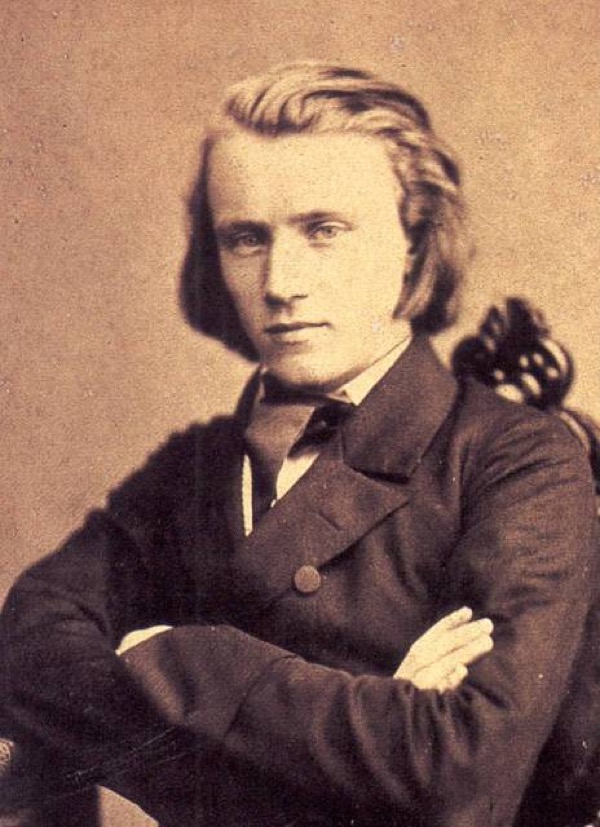
Johannes Brahms, 1853
That idea lies at the heart of Federica Righini and Riccardo Zadra’s latest recording. Performed on an 1860 Streicher piano similar to the one Brahms himself owned, the album invites listeners to encounter these familiar works through the instrument that played such an important role in the composer’s creative life. Rather than viewing the transcriptions simply as practical arrangements, the duo regards them as an extension of Brahms’s compositional thought.
“Brahms almost always worked out his musical ideas at the piano before they assumed their final form in the score,” they explain. “These versions can therefore be understood as a return to the very source of the creative process. They are far more than reductions: they seem to bring the music back to the place where the musical idea began to take shape.”
They began their exploration of Brahms’s piano transcriptions with the String Quartets, then continued with the Symphonies. The Quintets, they explained, served as a natural bridge between those two worlds. The works maintain the intimacy of chamber music while conveying a dense texture.
The more Righini and Zadra studied the transcriptions, the more they wondered why they had remained so neglected. As they explain, the works were “almost absent from the discography” and “had never really become part of the established repertoire of piano duos, either past or present,” despite their extraordinary musical value. For the duo, these are not simply domestic arrangements but works in which “Brahms fundamentally reimagines his own musical language from the perspective of the piano.”
For Righini and Zadra, the recording was never simply about documenting a neglected repertoire. Instead, they describe it as “the natural culmination of a long process of study and research,” driven by both their love for the two masterpieces and their belief that the piano versions offer “a uniquely privileged perspective on Brahms’s musical thought, structure and compositional language.”
The choice of instrument is equally prominent to that vision. Righini and Zadra selected an 1860 Streicher because it was Brahms’s favourite piano, and because they had the rare opportunity to work on an instrument virtually identical to the one he owned. The piano’s distinctive registers, transparent inner voices, and naturally balanced sound reveal details that can be more difficult to perceive on a modern concert grand. Its shorter resonance also allows textures to remain remarkably clear, while its responsive action influences not only articulation and touch but the performers’ entire physical relationship with the music.
Righini and Zadra further explain, “the challenge is not simply to realise every note, but to preserve clarity, musical direction and the independence of the individual voices within such a densely woven texture.” During their preparation, they spent a great deal of time comparing the transcriptions with the original string scores “both to understand more clearly the function of the individual voices and to resolve several inconsistencies, including a couple of harmonic errors that had apparently escaped even Brahms’s remarkably meticulous eye.” Where necessary, they introduced only the smallest adjustments. In the first movement of Op. 111, for example, they found that redistributing certain repeated notes into broken octaves “produces a more natural and effective result on the keyboard.” At the same time, in the Finale of Op. 88 they “slightly lightened the texture by removing a few doublings in the bass.” Throughout, their goal was never to simplify Brahms’s writing, but “to make it more natural and convincing on the piano.”
Perhaps the greatest discovery was not the revelation of entirely new musical ideas but a different way of hearing familiar ones. As the duo explains, transferring the music from strings to the piano changes the listening hierarchy. While the melodies remain as compelling as ever, rhythmic, harmonic, and contrapuntal elements emerge with far greater clarity. In the second movement of Op. 88, for instance, returning the music to the piano reconnects it with its origins in Brahms’s earlier keyboard works, allowing the rhythmic profile and character of the sarabande to emerge with immediacy.
The two quintets showcase different stages of Brahms’s creative life while complementing one another. Righini and Zadra say that what has always struck them about Op. 88 is “its freshness and sense of joy.” Although its structural and contrapuntal sophistication is remarkable, their aim is “to preserve the music’s natural flow, rhythmic vitality and luminous sonority,” allowing “its naturalness, flexibility and joyful inventiveness to emerge throughout the work.” Op. 111, by contrast, belongs to “a broader and more complex emotional world,” one that combines “profound melancholy with an overflowing love of life.” The duo believes that, in composing a second String Quintet, Brahms intended “both to carry the genre forward and to bring it to its fulfilment.” Thus, presenting the two works together is a logical programming choice and a way to show how each quintet illuminates the other and reveals “the remarkable breadth of his musical world.”
Far from replacing the original String Quintets, these performances offer another way of understanding them. Returning the music to the piano allows listeners to experience Brahms’s compositional thought from a different perspective while revealing details of the structure, harmony, and counterpoint that often remain beneath the surface. Righini and Zadra show that these transcriptions are not simply reductions of familiar chamber works but thoughtful reimaginings by the composer himself.
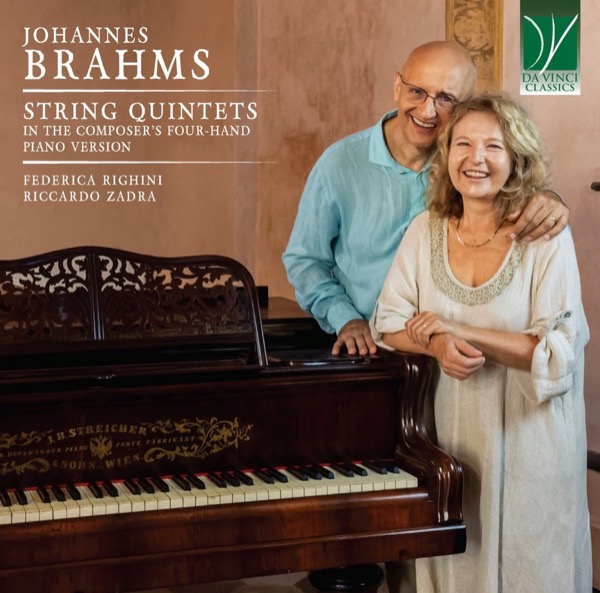
Brahms: String Quintets – In The Composer’s Four-Hand Piano Version, Federica Righini and Riccardo Zadra (Da Vinci Classics)
Brahms: String Quintets – In The Composer’s Four-Hand Piano Version
Performed by Federica Righini and Riccardo Zadra
Edition: Da Vinci Classics
For more of the best in classical music, sign up for our E-Newsletter