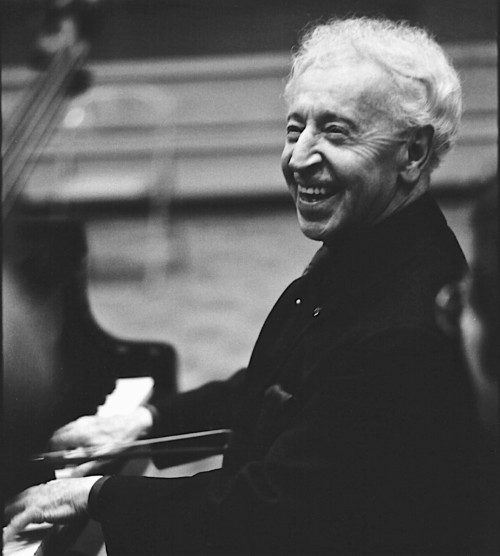
From Strauss’s Salome to Stravinsky’s Rite of Spring and beyond, some of the most famous pieces in classical music history began as scandals. (Read “The Most Controversial Classical Music Ever Written, Part 1”.)
When these five works first hit the stage, audiences and critics clutched their pearls, and sometimes censors even shut them down.
Whether it was the eroticism of Salome, the eclecticism of Bernstein’s Mass, or the sheer silence of John Cage’s 4’33”, each of the following five works pushed up against the boundaries of what music could be…and paid the price for it in the press.
Strauss – Salome (1905)
Dance of the Seven Veils from Salome
Richard Strauss’s opera Salome, based on Oscar Wilde’s lurid play, provoked immediate scandal for its shocking story and audacious music.
The one-act opera features Princess Salome’s depraved dance and her kissing of the decapitated head of St. John the Baptist: subject matter that outraged moral authorities.
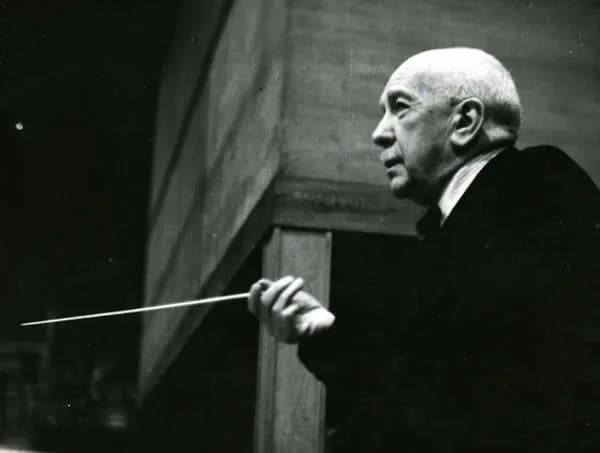
Richard Strauss conducting
- Gustav Mahler, conductor of the Vienna Court Opera, was unable to get the Viennese censor to approve mounting the opera.
- Wealthy patrons shut down the first New York production in 1907…and it didn’t return to the Metropolitan Opera until 1934!
- Singer Marcella Sembrich wrote after seeing it in Dresden, “The orchestra…was perfectly wonderful, but the music is unexampled lunacy. It can scarcely be called music at all – a chaos of 103 instruments playing in different keys at the same time, while the singers sing – beg pardon, screech – in other keys. It is interesting, but very little of it is beautiful. The subject is repulsive – perverse.”
However, proponents existed, too.
- Edward Elgar refused to condemn Strauss, calling him “the greatest genius of the age.”
- The New York Times reported, “Salome surpasses Don Quixote, Ein Heldenleben, the Symphonia Domestica in its minute orchestral illustration of incident. Not a word, not a motion, not a passing thought upon the stage escapes him, and he has resources for the depiction of each in orchestral tone.”
- Composer Arnold Schoenberg kept the score on his piano and told his piano students, “Perhaps in twenty years’ time someone will explain these harmonic progressions.”
Learn more about the controversial early life of Salome.
Stravinsky – The Rite of Spring (1913)
The premiere of the Rite has been described as inciting a riot, but the truth was more nuanced than that.
Nevertheless, it is true that many people were less than impressed.
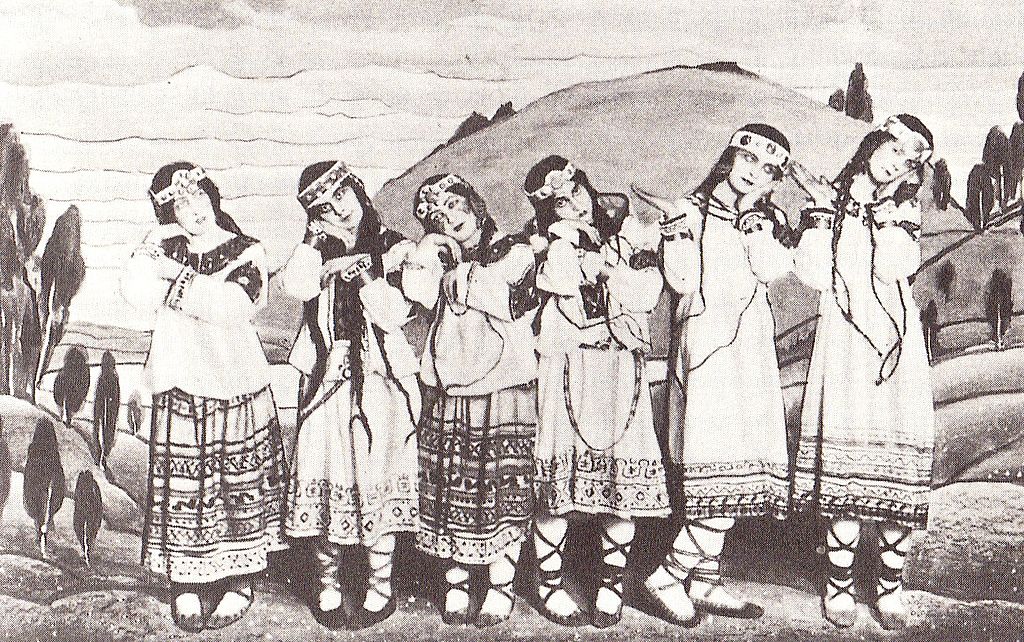
Dancers from The Rite of Spring, 1913
- Critic Henri Quittard wrote in Le Figaro that the work was “a laborious and puerile barbarity.” He scolded: “We are sorry to see an artist such as M. Stravinsky involve himself in this disconcerting adventure.”
- Puccini attended an early Parisian performance and described the ballet as “the work of a madman. The public hissed, laughed – and applauded.”
- Composer Julius Harrison wrote of Stravinsky’s “abhorrence of everything for which music has stood these many centuries…all human endeavour and progress are being swept aside to make room for hideous sounds.”
Others were more sympathetic.
- During the premiere week, Maurice Ravel attempted to quiet the sceptics around him.
- Musicologist Donald Jay Grout wrote, “The Sacre [Rite] is undoubtedly the most famous composition of the early 20th century… It had the effect of an explosion that so scattered the elements of musical language that they could never again be put together as before.”
- Writer Léon Vallas mused that Stravinsky had written music “thirty years” ahead of its time.
- A quarter century after its premiere, Walt Disney used excerpts from the ballet in the groundbreaking 1940 film Fantasia, signalling that the Rite was here to stay.
Check out our article about the intense premiere of the Rite of Spring.
Ives – Concord Sonata (1915)
Charles Ives’s Piano Sonata No. 2 (“Concord, Mass., 1840–60”) – commonly known as the Concord Sonata – is now acclaimed as a masterpiece of American modernism, but early on, it was received with scepticism.
It was written around 1915, published in 1920, and premiered in its entirety in 1939, to starkly mixed reviews.
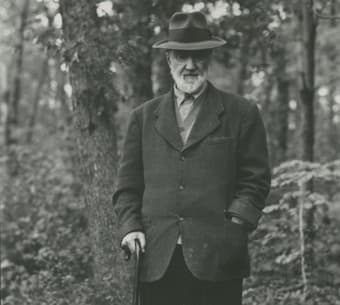
Charles Ives
- Composer and critic Elliott Carter was disappointed by it, writing in an infamous review of its “disturbing lack of musical and stylistic continuity.”
- Even Ives himself was, in some ways, ambivalent about the idea of a finished concert version: “I find that I do not play or feel like playing this music even now in the same way each time… Some of the passages now played have not been written out, and I do not know as I ever shall write them out, as it may take away the daily pleasure of playing this music and seeing it grow and feeling that it is not finished and the hope that it never will be – I may always have the pleasure of not finishing it.”
Not everyone was disappointed, though.
- Composer Henry Cowell and his wife Sidney reported, “The audience responded so warmly that one movement had to be repeated, and on 24 February, at a second Town Hall program that was devoted entirely to Ives, [pianist John] Kirkpatrick repeated the whole Sonata by popular request.”
- American writer Henry Bellamann has called it “elevating and greatly beautiful.”
Cage – 4’33” (1952)
David Tudor performing 4’33”
John Cage’s 4’33” (which consists of four minutes and 33 seconds of silence) remains one of the most controversial compositions ever conceived.
Premiered in 1952 in Woodstock, New York, by pianist David Tudor, who sat at a piano without playing a note, 4’33” challenged the very definition of music.
Reaction was extreme: many critics and musicians refused even to acknowledge 4’33” as music at all.
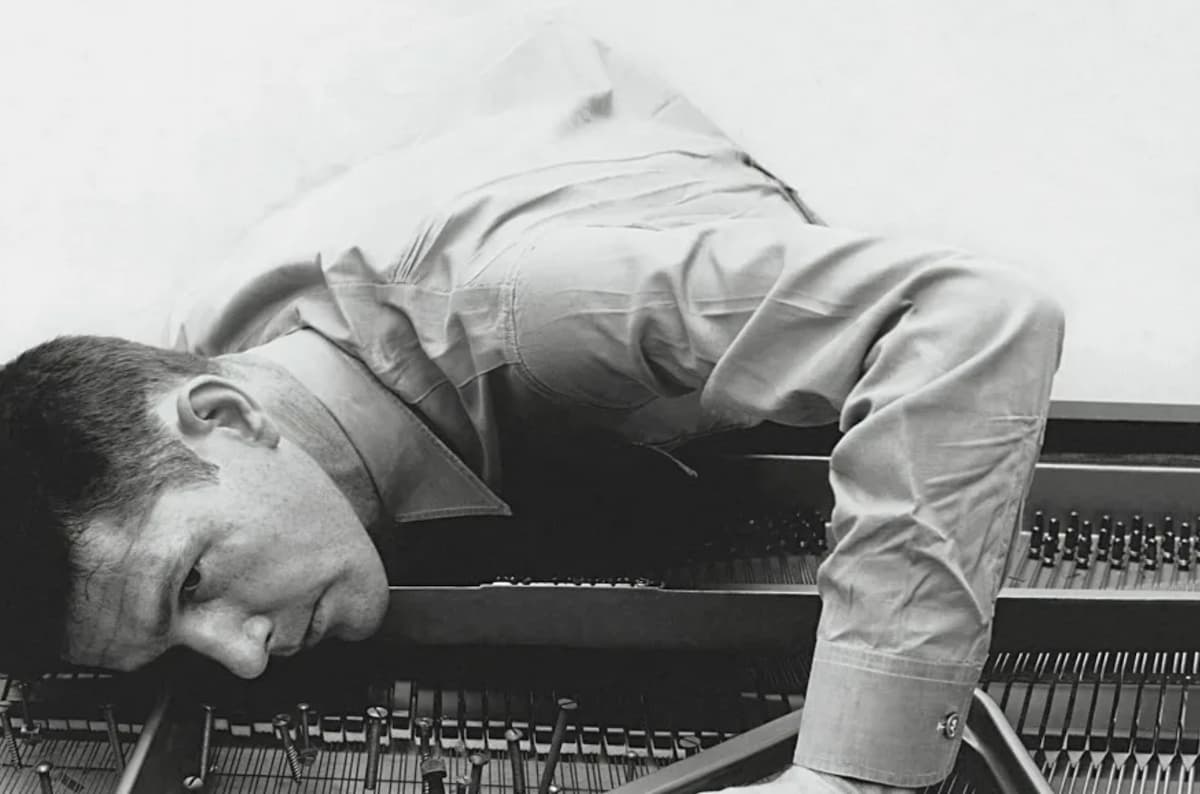
John Cage and his prepared piano
- At the premiere, a local reportedly yelled, “Good people of Woodstock, let’s drive these people out of town!”
- In 1954, a concert of contemporary works that included 4’33” elicited a scathing review from the New York Times: “Works of this sort have nothing in common with the disciplined art of Palestrina, Handel, Mozart and the obvious B’s; they are hollow, sham, pretentious Greenwich Village exhibitionism. Oddly, it is less easy to fool a naive audience with such things than a sophisticated audience that does not know very much about the structure of music; an audience, that is, more adept at intermission chatter than at working counterpoint.”
Others were more generous.
- Tudor himself noted that it’s “one of the most intense listening experiences you can have.”
- Critic Kyle Cann wrote that 4’33” is “one of the most misunderstood pieces of music ever written and yet, at times, one of the avant-garde’s best understood as well.”
- Cage himself was satisfied with the work, writing of the hubbub, “They missed the point. There’s no such thing as silence. What they thought was silence, because they didn’t know how to listen, was full of accidental sounds. You could hear the wind stirring outside during the first movement. During the second, raindrops began pattering the roof, and during the third, the people themselves made all kinds of interesting sounds as they talked or walked out.”
- BBC Music Magazine has named it one of the twenty works that defined the twentieth century.
Read contributor Frances Wilson’s thoughts on 4’33” and why she wants to experience a performance of it herself.
Bernstein – Mass (1971)
Leonard Bernstein’s Mass: A Theatre Piece for Singers, Players, and Dancers debuted in 1971 as the inaugural production at the Kennedy Center, and it immediately ignited controversy.
Blending Catholic liturgy with Broadway, rock, and social commentary, the Mass scandalized some religious and musical observers even as it wowed others.
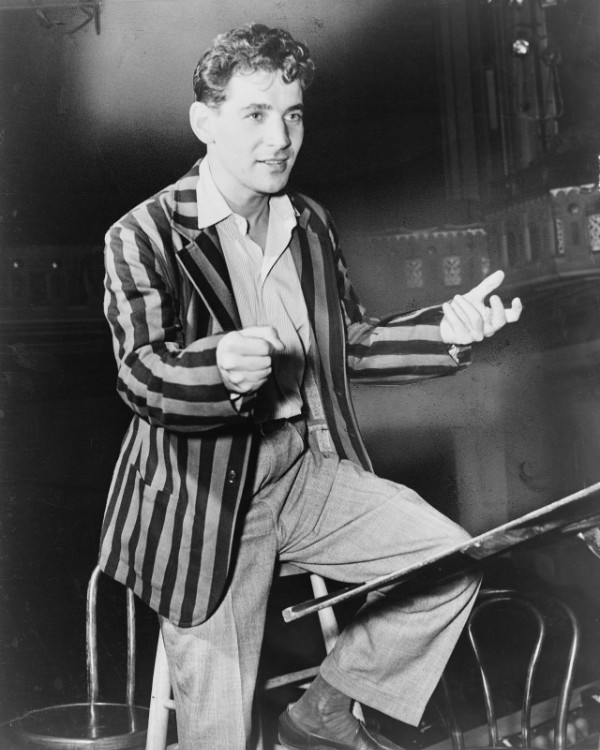
Leonard Bernstein, 1945
- The New York Times reported, “There were those who dismissed the Mass out of hand as vulgar trash, saying derisively that it was worthy of the building. There were those who were distressed about the treatment of the Catholic liturgy, especially the moment when the Cross is destroyed.”
- Critic Harold Schoenberg wrote, “At times the Mass is little more than fashionable kitsch. It is a pseudo‐serious effort at re-thinking the Mass that basically is, I think, cheap and vulgar. It is a showbiz Mass, the work of a musician who desperately wants to be with it.”
- Ten days later, the Times dropped another scathing review: “The Bernstein was a combination of superficiality and pretentiousness, and the greatest mélange of styles since the ladies’ magazine recipe for steak fried in peanut butter and Marshmallow sauce.”
Others, however, grew to like it.
- The New York Times revisited the work in 2002: “In retrospect, it’s hard to understand the hostility the work provoked. Admittedly, the text is glibly anti-establishment and often mawkish. But after 9/11, a line like ‘Everyone who hates his brother is a murderer’ no longer seems such pap.”
- In 2012, Australian magazine Limelight wrote of a local performance that it was “a brave production of a brave work that doesn’t shy away from exposing the contradictions and hypocrisy of life with or without religion.”
- Paul Hume from the Washington Post wrote, “While ‘Mass’ is theater and dance, it is above all music. Certainly, from the ‘Agnus Dei’ to the end, it is the greatest music Bernstein has ever written.”
Learn why Bernstein’s Mass came up in the infamous tapes of President Richard Nixon…and why Nixon called Bernstein “a son of a bitch”.
Conclusion
Classical music history shows that yesterday’s outrage sometimes turns into the next day’s masterpiece.
Richard Strauss, Igor Stravinsky, Charles Ives, John Cage, and Leonard Bernstein all created works that inspired pushback at the time of their premieres…but we’re still listening to all five of them today.
What’s your favourite controversial piece of classical music?
For more of the best in classical music, sign up for our E-Newsletter