A Confluence of Traditions
When Joseph Haydn attended the monumental Handel Festival at Westminster Abbey toward the end of May 1791, he encountered something far grander than mere musical entertainment. He witnessed an entire nation unified by a collective historical consciousness, channelled through the vast, thousand-performer choral architecture of an English Enlightenment idol. By the closing decades of the eighteenth century, London’s vibrant and fiercely competitive commercial music scene had cultivated a unique appetite for the revival of old masterworks alongside a continuing demand for new entertainments. This historical perspective placed Haydn—who had spent decades as a court servant in the insular world of the Esterházy estate—in a novel position. As Europe’s latest musical superstar, he found himself directly confronted with the “sublime”, a concept theorised by Edmund Burke as an irresistible, overwhelming force that elevates us through its sheer power.
This British encounter sparked a profound creative transformation. While Handel’s oratorios were certainly known in Vienna—largely through the efforts of Baron Gottfried van Swieten, who had arranged performances and aroused the interest of Mozart—the distinct English tradition of massive, public performance was entirely new to Haydn. It suggested a triumphant return to a grand vocal form he had not explored since Il ritorno di Tobia sixteen years earlier. Haydn resolved to create a work of unique ambition and international appeal: a secularised yet deeply spiritual monument that would secure his own place in posterity.
The Genesis and the Double Text
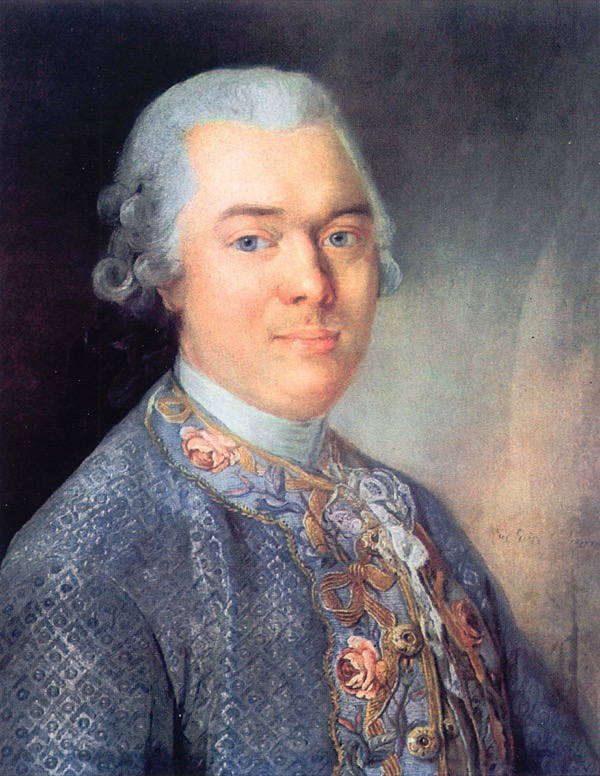
Gottfried van Swieten (ca 1750)
The genesis of The Creation (Die Schöpfung) is thus inextricably bound to this cross-channel cultural exchange. It was through the violinist-impresario Johann Peter Salomon that Haydn came by an anonymous English libretto based on the Bible and Milton’s Paradise Lost—a text once intended, by some accounts, for Handel himself. Upon his return to Vienna, Haydn entrusted this English draft to Baron van Swieten, the imperial court’s Trendsetter. Van Swieten did not merely translate the verses into German garb; he systematically compressed its overarching plan and interspersed the manuscript with precise suggestions for appropriate musical settings.
Once Haydn began composing in 1796, the two men collaborated closely on textual alterations. Van Swieten even devised a subsequent, though occasionally unidiomatic English version to match his German text and Haydn’s musical phrasing. The resulting double-language score published in the 1799 edition represented a radical milestone, offering a shared humanist masterpiece across linguistic boundaries. Although Salomon initially claimed rights to the text, a series of mail delays in 1800 ultimately put him at a disadvantage.
Structural Design and the Chaos of the Mind
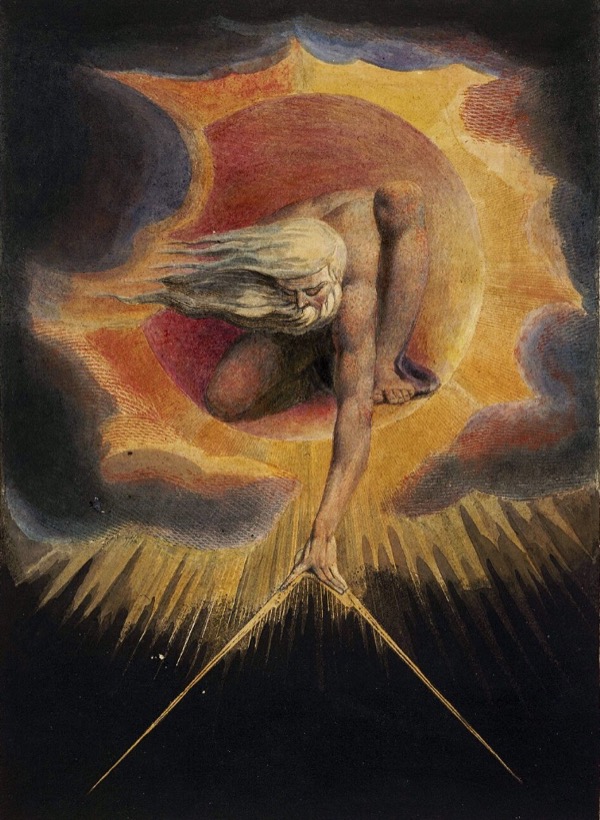
Europe a Prophecy (William Blake 1794)
The oratorio unfolds through an elegant, tripartite architecture. Parts I and II chart the cosmic genesis of the physical world through the narrative voices of three archangels: Gabriel (soprano), Uriel (tenor), and Raphael (bass). Each day follows a meticulous Enlightenment design: a prose narrative from Genesis, delivered in recitative, gives way to a poetic solo or ensemble commentary before culminating in a grand choral hymn of praise.
It is in the opening introductory Vorstellung des Chaos (Representation of Chaos) that Haydn, however, shatters the formal boundaries of his era. To depict a universe devoid of form, he deliberately eschews classical symmetry. Instead, he crafts a winding C-minor Largo characterised by shifting, unstable harmonies. This yawning, empty space does not arrive fully formed before the listener; rather, the disparate orchestral textures seem to congeal before our ears. It was an extraordinary essay in sustained tension, effectively paving the ideological way for the “primordial” musical openings of nineteenth-century symphonism, most notably the start of Beethoven’s Ninth Symphony.
Joseph Haydn: Die Schöpfung, Part I: Die Vorstellung des Chaos (Freiburg Baroque Orchestra; René Jacobs, cond.)
The Sonic Explosion of Light
This calculated instability heightens the impact of the work’s central aesthetic shock: the creation of light. Following Raphael’s hushed, bass recitation of the first words of Genesis, the chorus enters in a muted, trembling whisper as the Spirit of God moves upon the waters. On the final word of the divine command—“Let there be LIGHT”—the strings unmute after a single plucked note.
The chorus and orchestra erupt into a sustained, blinding burst of C major, reinforced by blazing brass and grand timpani strokes. For contemporary audiences, this sudden, radical transformation from C-minor obscurity to major illumination was recognised as the ultimate epitome of the sublime. A generation of later compositions would echo this sublime dramatic pivot, not least in Beethoven’s Fifth Symphony, which features a dramatic transition from C minor to C major at the start of its finale.
Sound Painting and the Interconnected Chain of Being
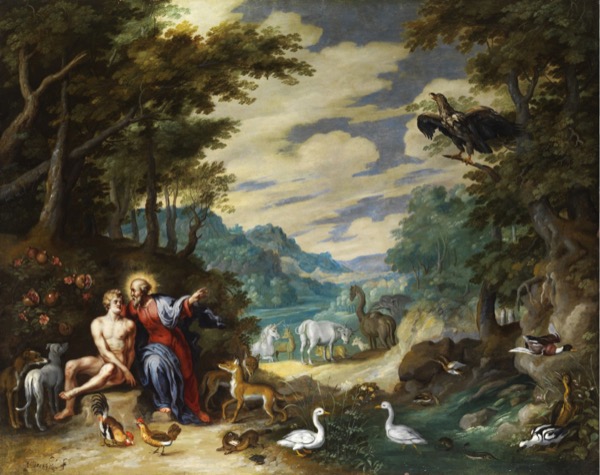
Creation of Adam in the Paradise (Jan Brueghel the Younger)
As the narrative progresses through the initial days of creation, Haydn employs a highly sophisticated degree of sound painting to populate his newborn cosmos. Though a subsequent Romantic generation—including Beethoven in his Pastoral Symphony—would dismiss such literalism as naive, Haydn’s musical mimicry is guided by a profound intellectual wit. Rapid, undulating scales delineate the scattering of storm clouds; sudden orchestral jolts evoke the flash of lightning; heavy, rhythmic thuds mimic the crash of thunder; and varying figures depict rain, clattering hail, and light, drifting snow. In the celebrated aria “Rollend in schäumenden Wellen” (Rolling in foaming billows), three bars of quick quavers illustrate the word “läuft” (runs) as a soft, purling brook emerges through matching violin figuration.
Joseph Haydn: Die Schöpfung, Part II: Auf starkem Fittiche schwinget sich der Adler stolz (Gabriel) (Julia Kleiter, soprano; Freiburg Baroque Orchestra; René Jacobs, cond.)
This pictorialism becomes even more pronounced in the zoological tapestries of Part II. The air and land are filled with distinct sonic signatures. The proud upward soar of the eagle is succeeded by the clarinet’s imitation of the lark, while historic bassoons depict the gentle conjunction of mating doves. The flute, meanwhile, captures the extended, elegant song of the nightingale. On the sixth day, the earth opens its womb to terrestrial beasts. A quick, sharp flourish brings out the roaring lion, a series of flexible, twisting notes shows the nimble tiger, and rapid rhythms evoke the leaping stag. The brass instruments play a proud rhythm for the noble horse with its flying mane.
Even the humblest creatures are granted a voice: a heavy, fortissimo bassoon and contrabassoon line emphasises the heavy tread of giant beasts sinking into the mud, followed immediately by a long, low, sliding note from the strings to show a worm creeping along the dirt. The sequence culminates in Uriel’s majestic C-major aria, “Mit Würd’ und Hoheit angetan” (In native worth and honour clad), proclaiming Man as the noble “King of Nature”. This nobility explicitly channelled the contemporary masonic and rationalist ideals of the Viennese Enlightenment.
The Domestic Ideal and the Dawn of a New Age
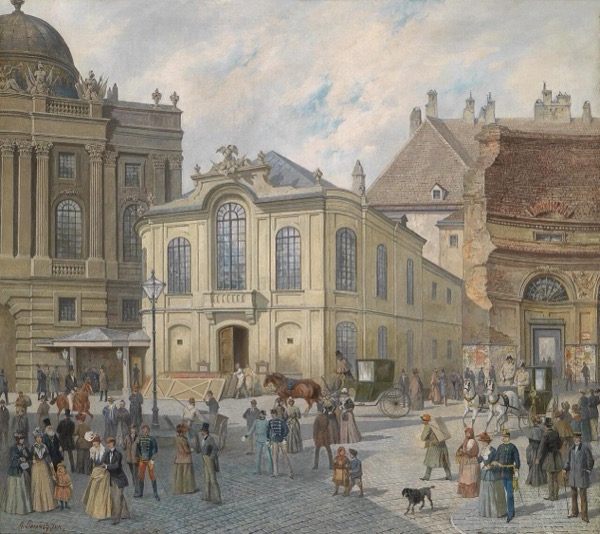
Old Burgtheater, site of the 1799 public premiere in Vienna
The true philosophical core of The Creation reveals itself in Part III, where the grand cosmic narrative abruptly shifts into the intimate, pastoral realm of Eden. Introduced by an exquisite, delicate configuration of three flutes, horns, and strings, the domestic sphere of Adam and Eve unfolds. Here, Adam sings of the morning dew and Eve of the evening cool; he sings of the fruit and she of the flowers, declaring that nothing has meaning without their mutual companionship. The work suggests that the ultimate crown of creation is human partnership, mutual reason, and love.
When the first public performance was given at Vienna’s Burgtheater on March 19, 1799, before a crowded auditorium, the reaction was rapturous. It aroused the warmest applause and approval for a work described by one writer as the “masterpiece of the new musical age”.
A few years later, in December 1808, a triumphant Viennese performance was organised to honour the ageing composer. The leading musicians of the city, including Beethoven, came to genuflect before the Grand Old Man of European music. When the orchestra reached that world-shattering chord on the word “Light,” Haydn, moved to tears, raised his hands towards heaven in a theatrically humble gesture. As one Berlin critic punned, “It is its own creation, of its own kind, its own free tool of music”.
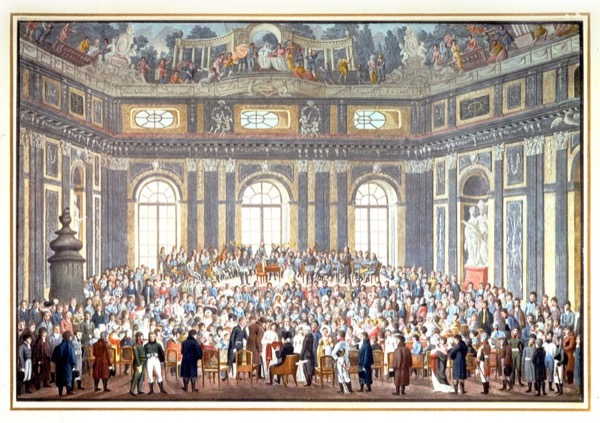
1808 performance of The Creation in honour of Haydn
For more of the best in classical music, sign up for our E-Newsletter