We spoke recently with the American composer Jessica Krash (b. 1959), whose new album, True Stories, came out in September. Collecting her recent compositions, it brings us what the composer describes as a crazy quilt, a patchwork of materials that might seem initially to be unrelated but that, as a whole, give us a new way of looking at the world.
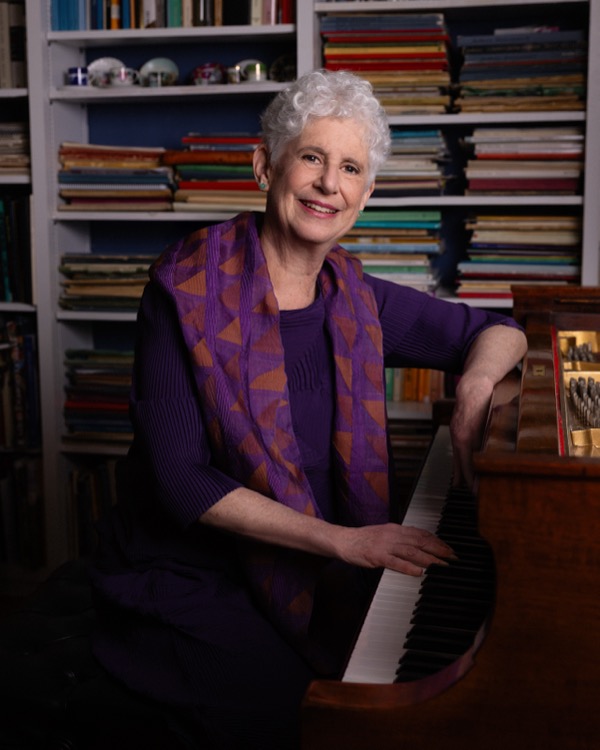
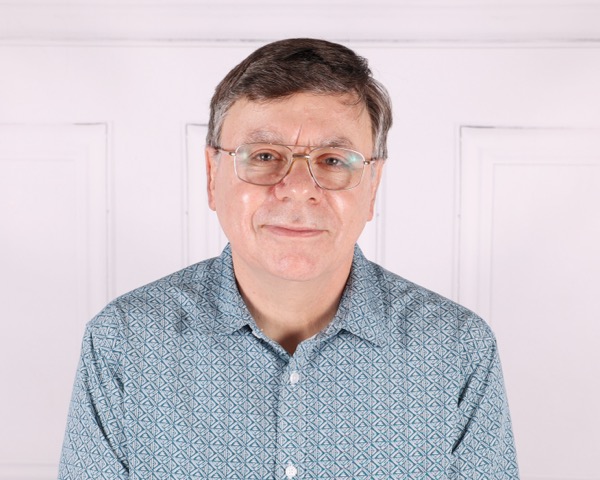
Jessica Krash (photo by Jennifer Packard)
In an earlier article on Professor Krash, we looked at a work for piano quintet that has been commissioned by the National Gallery of Art and The National Museum of Women in the Arts based on 14 paintings of women. She recast the portraits in modern terms, seeing a delicate beauty by Fragonard as secretly worrying about the global economy or imagining a Max Ernst metal mermaid as a pop diva.
In a similar fashion, this album mixes metaphors and ideas. She opens with a work she wrote as a processional for her son’s wedding, and in a simple work for cello and piano, she brings out all the pride she has in her son and her thoughts of the new life he and his wife are starting. There’s a bit of jazz, a bit of lazy wandering, and yet, at the same time, it is a processional.
Jessica Krash: What I Wish for You (Tanya Anisimova, cello; Jessica Krash, piano)
Later in the album, we encounter author and pianist Catherine Kautsky, who had commissioned a piece for piano and spoken word that she could perform on her book tour for Debussy’s Paris: Piano Portraits of the Belle Époque.
Krash created a vocal piece that took short phrases in Debussy’s own words; texts from Verlaine, Louÿs, and Baudelaire that Debussy had set; and titles of his pieces to create a work that encapsulates what we think of Debussy today, expressed in the sensibility of the 19th century.
Jessica Krash: Debussy Chez Moi (Catherine Kautsky, voice and piano)
It’s an interesting experiment in word and sound that evokes both the past and our present. We discussed other works on the recording that she had originally envisioned as vocal pieces but which became instrumental pieces in the end. Two of these were movements in 5 Pieces about Women in the Sky.
In this work, Krash takes up the singular topic of women in the air. She opens with an idea taken from an image by Marc Chagall. She observed that in so many of his pictures where women are in the sky, they don’t seem to be particularly happy. In this 1918 work, Over the Town, Chagall and his wife Bella fly over his hometown of Vitebsk.
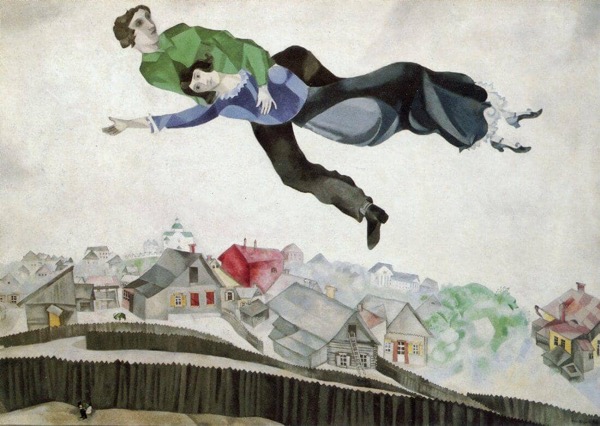
Chagall: Over the Town, 1918 (Moscow Tretyakov Gallery)
And so we have movement I, Flying Like Chagall’s Women, But Happier Sometimes. Although in some of the paintings, Chagall may be happy and smiling, his women remain solemn. He’s painting his internal emotions but fails to catch the women’s. Krash imagines her own happiness at being able to fly above her own town.
In the second movement, Krash reflects on the early days of Covid in the US and the observation that lockdown kept so many people working from home or overseeing their children’s education that only grandparents were on airplanes, as they had been the first to receive the new vaccines. Her music captures their thoughts and fears, tinged with a hint of the music of their earlier time. Krash had first conceived of this as a vocal piece but, in the end, decided to focus on the grandparents’ thoughts, expressed in the walking bass line.
Jessica Krash: 5 Pieces About Women in the Sky: No. 2. The Planes Were Filled with Grandmothers (Jessica Krash, piano)
The next woman in the sky is the Southwest Airlines pilot Tammie Jo Shults, who, when faced with a disabled aircraft, used all her skill to bring the plane to the ground safely. The passengers spoke of hearing her voice, describing it as the ‘steady, comforting, competent voice from the cockpit’. There’s drama in the work, with much rumbling in the lower keys of the piano, and moments of solitude as the passengers confront their mortality. This was also initially conceived as a vocal piece, since it was Shults’ voice that comforted her passengers.
The next occupants in space are the two astronauts, Christina Koch (engineer) and Jessica Meir (marine biologist), who did the first all-woman spacewalk in 2019. The picture of the two scientists, with their hair flying around their heads, captured Krash’s imagination, and so we have Gravitas Without Gravity – Images from the First All-Woman Spacewalk (2019).

The astronauts Jessica Meir (left) and Christina Koch with space drills, 2019 (NASA)
Krash closes the work with not one but seven women in the sky – the seven divine sisters known as the Pleiades. They were the seven sister-nymphs who were the companions of Artemis, the goddess of the hunt. Although not remembered by their separate names today, they were significant members of the Greek pantheon. The eldest three, Maia, Electra, and Taygete, had children by Zeus. Alcyone and Celaeno had many children by Poseidon. Sterope (or Asterope) had children by Ares, and the youngest, Merope, married Sisyphus and became mortal, which is why we only see 6 of the 7 sisters.
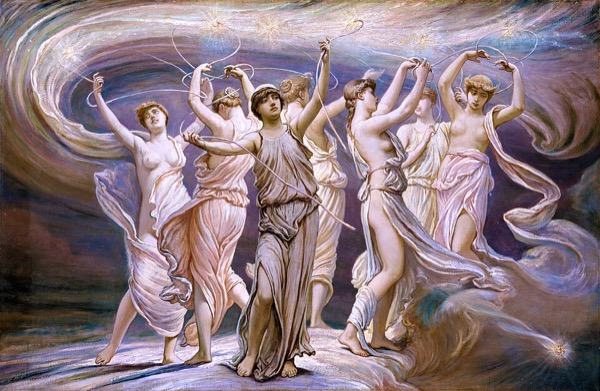
Elihu Vedder: The Pleiades, 1885 (Metropolitan Museum of Art)
Krash depicts the sisters as dancing within the vast emptiness of space. In the piece as a whole, the composer brings together these women from remote mythology and the modern day and puts them all on the same plane, flying in space.
Other works on the album imagine the wisdom of her own great-great grandmother in Ukraine in the 19th century, envisioning her as a kind of female fiddler on the roof. The work was commissioned for the 2022 Johansen International Competition for Young String Players and is played here by the winner of the competition, Jinan Laurentia Woo.
What I Learned From You was a commission by the Lithuanian Symphonic Wind Orchestra for a celebration of the 300th birthday of the 18th-century Lithuanian scholar Elijah ben Solomon Zalman, known as the Vilna Gaon, The Genius of Vilna. Krash’s grandfather emigrated to the US from Lithuania in 1922 where he had studied to be a rabbi in the tradition of the Vilna Gaon. Krash’s piece brings together fragments of traditional synagogue music, combining the traditions of the past with the hope of a better future.
Jessica Krash: What I Learned from You (Lithuanian Symphonic Wind Orchestra; Karolis Variakojis, cond.)
We asked what was next on her compositional page and she’s currently working on a trio for bassoon, horn, and piano. It started with music played at her father’s funeral. Although trumpets are more familiar at military funerals, this one used the tender and evocative sound of a French horn to be both the announcement of the burial and a warm welcome to the cemetery’s newest occupant. In a conversation with a bassoonist, she also admired his warm woodwind sound and he mentioned that he often paired with hornists. Opera transcriptions were his particular favourite.
The album as whole is a wonderful examination of music today, drawing on the historical and mythical past to tell us the True Stories that we have today. Every part of her life has also informed the music, including her explorations of Ghanaian music, Lithuanian / Jewish music, the heritage of Debussy from the 19th century, and the sounds of the world around her. Discover the music of Jessica Krash; her stories speak to all of us.

Jessica Krash: True Stories
Albany Records TROY2034
Release date: 4 September 2026
For more of the best in classical music, sign up for our E-Newsletter