In 1960, Columbia Pictures released the romantic biopic Song Without End, tracing the love affair between pianist/composer Franz Liszt and the married Princess Carolyne zu Sayn-Wittgenstein.
One would assume that this real-life story of forbidden love would make a great movie. However, one would be wrong.
Today, we’re looking at what makes it a tough watch and what you should keep in mind if you decide to watch it yourself.
Trailer for Song Without End
There are many long scenes with performances that don’t advance any narratives.
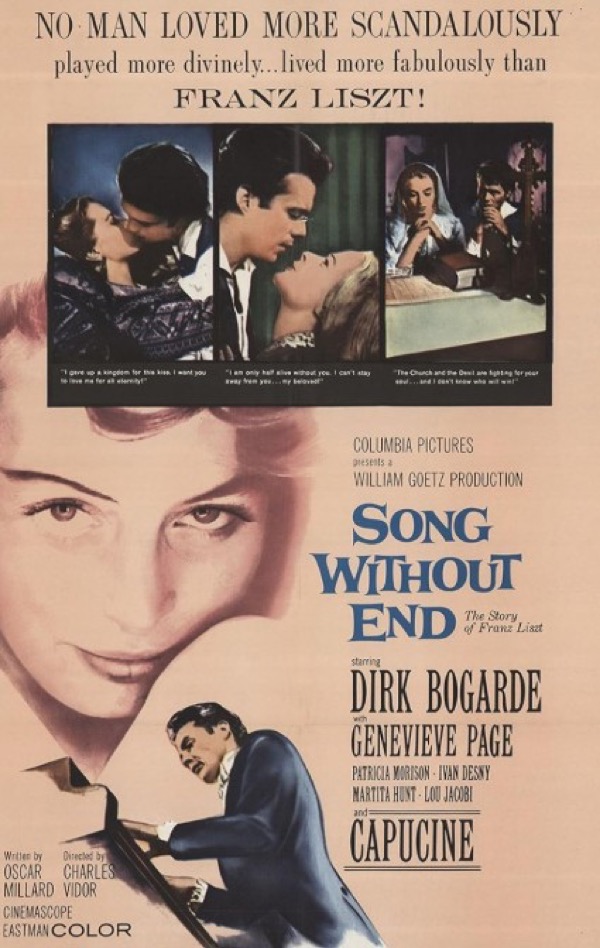
Song Without End (1960)
In the first hour, I lost track of the number of times the narrative thread was dropped. The music emotes. Princesses stare. Actor Dirk Bogarde, playing Liszt, mimes playing piano. Rinse, repeat in a number of glorious locations. After a while, it all blurs together.
The New York Times picked up on this in its 1960 Song Without End review:
There is often not time enough for more than a fragment of a number before the film is hopping on to the next. It is thus an excess of riches, musical and visual, telescoped in order to pack as much in as possible, that makes for distraction in this film.
Liszt playing La Campanella
The characters are shallow and unlikable.
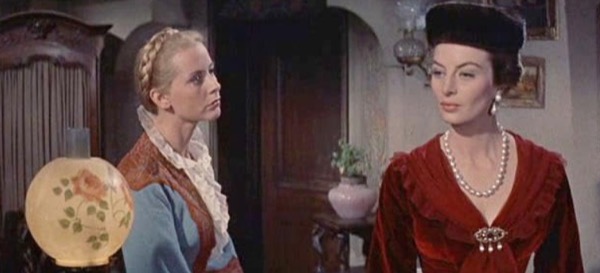
Song Without End: Carolyne and Marie
This was clearly a prestige biopic made with enormous resources, and yet, almost immediately, the characters undermine any emotional investment the viewer makes in them.
Early in the film, we’re introduced to Countess Marie d’Agoult, the woman who has left her husband for Franz Liszt and had three children with him.
But instead of being characterised as a gutsy rebel, as her history suggests, the film paints her as a bitter nag who holds a grudge against the church and wants to control Liszt’s career.
She is played by Geneviève Page, who employs a bizarre accent and looks like a 1960s model wearing 1830s hair.
Although their relationship is clearly on the rocks, there is no indication of what drew these two giants of the Romantic Era to each other.
Even the minor characters are unlikable, and not in an entertaining way.
George Sand seems to taunt Marie for causing a scandal in Paris, despite the fact that George regularly caused Parisian scandals herself. Liszt’s mother chuckles at his adultery. Meanwhile, Wagner gets annoyed with Liszt for the crime of not accepting his Rienzi score backstage, accusing Liszt of being drunk on public adoration.
Purely from a storytelling perspective, I don’t care about any of these characters, and I’m simply not very interested in seeing what happens to them.
Scene of Liszt and his friends experimenting with a church organ
Big parts of Liszt’s personal life are skipped over.
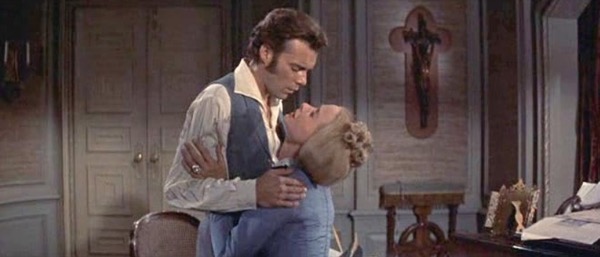
Song Without End: Marie and Liszt
One of the attractions of a musician biopic is seeing the juxtaposition between a performer’s onstage life and their personal life.
Unfortunately, the film portrays very little of Liszt’s personal life.
In real life, he neglected his children with Marie d’Agoult, leaving them in the care of his mother and servants before sending them to boarding schools.
But in the film, the emotional impact of his choices is lessened by the fact that we never see the children; we only hear them crying offscreen.
We also don’t get any insight into why he falls in love with Countess d’Agoult and Princess Carolyne. We’re aware that he’s attracted to beautiful women – but a lot of people are.
What made Liszt feel so deeply about these two women in particular that he was willing to risk scandal to be with them, besides the fact that they were attractive?
The film never bothers to explain.
Liszt playing his sixth Hungarian Rhapsody
The real-life Marie d’Agoult is done dirty.
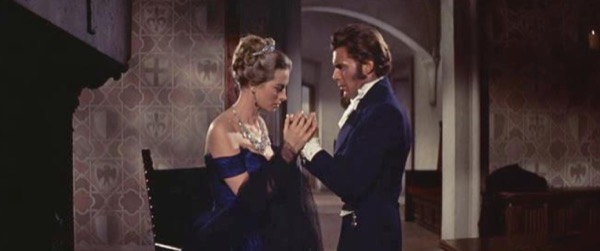
Song Without End: Carolyne
Marie d’Agoult is coded as a villain in this film. She tries to keep Franz from performing so that he can focus on composing serious music; she scolds him for spending time with his friends; she criticises him for not being involved in the life of their children; she hates the church that means so much to him. Every time she’s on screen, she’s sulking and seething and miserable. When Liszt breaks up with her, she practically goes catatonic.
One exchange stands out:
MARIE: I gave up so much for you.
LISZT [furiously]: You always manage to remind me of that! Always! It is remarkable how a woman will never let you forget, ever, the sacrifices she made for you, the price she’s going to make you pay for it.
But given that the societal punishments for adulterous women were much more severe than those for men, it only seems fair that she never let Liszt forget what she sacrificed.
The complaints she makes all sound reasonable to modern viewers – yet she’s clearly meant to be the villain of the movie.
The film does Princess Carolyne dirty, too.
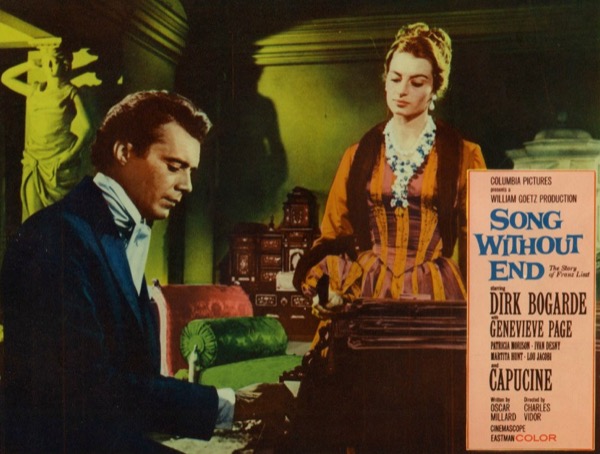
Song Without End (1960)
Scenes with Princess Carolyne and Marie d’Agoult
Marie isn’t the only woman the film misrepresents.
In real life, Carolyne zu Sayn-Wittgenstein was pressured by her father to marry an older man when she was barely a teenager. Part of the ceremony included a custom, standard at the time, of her father slapping her in front of the guests, so that if the marriage went badly, she could claim she’d been coerced into it. She got pregnant with her husband’s child, gave birth to her only daughter, and then separated.
Eleven years later, while on a business trip to Kyiv, she met Franz Liszt. She invited him to stay at her home. Soon, they would move together to Weimar, where they would live together for over a decade. It was only when she and Liszt were both in their forties that she began wholeheartedly pursuing an annulment.
In the film, she is still with her husband. Her daughter is nowhere in sight. There’s no real indication that she was involved in business or that she was a hugely prolific writer. Again, Liszt is merely attracted by her beauty, and that’s it.
The film also seems to suggest that they avoid a physical relationship, when in real life, they lived together for over a decade.
One true-to-life element of her character that the film does demonstrate is her Catholicism. Just like she does in the film, Carolyne goes to Rome to seek an annulment of her marriage. Despite getting heartbreakingly close, she is never granted it.
In the film, the two then appear to part ways. “You are God’s. His instrument,” she tells Liszt. “I was sent only to lead you back to him.”
In real life, though, they continued a relationship – albeit one more platonic in nature – for years to come. Their love for each other didn’t stop when her annulment fell through, and they stopped sleeping together.
The film misrepresents how Liszt became interested in Catholicism.
This doesn’t just serve to misrepresent what happened to Carolyne; it misrepresents Liszt’s path to Catholicism.
He didn’t return to Catholicism because his chaste love interest commanded him to.
Two other more pressing inciting events happened at this time that encouraged his renewed interest in religion.
In 1859, his college-aged son Daniel died, then, in 1862, his 26-year-old daughter Blandine died after giving birth. (His one surviving biological child, Cosima, would go on to marry Richard Wagner.)
Again, the New York Times was pointing this out back in 1960:
When he cannot have the princess (as wife), we are left to assume he gives the rest of his life to the church. These matters, which do bear faint resemblance to a part of the pattern of the life of Liszt, are brushed in so superficially that they carry little conviction or emotional strength, and the performances of the actors are, by necessity, more elaborate than they are deep.
The film’s religious tilt was reflective of 1950s America, not the 1840s European music scene.
This is a surprisingly religious movie. It was made around the time of many big religious epic movies (The Ten Commandments dates from 1956, Ben-Hur from 1959, and King of Kings from 1961).
After World War II, and throughout the early days of the Cold War in the 1950s and early 1960s, Hollywood placed a renewed emphasis on religion and portraying conservative values.
The story of a libertine composer tamed by his love for the church was an attractive proposition to filmmakers and studio executives.
But if the story were told today, it would likely emphasise other values.
The film can’t decide whether being obsessed with the praise of audiences is good or not.
There are many frustrating elements about this film, but one of the most frustrating is the fact that its overall message about Liszt’s legacy is contradictory and confused.
We are all watching the movie in the first place because we are interested in the legend of Franz Liszt: the flamboyant performer who mesmerised audiences and redefined virtuosity. We want to see how his music affects audiences emotionally, because it has affected us, the modern-day audience, emotionally.
However, the film seems to critique his desire for the spotlight and his pursuit of virtuosity, and other characters routinely criticize his passion for performing. Marie d’Agoult goes so far as to remark to Princess Carolyne: “There is the woman he is married to: the crowd.”
In a film of contradictions, the film’s implicit disapproval of audiences – when it presumably wants to resonate with Liszt’s modern-day audiences – is perhaps the most puzzling.
Between that, the butchering of the history of Liszt’s love interests, and the mangling of his history with Catholicism, in the end, Song Without End is simply not very good. There are so many other classical music biopics to enjoy. I’d recommend you seek them out over this one.
For more of the best in classical music, sign up for our E-Newsletter