Schubert and Beethoven have no doubt been the pianist Paul Lewis’ core repertoire. After following more than thirty of his concerts, I became curious about his most recent Mozart+ programs. Why pair Mozart’s sonatas with Poulenc’s Improvisations, Debussy’s L’Isle joyeuse, Schubert, and Chopin? I put these questions to him ahead of his China tour.
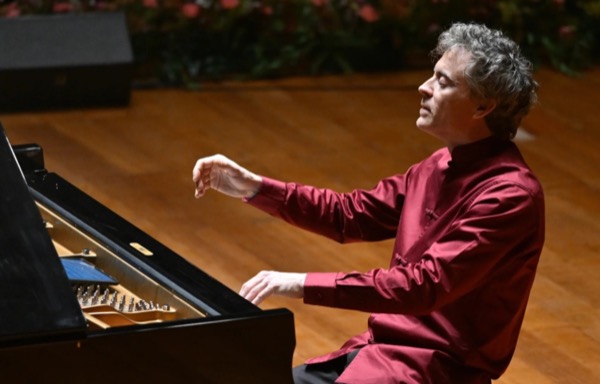
Photo by China National Centre for the Performing Arts in Beijing
Why Mozart now?
In a way, it’s a common story. The older one gets—and I’m now in my mid-50s—the closer one feels to Mozart’s music. One becomes more aware of its simplicity on the surface and its complexity beneath.
Mozart’s piano sonatas are sometimes overlooked. They are understandably overshadowed by bodies of work like the concertos, the operas, and the symphonies. Some of the sonatas are more domestically orientated, but even those have their greatness.
Given their staggering variety, I want to show how Mozart’s piano sonatas can actually take their place and stand alongside the great sonatas of Beethoven and Schubert.
Paul Lewis Plays Mozart: Piano Concerto No. 27
Your Mozart+ 1 program ends with Mozart’s Piano Sonata No. 14 in C minor. Do you see its connection with Beethoven?
It certainly lays the foundation for Beethoven’s C minor works, such as the Pathétique Sonata and the Third Piano Concerto. But Beethoven plays out his drama in a different way from Mozart. Beethoven’s C minor dramas are both an internal and an external struggle. Beethoven almost always resolves them. Mozart doesn’t.
In his minor-key works, Mozart explores the internal psychological drama. There is more of a classical restraint than in those Beethoven C minor pieces I mentioned. Without any real resolution at the end, they are rather un-Beethovenian.
Ludwig van Beethoven: Piano Sonata No. 8 in C Minor, Op. 13 “Pathétique”: I. Grave – Allegro di molto e con brio (Paul Lewis, piano)
What prompted you to put Chopin and Schubert in your Mozart+ 2 program?
From Mozart to Schubert and Chopin, there is indeed a vocal connection: Chopin is the most pianistically vocal composer, and Schubert is the greatest composer of Lied. I pair those two composers with Mozart to show where the cantabile and bel canto quality on the piano all started.
Paul Lewis plays Schubert: Piano Sonata in A Major D. 664, II. Andante
You will play two of Poulenc’s Improvisations, Hommage à Schubert and Hommage à Édith Piaf. Can you share what you find interesting about them?
I wonder how well Poulenc knew Schubert’s music, because this piece doesn’t sound very much like Schubert. It is more like a generic Viennese waltz. In performance, one can give it a touch of Viennese lilt. So it is more of a nod to Schubert than a real stylistic connection, which is not the case for the Edith Piaf improvisation.
Hommage à Édith Piaf feels as though it comes out of the French cabaret style. Poulenc is very specific in the way he writes the opening of the main theme: it begins very slowly, with just the first few notes, and then comes tempo subito, where you move straight into tempo. Poulenc’s composition draws directly from Édith Piaf’s singing style and the broader tradition of French cabaret at the time.
In your Mozart+ 1 program, you pair Poulenc’s Improvisations with Mozart’s sonatas. Could one reason be that both composers had an exceptional gift for melody and a strong affinity for the human voice?
Perhaps yes. But the shape of the program is really more of a musical pathway: it starts with Mozart, goes through Poulenc to Debussy, and then back through Poulenc to Mozart.
Stylistically, the musical languages of Mozart and Debussy are a long way apart, and to place Debussy next to Mozart would be, in some ways, a mismatch. But Poulenc provides a way in, because his piano writing shares certain qualities with Mozart’s: transparency, discretion, and characteristic figures. Poulenc also has the French flavour and language in his music, which relates directly to Debussy. In this way, we could find underlying connections between the pieces, between the composers.
Claude Debussy: Petite Suite: I. En bateau (Paul Lewis, piano; Steven Osborne, piano)
Each piece of Poulenc’s fifteen Improvisations was dedicated to a specific person. Is it necessary to know a little bit about the context in order to appreciate them better?
It can be informative and entertaining to know something about the dedicatees. They were mostly Poulenc’s friends, people he admired, and those in the arts world. The fifteen Improvisations were among Poulenc’s best piano pieces, and Poulenc himself treasured them very much. More than the dedicatees themselves, these pieces revealed more about Poulenc. Each one was like a personal message from Poulenc.
For example, Improvisation No. 6 was dedicated to a distinguished French pianist, Jacques Février. This particular improvisation is fiendishly difficult to play, so perhaps Poulenc was laying down a challenge to his friend… Who knows?
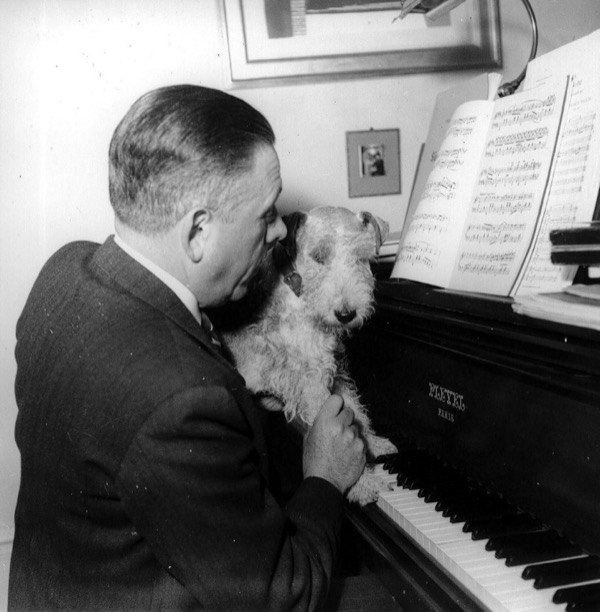
Francis Poulenc plays on the Pleyel piano with his dog, Mickey
How would you characterise Poulenc’s style as a pianist-composer?
When you play Poulenc’s piano music, you can get a very clear idea of what kind of pianist he was. He was not this hand-in-glove, moulded, completely liquid, fluid style of Chopin. It is like with Brahms, who did not possess this kind of connected technique and somehow played in blocks.
Technically and physically, the way you need to get around Poulenc is very different from the way you would play Chopin or Liszt. Poulenc involves the bouncing of arms and jagged gestures. In slower music, when there is a vocal line, you still need to produce a seamless legato. However, in his faster music, it can be tricky and challenging to stay relaxed.
Francis Poulenc: Sonata for Piano 4 Hands, FP8: I. Prélude (Paul Lewis, piano; Steven Osborne, piano)
Recently, you performed chamber music arrangements of Beethoven’s piano concertos at Wigmore Hall.
With the chamber arrangements, Beethoven’s piano concertos become slightly different. They feel like symphonic pieces played with smaller forces. You do have to change a few things because you are not playing with an orchestra. But that does not lessen the impact of the pieces. They remain just as rich, with the same intensity and the message they carry.
There are things that you learn on stage that you can never learn in a practice room. Performing Beethoven’s concertos in these different arrangements is certainly a learning experience.
Last spring, when the tenor Mark Padmore visited China, he described you as “the most thoughtful” and “one of the least egotistical musicians” he knew in the interview. Could you share your experience collaborating with him?
It is very kind of him, and I would say the same thing about him. We have worked together for 20 years at this point. It is one of those precious, instinctive partnerships where you do not have to analyse every single note and every single bar. I mean, we can do that in rehearsal, but now it happens at a different level. Instinctively, I can just feel when Mark is going to breathe and when he is going to make a certain sound.
It is important for pianists to play with singers. I have learned so much from Mark about how to produce a singing line on the piano. I learned how to feel it in the body, the way a singer breathes and takes in air before making a sound. I do that too now, even though I don’t make the sound with my breath at the piano. Pianists have to be in touch with the physiological timing and the shape of music.
Mark Padmore and Paul Lewis Perform Schumann’s Mit Myrthen und Rosen
You have been hosting the Midsummer Music Festival since 2009. Past guests have included Imogen Cooper, Steven Osborne, and Alfred Brendel, to name just a few pianists. As this year’s festival has just come to an end, what do you find most fulfilling about organising it and taking part in it?
Each year, we have a wonderful group of people. It is about inviting people that you admire, friends that you want to see, because you do not always have time during the year when you are busy travelling and playing concerts. Musicians do not always cross paths that easily, apart from at festivals like this.
For the audience from the outside, it looks wonderful. On another level, it can be stressful, because multiple concerts in a short space of time with different repertoires meant constant rehearsals and performances. But when you have got the right people around, it doesn’t feel pressured, because you are simply spending time making music with wonderful people.
For more of the best in classical music, sign up for our E-Newsletter
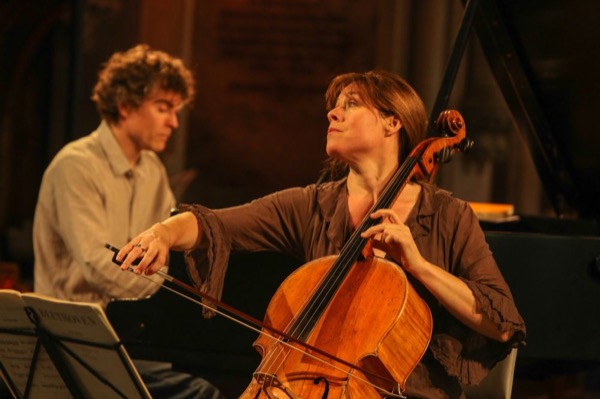
Paul and Bjørg Lewis at Midsummer Music Festival