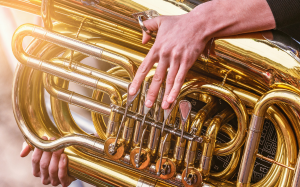
The French Horns are much loved for their warm, velvety, and powerful sound. Hornists are thought of as disciplined perfectionists who have to deal with the pressure of managing this complex instrument with its high technical demands. But we audience members do envy and love hornists.
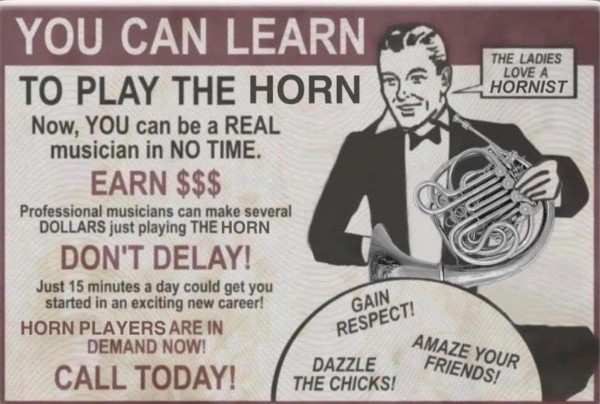
The horn evolved from hunting horns in France during the 17th century. The valves and tubing were developed later and allowed for a wider range of notes and if you uncoil the French Horn, the tubing would be 12 feet long or 365.7 centimeters. The conical tubing and backward-pointing bell makes the sound less direct than the other brass instruments.
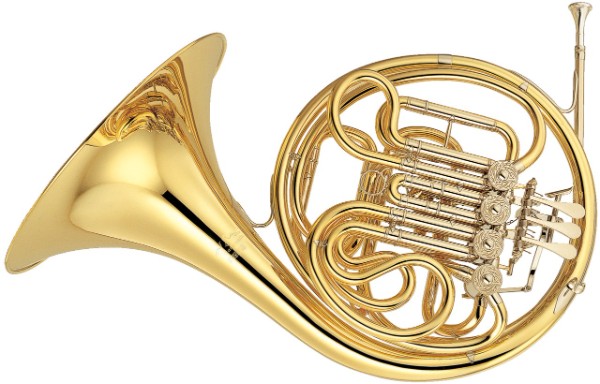
Since the horn has the widest range of the brass capable of playing both high and low notes, the instrument can be called upon for gentle, melancholy phrases as well as heroic, commanding lines. In fact, the range of the French Horn is very similar to the cello range and lends itself to lyrical melodies that we cellists also play. Its timbre too can vary widely, taking the spotlight in bright, brassy, and dramatic lines, but also blending easily with the woodwinds and/or strings.
Perhaps because the horn has the smallest mouthpiece in the brass family, the French horn can be quite difficult and finicky. The close proximity of the upper register is very challenging to consistently “nail.”
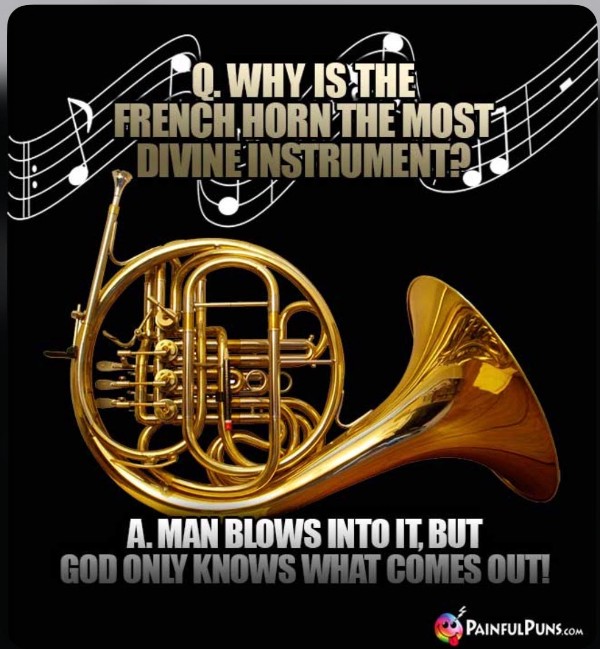
You might ask: why do they put their hand in there?
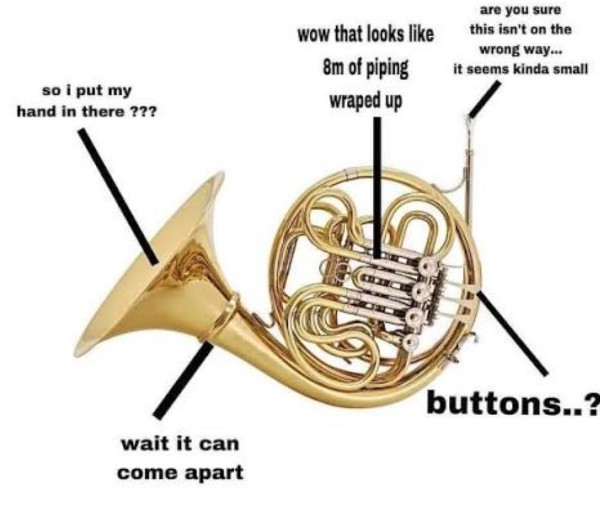
The right hand in the bell allows the player flexibility to create unique tonal colours and to adjust the pitch and timbre. The player can muffle the sound adding warmth, and subtly change the length of tubing, which modifies the pitch.
Although each player plays the entire range of the instrument, the section in an orchestra work in pairs: The first and third are the high note specialists, and the second and fourth are low note specialists. A fifth player, the assistant, sits next to the principal and takes over to allow the principal short breaks to save themselves for solos. Sometimes this player will also play the unison phrases. Many composers such as Mahler and Strauss have written for six or eight players as you will see below.
Some of my favorite moments in the orchestral literature shine the light on the French Horns. Sometimes it is the principal playing poignant melodies and other times the entire section dazzles us with their rich sound.
One of the most magical and exposed horn solos in the repertoire is the second movement of Tchaikovsky Symphony No. 5. The movement begins hushed and hesitant in the strings, producing a gorgeous and tender blanket of sound that surround the horn soloist. This excerpt below with the Vienna Philharmonic and Herbert von Karajan is quite spellbinding.
Tchaikovsky Symphony 5 – Vienna Horn Solo
Richard Strauss Till Eulenspiegel’s Merry Pranks Op. 28. also features a solo horn but of course is a different character entirely, portraying our naughty and impish protagonist. The principal player is given a mere twenty second introduction before he or she enters with the mischievous theme. No pressure!
The Berliner Philharmoniker perform Strauss’s Till Eulenspiegel / Horn tutorial
Let’s hear the entire piece.
Strauss – Till Eulenspiegels lustige Streiche | Mariss Jansons | BRSO
All the Brahms symphonies have prominent and lyrical horn parts. Brahms First Symphony from 1877 is celebrated for its rich orchestration, and the horn section plays a pivotal role in creating this beautiful sound. But it took Brahms many years to complete the work. “Remarking to his friend the conductor Hermann Levi: ‘I shall never write a symphony! You have no idea what it feels like, for someone like me always to hear such a giant as Beethoven marching along behind.’”
Brahms himself played the natural horn in his youth and it’s interesting to know Brahms was often after that quality of sound – soft and hand muted, legato, and a singing sound even though the valve horn existed by then. But during the introduction to the finale of the first symphony, the principal French horn is called upon to play forte, heroic and powerful, causing the audience to take notice as the hornist proclaims the arrival of the regal, rich string theme that follows. Let’s hear the horn.
Brahms’s 1st Symphony, Horn Solo
Here is the entire exquisite last movement which begins Adagio and mysterious with pizzicatos strings in a nebulous rhythm until the glorious horn melody enters. The dramatic introduction returns toward the end of the movement and as the tempo gets faster and faster, the horn theme is played by the full orchestra. The timpani is thunderous and the symphony ends with several huge chords.
Johannes Brahms: Symphony No. 1 in C Minor, Op. 68 – IV. Adagio – Allegro non troppo ma con brio (London Philharmonic Orchestra; Marin Alsop, cond.)
Both Gustav Mahler, and Richard Strauss employed larger horn sections significantly increasing the drama. Here is the vivid and magnificent eight horn opening to Mahler Symphony No. 3.
Mahler’s 3rd Symphony, Horns Soli Opening
And what could be more climactic than the eight horns wailing here during the peak of Strauss Ein Heldenleben (A Hero’s Life) Op. 40.
Strauss’s Ein Heldenleben, Horn Section Solo “Kraftstelle”
The final section The Hero’s Withdrawal From the World Strauss writes a solo violin and solo horn duo that is so stunning it gives me the shivers. The tremendous poise and control necessary to play with such purity of sound and so expressively is extraordinary.
Ein Heldenleben – Horn Solo – Matias Pineira – Berliner Philarmoniker
Below is the brilliant section of Ein Heldenleben the sixth of six parts complete. Listen also for the extended passages with English Horn.
Richard Strauss: Ein Heldenleben (A Hero’s Life), Op. 40, TrV 190 – Des Helden Weltflucht und Vollendung (The Hero’s Withdrawal from the World) (Richard Strauss 150th Anniversary “Ein Heldenleben” Orchestra; Ken-David Masur, cond.)
Now that you’ve heard the solo horn as well as the horn section playing together, I’d like to introduce you to a marvelous piece that features four solo horns. This piece is more rarely programmed but it’s one of my favorites. Schumann Konzertstück for Four Horns and Orchestra, in F major Op. 86 is in three movements and we hear the noteworthy variety that the instrument is capable of.
Robert Schumann: Concertstück in F Major, Op. 86 – I. Lebhaft (Vienna Symphony Orchestra; Fabio Luisi, cond.)
Call me biased but may I mention two of our most often played cello concertos that feature the French horn in prominent roles? —stately and tender in the case of Dvořák Concerto with Zara Nelsova playing.
Antonín Dvořák: Cello Concerto in B Minor, Op. 104, B. 191 – I. Allegro (Zara Nelsova, cello; St. Louis Symphony Orchestra; Walter Susskind, cond.)
And the edgy, brassy, and insistent horn in Shostakovich Concerto No. 1 with Truls Mørk performing.
Dmitry Shostakovich: Cello Concerto No. 1 in E-Flat Major, Op. 107 – I. Allegretto (Truls Mørk, cello; Oslo Philharmonic Orchestra; Vasily Petrenko, cond.)
We love the French horn and I hope you agree: the versatility and bravura playing of horn players is astonishing.
For more of the best in classical music, sign up for our E-Newsletter