In Paris in 1778, Wolfgang Amadeus Mozart (1756–1791) was desperately looking for a job. He’d been in Mannheim before then, but without any luck on the job front. Going to Paris offered more opportunities, but the one that was discussed, an organist job at Versailles, was not of interest. Mozart, in Paris with his mother, ran out of money and was reduced to pawning his valuables. On 3 July 1778, his mother fell ill and died, and all of Mozart’s dreams crumbled with her. Six months later, he was back in Salzburg, employed but unhappy.
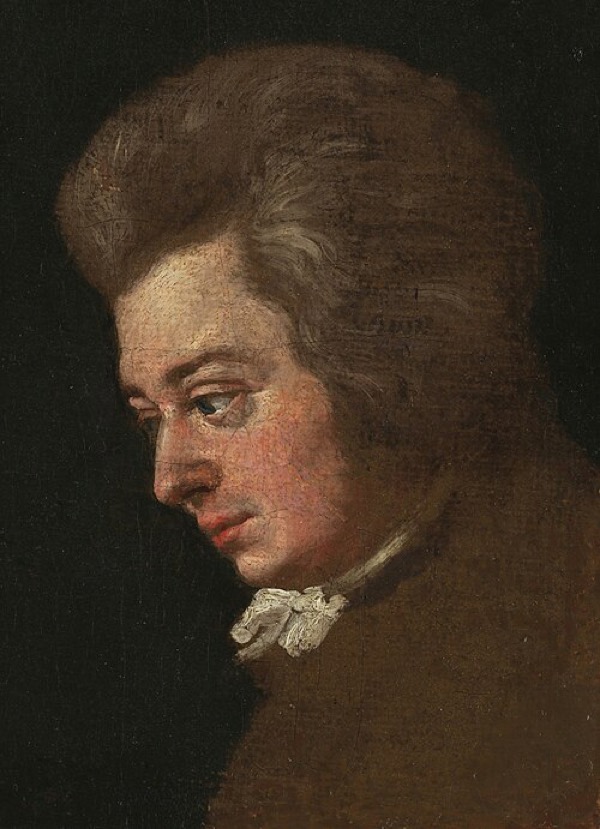
Joseph Lange: Mozart (detail), 1782
While in Paris, however, he wrote a sinfonia concertante, which combines the full orchestra with several soloists. It was an outgrowth of the Baroque concerto grosso, which we are so familiar with from Bach’s and Vivaldi’s work. By Mozart’s time, the concerto grosso had disappeared, and the sinfonia concertante took its place. The opportunity to show off several instruments in a concerto-like setting, along with a full orchestra, provided ample opportunities for a composer to demonstrate his abilities.
While in Mannheim, where he’d stopped on his way to Paris, Mozart had met Johann Baptist Wendling, principal flautist in Mannheim, Friedrich Ramm, principal oboist, the horn player Giovanni Punto, and the bassoonist Georg Wenzel Ritter. These four virtuoso players were to come to Paris to play the work (which they loved) at the Concerts Spirituels. The series director, Joseph Legros, had the sole copy of the score, but when the work was bumped from the program in favour of a piece with similar instrumentation by Giuseppe Cambini, the score was lost.
In 1869, an anonymous copy was found in the collection of Otto Jahn, a German archaeologist, philologist, and writer on art and music. He wrote a biography of Mozart, published in 1856, on the centenary of Mozart’s birth. In preparation for his writing, Jahn collected as much Mozartiana as he could, including music manuscripts and letters. Other letters that he could only see, he copied out by hand. When Jahn heard about Ludwig Ritter von Köchel’s project on Mozart (which resulted in the Mozart work catalogue, i.e., the Köchel catalogue), he donated his collection to Köchel.
It is not known when this manuscript was copied or, more importantly, when the instrumentation was changed from flute, oboe, horn, and bassoon to oboe, clarinet, horn, and bassoon. To compound the mystery, given the change in instrumentation, we’re not 100% certain that this is what Mozart wrote in 1778 because of errors in copying and in the composition.
Scholars have been divided: Alfred Einstein thought it genuine; Donald Tovey thought it inept. Stanley Sadie noted that the clarinet part cannot be directly transcribed as an oboe part. Martin Staehelin thought it unlikely that Mozart would have written a piece where all the movements are in the same key. More and more complex arguments are made about the work, some thinking that a forger was involved who really didn’t know what the four virtuoso soloists were capable of. Hugh Macdonald notes that Mozart only gave a ‘rather lame excuse’ to his father about why the score had been left in Paris and thinks that perhaps there was no score at all, only talk about it.
For performers, Mozart or not-Mozart, the piece is well-liked and widely performed. The final movement, an Andante con variazioni, takes a theme and does 10 variations on it before adding a coda, with each variation separated by the same little orchestral section.
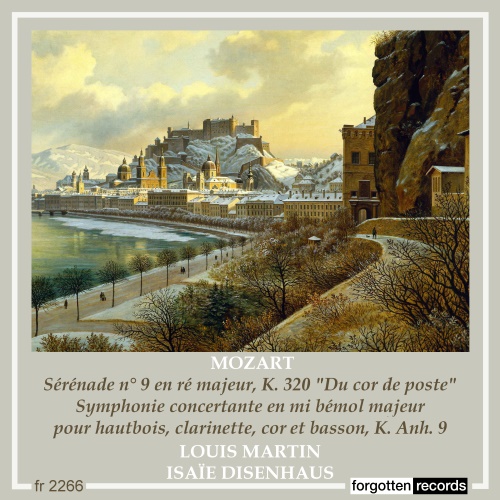
This recording was made in 1957 with Claude Maisonneuve (oboe), Guy Deplus (clarinet), André Fournier (horn), and André Rabot (bassoon) performing under Isaïe Disenhaus leading the Orchestre des Concerts Disenhaus.
Isaïe Disenhaus (1923–2006) was born in Belgium and told interviewers that during WWII, he played piano in Brussels nightclubs, evading the Nazis. In the 1950s, he went to the US as a conductor and returned to Belgium in 1975, where he worked as a producer for Belgium Radio, sometimes conducting the radio orchestra. He also taught radio production at INSAS (The Institut national supérieur des arts du spectacle et des techniques de diffusion), a film and drama school in Brussels.
 Performed by
Claude Maisonneuve
Guy Deplus
André Fournier
André Rabot
Isaïe Disenhaus
Orchestre des Concerts Disenhaus
Recorded in 1957
Official Website
For more of the best in classical music, sign up for our E-Newsletter