The viola d’amore was not your average viola – instead of the regular 6 strings, it had an additional 6 strings that were not bowed, but which vibrated when the main strings were played. These sympathetic strings, as they were called, added to the depth of sound of the instrument. They made a ‘silvery’ sound and have a clear tone. Leopold Mozart described the viola d’amore as ‘a special kind of violin that sounds especially beautiful in the stillness of the night’.
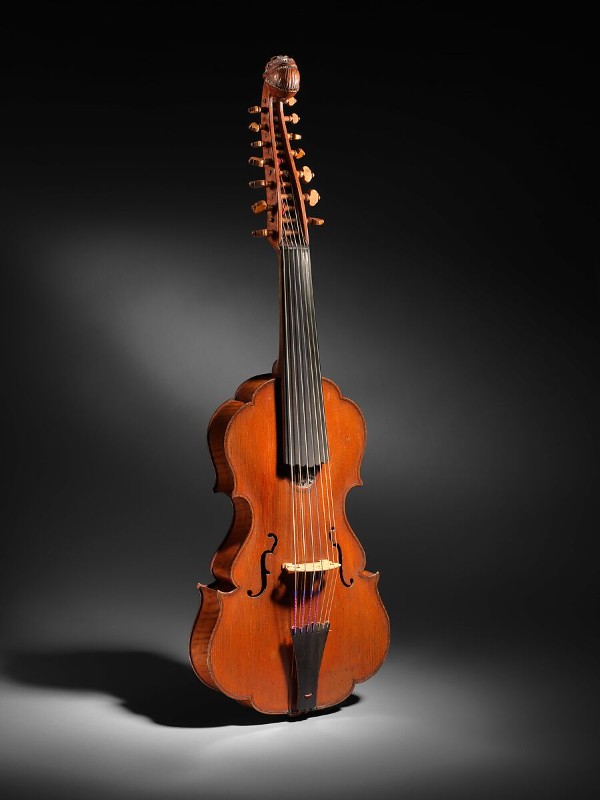
Viola d’amore with 14 strings made by Johannes Florenus Guidantus, 18th century (Metropolitan Museum of Art)
This video gives a clear example of the rich, resonant sound.
Peter Sheppard Skærved plays The Met’s Grancino viola d’amore
Although Vivaldi wanted to write for this rare instrument, they were not readily found in Venice, so he had to go to the instrument makers in Cremona to ask a luthier such as Stradivari for an instrument. Stradivari had been promoting the new instrument, so he knew what Vivaldi would have been looking for.
One of Vivaldi’s star pupils at the Ospedale della Pietà was a violinist named Anna Maria. One visitor to the Pietà described her as ‘the finest violinist in Europe’, and Vivaldi wrote many of his violin concertos for her. We believe that at least two of the 8 viola d’amore concertos were written for her because of Vivaldi hiding her initials in the titles: Concerto per viola d’AMore.
By having 6 strings instead of the usual 5 on a regular violin, the viola d’amore was capable of playing some chords and using some barre effects (where you play two strings in quick alternation, with one of them sounding the melody) that were not possible on the violin. Vivaldi, of course, incorporated these effects into his works.
Concertos on unusual instruments were popular in Vivaldi’s world, and he fulfilled that desire with many different kinds of instruments. Being a specialist on the viola d’amore (he was known to play it himself) meant more money to be earned teaching this unique instrument.
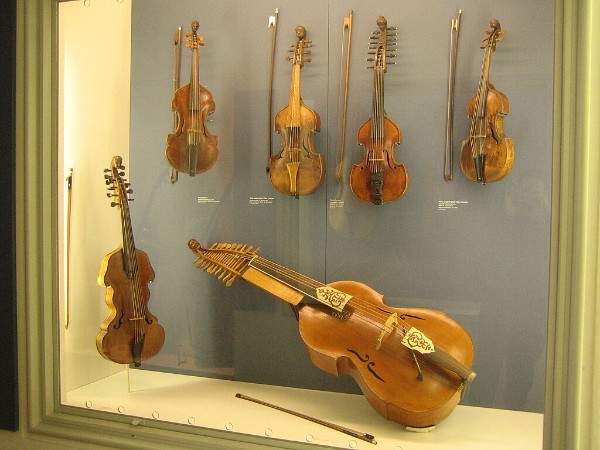
Violas d’amore (top row, 2nd from right, and bottom left) and a viola di bordone (baryton) (bottom right) (Deutsches Museum)
Antonio Vivaldi: Concerto for Viola d’amore in D minor, RV 394 – I. Allegro
This recording was made in 1950 with Renzo Sabatini as the viola d’amore soloist, playing with Anthony Bernard leading The London Chamber Orchestra.
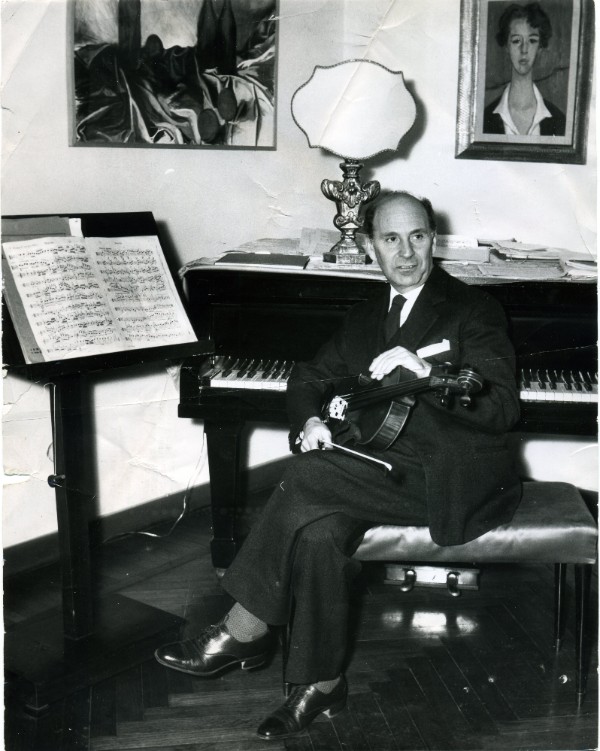
Renzo Sabatini
Sabatini (1905–1973) studied violin and viola at the Santa Cecilia Conservatory in Rome and toured widely as both a violinist and a viola d’amorist, recording two of Vivaldi’s concertos for Decca. After his concert touring stopped, he became an editor of Baroque Italian music, bringing out works by Ariosti, Asioli, Boccherini, Geminiani, Locatelli, Lorenziti, Pergolesi, Salieri, Tartini, and Vivaldi, as well as writing his own work. He played a Gasparo da Salò viola and a Capicchioni viola d’amore.
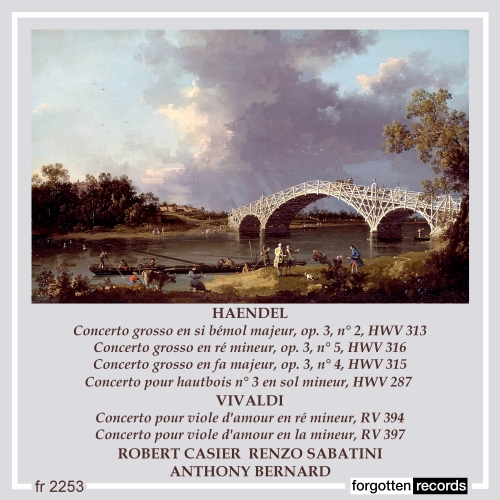
Performed by
Renzo Sabatini
Anthony Bernard
The London Chamber Orchestra
Recorded in 1950
Official Website
For more of the best in classical music, sign up for our E-Newsletter