Thomas Quasthoff was born on 9 November 1959 in Hildesheim, Germany. That wonderful bass-baritone has been called “one of the greatest singers of our time and certainly one of the most remarkable of any time.” As a singer, he had the uncanny ability to communicate seriousness and humour as if singing were the easiest thing in the world.
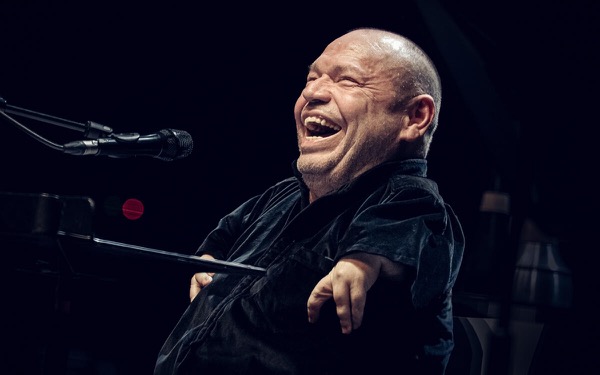
Thomas Quasthoff
Quasthoff lived his entire life with severe disabilities, yet as he once explained, “I wanted to be accepted as an artist who was disabled, not seen as a disabled person who was an artist. The key is not that negative things are happening, but how you deal with them.”
Thomas Quasthoff retired from the stage as a classical singer in 2012, but he has since returned as a jazz singer. To celebrate his birthday, let’s feature some of his essential recordings.
Thomas Quasthoff sings Bach: “Mein teurer Heiland,” Johannes Passion
Bach’s Human Heart
For Quasthoff, singing Bach was deeply personal. He never treated the music as an exercise in historical style or vocal beauty. Rather, he approached Bach through personal emotional identification with the text.
Quasthoff never claimed to present definite or authentic interpretations. As he once explained, “My approach to Bach is marked by a highly personal experience of this music. And this personal experience is what I’m trying to convey to the listener.”
For Quasthoff, a singer doesn’t have to be religious when singing Bach. Although he could empathise with the stories and put himself in Christ’s role, that doesn’t mean one has to believe in God.
Bach Was Always There
Bach’s music was part of his musical upbringing, as he sang cantatas and oratorios in his childhood. During his first professional singing lessons with Charlotte Lehmann, he started with Bach before moving on to Lieder.
He was once asked about his decision to record Bach with a modern orchestra rather than a historically informed ensemble, and he replied, “Some people say that you shouldn’t sing the music of Bach’s time with vibrato. What nonsense!”
Johann Sebastian Bach: Selig ist der Mann, BWV 57: Aria: Ja, ja, ich kann die Feinde schlagen (Thomas Quasthoff, bass; Berlin Baroque Soloists; Rainer Kussmaul, cond.)
Schubert’s Loneliness
In a 2002 interview with BBC Music Magazine, Quasthoff revealed, “Schubert’s Winterreise is my favourite song cycle. I started singing it very early; I was 20 when I gave my first performance. That was good, because this cycle really has to grow with you.”
And he continued, “Anybody who has ever been in love and lost that love can follow this story; it’s the easiest way to be isolated or to isolate yourself.” He certainly does not believe in beautiful singing for its own sake.
Here, as elsewhere, Quasthoff called the poems sacred texts and argued that singers must engage with their audiences through vocal colour and intelligible words. As he suggested on various occasions, younger singers today might sing too much beautiful singing.
Quasthoff/Barenboim perform Schubert: “Gute Nacht,” Winterreise
Losing Yourself in Schubert
In his Schubert interpretations, Quasthoff draws a distinct line between interpreting a song and actually inhabiting its character. He never wanted to interpret; he wanted to inhabit the emotional world of the protagonists.
When he was asked about the existential emptiness into which Schubert’s Winterreise ultimately leads, he replied, “I have found myself in that emptiness, too. It took me about an hour to become myself fully again.”
In his advice to young singers, Quasthoff stresses the need to understand what you’re singing. Dramatic tension must be maintained across all 24 songs of Winterreise, and what matters is a firm grasp of rhythm, then the text.
Quasthoff/Barenboim perform Schubert: “Der Leiermann,” Winterreise
Unbearable Emotions of Mahler
For Quasthoff, Gustav Mahler’s music is overwhelming and deeply personal. Specifically, Kindertotenlieder becomes an almost unbearable emotional experience. As he related in an interview with BBC Music Magazine, “I love nearly all of Mahler’s music.”
“The big compositions for me are the orchestral songs. The Kindertotenlieder bring up deep emotions that overwhelm me every time I perform them. To lose a child—it’s better not even to imagine that.” To sing Mahler is not an abstract meditation on mortality, as the subject matter is almost too painful to contemplate.
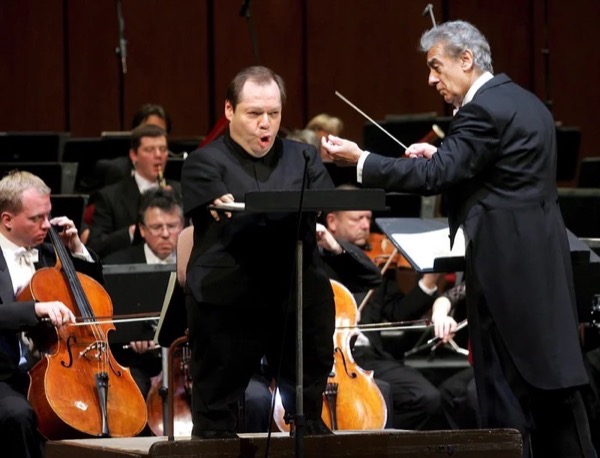
Thomas Quasthoff
In his first release for Deutsche Grammophon, Quasthoff teamed up with Anne Sofie von Otter, the Berlin Philharmonic and Claudio Abbado for a recording of Mahler’s Des Knaben Wunderhorn. That recording reveals the wonderful flexibility of Quasthoff’s voice, as he can be mischievous, earthy, or devastatingly serious.
Thomas Quasthoff sings Mahler: “In diesem Wetter, in diesem Braus,” Kindertotenlieder
The Freedom to Be Yourself
Thomas Quasthoff recalls that his brother listened to Jethro Tull and Deep Purple, and that he initially disliked that music. However, when his brother played jazz records, he loved it. Then his father bought him the Oscar Peterson double album, and he played it constantly.
What really attracted him to the performances by Oscar Peterson, Charlie Parker, and John Coltrane, for example, was the freedom of improvisation and the rhythmic complexity. Listening to jazz changed his understanding of rhythmic freedom, not only in jazz but in classical music as well.
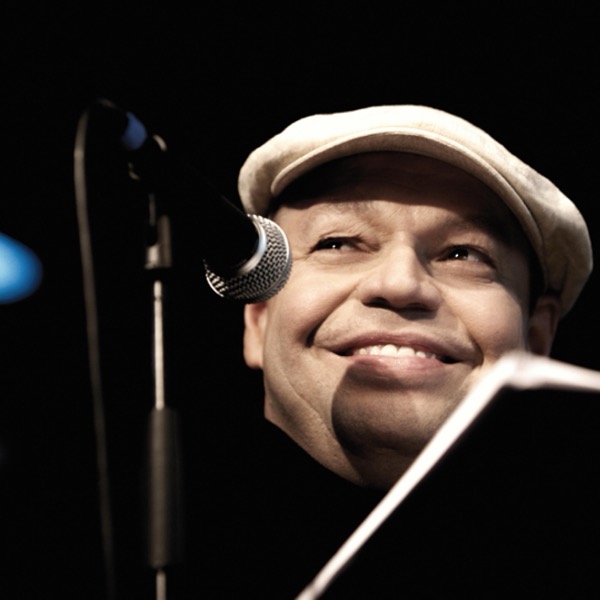
Thomas Quasthoff © Harald Hoffmann / DG
For Quasthoff, the world of classical music is too sterile, and the formality of classical concerts contrasts greatly with the intimacy jazz musicians establish with their audience. He has often said he wanted to bring that kind of intimacy into his own classical recitals.
Thomas Quasthoff sings “For Once in My Life”
The Art of Musical Connection
For Quasthoff, jazz is not a crossover genre, “as it has to sound totally different, and I try to sound totally different. It’s a different kind of music making. Jazz has to sound like jazz.” In general, he finds jazz liberating, as it lets him treat specific indications as guidelines rather than instructions.
Quasthoff originally enrolled at the university to study law, but he soon decided that he was artistically inclined instead. In his spare time, he started singing with jazz bands, and he gave his first public concert in 1980.
What connects these essential Quasthoff recordings is his versatility and flexibility across many different musical styles and genres. Behind it all is an artist who wants to communicate and connect. With every selection, he makes us feel he has lived through the full range of experiences.
For more of the best in classical music, sign up for our E-Newsletter