The Sound of the Place is a new book by British music teacher and composer Luke Ottevanger, in which he draws inspiration from places in Britain that have inspired other composers, including Mendelssohn, Vaughan Williams, Tippett, Britten, and Maxwell Davies.
I spoke to Luke about the book’s evolution, his experience visiting places with specific composer associations, and how that affected his creativity.

Luke Ottevanger
The Sound of the Place grew out of a period when you found yourself unable to compose. Can you describe what happened to your creative life during that period, and what finally prompted you to try to find a way back to composing?
I should stress that I only composed for myself, for the joy of it! If I had to define myself, I would have said that I ‘was’ a composer, but no one else would have seen me in such a way – they would have seen a music teacher. With that qualification in hand, things changed around 2011, when everything I tried to write quickly became dissatisfying to me and ended up in the bin. Eventually I gave up trying. It felt as if I had written myself into an impasse. I felt distressed at losing my creative outlet. The blockage was just that: the stopping up of something that had previously flowed, and it put me increasingly out of kilter.
Eventually, in early 2022, desperation to do something about it led to a sudden compulsion to travel to places where other composers had found inspiration, with the vague hope that what they had experienced might rub off on me, too.
The book takes you – and the reader – across the length and breadth of Britain in the footsteps of around thirty composers. How did you choose the composers and the places you wanted to visit?
When the idea hit me, it came with an initial list of obvious destinations attached. Some pieces are firmly linked to legends about where inspiration struck. Actually, ‘legend’ is a good word, because the first place on my list was Chanctonbury Hill, on the South Downs, with its connection to John Ireland’s atmospheric Legend. It has transmitted an enormous ‘sense of place’ to me ever since I first heard it in my early teens, and it is the one such location I have always wanted to visit.
And of course there were plenty of other places with even more well-known links to certain composers – Britten’s Aldeburgh, Elgar’s Brinkwells and the Malverns, Holst’s ‘Egdon Heath’ (to the extent that it is a real place), and so on. But I was never aiming to be ‘completist’. There would have been no point in that. I tried to visit places that called to me, some of which didn’t even really fit my own definition, but which nevertheless simply felt right.
Why did you decide that travelling to places associated with composers might help you recover your own creative confidence?
I suppose it was the fact that – because music exists solely as invisible vibrations in the air – composers can be imagined as receivers of these vibrations, people sensitive enough to pick up on the ineffable and make it ‘real’.
In this respect they are like flesh-and-blood incarnations of the windblown aeolian harp that Elgar kept at his house in Herefordshire, and in this sense this incipient music-in-the-air is perhaps the same thing as the inspiration I sought. The words of some of the greatest English composers tell us that they sensed this idea, and perhaps Elgar was even thinking of his aeolian harp when he said that ‘there is music in the air, music all around us; the world is full of it, and you simply take as much as you require.’
So I suppose what I really wanted was to find the places where this potential-music hangs in the air. And perhaps to sense it myself, too.
Were there any particular composers whose relationship with landscape you understood differently after actually visiting the places associated with their music?
Mostly, the experience intensified and deepened what I already expected to find, but that was really what I wanted anyway: to immerse myself in the reality of something I had previously imagined.
Above all, Peter Maxwell Davies. On the island of Sanday, Orkney, at the northernmost point of my travels, I had an unexpected encounter with the man who had cared for him in his final years and who still lives in the house, and it deepened and transformed many of my ideas.

Peter Maxwell Davies
But the real discoveries for me were to be found in the larger trends that I discerned: the extent to which this sensitivity to place is a particularly British (and largely English) trait; but also the degree to which it springs from the example of (the German) Mendelssohn, in a long thread that binds his Hebrides Overture to works like Tippett’s The Rose Lake.
Michael Tippett: The Rose Lake: The Lake Song is echoed from the sky: Slow (London Symphony Orchestra; Colin Davis, cond.)
We often talk rather loosely about a landscape ‘inspiring’ a composer. Having explored the subject in depth, what do you think that inspiration actually consists of – scenery, atmosphere, memory, history, solitude, or something less tangible?
It may be any of those things, and there are examples of all of them in the book. What surprised me was how often several of them seem to be operating simultaneously.
The earliest example of all of them is the opening of Mendelssohn’s Scottish Symphony. In this case, the atmosphere of the ruined chapel at Holyrood Palace prompted thoughts in Mendelssohn’s mind of the historical events which had taken place there. Still, these thoughts were filtered through the fact that he was experiencing this as a young man in an ancient city far from home, deeply aware of the past and of time’s passing. The impressive Andante which resulted is a heady brew in which the ‘outer’ weight of world history alternates with ‘inner’ music of personal reflection.
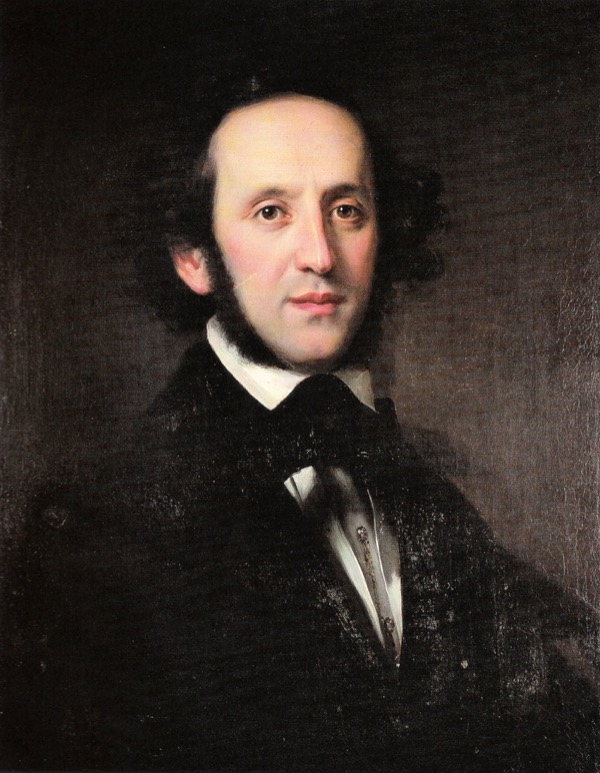
Felix Mendelssohn Bartholdy by Eduard Magnus (1833)
The genesis of Maxwell Davies’s Worldes Blis is even more complex – the memory of a youthful vision on the slopes of Helvellyn inspired it. Still, a few years after the piece premiered, when the composer moved to the Orkney Islands, he realised the music had always foreshadowed the landscapes of Hoy, where he now lived.
Peter Maxwell Davies: Worldes Blis (Royal Philharmonic Orchestra; Peter Maxwell Davies, cond.)
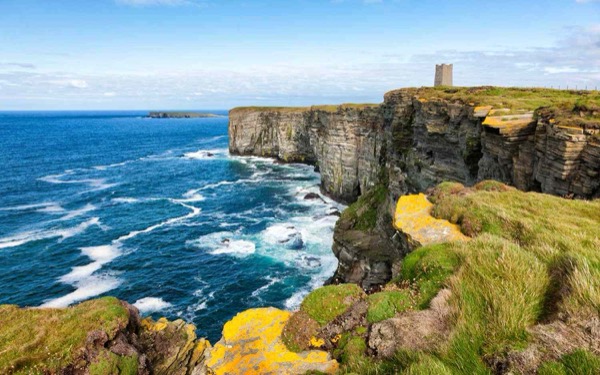
Orkney
The constant presence of the river Ouse flowing quietly by at the end of the road throughout Gavin Bryars’ childhood has seeped into much of his music and his style in general. Perhaps his whole character and way of thinking – calmly ruminative, associative, borderless – spring from these fluid beginnings…
What connects all of these, though, is the mysterious process of transmutation which turns landscape and location into musical expression.
From Mendelssohn’s journey to Scotland in 1829 to Benjamin Britten and Peter Maxwell Davies, the book spans nearly two centuries of music. Did you discover any recurring ideas about place and landscape across those very different generations of composers?
One recurring idea was the obvious but still surprising extent to which inspiration often comes not from beauty but from any strong impression, including the impact of industry.
So we probably think of inspiration coming from scenes of scenic splendour – the Malvern Hills, the South Downs and so on. But the last pages of Mendelssohn’s Reformation Symphony seem to have been born whilst the composer was deep underground in a Welsh mine whose miners suffered from debilitating lead poisoning. The sounds of the industrial Black Country society in which he was born echo through Havergal Brian’s music. [Harrison] Birtwistle’s conception of the world was altered when a gigantic power station was built in the next field to his childhood home. Gavin Bryars’ childhood was shaped largely by the presence of the tamed, tired River Ouse, bearing barges and cargo ships past the end of his street in Goole.
What matters is not whether a place is conventionally beautiful, but simply whether it has an imaginative charge for the person encountering it. Sometimes that charge may be beauty, but it can just as easily be ugliness, industry, danger or simply the accumulated weight of human activity. The fact that pollution often attended these scenes offered an ironic counterpoise to that fanciful idea of inspiration floating beneficently in the air.
Was there one particular journey or location that had an unexpectedly powerful effect on you – or somewhere where the reality was quite different from the landscape you had imagined through the music?
Many places affected me profoundly. One I often return to in my mind is Tintagel, which I visited primarily because of [Arnold] Bax but whose Elgarian connections affected me just as deeply. It was a heavy, overcast late afternoon following a lot of driving, a lot of walking, and a lot of powerful impressions. As I stood on the cliffs, I felt the weight of the nameless something that happened there, and that seems to have given the place such significance to Elgar and his ‘Windflower’, Alice Stuart Wortley.
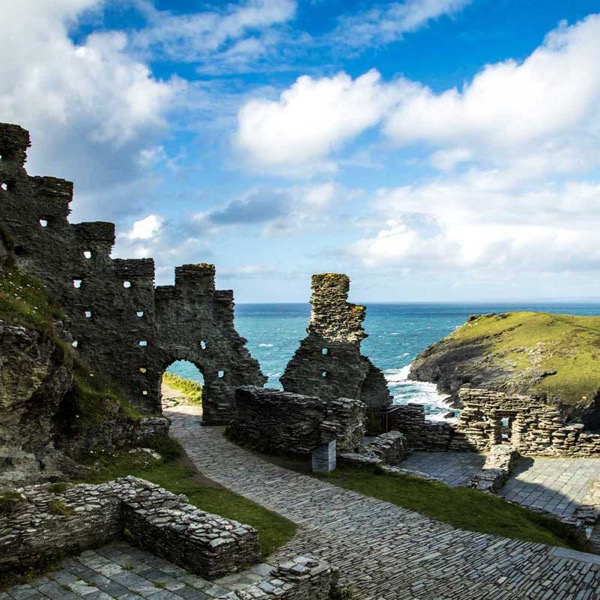
Tintagel Castle
But the place where the reality most unexpectedly transformed the music for me was the dew-drenched orchard I stumbled into at Darvill’s Hill (the tiny hamlet in the Chilterns on the hill above [Edmund] Rubbra’s house) where John Foulds seems to have heard those ‘clairaudient’ voices, which he transcribed in his Gandharva Music. I was there in May, and the place was buzzing with a joyful, burgeoning verdancy that I instantly associated with another work by Foulds that bursts with exactly this same flourishing: the unique, wondrous April-England, a full-blooded piece compared to which Gandharva Music is a light pencil sketch of an intangible idea.
John Foulds: April England, Op. 48, No. 1 (Peter Jacobs, piano)
Has researching the relationship between music and place changed the way you listen to British music – and is there now a particular landscape that, for you, has become inseparable from a particular piece of music?
Profoundly yes, to both. I have always loved the music of many British composers, but only in the same way that I love the music of many (say) French, Spanish, Russian or Czech composers – loving the national style, revelling in the sense of place it imparts. Writing the book changed this subtly, because I began to sense something different in the way British music is British. It has nothing to do with quality, of course, only tone. There is a kind of eyes-welling-up fulsomeness, an innocence, and a wildness too, that comes, perhaps, from being at the fringes of the continent. I think of it as being at the bottom of a well-kept garden, where the grass grows longer, and the wildflowers are poking up. There is a nice phrase by Wilfrid Mellers which sums it up – ‘our native woodnotes wild,’ he wrote.
What are your favourite works which evoke a particular “sense of place”?
There are many, including some I have already mentioned. April-England, as I said. Bax’s Tintagel and the Tintagel works of Elgar – the Second Symphony and the Violin Concerto. And of course Elgar’s three ‘Brinkwells’ chamber works: the String Quartet, Piano Quintet and Violin Sonata. Ireland’s Legend and his Cello Sonata. The slow movement of Rubbra’s Sixth Symphony. Holst’s Hammersmith and his Egdon Heath. Tippett’s Ritual Dances. Maxwell Davies’s difficult but unique Worldes Blis. Vaughan Williams’s Flos Campi and his Third and Fifth Symphonies. Weir’s dancing Ardnamurchan Point. Birtwistle’s Oockooing Bird and his Duets for Storab. Baines’s Paradise Gardens… And, even more than The Hebrides, that opening Andante of Mendelssohn’s Scottish Symphony. I could go on…
Arnold Bax: Tintagel (Royal Scottish National Orchestra; David Lloyd-Jones, cond.)
The journeys were partly an attempt to restore your own creative confidence. At what point did you begin to feel that composition was becoming possible again, and did returning to it change the kind of music you wanted to write?
On the way to Cornwall, I visited the Bronze Age Rainbarrows on Duddle Heath in Dorset, as close as you can get to visiting [Thomas] Hardy’s and Holst’s ‘Egdon Heath’. I got soaked to the bone, covered in mud, torn at by thorns. Totally bedraggled! But the experience was magical.
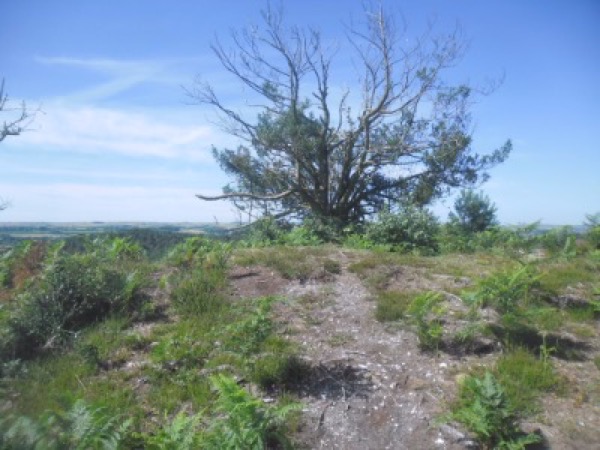
Egdon Heath
At one point, as I walked through the woods, I was approached by three silent and unconcerned wild ponies, one brown, one black, one white, like something in a fairy tale. The otherworldly nature of this stayed with me, as did the image of myself as an awkward kind of wild man stumbling through the scene, and when I got home, music began to flow easily for the first time in years.
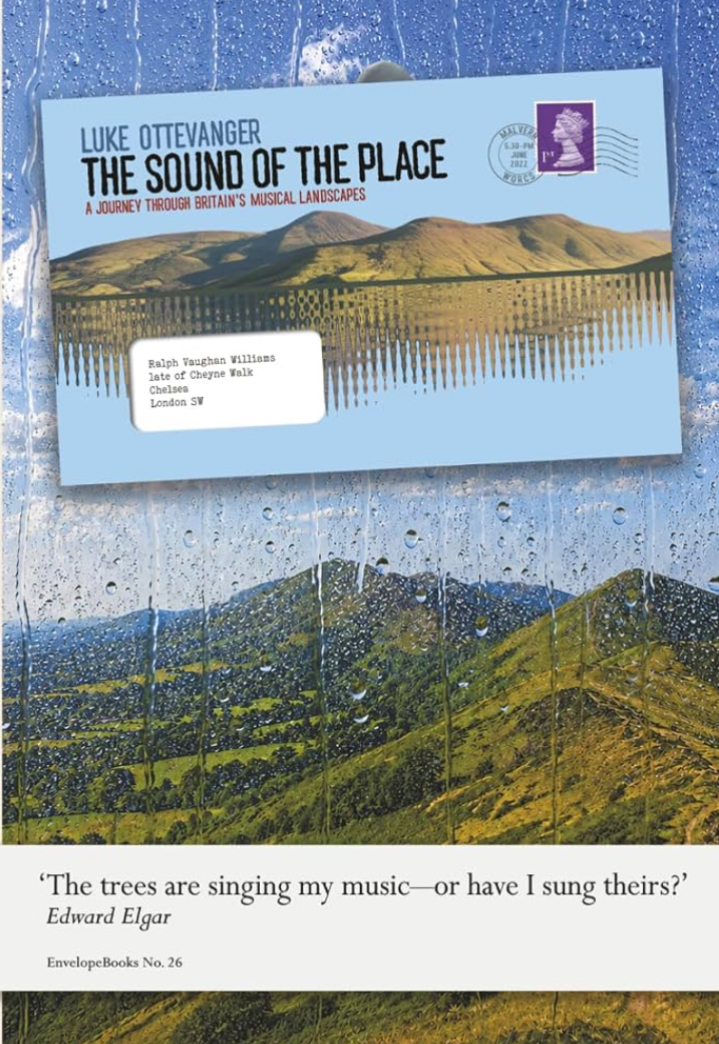
The Sound of the Place book cover
The Sound of the Place by Luke Ottevanger is published by Envelope Books. https://envelopebooks.co.uk/books/the-sound-of-the-place
For more of the best in classical music, sign up for our E-Newsletter