More than 62 million people have watched David Hicken’s music on YouTube, yet the composer behind those numbers works from a relatively quiet corner of northern Thailand. An English composer, organist, and pianist, Hicken has built an international audience from his studio in Chiang Mai, where he composes, performs, records, and publishes his music. His path to this unconventional musical life, however, began not with a plan to reinvent his career, but with a decision to start over.
Providence
David Hicken
After nearly 30 years in the United States, Hicken felt it was time for a change. He had visited Thailand more than two decades earlier and had enjoyed his time there, so when he decided to leave the United States, Thailand seemed like a natural place to begin a new chapter. “I just wanted a change, a new life,” Hicken says. He moved to Thailand with his mother, now 91, and his daughter, who is now 21, along with their three dogs. He met his Thai wife only after settling in the country.
Since then, Chiang Mai has become much more than a place to live. Hicken immersed himself in the local culture and studied Thai with a teacher three days a week. He also discovered a classical-music community that was more active than he had expected, with piano teachers, music programs, student orchestras, concerts, music stores, and piano technicians. His daughter studied clarinet at Payap University, and Hicken gradually became familiar with the city’s musical life.
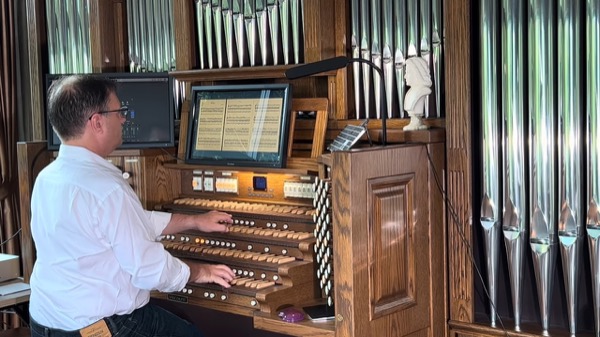
His own musical setup in Thailand is unusual. As Hicken notes, organs and organ music are relatively uncommon in the country, with only a couple of pipe organs in Bangkok, in his estimation. He owns two electronic organs from the Italian company Viscount; one installed in his home and another in the mountain village where his wife grew up. Because the village has no electricity, the smaller organ runs entirely on solar power. The electronic instruments are also practical in Thailand’s humid climate, which would make maintaining a traditional pipe organ difficult. His instruments use sampled sounds from organs in different locations in Europe, giving him access to a wide range of organ colours without the challenges of maintaining pipes.
This unusual environment has become part of his musical life. One of his works, Chiang Mai Rhapsody, combines organ, piano, harpsichord, and string sounds, and he has also created a two-piano version of the piece.
Chiang Mai Rhapsody
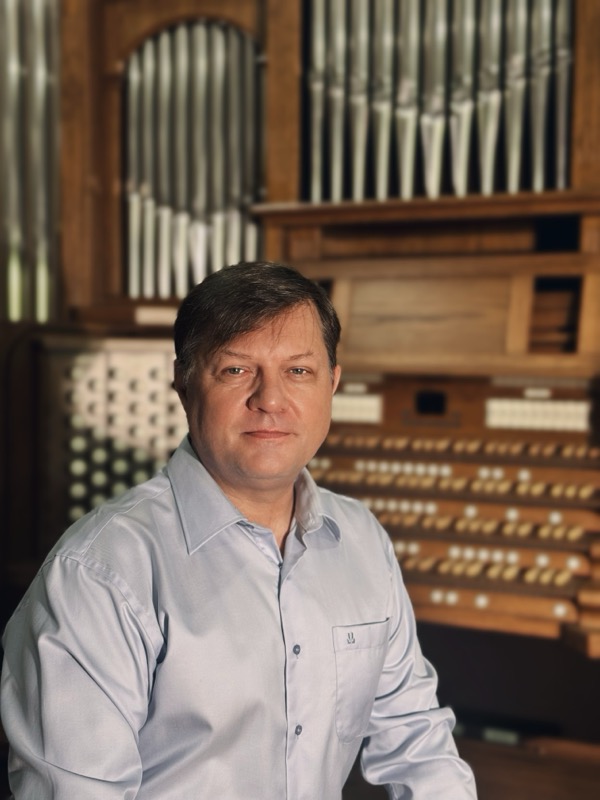
David Hicken
Although Hicken spent many years working in churches as an organist and choir director, he does not generally compose sacred music. Instead, he writes music that he enjoys performing, emphasising melody and traditional harmony. “I write for myself first and foremost,” he says. “I write what pleases me. I write what I enjoy playing.”
His approach to composition has evolved. His earlier works tended to be harmonically simpler, faster, and more immediately exciting, whereas his newer music has become increasingly influenced by counterpoint. His background as an organist and his admiration for Bach have played an important role in this development.
“As a composer I tend to think more horizontally,” he says, describing his interest in musical lines that intertwine rather than simply placing a melody over an accompaniment.
That personal approach to composition has also become important in his relationship with his online audience. Hicken’s YouTube channel began in 2013, when, while teaching a large studio in Honolulu, he arranged Carol of the Bells for his students’ parents as a Christmas gift. The video received an unexpectedly strong response, which encouraged him to share his original compositions online. He began regularly producing videos of his own music in 2015.
Carol of the Bells
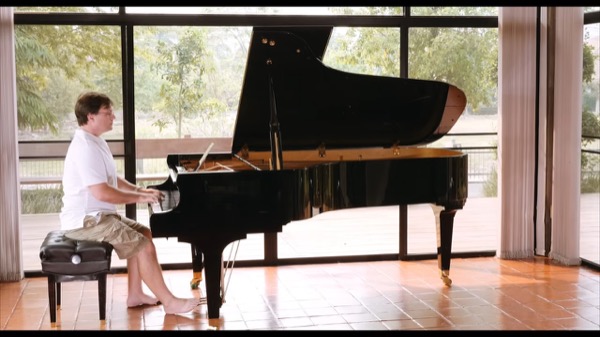
David Hicken at the piano
As his audience grew, Hicken began noticing that some pieces drew considerably more attention than others. For a time, he let those numbers influence what he wrote. Eventually, however, he realised that trying to recreate the success of a previous piece could compromise the music.
“When I try to write something thinking, ‘This will be the next more successful piece,’ it weakens it,” he says.
He now prefers to write what comes naturally and to let listeners decide what resonates with them. He says his own judgment of a piece does not necessarily align with its popularity. He points to Incantation as an example. Although the work was particularly successful with listeners, he considers it a weaker composition than some of his other works.
Incantation
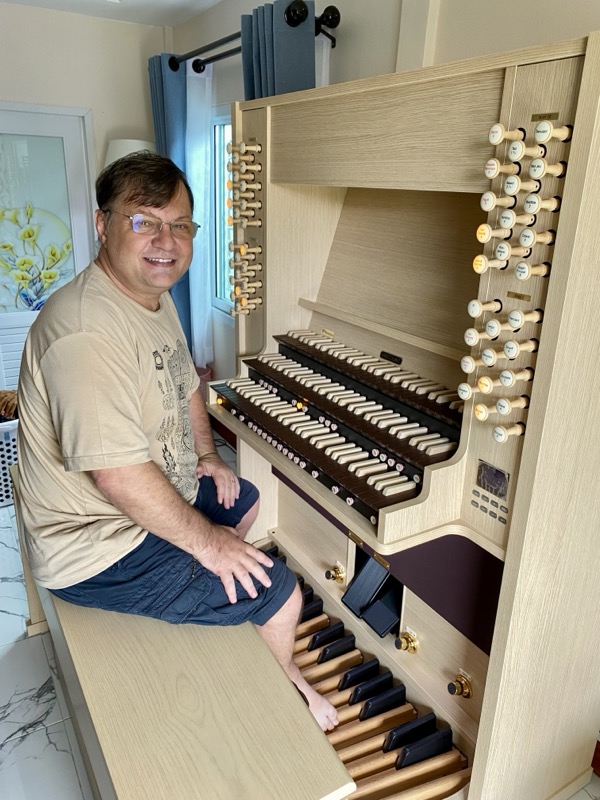
David Hicken
YouTube has transformed the way Hicken shares his music, allowing him to reach audiences far beyond the traditional concert hall without maintaining a large concert repertoire or travelling regularly. The growth of his online audience also helped him rethink his career. After years of teaching, including a period in Honolulu when he taught about 50 students a week and often worked seven days a week, he realised that teaching left him too little time and energy for composition.
“I made a decision to leave teaching and compose full time,” he says. “It’s been very good for me. It was the right decision.”
Today, Hicken continues to compose, perform, record, and share his music from Chiang Mai. What began as a desire for “a change, a new life” has become a musical life built largely on his own terms, with YouTube connecting his work to listeners around the world.
To know more about David Hicken, please visit his website https://davidhicken.com and his YouTube Channel: https://www.youtube.com/channel/UCRAWjJnIGOetJxxoipsTPvw.
For more of the best in classical music, sign up for our E-Newsletter