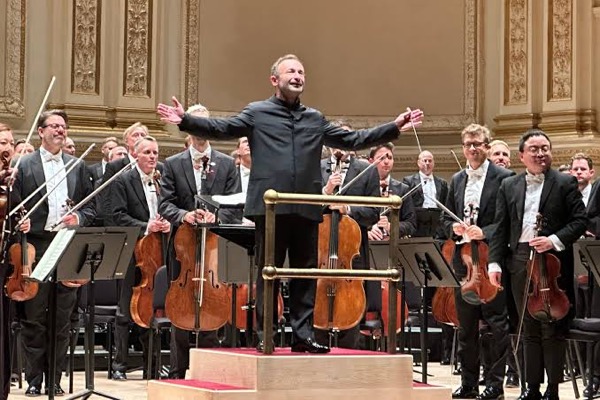
The New York Philharmonic’s two-night tenure at Elbphilharmonie continues the ambitious projects of major American orchestras visiting Hamburg this year. Newly appointed as music and artistic director, Gustavo Dudamel brought the exact same program he performed during his inaugural week in New York for his second night at the Elbphilharmonie.
Contemporary Soundscapes and Multimedia Memories
The programme starts with Invisible House, a commission premiered last month by Canadian composer Zosha Di Castri. It claims to draw inspiration from her ancestor’s World War I immigrant experiences, Ukrainian folk songs and poetry. The piece begins in a dark and somewhat muddy soundscape. Low strings and percussion ensembles form a vibrant sonic foundation. During the first section, different instrument groups seem to work independently. They move in their own distinct rhythms and figures, without any intention to blend or get closer. The complex percussion section creates a perpetual-motion background that feels restless. Meanwhile, the orchestra’s brass section enters periodically with glissandos, adding extra radiance.
The overall interpretation sounds like a dense jungle of swing rhythms and metropolitan noise. The music then transitions into a relatively quiet section, where the strings’ pizzicato play against a backdrop of long, sustained brass notes. What caught the audience’s attention was that the percussionists even joined in by clapping their hands. After moving through an extended solo cello passage and a full orchestral section, the piece concludes rather unexpectedly with a delicate harp segment. To be sure, Invisible House does not allow too much interpretive space for the conductor and orchestra. The dense score sounds like a collection of vivid orchestral exercises. New York Philharmonic offers plenty of fresh auditory colours, but the work elusively keeps the audience at an emotional distance.
On the Transmigration of Souls – Nov 14-17
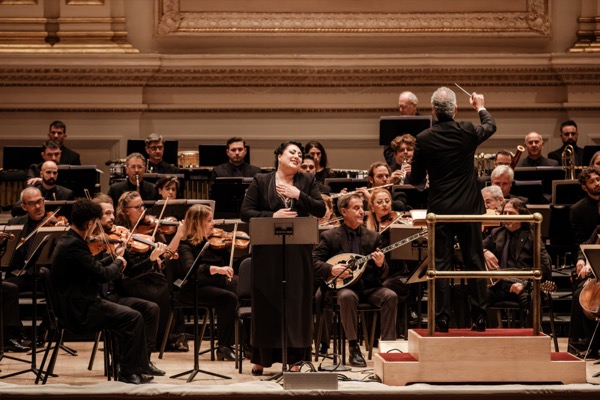
In contrast, John Adams’ On the Transmigration of Souls, the large-scale piece in memory of 9/11 victims, which the orchestra premiered in 2002, invites the audience to a powerful multimedia sonic installation. The work relies heavily on recorded sounds broadcast through speakers inside the hall. Street noises from New York City and repeated human voices create a realistic urban backdrop. When the three Orfeó Català choirs first enter, their fragmentary singing sounds cold and emotionless. They are accompanied by the orchestral support, with only sustained string notes and simple harp chords. Throughout, the New York Philharmonic plays in a very dedicated or even pious manner.
Gradually, a threatening wave of sound builds up across the stage. At this point, the choirs move from singing to a spoken-word style. Following a dramatic and extended passage for the brass section, the choir reaches an emotional peak, repeatedly chanting the words “light” and “love”. Finally, the piece fades away into silence as a long list of victims’ names is read.
John Adams: On the Transmigration of Souls (Brooklyn Youth Chorus; New York Choral Artists; New York Philharmonic Orchestra; Lorin Maazel, cond.)
Admittedly, Adams’ composition keeps an intellectual distance from the overly heated events, avoiding any direct personal commentary. Yet, by incorporating traceable texts linked to specific individuals and incorporating sonic materials drawn from the real-world environment, he manages to prevent the work from becoming overly abstract or entirely anonymous.
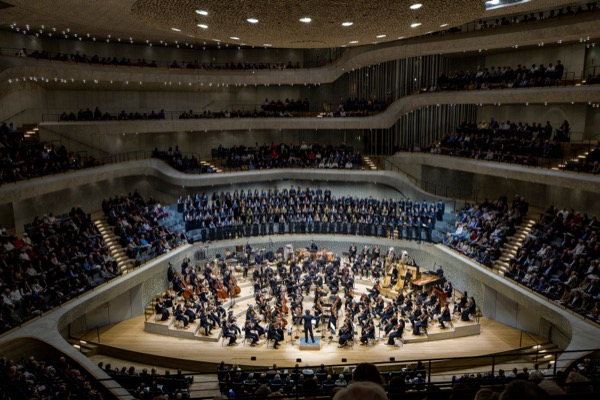
Credit: Todd Rosenberg
Mechanical Power
One might feel the two contemporary North American works in the first half presented the New York Philharmonic largely as a mechanism for producing sound. In the second half, it brought a shift toward something far more concrete with Sergei Prokofiev’s Symphony No. 5 in B-flat major, written in 1944 during the composer’s stay at the Composers’ Union house in Ivanovo.
The opening Andante movement begins with a warm and heavy theme entrusted initially to flutes and bassoons before passing to the strings. Dudamel guides the music forward at a moderate speed through thick orchestral textures, driven by an undeniable sense of willpower.
The second movement, Allegro, completely changes the atmosphere. Built on an intense regular rhythm, the music moves with agility, utilising material originally intended for the ballet Romeo and Juliet. The violins lead the way with a confident swagger, while bright accents from the woodwinds and a diverse percussion section add flashes of colour to the driving tempo. In the middle section, the brass delivers a quirky, even slightly awkward theme. After a dramatic acceleration, the initial themes return in an even crazier fashion. This movement felt like Gustavo Dudamel’s most natural and inspired moment during the entire concert, as he guided the orchestra through the complex rhythms with boundless energy.
The third movement, Adagio, returns to a darker tone and a movement of sustained lyricism. The main theme, marked by sharp dotted rhythms in the strings, unfolds over this sombre background before moving into a fiercely dramatic middle section. The finale brings the symphony to an energetic conclusion, introduced by a tranquil reminiscence of the symphony’s opening. The orchestra unleashed a relentless, engine-like momentum that pushed the music forward. The drive was supported by an overtly cheerful principal theme and a strong Russian element in the basses. In the closing bars, the frantic energy builds to a determined close. The New York Philharmonic unreservedly showcased their power and metallic sheen in this symphony: a complex mixture of optimism and oppression reminiscent of early Manhattan skyscrapers.
Taken together, none of these three works offered an easy listening experience, and for the most part, they could hardly be described as bringing simple joy. Following such a hard-core programme, the Waltz from Leonard Bernstein’s Divertimento served as a softening touch.
For more of the best in classical music, sign up for our E-Newsletter