One of the most fascinating and versatile musicians of the first half of the twentieth century, George Enescu composed only one opera. Oedipe would occupy the composer intermittently for more than twenty years, and it eventually premiered at the Paris Opéra, the Palais Garnier, in 1936 to great success.
Nevertheless, the opera was not kept in the repertoire, and only in 1955, directly after Enescu’s death, was it played in a radio production in France. Its first staged performance in Bucharest was three years later, and today we recognise it as one of the most fascinating operas of the twentieth century.
George Enescu: Oedipe (excerpt)
A Prodigy Between Worlds
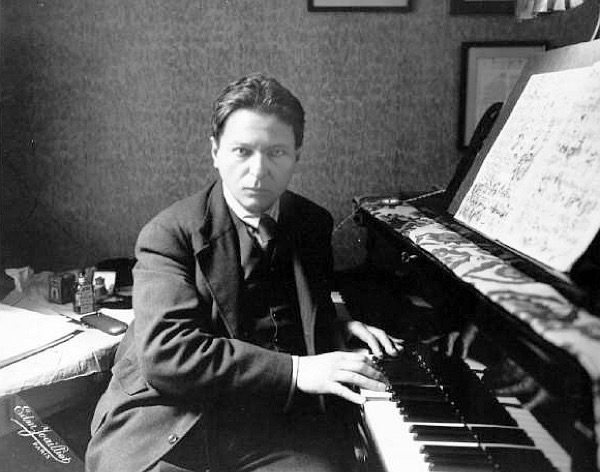
George Enescu, 1930
Born in a small Romanian village, George Enescu was a childhood prodigy and the youngest student ever admitted to the Vienna Conservatory in 1888. After graduating and doing some freelance work, his teacher, Joseph Hellmesberger Sr., suggested moving to Paris.
Enescu arrived in Paris in 1895 to continue his studies at the Paris Conservatoire. He studied composition under Massenet and Fauré, and counterpoint under André Gédalge. Fellow students and friends at the Conservatoire included Ravel, Schmitt, Koechlin, Casella, Cortot, and Thibaud.
And while his compositional style became more clearly defined, the prospects of a career as a composer in Paris were not encouraging. As such, Enescu led a divided existence between France and Romania, with his energies divided between performance and composition.
The Choice of a Myth
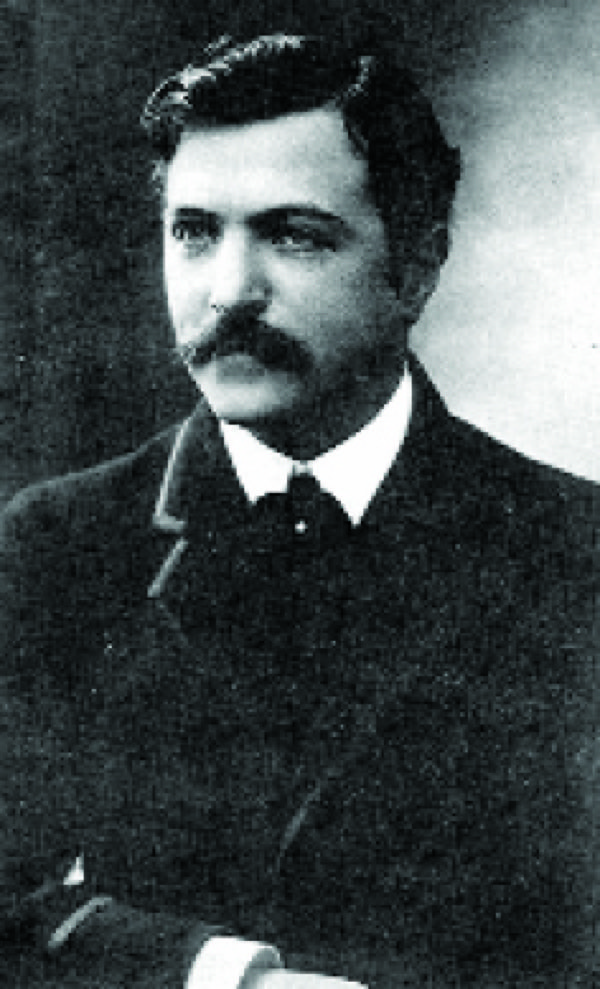
Edmond Fleg
By 1906, Enescu had decided to compose an opera, but it took him a further three years before the subject matter became clear. It so happened that Enescu saw the play Oedipus Tyrannus (Oedipus King) by Sophocles in 1909, with the renowned French actor Jean Mounet-Sully in the title role.
Fascinated by the performance, Enescu decided to use this myth and began looking for a librettist. Eventually, he settled on Edmond Fleg, a Jewish French writer, thinker, novelist, essayist, and playwright, who was crucial in constructing a modern French Jewish identity.
Fleg wrote the libretto in French, but unlike Sophocles’ play, the first and last acts trace the story from Oedipus’ birth to his death, with the tragedy confined to the central two acts.
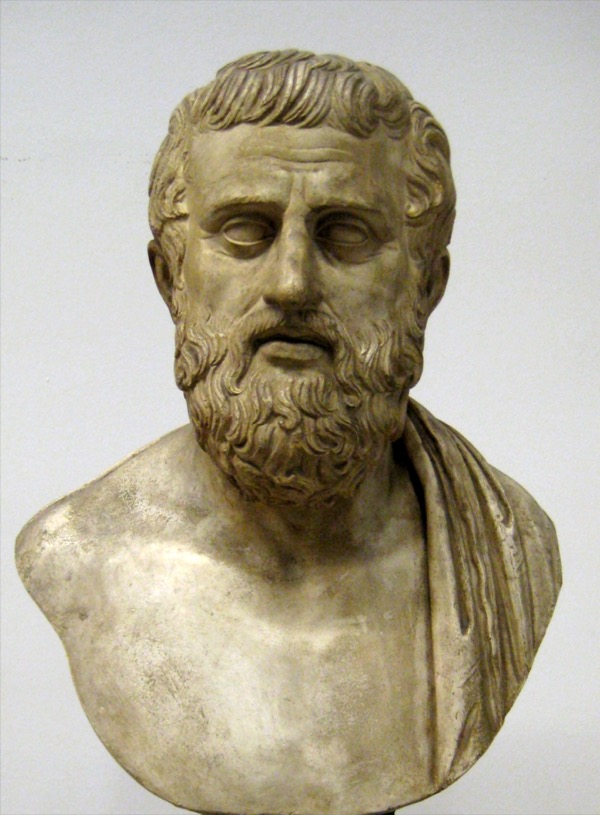
Sophocles (Pushkin Museum)
George Enescu: Oedipe: Act III: Oh! Oh! Helas! Helas! (Monte Pederson; Egils Siliņš; Davide Damiani; Vienna State Opera Chorus; Vienna State Opera Orchestra; Michael Gielen, cond.)
Composing Destiny
The first musical sketches date from 1910, but the score was not finished until 1931 or 1932. Even the libretto, although drafted before World War I, matured slowly, and it only emerged as the most comprehensive treatment of the Oedipus myth in 1921.
As John C. G. Waterhouse and Irina Boga write, “The initial idea of the tragedy on the myth of Oedipus is to describe a man destroyed by unavoidable destiny. Enescu perceives this conflict differently, deciding to offer the character the chance to regain his purity, thus building his character as a winner, a man who is ‘stronger than destiny’, contradicting the obstacles a hostile fate places in his path.” (Oedipus, GMO, 2015)
Orchestration aside, Enescu’s main period of work on the music took place between the summer of 1921 and November 1922. He played the entire opera to a group of friends, but the completion of the full score, interrupted by several European and American engagements, would take almost another decade.
George Enescu: Oedipe: Act II Scene 2: Est-ce deja le Roi? (Monte Pederson; Egils Siliņš; Davide Damiani; Vienna State Opera Chorus; Vienna State Opera Orchestra; Michael Gielen, cond.)
Classic Form and Modern Voice
The Myth of Oedipus is concerned with an ancient theme, but Enescu conceives the music along the lines of a modern musical drama in the style of Richard Wagner. As such, we find a prelude instead of an overture, yet Enescu alternates between the classic and the modern.
“The structure is classic, unfolding in four acts with a prologue and epilogue, but the development is modern. It follows elements of the musical lexicon specific to the twentieth century by including modalism combined with tonality, a modern orchestra, revolutionary in terms of rhythm and aesthetic, and a collaboration between harmony and elements of heterophony and counterpoint.” (Oedipus, GMO, 2015)
The scoring shows great originality, while the musical language is unique to Enescu, with its shifting harmonies and thematic transformations. He daringly offers unusual sounds in the score, for example, combining the sound of thunder with a shepherd playing his flute.
George Enescu: Oedipe: Act I Prologue: Prelude (Monte Pederson; Egils Siliņš; Davide Damiani; Vienna State Opera Chorus; Vienna State Opera Orchestra; Michael Gielen, cond.)
The Child of Prophecy
This dramatic musical treatment of the Oedipus myth is unusual in that it attempts to cover the entire story of Oedipus’ life, from birth to death. Act 1 takes place in the royal palace of Thebes, at the time of Oedipus’s birth, son of Laius and Jocasta.
The celebrations led by the High Priest are interrupted by the blind prophet Tiresias, who tells Laius the punishment for his disobeying Apollo’s injunction to bear no descendants.
Tiresias tells them that, one day, the child will murder his father and marry his mother. Laius is appalled and horrified, and he orders a shepherd to abandon the infant in the mountains so that it will die.
George Enescu: Oedipe, “Act 1”
Fate at the Crossroads
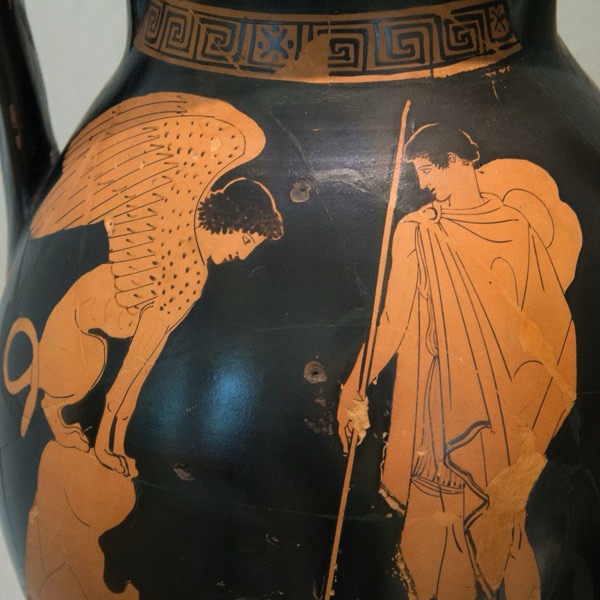
Oedipus and the Sphinx, pelike, 450–440 BC (Berlin F 2355)
In Act II, twenty years have passed, and the child has survived and lives in Corinth with King Polybus and Queen Merope. He has dark visions, and when he consults the oracle at Delphi, it is predicted that he will kill his father and marry his mother.
Oedipus, who thinks that Polybus and Merope are his biological parents, flees the palace but first reveals the prophecy to Merope. At the famous crossroads, Oedipus is insulted by Laius and his companions, and he kills them in self-defence, witnessed by an old shepherd, before completing his journey to Thebes.
The final scene in Act II features the Sphinx, a monster in the form of a winged lioness with a woman’s head, who kills everyone who cannot answer her riddles. Oedipus offers to challenge her to save the city, and when the Sphinx dies, he is rewarded with marriage to the widowed Jocasta.
George Enescu: Oedipe, “La Sphinge”
Recognition and Ruin
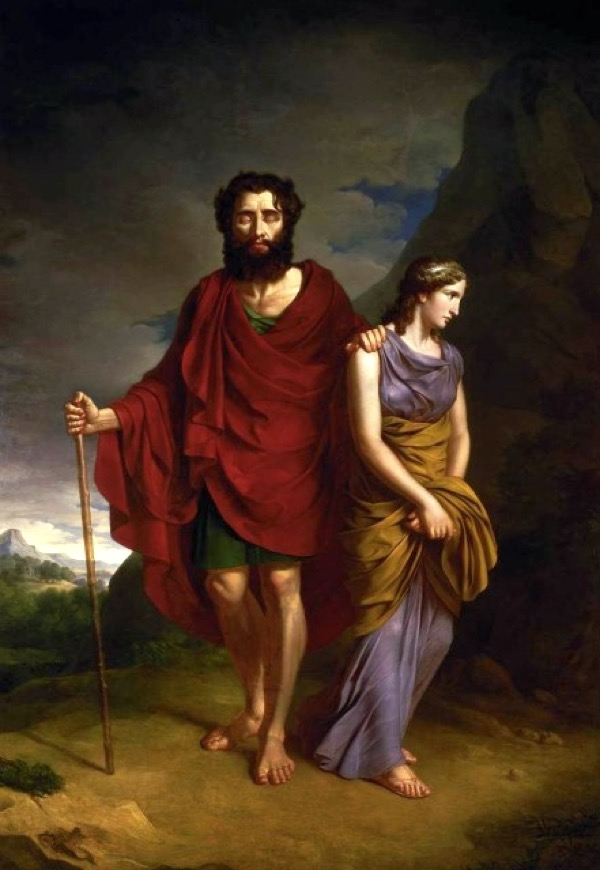
Oedipus and Antigone by Brodowski
In Act III, twenty more years have passed, and Thebes is enjoying peace and prosperity with Oedipus as king. However, at last the city-state is struck by plague, and Jocasta’s brother Creon has gone to Delphi to consult the Oracle.
The plague will only end after the murderer of Laius has been exposed and punished, and Creon summons Tiresias and the old shepherd to the city. The facts are revealed by Tiresias, but are not believed by Oedipus until Jocasta reveals how Laius was murdered.
Jocasta commits suicide, and Oedipus blinds himself. Creon sentences Oedipus to exile, and he accepts the punishment as the only way to save the city. His favourite daughter, Antigone, decides to accompany her father and be his guide.
George Enescu: Oedipe (excerpt)
Redemption at Colonus
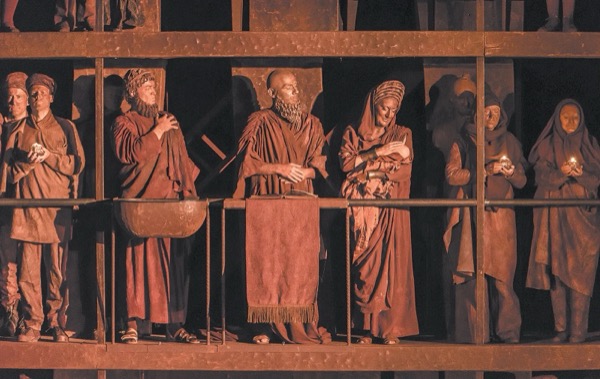
Oedipus at the Royal Opera House
After years of wandering, Oedipus and Antigone arrive at Colonus, near Athens, in Act IV. Antigone describes the flowery grove to Oedipus, who understands he will die there peacefully.
Creon suddenly arrives and attempts to persuade Oedipus to return to Thebes. When Oedipus refuses, Creon takes Antigone hostage. She is eventually freed, and Oedipus is welcomed into Athens. However, he takes his leave of everyone and settles in the flowery grove where he will die.
Daniel Ponder describes Oedipe as “the last French Grand opera, featuring elements of French Grand Opera influenced by Meyerbeer, Romanian folk music traditions, Viennese 19th century symphonic music, and Turkish maqam.” (Ponder, Oedipe, 2009)
George Enescu: Oedipe (excerpts)
A Synthesis of Styles
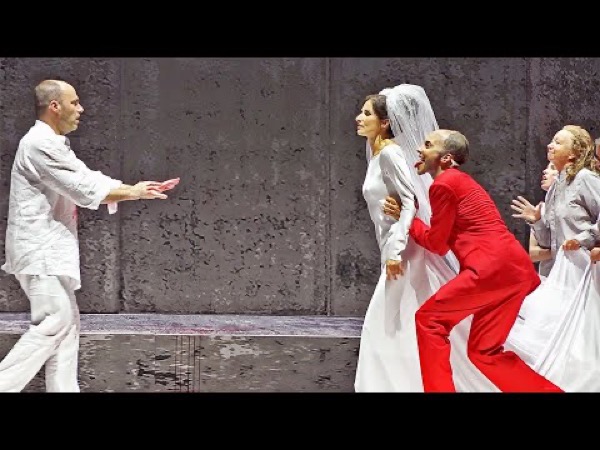
Oedipe, Berlin
The opera’s eclecticism and synthesis of styles prevent the work from fitting into one single school of composition—the tortuously chromatic orchestral prelude features, in a distinct Wagnerian manner, several of the main motifs.
We find the theme of Fate, the idea of “man’s victory,” and a phrase associated with Jocasta. However, “Enescu’s technique is too flexible for such exact labels to be wholly satisfactory: recurrent themes often change both shape and function, and seemingly distinct motifs can show clear family resemblances.” (Oedipus, GMO, 2015)
The opera is also infused with elements of Romanian folklore, including the improvised shepherd’s call on the piccolo, echoed by the clarinet and heard throughout. It has been suggested that through the use of culturally indicative music, Enescu makes clear references to his history and his homeland.
George Enescu: Oedipe: Act III: Qu’entends-je, Oedipe? (Monte Pederson; Egils Siliņš; Davide Damiani; Vienna State Opera Chorus; Vienna State Opera Orchestra; Michael Gielen, cond.)
Acclaim and Obscurity

Oedipe, Salzburg
The opera’s premiere featured minimalist, avant-garde staging derived from Russian and German theatrical traditions of the early twentieth century. It was hailed for its inventiveness, creativity, and the unique balance and blend between voices and orchestra.
Darius Milhaud was particularly impressed, calling it “a crowning achievement and prime example of the Académie Française and the Conservatoire Supérieur… One is easily lost in the meandering that gives testimony to a conception somewhat rhapsodic of the music.” (Ponder, Oedipe, 2009)
Yet despite its successful premiere, Oedipe quickly fell out of favour. Some authors point out that Europe was still recovering from the First World War, followed by the Nazi movement and the rise of Fascism, and that the grand scale of production would have been economically difficult to sustain.
George Enescu: Oedipe (excerpt)
Legacy and Rediscovery
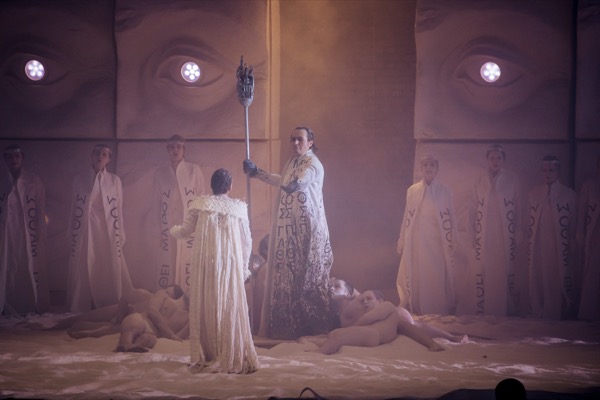
Oedip in the FIGE programme, Opera Națională București, 15 September 2025
It does require a large principal cast, a large orchestra including triple winds, and a large chorus. It was simply too expensive and grand to put together during World War II.
The first German production took place in Berlin in 1996 and later travelled to the Vienna State Opera. The U.S. premiere took place in 2005, and the Salzburg Festival took it up in 2019.
George Enescu was a man of the world, and his opera reflects musical eclecticism and cultural identities. Darius Milhaud called it a work of modernity that reflects the clash of cultures and influences that brought the French school of composition into the twentieth century.
Most likely, this element of eclecticism is what brought the opera its initial success, and also its unfortunate obscurity during and after the Second World War. In addition, there are no great arias or duets, and the momentum of the narrative advances through the choral writing and the drama on the stage.
Oedipe must be seen and heard repeatedly to understand the complexity of this marvellously complex score. In recent years, major productions in Brussels, Salzburg, London, Paris, and Bucharest have made such rediscovery possible.
For more of the best in classical music, sign up for our E-Newsletter