Wolfgang Amadeus Mozart is one of the most famous composers who ever lived – but the myths surrounding him sometimes obscure the quirkier facts about his life.
Beyond the powdered wigs, Mozart was a complicated, funny, deeply human figure whose life was full of surprising twists and turns.
From his real name to his romantic disasters to the mysteries surrounding his final compositions, these Mozart facts reveal a man far more interesting – and human – than the legend.
Technically, Mozart’s middle name wasn’t Amadeus.
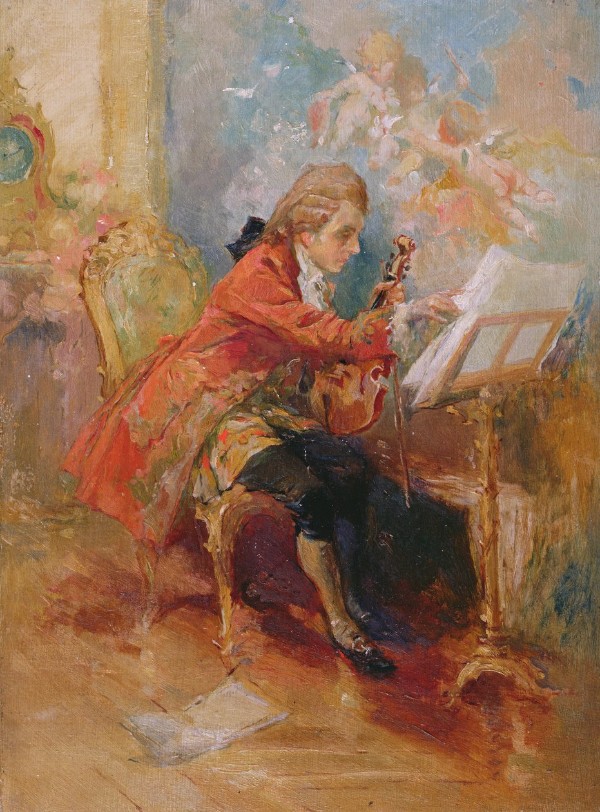
Jean Louis Ernest Meissonier: Mozart Playing the Viola
His full baptismal name was a mouthful: Joannes Chrysostomus Wolfgangus Theophilus Mozart.
Joannes Chrysostomus honoured the saint’s day on which he was born; Wolfgangus referenced his maternal grandfather; and Theophilus was the name of his godfather.
Theophilus is a Greek name meaning “loved by God” – and Amadeus is the Latin translation of that phrase.
Mozart himself often signed his name “Wolfgangus Amadeus,” but Theophilus was the name he was actually given.
We covered this in our article about composer nicknames here: https://interlude.hk/composers-and-their-nicknames/
Mozart had an equally talented sister named Nannerl – but she was sidelined from becoming a professional musician after she came of marriageable age.
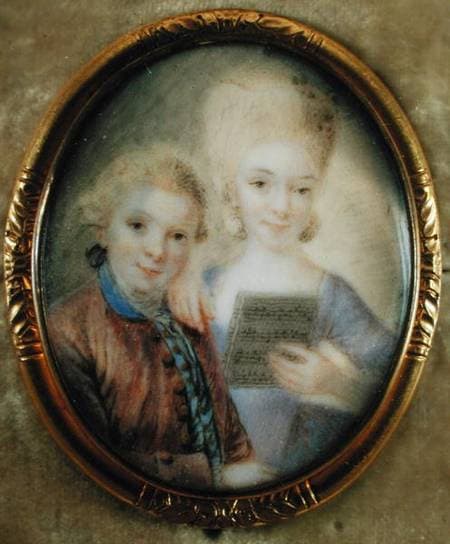
Wolfgang and Nannerl Mozart
Mozart’s older sister Maria Anna, nicknamed Nannerl, was born five years before Wolfgang.
He first fell in love with music by watching her lessons with their father Leopold. Like any little brother, he wanted to copy everything she did.
When Wolfgang also proved to be a prodigy, the two toured Europe together for years, performing in concert halls and palaces.
After she turned eighteen, the tours stopped. She married a baron in 1784, became a wife and mother, and continued to play piano – but never toured again.
We looked at Nannerl Mozart’s biography here: https://interlude.hk/maria-anna-mozart-the-bittersweet-story-of-mozarts-prodigy-sister/
Mozart likely met Marie Antoinette when he was a child.
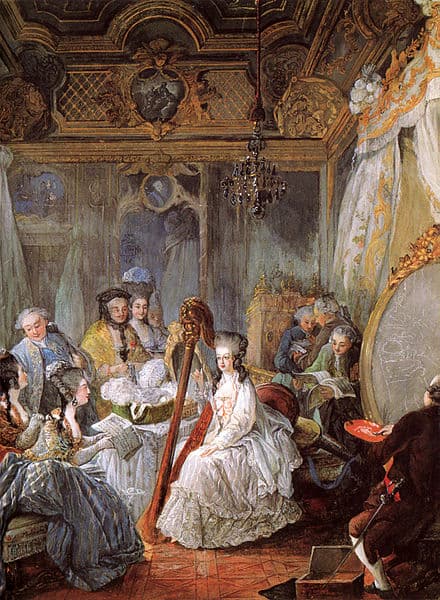
Queen Marie Antoinette playing the harp
Marie Antoinette was born in 1755 – just one year before Mozart – the fifteenth child of Empress Maria Theresa and Holy Roman Emperor Francis I.
When the Mozart children toured Europe performing for royal and aristocratic families, they visited the Habsburgs at Schönbrunn Palace in Vienna in October 1762. During that meeting, Mozart famously jumped into Maria Theresa’s lap.
Whether Marie Antoinette was present or not isn’t documented but given her musical talent and how close in age she was to Mozart, it’s very likely she was.
Legend has it that after he tripped and Marie Antoinette helped him up, Wolfgang proposed to her. It’s a charming story, but the historical record doesn’t back it up.
We looked at Marie Antoinette’s lifelong relationship with music here: https://interlude.hk/marie-antoinette-the-last-queen-of-france-there-is-nothing-new-except-what-has-been-forgotten/
Mozart (and his family) had an infamously scatological sense of humour.
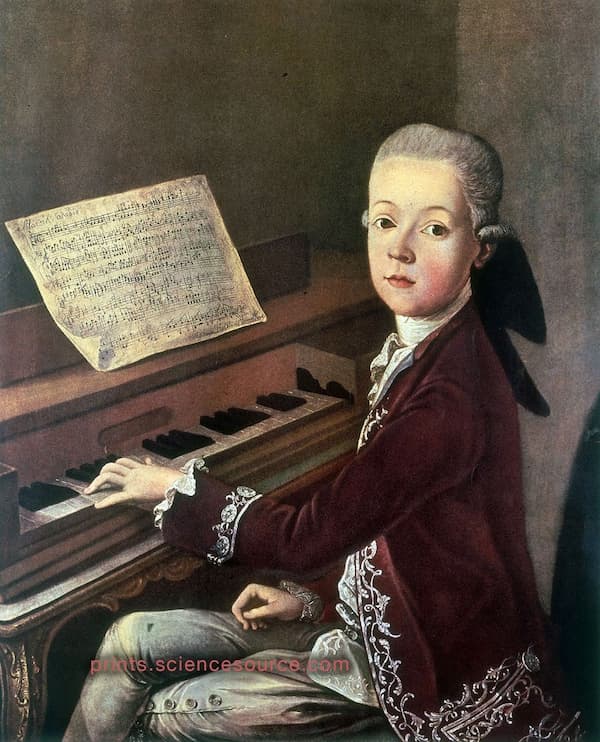
Mozart at the piano
So much crude humour appears in the Mozart family letters that some scandalised editors scrubbed the references from their published editions. Mozart, his mother, and his cousin were especially vulgar.
Occasionally it spilt from his correspondence into his compositions – most memorably in the three-part canon Leck mich im Arsch, which translates roughly as “kiss my ass,” likely meant to be a silly party piece for friends.
We looked at the story behind Leck mich im Arsch here: https://interlude.hk/eight-pieces-of-classical-music-with-the-weirdest-names/
“Leck mich im Arsch”
Mozart and Haydn were huge fans of each other, not rivals.
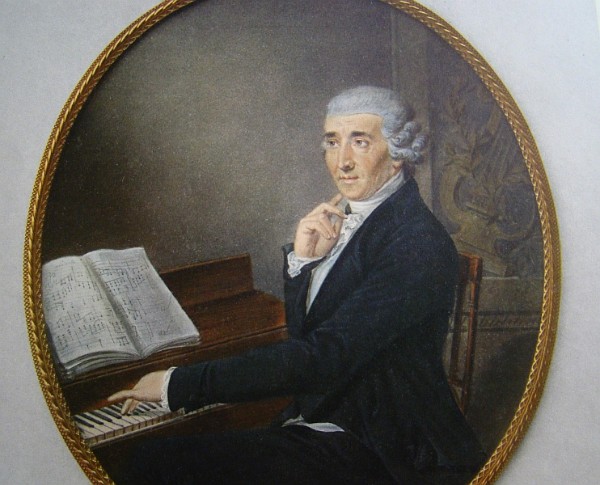
Joseph Haydn
The two composers likely met soon after Mozart moved to Vienna to begin his freelancing career.
Haydn‘s string quartets deeply inspired Mozart, and in 1785, he published six quartets of his own, with a warm dedication page addressed to Haydn.
After hearing them, Haydn told Mozart’s father Leopold: “Before God, and as an honest man, I tell you that your son is the greatest composer known to me either in person or by name. He has taste, and, what is more, the most profound knowledge of composition.”
We delved into the history of Mozart and Haydn, as well as what Mozart thought of other colleagues, here: https://interlude.hk/wolfgang-a-mozart-and-his-fellow-musicians/
Mozart fell in love with Aloysia Weber before marrying her sister Constanze.
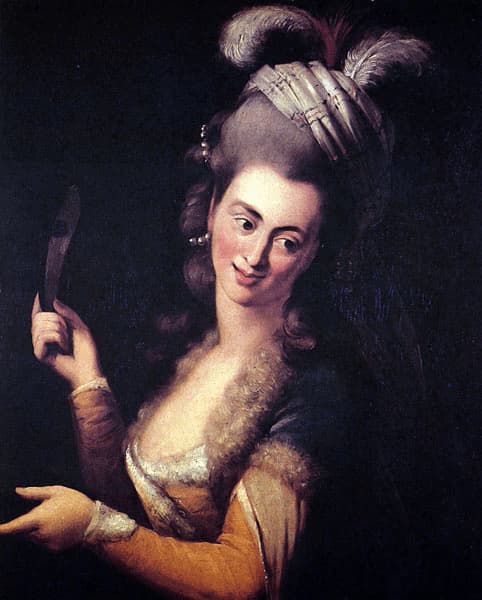
Aloysia Weber as Zémire in André Grétry’s opera Zémire et Azor, painting by Johann Baptist von Lampi the Elder © Wikipedia
While in Mannheim, Mozart became infatuated with a talented young singer named Aloysia Weber, writing arias for her and reporting to his father in admiring terms about her voice.
She didn’t return his feelings – or perhaps valued her career more.
After she later ignored him in Munich, Mozart sat down at a piano and sang a song whose title translates roughly as “the one who doesn’t want me can kiss my ass.” That choice of repertoire did not help his case.
Mozart moved in with his wife before they got married.
Mozart eventually got over the snub. After Aloysia married someone else, Mozart returned to the Weber household as a boarder – and this time fell for her younger sister Constanze.
Their courtship was tempestuous: his father disapproved, and they briefly broke up when Constanze let another man measure her calves in a parlour game.
But they reconciled, and in the summer of 1782, the couple moved in together, to her mother’s horror. Mozart hinted to his father that they’d consummated the relationship, writing to him, “All the good and well-intentioned advice you have sent fails to address the case of a man who has already gone so far with a maiden. Further postponement is out of the question.” They married in August.
We investigated the stories of how the Weber sisters became Mozart’s muses and, eventually, wife: https://interlude.hk/how-the-weber-sisters-became-mozarts-wife-family-and-muses/
Mozart wrote one of his string quartet movements while his wife was in labour, and supposedly wrote her cries into the music.
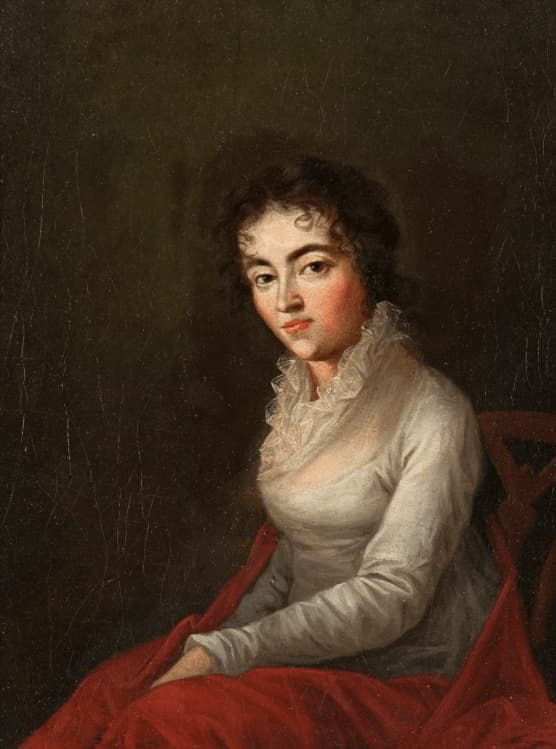
Constanze Mozart as portrayed in 1782 by her brother-in-law Joseph Lange © Wikipedia
On 17 June 1783, while the pregnant Constanze laboured through the night, Mozart nervously composed two movements of his D-minor String Quartet, K. 421.
Constanze later claimed her cries inspired the chromatic minuet.
Five hours later, a boy arrived – “fine, sturdy, round as a butterball,” Mozart reported to his father.
Mozart String Quartet No. 15, Movement 2
We looked at what happened to all seven of Mozart’s children here: https://interlude.hk/what-happened-to-mozarts-children/
Mozart’s “Musical Joke” (K. 522) is a piece written to mock bad composers.
Written in 1787 for two horns and string quartet, Ein musikalischer Spaß (A Musical Joke) is a meticulously crafted parody of incompetent composition.
It features clumsy voice leading, awkward phrasing, a soloist who can’t quite manage their part, and a finale in which all the instruments, despite their best efforts, end up in four different keys simultaneously.
The piece works because Mozart plays it completely straight.
We looked at how – and why – Mozart still makes us laugh here: https://interlude.hk/why-mozart-still-makes-us-laugh/
Mozart’s Musical Joke
Mozart wrote his last three symphonies over the course of one summer in 1788 – and he might have conceived of them as a linked group.
Mozart wrote his Symphonies No. 39, 40, and 41 during an astonishing six-week burst in the summer of 1788.
The circumstances behind their composition are genuinely mysterious. There’s no record of commission, no documented premiere. They’re three of the most famous works in the repertoire, but we’re totally in the dark about why they exist.
Mozart’s Symphony No. 40
The “linked trilogy” idea comes from the fact that they’re distinct but complementary in character: 39 is in E-flat, warm and prominently featuring the clarinet; 40 in G minor, restless and driven and proto-Romantic; and 41 in C major, a monumental achievement of compositional technique, with the most dazzling symphonic finale he ever wrote.
Together, they cover an enormous expressive range – which has led scholars to wonder whether they were conceived as a set or possibly for a concert series that never happened.
We looked at which of these symphonies are among his most popular on YouTube: https://interlude.hk/the-8-most-viewed-mozart-symphonies-on-youtube/
After Mozart’s death, his widow Constanze had the Requiem finished – partly to prevent the man who commissioned it from passing it off as his own.
The Requiem was commissioned anonymously by Count Franz von Walsegg, who had a habit of presenting purchased compositions as his own work.
Mozart died before completing it, and Constanze arranged for his student Franz Xüssmayr to finish it.
She later claimed that Mozart had become convinced the mysterious intermediary who delivered the commission was a messenger of death – and that at the end, Mozart was writing the Requiem for himself.
We looked at the stories behind Mozart’s friends and rivals, including Count von Walsegg, here: https://interlude.hk/mozart-and-his-circle-of-friends-ii/
Lacrimosa from Mozart’s Requiem
Many people know that Mozart was buried in an unmarked grave – but that was actually standard practice in 1790s Vienna.
The image of Mozart dying in poverty and obscurity, tossed into a pauper’s grave, is one of classical music’s most persistent myths.
In reality, unmarked communal graves were the norm for middle-class residents in late 18th-century Vienna.
Mozart’s unmarked grave says more about Viennese burial customs than it does about how the world valued him.
We wrote about Mozart’s death and burial here: https://interlude.hk/on-this-day-5-december-wolfgang-amadeus-mozart-died/
Although he died at the age of 35, Mozart wrote 600 works.
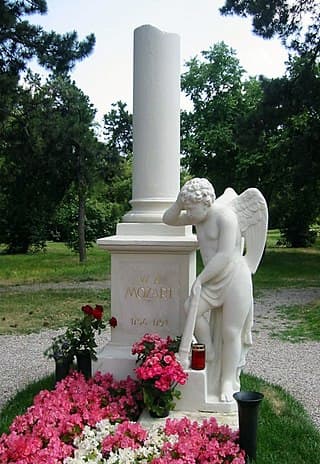
Austria, Vienna, St. Marx Cemetery, The gravestone of Wolfgang Amadeus Mozart
Given that Mozart was five when he started composing, that means he wrote about twenty works a year.
That means if he’d lived into his seventies as Haydn did, we would have heard about 850 more, with a lifetime output of over a thousand works.
It’s an incalculable loss to ponder.
Conclusion
Mozart died at thirty-five, and the world has spent the centuries since trying to take the full measure of what was lost.
But perhaps the most remarkable thing about him isn’t the music he left behind – it’s the person behind it: irreverent, warm, occasionally ridiculous, and possessed of a genius so natural it spilt into everything he touched, from his symphonies to his party songs to the string quartet he wrote while his wife gave birth in the next room.
The facts of his life don’t diminish the legend. They make it better.
For more of the best in classical music, sign up for our E-Newsletter