Do you feel like you’ve encountered too many classical music programs that seem like the “greatest hits?” Or those that comprise the “same ole same ole” trendy works with a dose of contemporary commissions without regard for how the works complement each other? Sometimes it seems to me that well-thought-out programming is dead and the decisions might have been made through the marketing department.
This was not the case at a recent Saint Paul Chamber Orchestra concert (SPCO, St. Paul, Minnesota) entitled “Jonathan Biss Plays Schumann’s Piano Concerto.” As a subscriber to this excellent and enterprising ensemble, I expected this would be no ordinary program, and sure enough it was so inspired and thought-provoking that it has me ruminating weeks later.
One would expect no less from this distinguished artist, the grandson of cellist Raya Garbusova (for whom Barber wrote his Cello Concerto), and the son of violinist Miriam Fried and violist Paul Biss. To say he has established himself as one of the great interpreters and pedagogues of music would be an understatement. Biss has performed with the world’s most eminent orchestras, has been a co-director of Marlboro Music School and Festival, has served as faculty at the Curtis Institute of Music and is the author of several books, including the recent release My Life with Beethoven. Biss recorded all 32 Beethoven Piano Sonatas, and he conducted a series of free online lectures Exploring Beethoven’s Piano Sonatas in 2020 – the 250th anniversary of Beethoven’s birth.
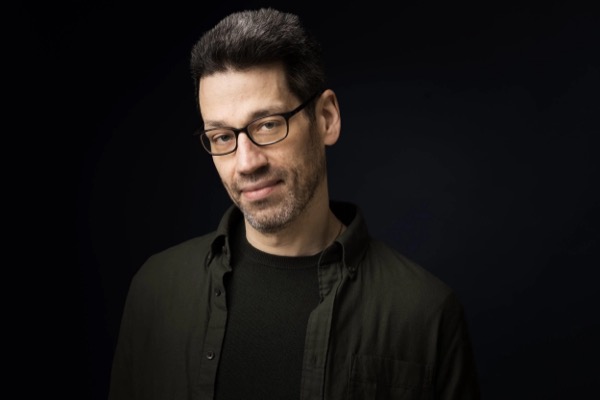
Jonathan Biss © Benjamin Ealovega, 2023
Biss poses the question, “How will one piece affect the perception or listening of the other?” In other words, he challenges, even upends, preconceptions of how a work “ought” to be received.
The program included the following works:
Robert Schumann – Introduction and Allegro appassionato (Konzertstück)
György Kurtág – Hommage á R. Schumann for Clarinet, Viola, and Piano
Clara Schumann – Trio in G Minor for Violin, Cello, and Piano
Augusta Reed Thomas – Clara’s Ascent
Robert Schumann – Piano Concerto in A minor Op. 54
György Kurtág – Selections from Játékok (Games) for Solo Piano and Signs, Games, and Messages for String Trio.
Biss features Schumann’s world and influences. What was not evident at first glance was not simply that the R. Schumann works nicely bookended the program. The musical partnership with Clara Schumann is brought to the fore. She was the more renowned artist of the two at the time—a celebrated pianist and lauded musician. Clara was much more than Robert’s muse (and Brahms‘s). Biss contends that both Schumann and Brahms wrote their music with Clara’s abilities, facility, and style in mind.
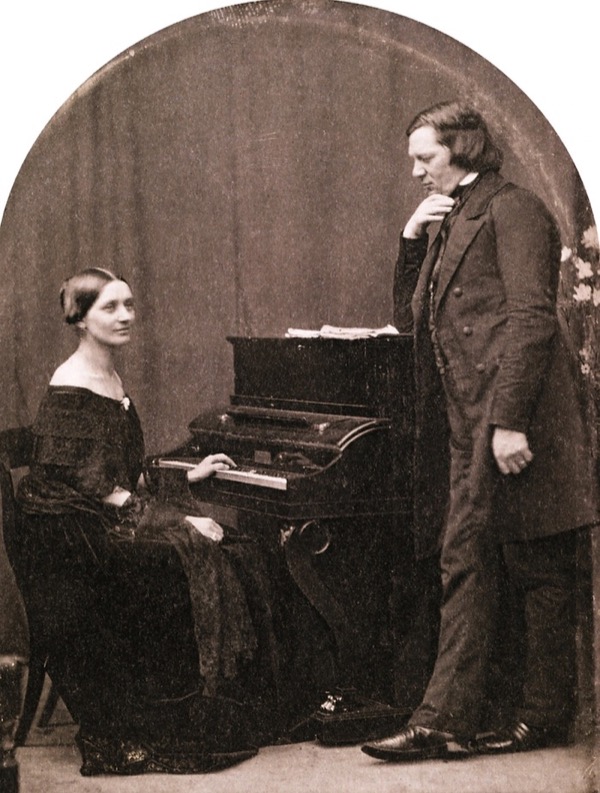
Clara and Robert Schumann
The Introduction and Allegro appassionato Op. 92 from 1849, dedicated to Clara, was a lovely opening piece, and Biss’ playing was fluid and lyrical. A poetic opening followed by a fervent and fast section was just the inviting piece to draw listeners in.
Robert Schumann: Introduction and Allegro appassionato, Op. 92 (Vladimir Ashkenazy, piano; London Symphony Orchestra)
Hungarian György Kurtág, born 1926 and still with us, composes in very brief moments, in fragments and miniatures reminiscent of Webern, and certainly it’s enigmatic.
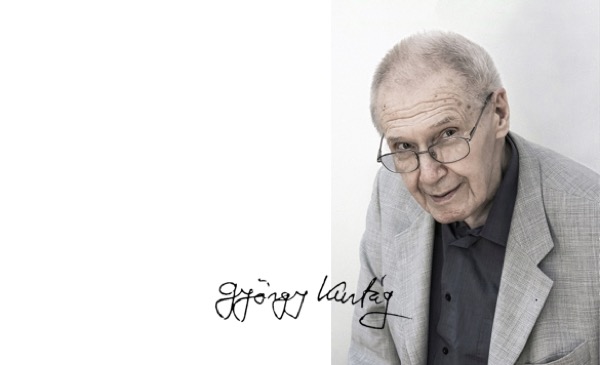
György Kurtág
The first Kurtág piece on the program thrust us into the present day with contemporary techniques, including tonal clusters Biss played with his entire forearm, remarkable pianissimos and contrasting timpani strokes with a mallet on the bass drum. This trio emulates Schumann’s late work Märchenerzählungen Op. 132 (Fairytale Narrations) for the same instrumentation, and each movement alludes to specific features of Schumann’s music. Below is the Schumann work and then a sample of the Kurtág.
Robert Schumann: Märchenerzählungen (Fairy Tale Narrations), Op. 132: I. Lebhaft, nicht zu schnell (Paul Meyer, clarinet; Antoine Tamestit, viola; Eric Le Sage, piano)
György Kurtág: Hommage à R. Sch., Op. 15d: I. Merkwürdige Pirouetten des Kapellmeisters Johannes Kreisler (Kammerata Luxembourg)
György Kurtág: Hommage à R. Sch., Op. 15d: II. E.: der begrenzte Kreis (Kammerata Luxembourg)
The Clara Schumann Trio from 1846 was a striking contrast. It’s a lovely and accomplished work, and sadly we only heard the slow movement in this program. As a performer, Clara had played a great deal of chamber music, rubbing shoulders with leading composers, including Felix Mendelssohn. The trio represents only two chamber music pieces that she wrote. At a time when women were not accepted as composers and busy as a concert artist, raising eight children, and taking care of her husband who was increasingly mentally ill, we can understand that Clara’s composing days were limited. Here it is in its entirety.
Clara Schumann trio complete
Commissioned by the Chelsea Music Festival, Clara’s Ascent by Augusta Read Thomas was timed to coincide with the 200th birthday of the composer and pianist; “this work honours the legacy and contributions of a pioneering performer, caring collaborator, and artistic confidant.” The work is centred around the cellos, beginning in the lowest sonorities and rising throughout. I found it very interesting and unique. Thomas, an exceedingly prolific composer, is featured in an interesting interview below, offering an insight into how a contemporary composer conceives their work.
Augusta Read Thomas
The first movement of Schumann’s Piano Concerto in A minor, Allegro affettuoso, was intended to be a free-standing piece. In fact, he’d struggled to compose the one-movement Fantasy written in 1841. Clara convinced him to expand the movement into the full piano concerto, finally completed in 1845, the work that we know today.
Robert Schumann: Piano Concerto in A Minor, Op. 54: I. Allegro affettuoso (Claudio Arrau, piano; South West German Radio Symphony Orchestra, Baden-Baden; Ernest Bour, cond.)
Biss, after playing the first movement and before the slow movement of the concerto, had his string colleagues come to the front of the stage, and the Kurtág pieces were inserted— 7 movements, alternating the solo piano music with selections of the string trio works. What a surprise. Kurtág, known for his distilled approach —many movements lasting only a few seconds in duration—are pared down, pure and precise musical gestures. From the program notes by Aaron Grad, Kurtág explains,
“Each idea was intended to emulate “children playing spontaneously, for whom the piano still means a toy. They experiment with it, caress it, attack it, and run their fingers over it. They pile up seemingly disconnected sounds, and if this happens to arouse their musical instinct, they look consciously for some of the harmonies found by chance and keep repeating them.”
Here are two exceedingly short examples of Kurtág from Jatékok.
György Kurtág: Játékok (Games), Book 6: Születésnapi elégia Juditnak (Birthday Elegy for Judit) (Jonathan Biss, piano)
György Kurtág: Játékok (Games), Book 3: Hommage à Schubert (Jonathan Biss, piano)
Biss then returned to the piano concerto slow movement marked Intermezzo: Andantino grazioso- finale Allegro vivace.
Aside from the sonic shock, moving from Schumann to Kurtág and back to the gentle slow movement of Schumann, I think Biss’ intention worked: to shake us out of listening in any complacent or traditional way, and to dispel preconceptions. Despite this being a beloved work, one I’ve played countless times, and because of Biss’ wonderful and convincing playing, the juxtaposition compelled me to hear it in an entirely new way.
Whether one enjoyed the positioning of the Kurtág and the sequence of the other works or not, Biss had a laudable and brilliantly conceived vision for the program that I believe is missing from too many concerts. Further, I think Biss set the pieces that are more challenging to listen to in a thoughtful way. Too often in my experience, opening the program with a new piece, when the audience is least ready to hear it, is a disservice to contemporary works. Audience members will often just come late.
It would be a pleasure to encounter more concerts that are conceived with thoughtful consideration—that have a theme, a concept, a relationship and contrast between pieces, so that they flow somewhat naturally and offer an overarching experience from beginning to end that resonates for days or weeks later as this one did.
For more of the best in classical music, sign up for our E-Newsletter