Classical music history is often viewed with reverence, but behind many of its most celebrated scores lie some very messy stories of real life – and death.
Across the Baroque, Classical, and Romantic eras, a surprising number of composers met their ends in ways that were violent, bizarre, or tragically ironic.
From political intrigue and botched medical treatment to poisonings, strokes, and mysterious accidents, these deaths remind us that composers were not untouchable geniuses living in ivory towers; they were people navigating dangerous social worlds, fragile health, and the limits of eighteenth- and nineteenth-century medicine.
Alessandro Stradella (1682)
Stradella’s Aria da Chiesa
In 1677, composer Alessandro Stradella began an affair with his employer’s mistress, whom he had been hired to teach music to.
Stradella attempted to run off with her. It wasn’t a particularly wise idea, given that she was the niece of the Doge of Venice, and an international incident nearly followed.
That October, Stradella was attacked by two would-be assassins who left him for dead.
Somehow, he survived the first attack, but in 1682, he wasn’t so lucky and was murdered in Genoa by multiple men.
The exact identities of the perpetrators are still unknown, but rumours pointed to the brothers of another of his lovers.
Learn more about Stradella: https://interlude.hk/movers-and-shakers-of-musical-world-alessandro-stradella-1643-1682/
Jean-Baptiste Lully (1687)
Lully’s Te Deum – Vicent Dumestre & Le Poème Harmonique
Jean-Baptiste Lully was a composer who worked in the court of King Louis XIV.
After the king survived a dangerous surgery in 1687, Lully mounted a performance of his Te Deum to celebrate. While conducting, Lully beat time using a staff.
During the performance, disaster struck. He stabbed his own foot, and gangrene set in. The treatment would have been amputation of a toe. Lully refused and became so sick that he died.
Learn about Lully and some other composers who died on the podium: https://interlude.hk/five-conductors-who-died-on-the-podium/
Johann Schobert (1767)
Schobert’s Harpsichord Concerto No. 3 – Pratum Integrum Orchestra
Johann Schobert was a composer who worked in Paris in the mid-eighteenth century. His lyrical compositions became an inspiration for a young Wolfgang Amadeus Mozart.
In 1767, Schobert went mushroom-picking with his family just outside Paris.
He brought the bounty to a restaurant to have it prepared, but a chef refused, claiming the mushrooms were poisonous.
He then went to a second restaurant, where another chef told him the same thing.
Frustrated, he returned home to prepare them himself. The resulting soup killed Schobert, his wife, one of his children, and a family friend.
Frantisek Kotzwara (1791)
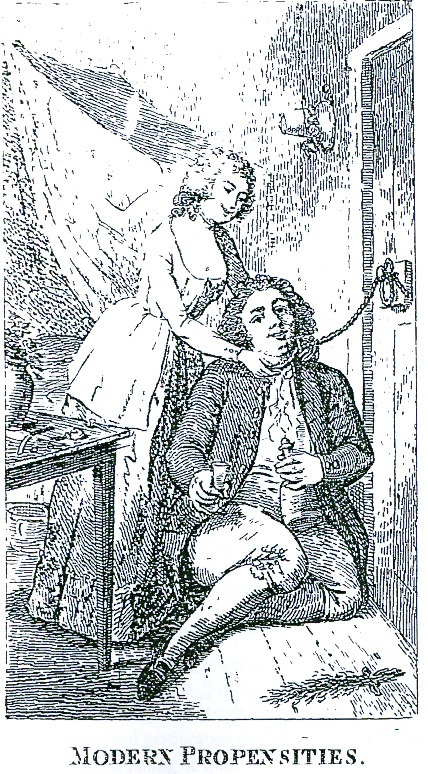
Kotzwara’s death
Frantisek Koczwara / Philipp Jakob Riotte: The Battle of Leipzig – The Battle of Prague (arr. for 2 orchestras) (Berlin Radio Symphony Orchestra; Berlin Polizei Orchester; Caspar Richter, cond.)
Frantisek Kotzwara was a violist, bass player, and composer who made his career in London.
His most popular piece was “The Battle of Prague,” music that was inspired by a real-life 1757 battle between the Kingdom of Prussia and the Habsburg monarchy.
However, he is most famous for the way he died: in the company of a prostitute named Susannah Hill.
We’ll be discreet here, but his erotic adventure led to his death.
You can read more of the salacious details here: https://interlude.hk/death-by-autoerotic-asphyxiationfrantisek-kotzwara/
Fanny Mendelssohn Hensel (1847)
Fanny Mendelssohn Hensel’s String Quartet – Augustin Hadelich, Andrew Wan, Matthew Lipman, Julie Albers
Fanny Mendelssohn was Felix’s beloved older sister, who was discouraged from pursuing music as a career because of her gender.
Despite this, she wrote hundreds of works, even while working as a wife and mother.
In her forties, she began conducting concerts at home. In May 1847, she was rehearsing a performance of Felix’s cantata The First Walpurgis Night.
She was directing from the piano when she lost sensation in her hands. This had happened before, so she took a break and rubbed her fingers with vinegar to try to get the feeling back in them. She yelled from the other room as they sang, “How beautiful it sounds!”
She then had a stroke, and she died before the day was over.
Felix was inconsolable. Chillingly, he died of a stroke five months later.
Louis Moreau Gottschalk (1869)
Louis Moreau Gottschalk’s “Morte!”
Louis Moreau Gottschalk was born in New Orleans in 1829 and became an internationally renowned composer and pianist.
On 24 November 1869, while on tour in Brazil, he caught yellow fever. He went onstage and played his work “Morte!” (“Death”). He started the next piece on the program, but collapsed during it.
He died three weeks later, possibly from a quinine overdose.
Jacques Offenbach (1880)
Jacques Offenbach’s Overture from “The Tales of Hoffman”
French operetta composer Jacques Offenbach suffered from gout for years, often needing to be carried into opera houses. Despite his poor health, he continued composing.
In 1880, he was working on his masterpiece, The Tales of Hoffman. Unfortunately, his condition was deteriorating, and in his final hours, he was overheard telling his dog, “I would give everything I have to be at the première.”
He died in October, but he’d managed to complete the vocal score. His son and a family friend finished the orchestration, and the operetta was premiered in February 1881.
Learn more about Offenbach’s painful death: https://interlude.hk/on-this-day-5-october-jacques-offenbach-died/
Bedřich Smetana (1884)
Bedřich Smetana’s Vltava (The Moldau)
In 1874, Czech composer Bedřich Smetana began to go deaf.
By January of the following year, he wrote in his journal, “If my disease is incurable, then I should prefer to be liberated from this life.”
Ironically, over the following years, his work became increasingly popular, even as his health worsened.
By 1882, in addition to his deafness, he was experiencing symptoms like depression, mood changes, and even hallucinations.
His condition deteriorated so completely that his family sent him to an asylum in April 1884. He died the following month.
His family believed the root cause was syphilis.
Alexander Borodin (1887)
Alexander Borodin’s In the Steppes of Central Asia
Borodin was a unique figure in classical music: he was both a chemist and a composer. As you can imagine, he dealt with a lot of stress working in both fields at once.
He wrote to his wife:
“God knows, I am expected to be Glinka and Semyon Petrovich, scientist and committee-man, artist, official, benefactor, father of adopted children, doctor and invalid, all rolled into one. But it won’t be long before I am nothing more than the last of these.”
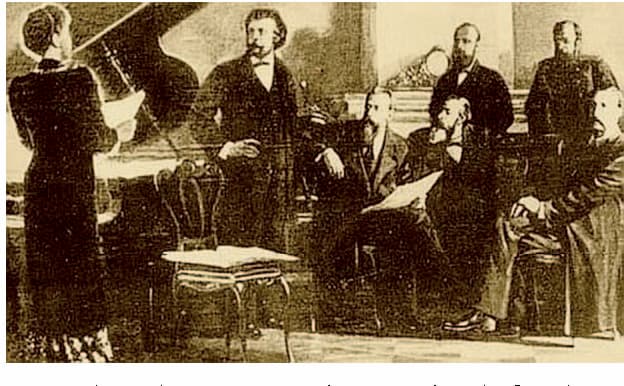
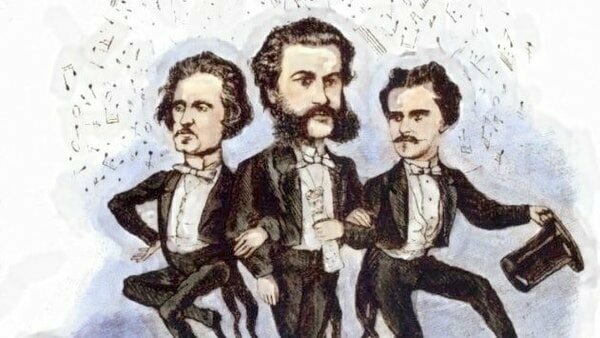
The Russian Five, with Borodin on the right
All of this stress finally got to him. In February 1887, he attended a ball and collapsed there.
In the words of an eyewitness:
“Borodin was speaking indistinctly as though his tongue had grown numb, and he seemed to be swaying. I shall never forget the look on his face; a helpless, pitiful, and frightened look. I hardly managed to cry ‘what’s the matter?’ before he collapsed onto the floor.”
An autopsy revealed he had a burst artery in his heart.
Read more: https://interlude.hk/on-this-day-27-february-alexander-borodin-died/
Charles-Valentin Alkan (1888)
Charles-Valentin Alkan’s Concerto for Solo Piano (excerpt)
Alkan was one of the more striking figures in nineteenth-century music. He wrote some of the most difficult piano music ever.
His death is shrouded in mystery. Legend claims that he was crushed by a falling bookcase while reaching for a volume of the Talmud, but that’s likely apocryphal.
However, in the 1980s, a letter from an Alkan student came to light, explaining that he’d fallen in the kitchen. He’d reached out for a coat rack for support, and it had fallen on top of him. He died soon after.
Still, the bookcase legend persists…as does the popularity of his enigmatic music.
Learn more about him and the death: https://interlude.hk/stretching-etude-alkans-remarkable-op-39/
Ernest Chausson (1899)
Ernest Chausson’s Concert for Violin, Piano, and String Quartet
Ernest Chausson was a polished French composer who hailed from a wealthy family. His music career was just taking off when he died in a freak bicycle accident at his country home, fifty kilometres outside of Paris.
Somehow, while riding downhill, he lost control of the bicycle and hit a brick wall. The resulting injuries killed him.
There have been suggestions that he was attempting suicide, but nobody knows for sure.
Conclusion
Whether sudden or prolonged, public or private, these deaths shaped how these composers’ final years – and final works – were understood.
Some died in scandal, some in poverty or illness, others in moments of cruel coincidence.
All left behind extraordinary music that we still turn to today.
In Part 2, we’ll continue this exploration with more composers whose deaths were equally sad, strange, or unsettling, further complicating the idea that great music emerges from timeless, protected lives. Classical music history, it turns out, is far stranger than it often appears.
For more of the best in classical music, sign up for our E-Newsletter