In 1912, Claude Debussy bowed reverently to a long-forgotten predecessor: “Rameau is, whether we want to admit it or not, one of the most solid foundations of music, and one can advance without fear on the beautiful path he traced.” As the father of French musical modernism, Debussy was deeply captivated by the sensory worlds of this baroque master. Amidst the late 19th and early 20th-century Wagnerian fever and Rossini craze that gripped Paris, Debussy, alongside Camille Saint-Saëns, recognised a striking avant-garde modernism hidden within the French Baroque. Saint-Saëns went as far as to state that the “immortal Rameau is the greatest musical genius France has produced.“
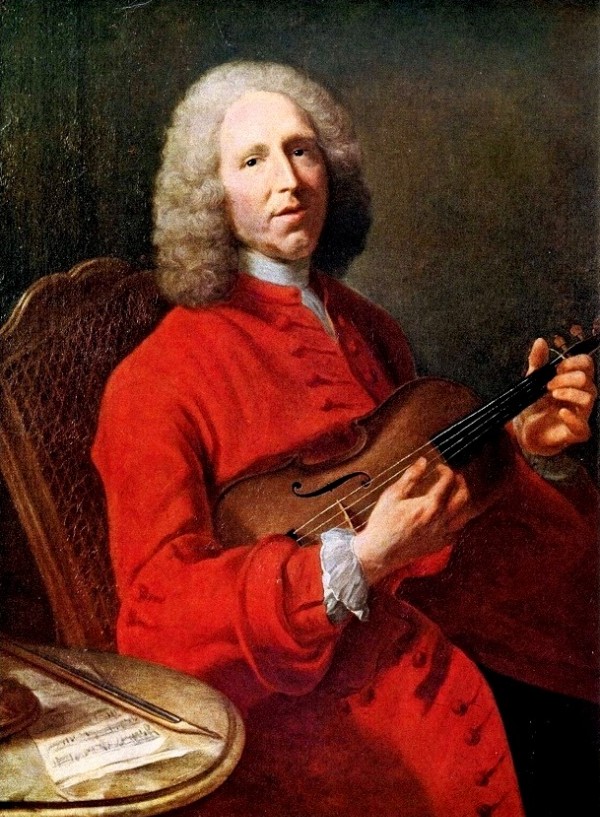
Jean-Philippe Rameau
Yet, these posthumous laurels long remained without a corresponding echo. Nowhere is this historical eclipse more poignant than in the fate of Jean-Philippe Rameau‘s final masterpiece, Les Boréades. Composed in the twilight of his life, this five-act tragédie lyrique did not receive its complete concert premiere until 1975 in London—nearly two centuries after its conception. It was a resurrection led by John Eliot Gardiner, who subsequently directed its scenic world premiere at the Festival d’Aix-en-Provence in 1982.
What caused this monumental work to be buried so deeply in the archives of the Bibliothèque Nationale? The answer goes far beyond the mere passing of an octogenarian composer; it lies at the intersection of aesthetic warfare, political subversion, and a radical musical vision that was centuries ahead of its time.
The Silent Desks of 1763: A Hidden Aesthetic Ousting
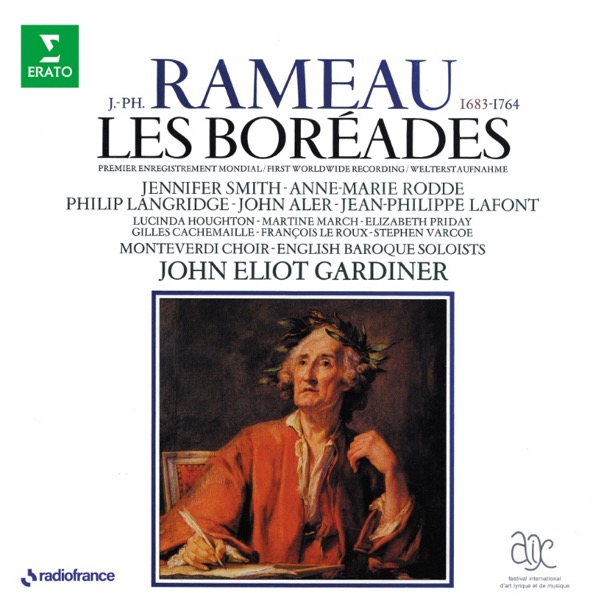
CD cover — Rameau: Les Boréades, John Eliot Gardiner (1990)
For centuries, standard music history textbooks parroted a convenient narrative: the rehearsals of Les Boréades were running smoothly in the late summer of 1764 when the 81-year-old composer was suddenly struck by a fatal putrid fever. Out of respect and logistical disruption, the management of the Paris Opera allegedly halted production, shelving the manuscript indefinitely.
However, modern research by Rameau scholar Sylvie Bouissou shattered this myth. Les Boréades was actually sitting on musicians’ desks more than a year earlier, in April 1763, fully prepared for a premiere at the court festivities of Choisy to celebrate the end of the Seven Years’ War. It was not death that silenced Les Boréades in 1763; it was an abrupt administrative replacement.
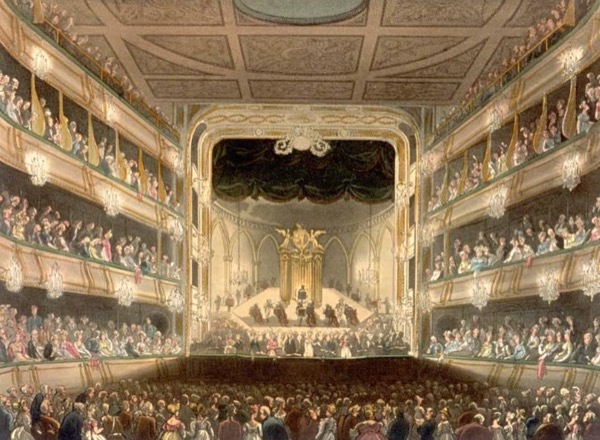
The work chosen to replace it was Ismène et Isménias by Jean-Benjamin de Laborde, a former pupil of Rameau. Laborde represented the shifting tides of Parisian taste—a generation that craved Italian-inspired simplicity and effortless, tuneful melodies. Laborde was also a politically formidable figure: Governor of the Louvre and First Valet of the King’s Chamber. Compared to Laborde’s light, accessible score, Rameau’s final work was deemed monstrously difficult. Its intricate rhythms, abrupt orchestral breaks, and complex accompanied recitatives posed unprecedented challenges for the opera orchestra of the day.
Furthermore, the Opera missed a visual marvel. The stage machinist Girault had just invented a device utilising rotating cylindrical backcloths to create rapid, realistic transformations of the sky. Les Boréades, a work structurally dependent on the unleashing of natural elements and roaring tempests, was engineered for this technology. Yet, it was destined to remain unperformed, a victim of changing musical fashions and administrative cowardice.
A Strategy of Refusal: Enlightenment and the Masonic Subversion
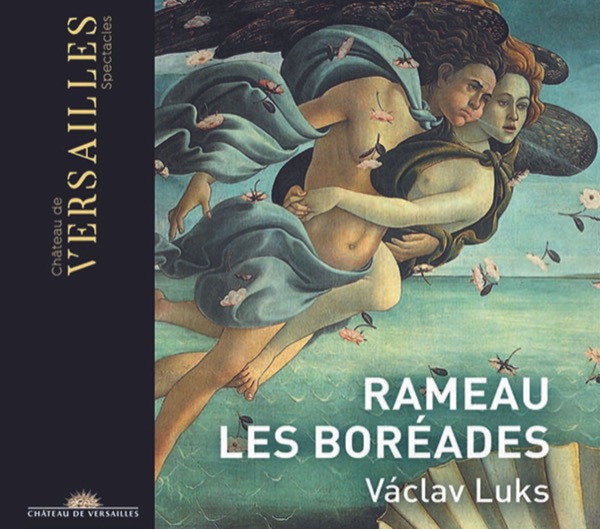
CD cover — Rameau: Les Boréades, Václav Luks (2020)
Beyond the musical complexities, the real reason Les Boréades was suppressed may have been its highly volatile, system-critical libretto. Though officially anonymous, the text is widely attributed to Louis de Cahusac, Rameau’s long-time collaborator and a prominent Freemason, who died in 1759.
Viewed through the lens of late 18th-century French absolutism, the plot of Les Boréades is a daring political allegory. Queen Alphise of Bactria is pressured by ancient traditions to marry a descendant of Boreas, the tyrannical God of the North Wind. Instead of bowing to divine, absolute authority, Alphise chooses to abdicate her throne to remain true to her love for Abaris, a young stranger of unknown origin raised by the priests of Apollo.
“The greatest good is liberty!”
This bold declaration, sung by the wise nymph Orithia in Act II, was not merely a romantic sentiment; it was a rallying cry of the Enlightenment. In a France still reeling from the traumatic 1757 public execution of Robert-François Damiens (who had attempted to assassinate King Louis XV), the royal censors were fiercely paranoid. Any theatrical text suspected of undermining monarchical authority or endorsing anti-establishment values was ruthlessly silenced. By framing a story around a monarch who surrenders absolute power for personal autonomy and equality, Cahusac and Rameau had penned an operational manual for the Enlightenment’s ideal of the “enlightened despot.”
As musicologist Jean-François Labie observed, Rameau adopted a “strategy of refusal” in his final years. Realising that the society around him was decaying and that his aesthetic was being attacked by the Buffonists—including Jean-Jacques Rousseau, who claimed Rameau’s music was overly intellectual and incapable of moving the heart—Rameau retreated into a closed musical system. He utilised the archaic, rigid framework of the tragédie lyrique to hide a profound meditation on human freedom, actively ignoring the historical realities around him while encoding universal truths into his harmony.
Unheard-of Modernism: The Dramatic Symphony Liberated
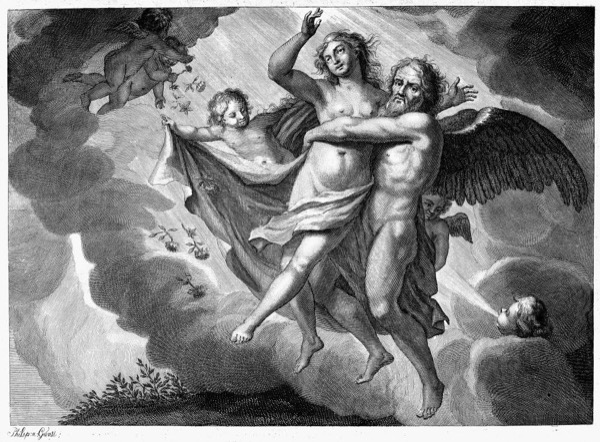
An 18th-century copper engraving of the abduction of Orithyia by Boreas, an allegory of spring foliage blighted by northerly winds
Musically, Les Boréades is an astonishing anomaly—a baroque pterodactyl soaring into the operatic landscape of Gluck, Piccinni, and Haydn. Rather than succumbing to creative exhaustion, the octogenarian Rameau dismantled decades of theatrical conventions.
Jean-Philippe Rameau: Les Boréades: Act III Scene 4: Orage, tonnerre et tremblement de terre (Collegium 1704; Václav Luks, cond.)
For the first time in 91 years of French operatic tradition, Rameau abolished the allegorical prologue designed to flatter the king. Instead, the Italian-style overture—a vivid depiction of a royal hunt featuring jagged, fragmenting horn calls—merges directly into the dramatic action. Queen Alphise begins her opening recitative just as the final orchestral chords die away, plunging the audience immediately into her psychological distress.
The structural continuity Rameau achieves in the final three acts is magnificent. In Act III, a conventional celebratory chorus (Régnez, régnez, belle Alphise) is violently disrupted by a terrifying orchestral tempest summoned by the spurned Boréade suitors. The natural elements are unleashed in a staggering, dramatic symphony, culminating in the harrowing Act IV chorus Nuit redoutable (Fearful Night). Here, the music acts as a leitmotif, binding the metaphors of love and storms into a seamless symphonic web.
Jean-Philippe Rameau: Les Boréades: Act IV Scene 4: Ballet: Entrée (Collegium 1704; Václav Luks, cond.)
Rameau’s orchestration in Les Boréades is remarkably experimental. He introduces an unprecedented quintet of clarinets, horns, and bassoons, and utilises independent solo violins to double the flutes against the ripieno strings. In the prelude to Act V, he employs brief, gasping, fragmented instrumental gestures that sound remarkably modern.
Yet, against this terrifying fury, Rameau places some of his most sensuous music. The instrumental Entrée de Polymnie in Act IV, Scene 4, stands as perhaps the most meltingly gorgeous orchestral writing to emerge from the entire Baroque era. And the brief, exquisite Act V love duetto between Alphise and Abaris (Que ces moments sont doux) possesses a harmonic voluptuousness that, as Gardiner rightly noted, would have undoubtedly won the ecstatic applause of Debussy.
The Last Sun in the Baroque Firmament
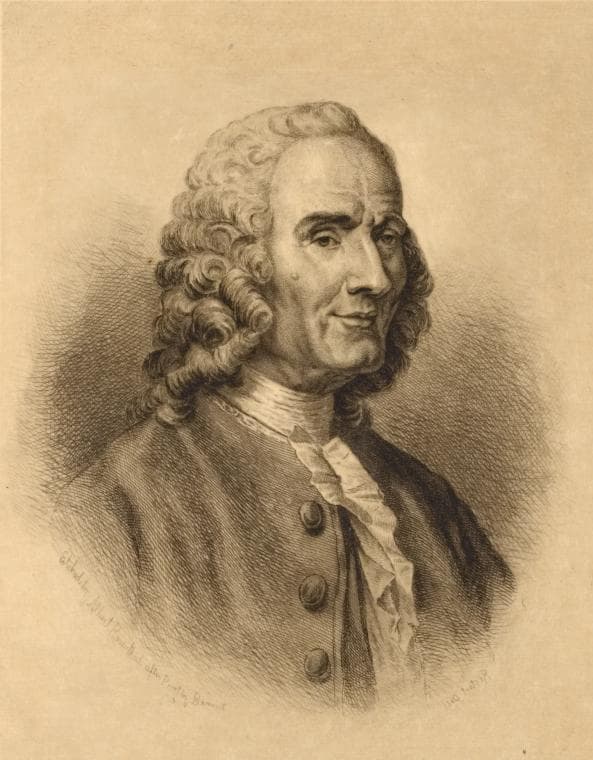
Jean-Philippe Rameau
Les Boréades left no musical heirs. It stands as the last blinding sun in the firmament of the tragédie-ballet, a glorious sunset over the twilight of the Ancien Régime. It is a work of supreme paradox: inherently conservative in its genre, yet radically prophetic in its execution.
Perhaps Rameau knew that this music was too difficult for the orchestras of his time and too sophisticated for the changing tastes of the Parisian public. In writing Les Boréades, he chose, for once in his long career, to write purely for himself. And in the opera’s final, defiant, and ecstatically joyful contredanse, one can almost see the elderly maestro looking back across the centuries, flashing a triumphant grin at his detractors.
For more of the best in classical music, sign up for our E-Newsletter