For fans of the fortepiano, Ronald Brautigam needs no introduction. His exhaustive discography of Haydn, Mozart, and Beethoven never ceases to amaze with its delicate yet bold sound.
This May and June, Mr. Brautigam undertook his first tour of China, visiting five cities. Two recitals in Shanghai and Shenzhen were completely sold out. Who could resist hearing the Moonlight Sonata on a Paul McNulty copy of a Walter & Sohn fortepiano? In addition, Mr. Brautigam performed on an original 1862 Bechstein, courtesy of the renowned piano collector Mr. Jingyan Xu.
Bringing seven distinct programs to his Chinese concerts, Mr. Brautigam is dedicated not only to sharing his music but also to engaging audiences through his words. His insights into historical pianos seem inexhaustible. Although he performs a great deal of late Schubert in Beijing, Chengdu, and Guangzhou, Beethoven remains the focus of our conversation.
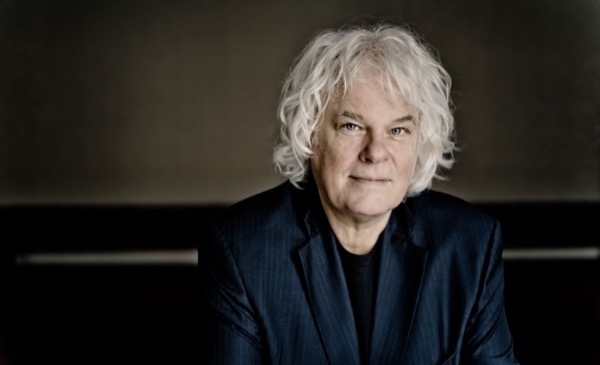
Ronald Brautigam, photo by Marc Borggreve
How did you become a fortepianist?
In the 1980s, Mozart was already one of my favourite composers, and I had very specific ideas on how to play his music. It just didn’t always work on a modern piano; I simply couldn’t get the lightness I had in mind. I happened across a full-page ad in one of the Dutch music magazines for Paul McNulty’s fortepianos and saw that his workshop was basically around the corner from where I lived.
Just out of curiosity, I decided to go and have a look, and there I found him with a newly finished 5-octave fortepiano. Having played the instrument for half a minute, I knew that this was what I’d been looking for all along without knowing. And the rest is history!
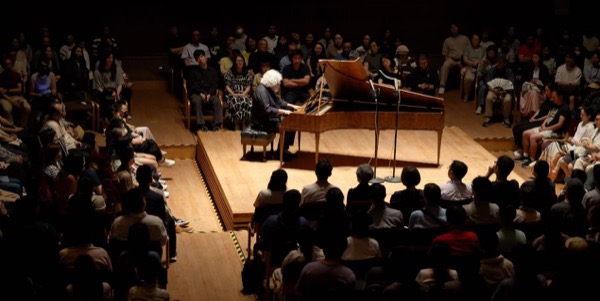
Brautigam’s fortepiano recital at Shanghai Symphony Orchestra, photo by LeiLei Cai
Who are some of your role models for the listeners to check out?
Artur Schnabel, Rudolf Serkin and Wilhelm Kempff, three phenomenal Beethoven specialists. For the rest, I try to listen to colleagues as little as possible to keep my own interpretations fresh and musically “uncontaminated”.
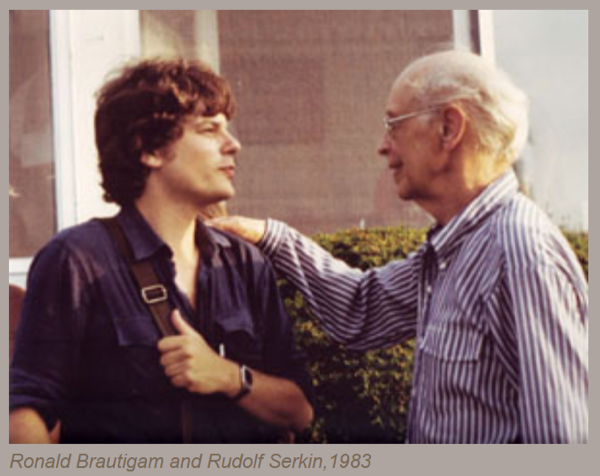
From Ronald Brautigam’s Official Website
You studied with the great Rudolf Serkin. How might Serkin’s pianism fit with the historically informed performance?
The most important thing Serkin taught me was respect for the composer and his music: make yourself invisible, as it were, don’t sit between the music and the audience. I am convinced that Serkin – or Rudi as he liked to be called – would have embraced historical instruments if he were alive now. He spent his whole life trying to get closer to his beloved composers and their musical intentions, and playing a similar instrument to theirs would have delighted him.

Moonlight Sonata 1802 First Edition Score from IMSLP (Public Domain)
Beethoven wrote very specific instructions at the beginning of the “Moonlight Sonata”. How do you achieve it on the fortepiano?
“Sordino” is the Italian term for what we call the dampers: “senza sordino” means “with lifted dampers”, therefore creating a resonance where the harmonies will be rather blended. For a long time, pianists have interpreted this as lifting the dampers throughout the whole movement; nowadays, the consensus is that Beethoven asks for a lot of lifted dampers, better known as “right pedal”, but definitely not continuous. He wants a very delicate and resonant movement, but no “swimming pool”…
Then again, the resonance of these old fortepianos is a lot less than that of our modern concert grands – the sound disappears much faster – so on a fortepiano, you can be more generous with the right pedal than on a modern instrument. But in the end, it’s your ears that have to decide when the sound gets too blurred or the different harmonies become too drowned out.
Ludwig van Beethoven: Piano Sonata No. 14 in C-sharp minor, Op. 27, No. 2 “Moonlight” – I. Adagio sostenuto (Ronald Brautigam, fortepiano)
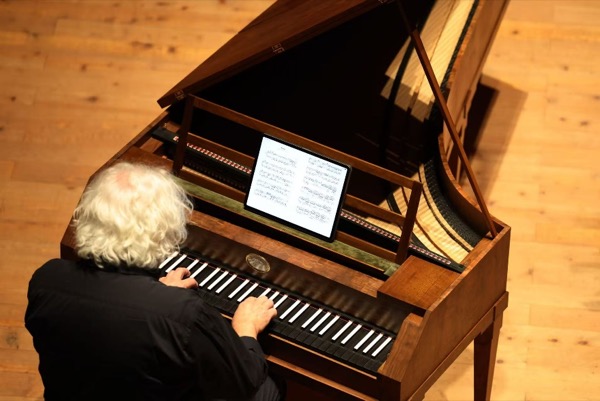
Brautigam on McNulty’s copy of a Walter fortepiano in Shanghai, photo by LeiLei Cai
Beethoven’s No. 13 in E-flat major is also titled “Sonata quasi una fantasia”. Why is this piece particularly suited for the fortepiano?
Beethoven is known for sudden dynamic contrasts, and they work much better on a fortepiano, where the sound is gone as soon as the damper hits the string. I sometimes compare it with a small city car that’s very manoeuvrable, in contrast to the grand limousine that takes time to react. Modern pianos were designed for a broad, singing tone, so their dampers aren’t as acute as those of a fortepiano: a modern piano wants to sing on, and one can feel rather frustrated by a sudden damper action. The difference between staccato and legato is also more pronounced on a fortepiano, again thanks to the great damping of the sound.
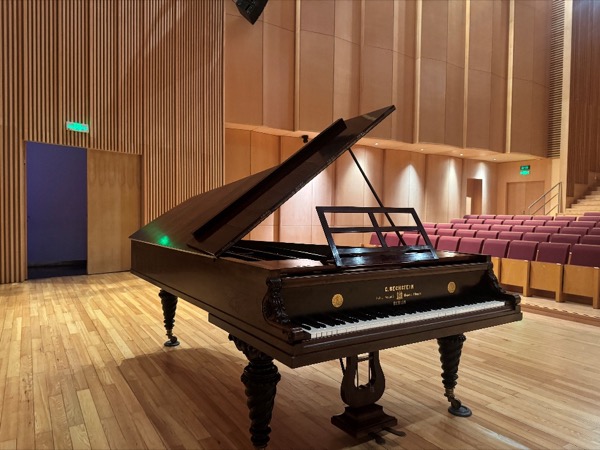
1862 Bechstein at Shenzhen Mountain View Theatre, photo by Becky Feng
At Mountain View Theatre in Shenzhen, your recital used a 1862 Bechstein. Have you played on similar instruments before?
It is a very interesting concept to perform Beethoven’s music on an instrument built 35 years after his death. Grand pianos from around 1862 are already much more like our modern concert grands in volume and colour; they still, however, contain some of the sound philosophy of the earlier Viennese builders. More transparency, a real sense of lower, middle and upper registers. The main difference would be the use of a metal frame instead of a wooden one for the strings; this allows for thicker strings with much higher tension, thereby producing a much louder sound. Knowing that Beethoven was forever dissatisfied with the pianos of his day, looking for more volume and a wider colour palette, I wouldn’t be surprised at all if this 1862 Bechstein had become one of his favourite pianos…
With a Bechstein from 1862, the differences are not as spectacular as with earlier Viennese instruments. The tendency in piano building was to seek more colours and a more carrying sound: this would also be the perfect instrument for playing Brahms‘ first piano concerto from 1858 onward. The instrument is, of course, more suited to Beethoven’s later piano works, such as Op. 78 and Op. 111, but that is always an issue when playing “mixed” programs on fortepiano. Ideally, every Sonata would have its own instrument…
Are fortepiano and modern piano techniques like linguistic skills, such as switching between speaking Dutch, German, or English?
The greatest difference between a fortepiano and a modern one would be the action, the trajectory between pushing a key down and the hammer hitting the string. Without going into technical details, it means that playing a fortepiano is much lighter than playing a modern grand. You only need the tips of your fingers, rather than your whole body weight, to produce the sound. It took me years before I really felt at home on these early instruments: you are suddenly left with lots of bodily energy that has nowhere to go… it really is like learning to speak a new language. But like every newly learned language, the more fluid you get, the more fun it is!
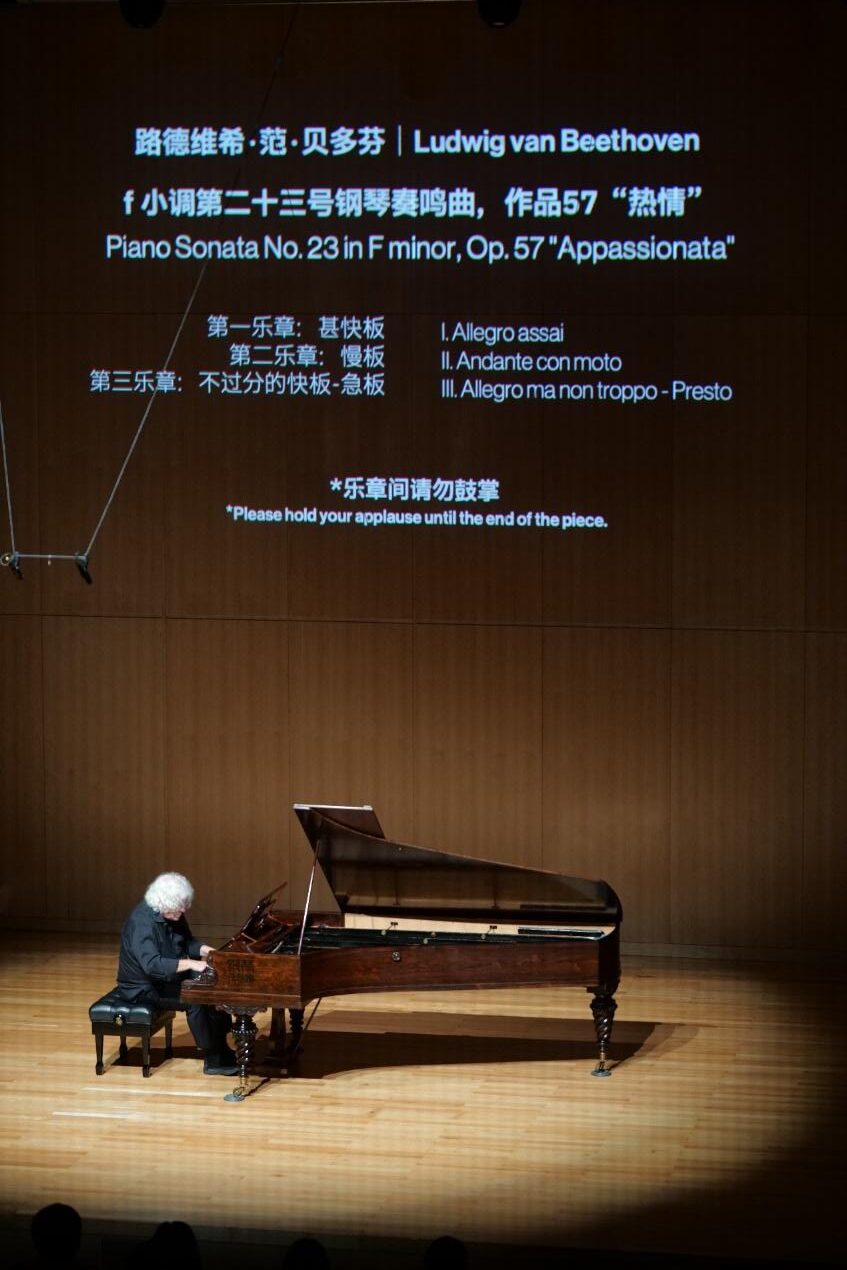
Shenzhen Mountain View Theatre, photo by Wenxi Zhang
In one program, you will contrast the gentle Op. 78 À Thérèse with the turbulent Op. 57 Appassionata. What is revealed in this Romantic Poetry vs. Fated Tragedy duel?
The general opinion of Beethoven is that of a rather complicated and wild genius. The Appassionata sonata is a perfect example. Even on a modern piano, you hear the instrument moaning like a small wooden ship on a stormy ocean. There is, however, a side of Beethoven that is equally interesting: whenever he was in love – and that happened a lot – he could compose the most charming music as a gift to one of his “victims”. Op. 78 À Thérèse is one of his loveliest and most tender compositions; F-sharp major is the highly unusual key he chose for it. Playing this sonata together with Op. 57 shows the two very different sides of Beethoven: his Yin and Yang, if you like.
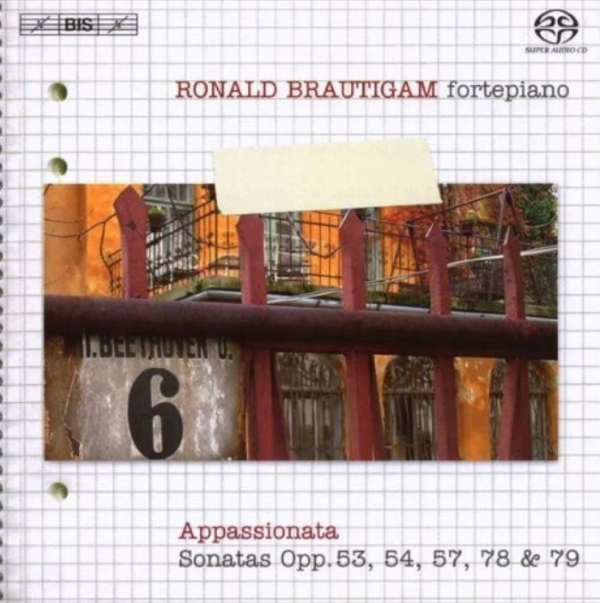
Beethoven’s Appassionata would have pushed the earlier piano to its extreme. To what extent is playing it on a historical piano a much riskier adventure?
Modern pianos are far more solid than their earlier ancestors. Let’s not forget that Viennese pianos were entirely made of wood and therefore less robust than later instruments with cast-iron frames. So yes, it is riskier to play it on an older instrument, but also more exciting: you clearly hear Beethoven’s struggle with a piano that’s far too small to cope with his large emotions.
You will perform Beethoven’s Op. 81a Les Adieux and his Op. 111 in parallel. Is it because of their shared spirit of saying farewell?
I didn’t really have a set-out plan when I programmed these two masterpieces. There was a lot of input from the organisers too, and I remember that Shanghai particularly liked these two sonatas in the second half. But they go very well together: Op. 81a, a temporary farewell to Archduke Rudolf, Op. 111, a definite farewell to the sonata form.
Brautigam plays Les Adieux
In what way do you feel like a historical piano’s features enhance the expressive power of Beethoven’s last piano sonata, Op. 111?
The first movement of Op. 111 is actually not that revolutionary: it follows the classical sonata form in a way comparable to Op. 13, the Pathétique Sonata. It is the last movement that totally stands out, perhaps only in the same way as the later Diabelli Variations: a catalogue of Beethoven’s piano writing. As for the cantabile, let’s not forget that Beethoven was totally deaf at the time of composing Op. 111 and therefore no longer had any audible connection to the instruments of his time. The Arietta was composed for an instrument that had never been and probably never will be, the “ideal” piano. Even today, with our modern “perfect” pianos, the music sounds best to me when sitting down with the score. This is absolute music that transcends the physical and technical limitations of any instrument.
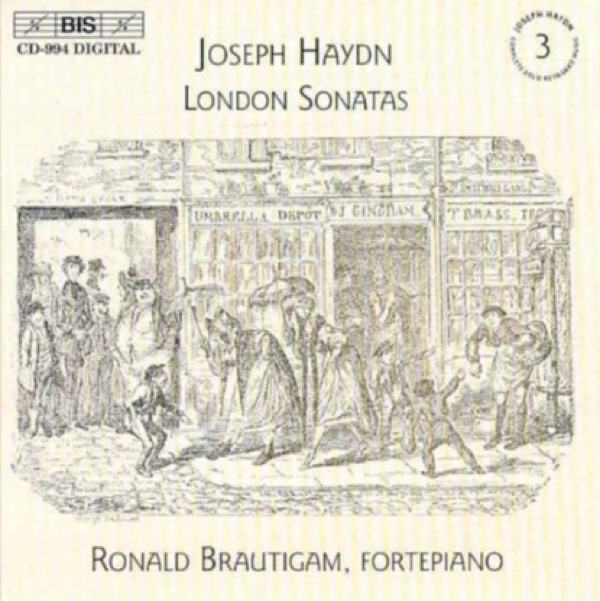
Haydn’s London sonatas were influenced by his encounter with the Broadwood piano. How did innovative instruments shape Haydn’s keyboard language?
In his three London sonatas, Haydn pulls out all the stops. He was clearly impressed by the possibilities of these English pianos, their singing quality and fuller sound. Concert life in London at the time catered for the middle classes rather than the aristocracy; the large scale of the first and third of these sonatas gives them a true concert-stage character, music that is no longer meant to be played in aristocratic salons but in genuine concert halls for a wider audience.
Sometimes it is the instrument that tells you what repertoire to play on it. With earlier fortepianos, one is restricted by the keyboard range in what to play. Mozart, Haydn, and early Beethoven knew only a piano with a range of 5 octaves, so their music is nicely contained within that range. Whenever I have to limit my repertoire to 5 octaves, I like to show the audience the unlimited possibilities this rather constricted range gives. It shows that sometimes less really can be more!
Joseph Haydn: Piano Sonata No. 62 in E-flat major, Hob. XVI:52 – I. Allegro (Ronald Brautigam, fortepiano)
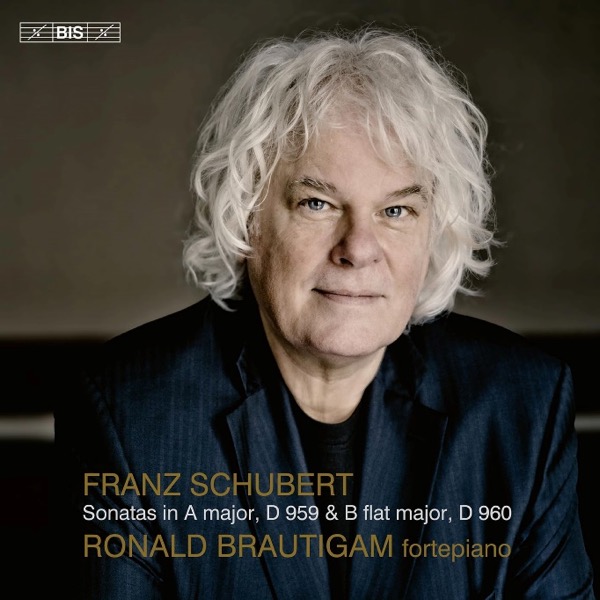
You recently recorded Schubert and will be touring with some of Schubert’s late sonatas. How has your knowledge of Beethoven informed your understanding of Schubert?
Schubert was heavily influenced by Beethoven, his role model, as it were. If Beethoven is the architect, interested in motifs rather than melodies, Schubert is then of course the king of Lieder, a master of melodies, whether composing symphonies, chamber music or piano sonatas. Playing his Sonatas is like singing a Lieder recital with all its different emotions.
Brautigam plays Schubert’s 4 Impromptus op.90 D 899
You have extensively recorded and performed works by Haydn, Mozart, Beethoven, and others. Can you share with us a few special “moments musicaux” when you felt deep connections to these composers?
I’ve been very lucky to find a CD company – BIS Records – that likes to do things completely. By recording the complete piano works of Mozart, Haydn and Beethoven, I had a great opportunity to look into their musical kitchens and lift some lids from bubbling pots. By not sticking to the well-known masterworks, but looking into the often neglected “semi-masterworks”, I learned a lot about these composers. Most pianists have three or four Haydn sonatas in their repertoire; I was “forced” to learn all 52 of them. It’s the only way to really get to know a composer, with all his ups and downs.
For more of the best in classical music, sign up for our E-Newsletter