György Ligeti, one of the most innovative and influential avant-garde composers in the latter half of the twentieth century, died on 12 June 2006 in Vienna. And if you don’t know his name, you probably have heard some of his music.
The film director Stanley Kubrick used Ligeti’s music in three films. Can you guess which ones? The soundtrack for 2001: A Space Odyssey includes excerpts from four pieces. The Shining features a short excerpt, and so does Eyes Wide Shut.
Deep Space Music

György Ligeti
Ligeti was certainly a most innovative and influential figure, and the term “micropolyphony” is closely associated with his name. In fact, micropolyphony was developed by him, and this texture permeates Atmosphères of 1961.
Kubrick used excerpts from Atmosphères in his 2001: A Space Odyssey, specifically for the scenes in deep space and those with the monolith. But what is micropolyphony all about? Shall we try to find a workable definition and draw up a quick listening guide for Atmosphères?
György Ligeti: Atmosphères
Hidden Web of Sound
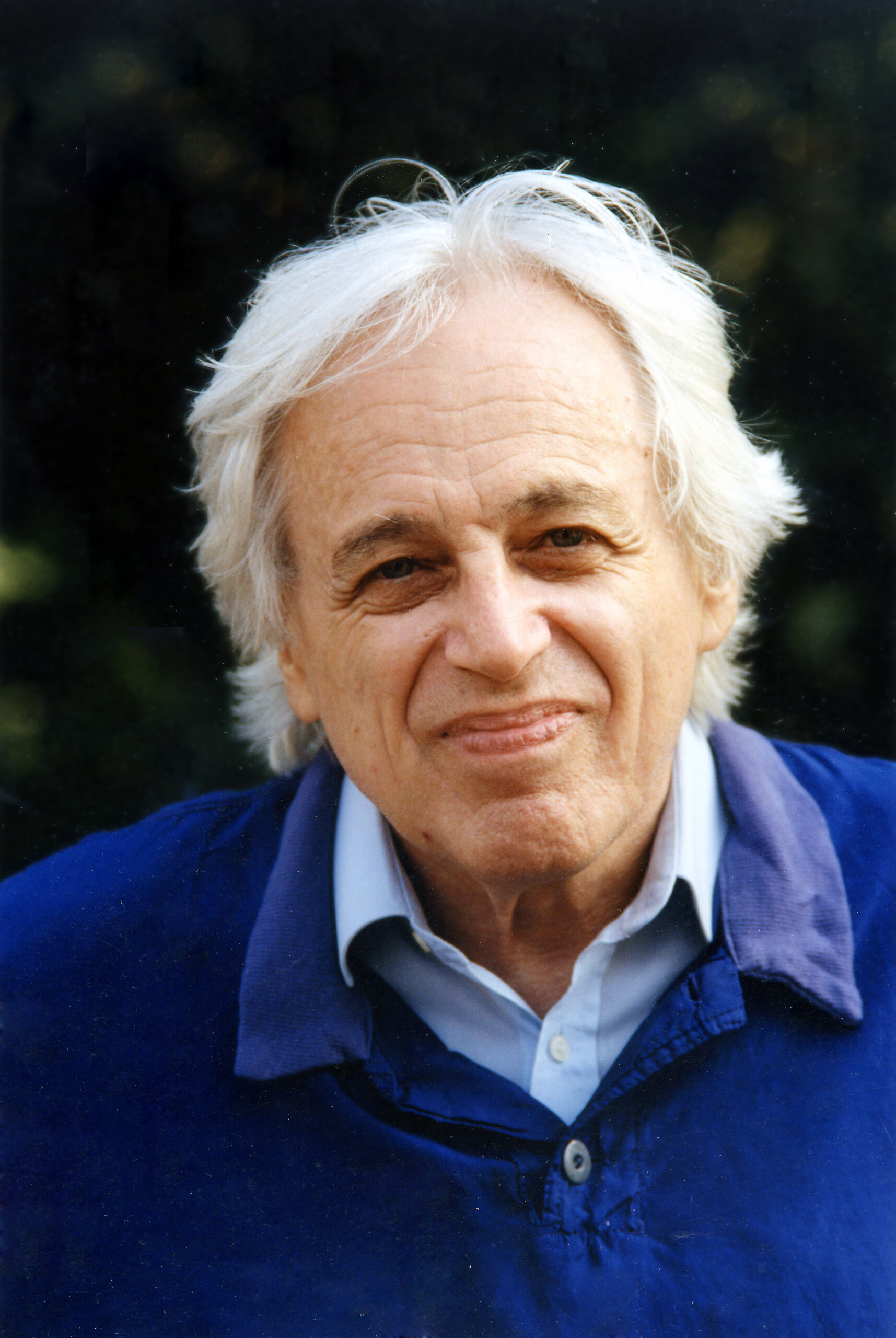
György Ligeti
You might have noticed that micropolyphony contains the word polyphony, basically meaning “many sounds.” So in both cases, we are essentially talking about a musical texture. The differences between micropolyphonic and conventional polyphonic texture were described by Ligeti.
“Technically speaking, I have always approached musical texture through part-writing. Atmosphères has a dense canonic structure. But you cannot actually hear the polyphony, the canon. You hear a kind of impenetrable texture, something like a very densely woven cobweb.”
“I have retained melodic lines in the process of composition, they are governed by [strict] rules …but the rules of this polyphony are worked out by me. The polyphonic structure does not come through; you cannot hear it; it remains hidden in a microscopic, underwater world, to us inaudible. I call it micropolyphony (such a beautiful word!)” (Micropolyphony, Wikipedia)
Making Sense of the Sound Cloud
When composers talk about their own works or processes, it is sometimes difficult to follow. So let’s try to filter Ligeti’s explanation through the words of Paul Griffiths, one of the foremost experts on this subject.
Griffiths writes, “Atmosphères (1961) is almost a single cloud, drifting through different regions of colour, harmony and texture, whether in the form of sustained tones…or of what he called ‘micropolyphony,’ consisting of dense weaves of canons at the unison, in which the lines move at different speeds and are not separately identifiable. (Griffiths, GMO, 2011)
Motion without Movement
Essentially, we find a texture which consists of many lines of dense canons moving at different tempos or rhythms. But if you can’t hear it, what’s the point? Of course, you can hear it, but Atmosphères gets rid of conventional melody, harmony, and rhythm in favour of sound masses. It does not develop in the conventional sense, but everything collapses into what has been called a magma of sound.
As notes move along the same path but at different speeds, it gives the impression of simultaneous immobility and motion. In the event, Atmosphères has been performed around the world and recorded more than once. And to no one’s surprise, it has been widely imitated.
So much for the theoretical background, but let’s move on to a brief listening guide for Atmosphères now.
From Cloud to Dissolution
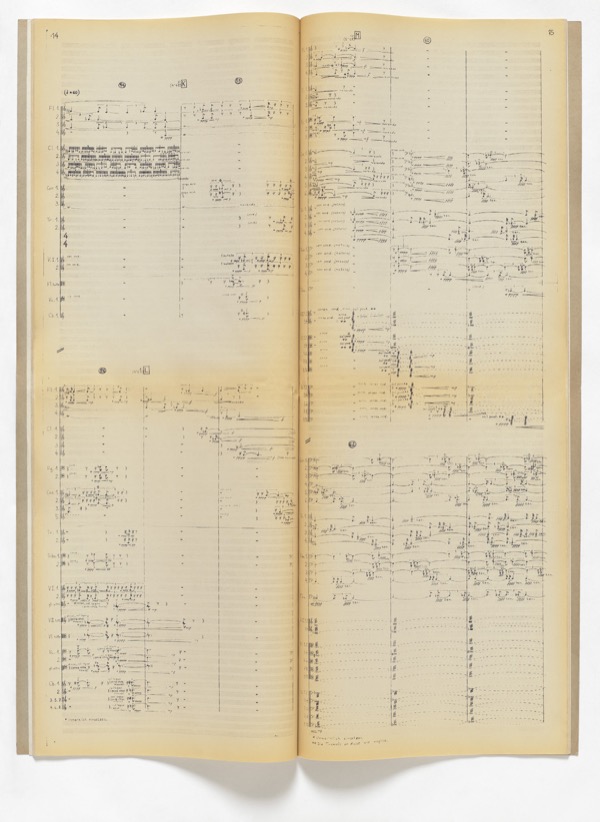
György Ligeti: Atmosphères full score
0:00–1:30″: Emergence of a Vast Sound Cloud
It all starts with a huge orchestral cluster that seems almost completely motionless. There are no melodies to follow, as the entire orchestra submerges into an immense sustained sonority. Yet internally, you start to hear tiny internal movements that create microscopic instability.
Essentially, we are listening to a paradox. The music feels completely frozen, yet it is constantly shifting inside, and that is micropolyphony in action.
1:30–3:00″: Intensified Internal Motion
Gradually, the texture becomes more active as small motions begin to emerge within instrumental groups. The register almost imperceptibly expands and contracts as the sonic mass is gaining tension.
At points, the orchestra starts feeling heavier or lighter, like gradual pressure changes within a cloud. Nothing dramatic is happening yet, except for tiny flickers of instrumental colour.
3:00–5:00″: Fragmentation and Contrast
The unified mass is starting to break apart as certain registers become more audible. More instrumental colours are briefly emerging, and the entire orchestral fabric grows more transparent.
A commentator once called this the most striking effect of the work, as the sound cloud momentarily reveals its internal structure.
5:00–6:45″: Extreme Registers and Instability
The orchestra is starting to expand, like a gigantic cosmic cloud drifting apart in multiple layers. The high and low registers become much more pronounced, and the sonic balance feels very unstable.
There is no dramatic climax in the conventional sense, just a spatial expansion of sound that creates a widening space.
6:45–End: Dissolution
There is also no conventional resolution to this piece, as the work gradually withdraws. Density decreases, and the motion becomes more fragile. And we certainly hear that silence is encroaching, coming closer until stillness is all that’s left.
Many Voices Become One

György Ligeti (© Schott Music / H. J. Kropp)
We essentially hear an extremely dense counterpoint of up to 56 voices. Each string instrument is actually playing its own individual part. But the imitative entrances are so close (micro) that it is impossible to hear them separately.
All this contributes to a sense of immobility, like evolving sound structures detached from the passage of time. Ligeti suggested that he took this idea of static music from Wagner‘s Prelude to Das Rheingold and the Prelude to Act 1 of Lohengrin. He also credits Bartók and Schoenberg, but as Peter Laki writes, “none ever achieved stasis through its exact opposite.”
Apparently, Ligeti thought that micropolyphonic textures most closely aligned to oriental tapestry, suspended and outside time. One thing is sure: the dense sound-fog produced by micropolyphony became known as his signature style.
Ligeti on Screen
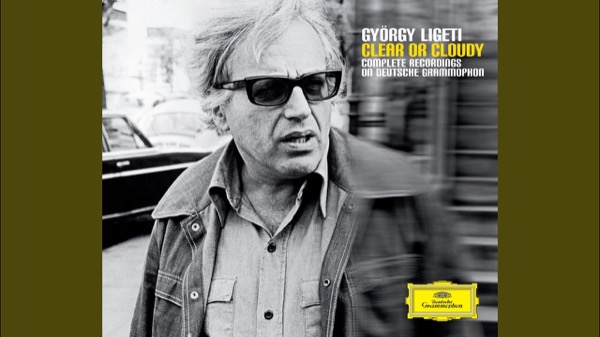
György Ligeti: Clear or Cloudy — Complete Recordings on Deutsche Grammophon
Ligeti’s signature style has been used in numerous films beyond the Kubrick classics. It certainly seems to be in vogue when the subject matter involves outer space, psychological thrillers, and crime dramas.
Martin Scorsese used it for his 2010 thriller Shutter Island, and Michael Mann used Ligeti’s Cello Concerto for his 1995 film Heat. If you have watched Godzilla (2014), you heard snippets of Ligeti, as you would in the 2017 film The Killing of a Sacred Deer.
And let’s not forget that some episodes of the famous radio series The Hitchhiker’s Guide to the Galaxy featured Ligeti’s music as background.
For more of the best in classical music, sign up for our E-Newsletter