Did you know that Ludwig van Beethoven composed 722 works, but only 138 of them carry opus numbers? Opus numbers are actually work numbers assigned by Beethoven’s publishers during his lifetime. The basic question is, why on earth did Beethoven not want so many of his pieces published?
There are many possible answers to that question, including the composer retaining artistic control and his reputation. Many pieces were never meant for the public but intended as gifts, teaching materials, or even private experiments.
Ludwig van Beethoven: Bagatelle No. 25 in A minor, WoO 59 “Für Elise”
WoO Catalogue
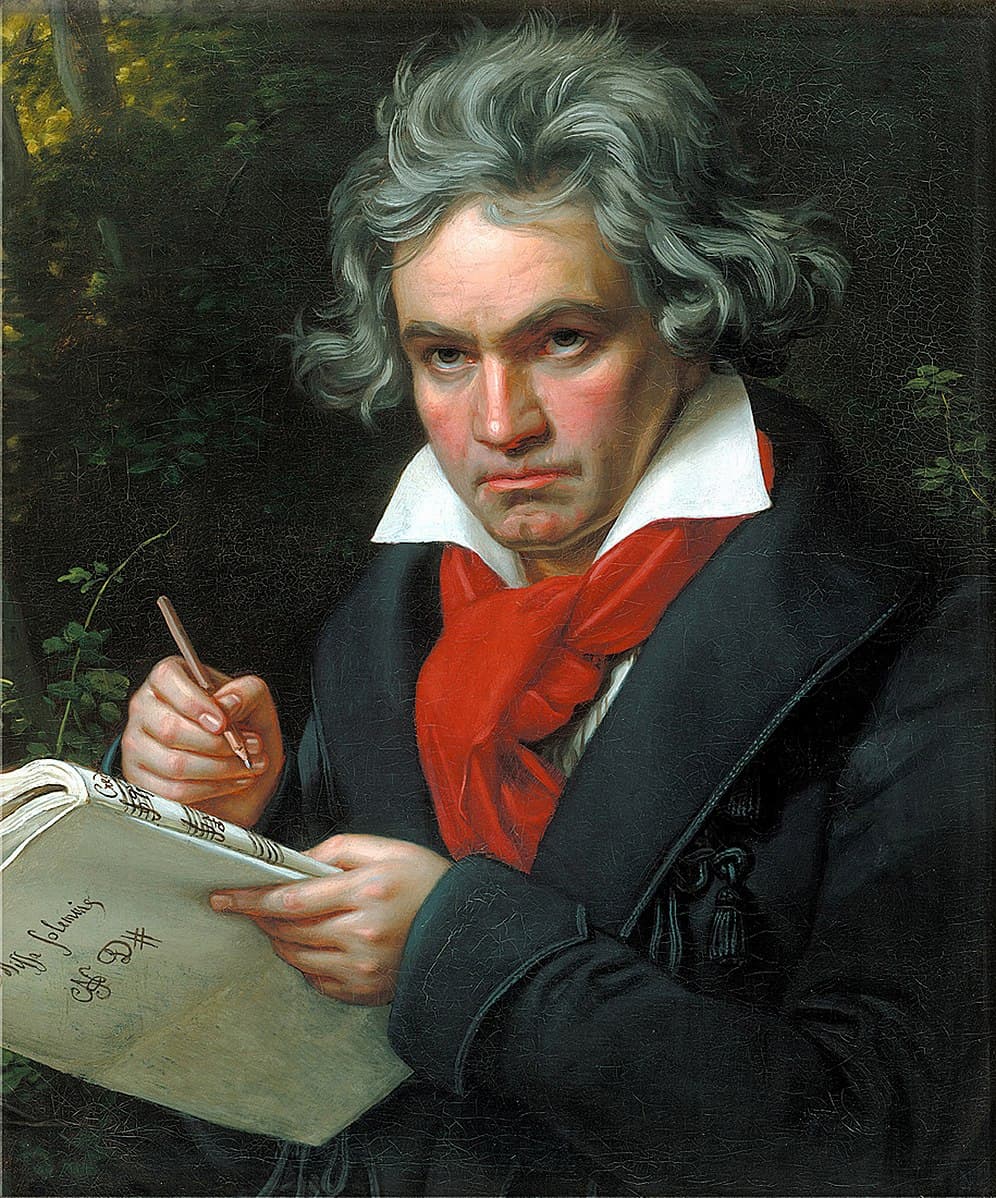
Portrait of Ludwig van Beethoven
Beethoven obsessively revised his compositions, and with some pieces, he simply lost interest or judged them not good enough. And in terms of publishing, Beethoven was extremely fussy. He would argue with his publishers for days or even weeks, bargaining ruthlessly and demanding huge fees.
In the 20th century, some clever musicologists in Germany wanted a better overview of Beethoven’s entire oeuvre. They started listing all the compositions of Ludwig van Beethoven that were not originally published with an opus number, or survived only as fragments.
Ludwig van Beethoven: Piano Sonata in E-flat Major, WoO 47 No. 1 “Kurfürstensonate”
The Jewel of the WoO Collection
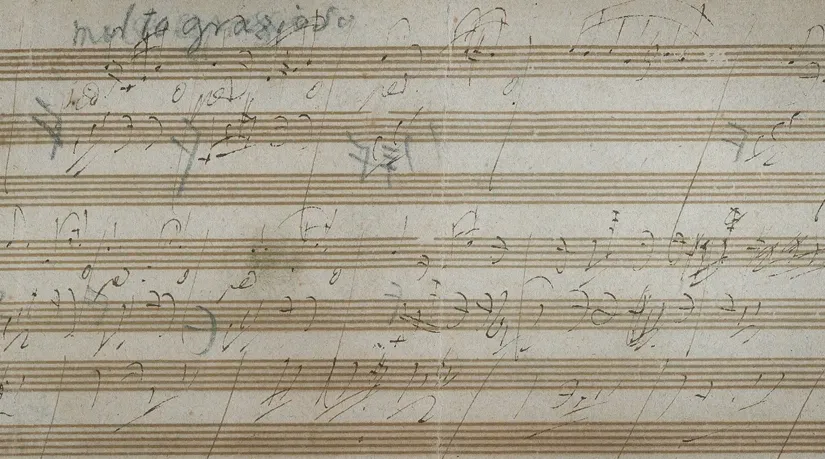
Für Elise manuscript
This musical catalogue, prepared by Hans Halm and Georg Kinsky in 1955, assigned “WoO” numbers, which just means “Werke ohne Opuszahl” or “Works without opus numbers.” To commemorate his death on 26 March 1827, we thought it might be interesting to feature some of Beethoven’s most famous WoO compositions.
Talking about WoOs, we immediately find one of the most popular short pieces by Beethoven, a “Bagatelle” with the nickname “Für Elise.” Probably composed around 1810 and reworked in the early 1820s, it was first published only in 1867, four decades after the composer’s death.
And even then, it was only published in an appendix to a collection of Beethoven letters. The inscription “Für Elise” basically remains a mystery, but there are plenty of juicy theories going around. Scholars who looked at the sketches believe that Beethoven contemplated a somewhat more sophisticated layout of the arpeggios, but could not find a way to produce a definite version.
Ludwig van Beethoven: Piano Concerto in E-Flat Major, WoO 4 (reconstructed by W. Hess) (cadenzas by See Siang Wong) (See Siang Wong, piano; London Philharmonic Orchestra; Roger Norrington, cond.)
Childhood Sonatas
A good number of Beethoven’s WoO compositions originated during his childhood in Bonn. And that includes Three Piano Sonatas WoO 47, probably dating from between 1782 and 1783. Dedicated to the Prince-elector Maximilian Friedrich, they are predictably known as the “Kurfürstensonaten.”
But here is a little twist. These sonatas were actually published in 1783 and described as the work of a boy of eleven. Yet, in these early compositions, pianists already detect important elements of Beethoven’s genius, which he constantly developed in his later works.
Without going into detail, these sonatas already show Beethoven’s interest in the handling of musical form. Against the background of piano sonatas written in the 1770s, Beethoven’s approach is rather personal and imaginative. This is a clear case of musical experimentation, and the mature Beethoven had no intention of sharing these early efforts with the public.
Ludwig van Beethoven: Piano Quartet in E-flat Major, WoO 36 No. 1
The Earliest Piano Concerto
Ludwig van Beethoven’s earliest piano concerto dates from around 1784-85. Scored in E-flat Major, and assigned the WoO 4 number, the surviving manuscript copy is actually incomplete. It contains the complete solo part and a piano reduction of all orchestral passages whenever the soloist is not playing.
Beethoven also included ideas on instrumentation, such as strings, horns, and flutes. A lot of the musical material thus survives, and the Beethoven scholar Willy Hess completed his reconstruction of the concerto in 1943. Since then, a number of different reconstructions have been completed, with pianists adding their own cadenzas.
Although it is very early Beethoven, the music is full of originality and touching moments. Specifically, the “Larghetto” contains some haunting passages when the theme is taken to dark and unforeseen vistas. Some critics suggest that this slow movement is more original than those from the 1st and 2nd Piano Concertos.
Ludwig van Beethoven: Andante favori WoO 57
The Boy Wonder
Ludwig van Beethoven was already known around his hometown of Bonn as a brilliant pianist, famed for his stunning improvisations. He made his first public appearance as a pianist at the age of seven, and by the age of ten, he was already assistant to the court organist in Bonn, Christian Gottlob Neefe.
A local critic wrote, “This boy of eleven years is a most promising talent. He plays the piano very skilfully and with power, reads at sight very well and is now trained in composition.”
These composition lessons resulted in three piano quartets, written when Beethoven had not yet reached his 15th birthday. They are written in the style of Mozart, but the brilliant piano writing already gives a sense of the mature Beethoven. First published after Beethoven’s death, these lively juvenile works are lyrical and charming, but dominated by a sparkling piano part.
Ludwig van Beethoven: 32 Variations in C minor, WoO 80
Favourite Andante
Every pianist knows the “Waldstein Sonata,” Op. 53. But did you know that it originally had a completely different second movement? Apparently, a friend of Beethoven told him that the original “Waldstein” was simply too long.
Beethoven was no friend of constructive criticism, but after some reflection, he agreed. As such, he excluded the “Andante” and replaced it with the introduction to the rondo we all know now.
One year after the publication of the sonata, the “Andante favori” was also issued. And it is Beethoven’s student Carl Czerny who provides the reason for the nickname. He suggests that Beethoven played it frequently in salons across Vienna, and that it became highly popular. Hence, he gave it the title “Favoured Andante.”
Ludwig van Beethoven: Rondino for Winds, WoO 25
“A Folly of Mine”
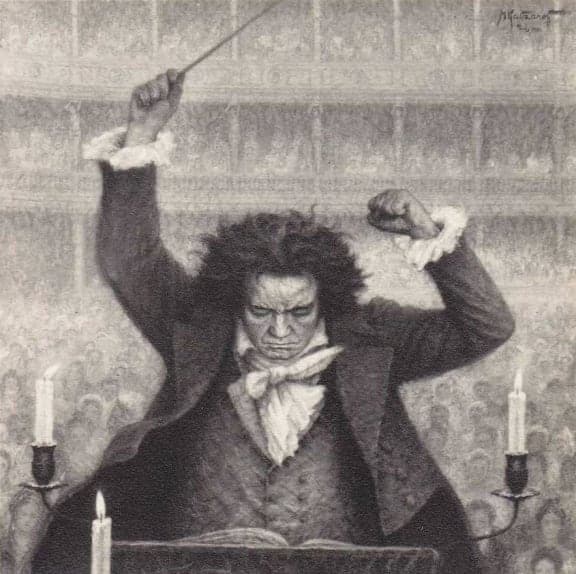
Beethoven conducting
The set of 32 variations in C minor originated in 1806. It comes from the same year in which Beethoven composed the three Razumovsky quartets, and he was working on his opera Fidelio.
Composed four years after the publication of the Eroica Variations, Beethoven writes a baroque-like chaconne theme that is followed by strictly eight-bar variations. The exception is the last variation, which escalates into a free finale. In fact, these variations have been called Beethoven’s most overt pianistic homage to the Baroque.
The piece was popular during Beethoven’s lifetime, and despite its wonderful coherence, Beethoven did not assign an opus number. We still don’t know why, but an anecdote tells of Beethoven listening to a friend practising the piece and calling it “a folly of mine.”
Ludwig van Beethoven: Kantate auf den Tod Kaiser Josephs II (Cantata on the death of the Emperor Joseph II), WoO 87, “Trauerkantate” (Reetta Haavisto, soprano; Juha Kotilainen, bass; Chorus Cathedralis Aboensis; Turku Philharmonic Orchestra; Leif Segerstam, cond.)
Charming Rondino
The Bonn elector Maximilian Franz had a passion for musical entertainment. This pleasure involved 8 wind soloists from the court orchestra. In 1791, a musical expert heard a performance and wrote, “The ensemble consists of two oboes, two clarinets, two bassoons, and two bugles.”
He continues, “these eight musicians well deserve to be called masters in their profession. There is hardly any music of this kind in such harmony and with such a high degree of truth and perfection.”
Around the same time, Beethoven was working on his Op. 103, an octet for wind instruments in E-flat Major. That work originally featured a six-minute Rondo WoO 25, intended to be its finale. In the end, Beethoven did not include this Rondo in Op. 103, and it was published as a separate “Rondino” by Anton Diabelli in 1830.
Ludwig van Beethoven: Piano Trio in E-Flat Major, WoO 38 (Milander Quartet, Ensemble)
Forgotten Cantata
Maximilian Franz was the youngest son of Empress Maria Theresa, and his court in Bonn became an important cultural centre. His brother, Josef II, became Holy Roman Emperor and died in February 1790.
There was general mourning in Bonn, and Beethoven, a member of the court musical establishment, wrote his Cantata on the Death of Emperor Joseph II on this occasion. Maybe Beethoven even showed the composition to Haydn when the elder composer returned from his first visit to England.
It is a rather substantial work, and as far as we know, it was not performed during Beethoven’s lifetime. There was a performance in Vienna in November 1884, fifty-seven years after the composer’s death. First printed in 1888, it remains one of Beethoven’s lesser-known works.
Ludwig van Beethoven: 7 Variations on “God Save the King” WoO 78
Almost Op. 1
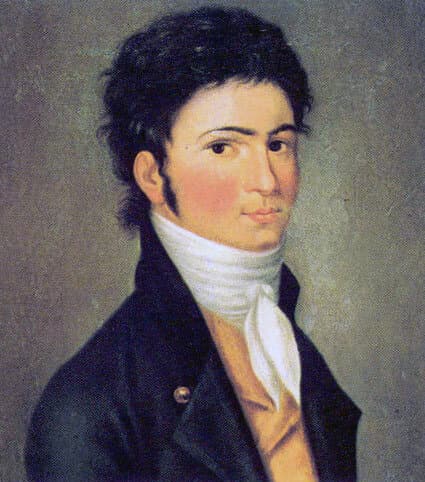
Beethoven as a teenager
The pieces that Beethoven considered substantial and impressive enough to carry the prestigious “Op. 1” label are three Piano Trios. These works date from the early 1790s, with some movements probably dating back to his time in Bonn, but Beethoven very carefully chose them as his official debut to the musical world.
Beethoven might well have included the Piano Trio in E-flat Major, WoO 38, a work probably dating from around the same time. At least some parts of this trio date from his initial time in Vienna, while others might have originated in the mid-1780s.
The music was only found among Beethoven’s papers after his death and was published in 1830. Anton Schindler, Anton Diabelli, Ferdinand Ries, and Carl Czerny all certified it as a genuine composition by Beethoven.
Ludwig van Beethoven: 5 Variations on Rule Britannia in D Major, WoO 79 (Alfred Brendel, piano)
“God Save the King”
Beethoven’s financial interest in his piano music is not based on his sonata but on the many sets of variations. In short, Beethoven also wanted to be known as a composer of popular music. Two of his piano variations employ British airs as he was looking to appeal to a wider amateur market.
The two sets of variations under discussion are “God Save the King” and “Rule Britannia,” WoO 78 and WoO 79, both composed in 1803. Beethoven never crossed the English Channel, and he did not know many British people personally.
However, by using these famous tunes as the basis of small variation sets, Beethoven was attempting to appeal to people both at home and abroad in the aftermath of Napoleon’s imperial declaration. It was both a political statement and a way to appeal to the Commonwealth markets.
The Dedication Twist
The Seven Variations for piano and cello in E flat major WoO 46 on “Bei Männern, welche
Liebe fühlen” from Mozart’s opera The Magic Flute, was a New Year’s present for Count Browne. He was a high-ranking officer in the Imperial Russian Army and the son of the governor general of Livonia and Estonia.
With Beethoven, there always seems to be a twist. On the original manuscript of this work, the composition is dedicated to the Countess Fries. She was the wife of the richest man in the kingdom, and Beethoven had already dedicated three works to her, including the “Spring Sonata.”
It seems that Beethoven changed his mind at the last minute and dedicated the work to Count Browne instead, as he was one of the great patrons of music. The work was worthy of royalty, but in Beethoven’s eyes, not for an opus number.
The Man Behind the Myth
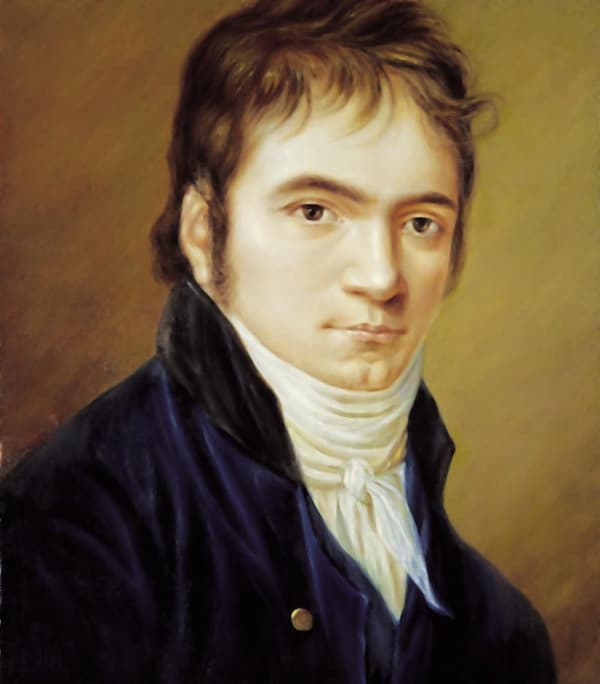
Christian Horneman: Ludwig van Beethoven, 1803 (Beethovenhaus Bonn)
Beethoven was always fiercely protective of his artistic reputation, and he was a relentless perfectionist. Add to this a shrewd business sense, and we find some of the reasons why he didn’t assign opus numbers to so many of his works.
In my opinion, the best WoO pieces are not “second-class” Beethoven. They are certainly worthy of exploration and performance, and as an added bonus, we get to know a bit more about the man behind the myth.
For more of the best in classical music, sign up for our E-Newsletter