
Michael Haydn was born on 14 September 1737 in the Austrian village of Rohrau.
His father was Mathias Haydn, a wheelwright and local government official. His mother was Maria, a cook, wife, and mother. Both parents were enthusiastic amateur musicians and singers.
Oh, yes, and Michael’s older brother was none other than Joseph Haydn, one of the greatest composers of all time.
Today we’re looking at the life of Michael Haydn, how he became a musician, his friendship and rivalry with the Mozarts, and why today he lives in his brother’s shadow…even though back in their day, it was the other way around!
Michael Haydn’s Childhood
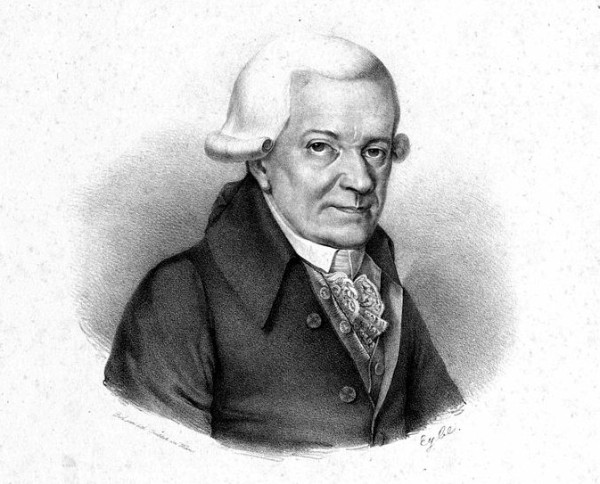
Michael Haydn
In 1738, Mathias and Maria faced a difficult decision. Their son Joseph was clearly musically gifted. They also knew he wouldn’t be able to pursue his education if he stayed in Rohrau.
So when a relative named Johann Matthias Frankh, who was a schoolmaster and choirmaster, offered to take Joseph to live with him and train him, his parents agreed.
Joseph was just six years old, and Michael was one.
Unfortunately, the Frankh household turned out to be an abusive one. You can read more about Haydn’s early struggles.
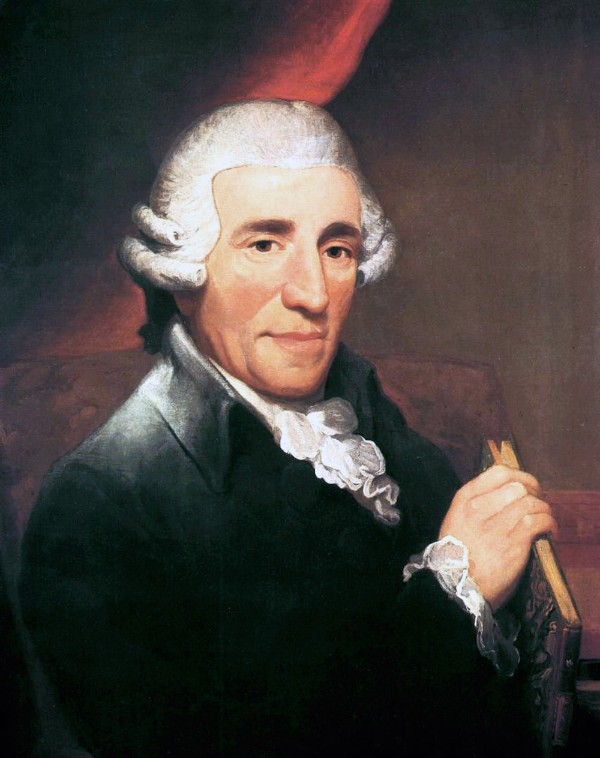
Joseph Haydn
In 1740, at the age of eight, Joseph moved to Vienna after being discovered by George Reutter, the director of music at St. Stephen’s Cathedral.
The cathedral was always looking for talented boys to sing in their choir, since women were not allowed to sing in church at the time.
It turns out that Michael was growing into a musical child, too. So in 1745, Michael followed his older brother to Vienna.
At the time, Michael was eight and Joseph was thirteen.
Because of their age difference and the young age at which Joseph had been sent away, the two children wouldn’t have known each other very well when they reunited in Vienna.
Michael Haydn in Vienna: The More Talented Brother?
Michael was, like his brother, astonishingly gifted. In fact, some believed he was even more talented than Joseph was.
Before his twelfth birthday, he was making extra money by working as a substitute organist at the cathedral. He also began composing.
Reutter was so pleased with his development that he supposedly wrote to Mathias Haydn that if he had twelve sons, he would take all twelve.
(As it turns out, a third Haydn brother – Johann, nicknamed Hansl – did join his older siblings at St. Stephen’s. But he turned out to be less talented than them and is barely remembered today.)
In 1749, Joseph’s voice broke. He also began rebelling. He pranked a fellow chorister by cutting off his pigtail. Reutter was furious and threatened to cane him. Joseph got into an argument with him and ended up fired and homeless.
Around 1753, Michael’s voice also broke, and he, too, was forced to leave the Cathedral, although it seems that, unlike his older brother, he left with his dignity intact.
Michael Haydn’s Missa Sanctorum Cyrilli et Methodii
Michael Haydn Moves to Salzburg…and Meets the Mozarts
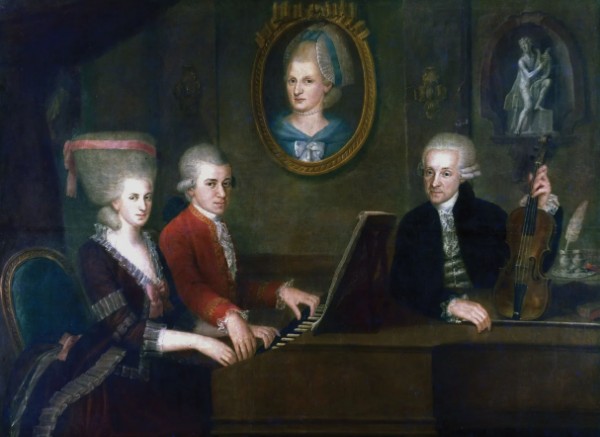
The Mozart family
In 1760, Michael took a position as Kapellmeister in the city of Großwardein, now Oradea in Romania.
Two years later, he accepted an offer in the city of Salzburg, where, at the age of 25, he became court musician and concertmaster to Prince-Archbishop Sigismund Graf von Schrattenbach.
He became colleagues with Leopold Mozart (Wolfgang’s father), who was the principal second violinist in the court orchestra.
The year Michael moved there, Wolfgang Amadeus Mozart turned six. Michael would have witnessed the boy’s astonishing talents develop firsthand…as well as those of his equally accomplished older sister, Maria Anna Mozart, nicknamed Nannerl.
Michael Haydn’s Marriage…and Tragedy
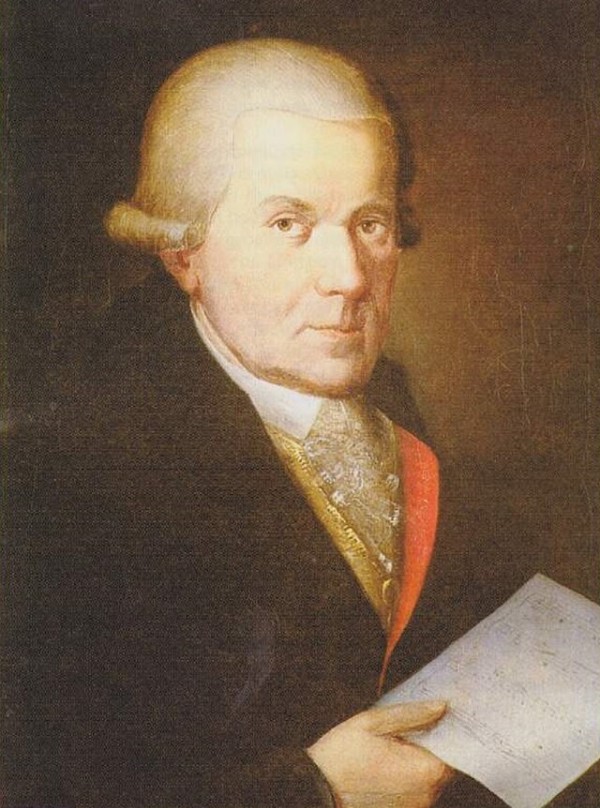
Michael Haydn
In 1768, at the age of 31, Michael married 23-year-old Maria Magdalena Lipp, who was a singer at the Salzburg court.
We know relatively little about her, besides the fact that the women in Mozart’s family didn’t like her.
Regardless, she appeared in productions of Wolfgang’s works, such as Die Schuldigkeit des ersten Gebots in 1767 (a child Mozart wrote the first act, while Michael wrote the second act) and Il re pastore in 1775.
Mozart’s portion of Die Schuldigkeit des ersten Gebots
In 1770, Michael and Maria had a baby girl, but tragically, she died before her first birthday. The couple never had any more children.
In late 1771, Michael wrote an especially influential requiem mass. Its full title was Missa pro defuncto Archiepiscopo Sigismondo, or Mass for the deceased Archbishop Sigismondo.
Heartbreakingly, it seems likely to have also been inspired by the death of his baby daughter.
The Rivalry with the Mozarts Heats Up
Michael Haydn’s 1771 Requiem
Leopold and sixteen-year-old Wolfgang were both present at Michael Haydn’s requiem premiere, and likely played in the orchestra for it.
Wolfgang remembered the work for years. In fact, there are several striking similarities between it and his own requiem.
For his part, Joseph admired his brother’s work, going so far as to say that the quality of his religious compositions surpassed his own.
However, Michael Haydn didn’t get as many major commissions as he might have otherwise…because Leopold was always working to ensure that Wolfgang would get the commissions!
There is a long-standing rumour, based on a letter written by Leopold, that Michael was lazy and an alcoholic.
However, at the time, the ever-ruthless Leopold was trying to play down Michael’s abilities; he wanted Wolfgang to be hired as organist at Trinity Church in Salzburg, but in the end, Michael got the job, to Leopold’s consternation.
How Did Michael Haydn Inspire Mozart?
Michael Haydn would spend over four decades working in Salzburg.
Over the course of his career there, he would compose over 350 pieces of music. In all, he wrote around forty symphonies, a dozen concertos, and countless other works.
We know that Mozart respected his output. He copied some of his symphony scores and even conducted performances of them.
Their quality is such that, for many years, Michael’s 25th symphony was mistaken for Wolfgang’s 37th.
The confusion began because Mozart actually did compose an introduction for the 25th, and historians assumed the entire work was his. But the meat of the piece is actually Michael’s.
Wolfgang Mozart’s 37th Symphony / Michael Haydn’s 25th Symphony
Another interesting intersection between the two men is how they both wrote for string quintet. Mozart famously wrote six between 1773 and 1791. Michael wrote one in February 1773, suggesting that he might have inspired Mozart to take up the genre.
Michael Haydn’s Work as a Teacher
In addition to working as a concertmaster and composer, he also taught.
Among his students were Anton Diabelli, who would go on to become one of the most important music publishers of his generation, and Carl Maria von Weber, a young composer who remade German opera and helped to usher in the Romantic Era.
The Final Years of a Great Career
In 1802, when he was 65, Michael was offered lucrative positions by two separate wealthy luminaries: Prince Esterházy (Joseph’s employer) and the Grand Duke of Tuscany.
In consultation with Joseph, he decided to remain in Salzburg.
The brothers stayed close via letter even toward the end of their lives.
Once when Michael lost his silver watch, he mentioned it to Joseph. Joseph, in turn, sent him a gold one, a testament to his undimmed affection for his little brother.
When Joseph’s oratorio The Creation was mounted in Salzburg, Michael performed in it.
Michael Haydn’s Death and Posthumous Reputation
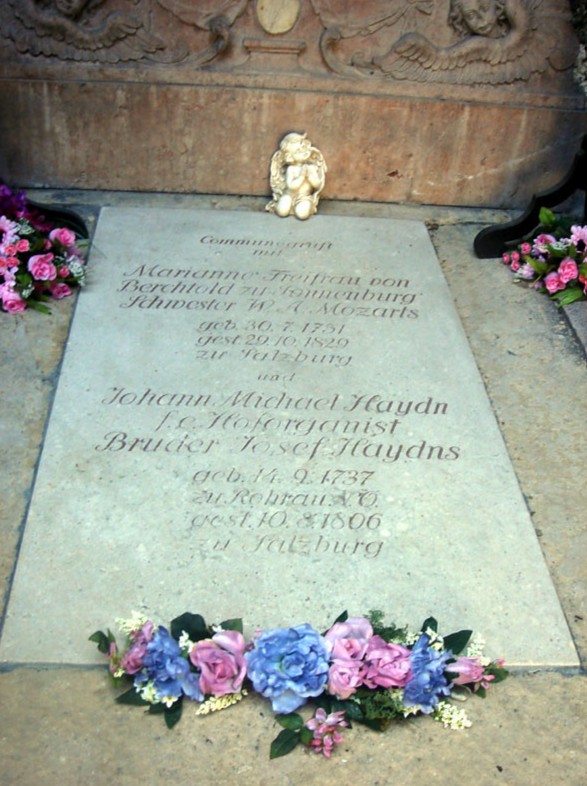
Grave of Nannerl Mozart and Michael Haydn
Michael Haydn died in the summer of 1806, three years before Joseph. He was 68 years old.
His funeral was one of the grandest ever held in Salzburg. He ended up being buried alongside Mozart’s sister Nannerl.
During his lifetime, Michael was as respected as Joseph. (Maybe even more so, at times!)
In fact, in 1811, writer and critic E.T.A. Hoffman wrote:
“Every connoisseur of music and its output knows and has always known that Michael Haydn, as a composer of sacred music, has to be counted amongst the first-rate composers of this discipline from every time and every nation.”
Why Don’t We Remember Michael Haydn Today?
His career was obviously very impressive. So why don’t we remember Michael Haydn today?
First, he didn’t like having his works printed, making them harder for music lovers – and later, historians – to find.
Second, he never went on the kinds of tours that Joseph Haydn did, meaning that his audience stayed smaller and more local than it otherwise would have been.
But given his influence on Mozart, and the high regard that Joseph held his work in…maybe it’s time for a broader re-evaluation of his work!
For more of the best in classical music, sign up for our E-Newsletter






I became a fan of Michael Haydn after studying him for my Master’s capstone. THANK YOU for your article to reinforce him and his great works!