Over the past decade, it has become more and more common to see women conducting orchestras.
Many people believe that women only started conducting in the twentieth century, but that belief would be mistaken.
As of 2025, we’re still waiting for a comprehensive scholarly study of the history of women conductors, so you shouldn’t consider this list final.
But here are seven of the first women conductors, all born before 1870, and all active in the nineteenth century.
Fanny Mendelssohn Hensel (1805–1847)
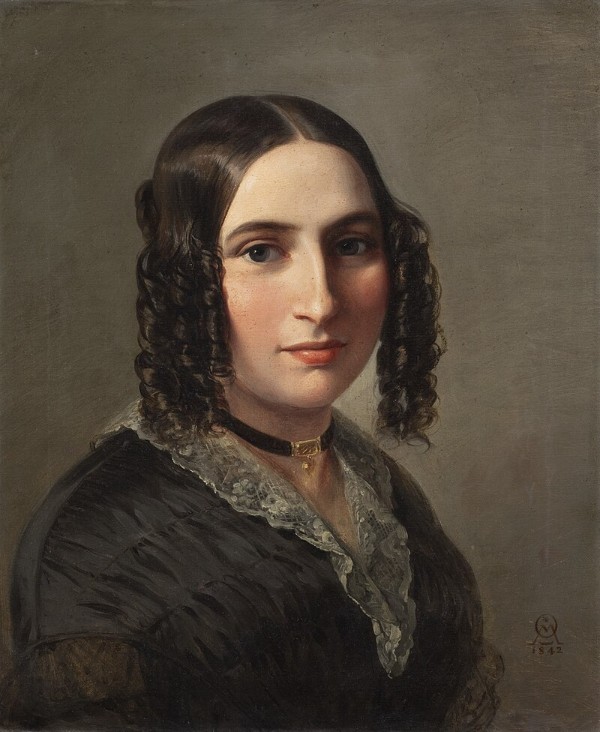
Fanny Mendelssohn Hensel
Fanny Mendelssohn was born in 1805 to a wealthy family in Hamburg. Four years later, her brother Felix was born.
Fanny and Felix were some of the most astonishing musical prodigies in music history. Their musical dialogue with one another during their childhoods was deeply formative to their respective developments, and their family’s wealth enabled them to receive the best education and opportunities available.
However, because of their wealth, it was considered inappropriate for Fanny to appear before the public, despite her talent as a pianist.
She did perform frequently at home concerts, which she became famous for. She even arranged for small orchestras to appear at her salons.
Fanny Mendelssohn’s Overture in C-major
She once wrote to Felix, “Mother has certainly told you about the…orchestra on Saturday and how I stood up there with a baton in my hand… Had I not been so horribly shy and embarrassed with every stroke, I would’ve been able to conduct reasonably well.”
She was rehearsing a chorus in a work by her brother in May 1847 when she suddenly lost feeling in her hands. She went to put them in vinegar to restore feeling as the chorus sang, and she called out from the other room, “How beautiful it sounds!”
She then had a stroke and died before the day was over.
Learn more about the life and tragic death of Fanny Mendelssohn Hensel.
Nina Stollewerk Rosthorn (1825–1914)
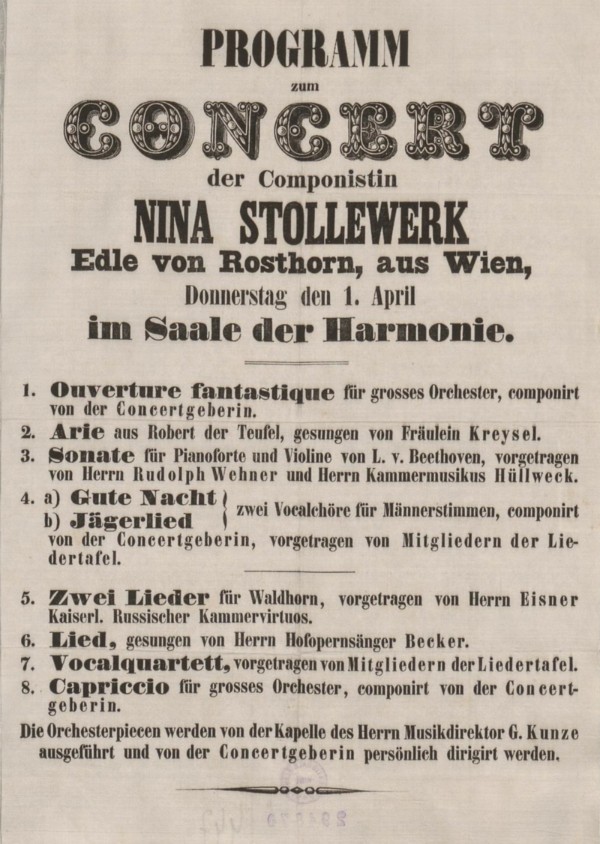
Nina Stollewerk was born in Vienna in 1825. She studied music with Simon Sechter, who taught giants like Bruckner, Thalberg, and Vieuxtemps.
She wrote her first lieder at the age of 16. Jenny Lind, one of the most famous singers in the world, sang her music.
In 1851, she appeared as a conductor at Munich’s Odeon concert hall, conducting her own works.
Reviews appeared of her in the press, all centered around her gender. In 1852, one newspaper wrote:
“One could certainly accept the emancipation of women in the direction of art, which is so close to the female emotional world, especially when, as in the case of Nina Stollewerk, she also appears as a conductor with such unpretentiousness, talent, and a clear inner drive for such artistic activity.”
Other critics were more hostile.
“The lady should spare herself the trouble of conducting herself, at least in public; it is, apart from its peculiarity, in fact – superfluous!”
Elfrida Andrée (1841–1929)
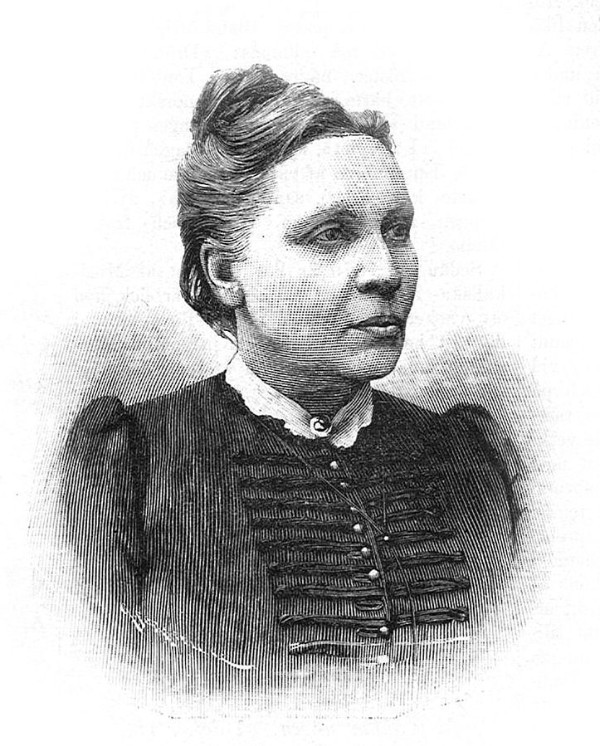
Elfrida Andrée, 1891
Elfrida Andrée was born in Sweden in 1841. She had to fight for the position, but in 1867, she became one of the first women in the country to work as a church organist.
She also composed. It was her dream to write works for orchestra. “The orchestra, that is my goal!” she wrote in the 1870s.
She did write two symphonies, but the premiere of the first (where she was not on the podium) was lackluster.
Elfrida Andrée’s Symphony No. 2
In 1897, when she was in her mid-fifties, she became the head of the Gothenburg Workers Institute Concerts. One of her duties was conducting concerts. This made her the first Swedish woman to conduct in public.
Florence Ashton Marshall (1843–1922)
Florence Ashton Marshall was born in Rome to an artistic English family in 1843.
She married a writer and music collector named Julian Marshall in 1864 and had three daughters.
She began studying music relatively late in life, attending the Royal Academy of Music beginning in 1873. Eventually, she became an accomplished and prolific composer, writing a number of songs, operettas, and works for orchestra.
She and her husband both contributed to the first edition of the Grove Dictionary of Music and Musicians.
In the late nineteenth century, she was elected an associate of the Royal Philharmonic Society, a prestigious British music society.
She was also selected to lead the South Hampstead Orchestra, which she did for over thirty years. During her tenure, she performed with giants like violinist Mischa Elman and even presented a Brahms symphony.
Helen Pleydell-Bouverie, the Countess of Radnor (1846–1929)

Helen Matilda Chaplin
Lady Radnor was born Helen Matilda Chaplin on 21 March 1846 in the town of Ryhall, a hundred miles north of London.
She studied music as a young woman, but married in 1866.
Her first attempt at conducting came when she decided to conduct a church choir, until she was asked to stop “interfering.” But she’d been bitten by the conducting bug.
At the height of the Victorian era, she used her wealth and title to found an organisation called the People’s Entertainment Society. She also began appearing both in private and in public as a singer.
In 1881, she founded a string orchestra made up of aristocratic women players. In 1894, they premiered a work by the celebrated British composer Hubert Parry.
Hubert Parry’s Lady Radnor’s Suite
The Musical Times reviewed her performance:
Lady Radnor is a conductor of quite exceptional qualifications, who evidently exercises the indefinable influence over her players which distinguishes the conductor “born, not made.” Her beat is decided and expressive, and she uses her left hand in an effective manner suggestive of a sympathetic study of Dr. Richter’s methods. Her whole attention is given to the forces under her command, for she does not belong to those animate metronomes who, as someone – was it Bulow? – said “have their head in the score instead of the score in their head.” Lady Radnor, in fact, hardly ever referred to the music in front of her, even Dr. Parry’s Suite being apparently conducted by heart.
In 1896, the year she retired, the orchestra consisted of nineteen first violins, eighteen second violins, twelve violas, fourteen cellos, seven double-basses, and timpani.
Josephine Amann-Weinlich (1848–1887)
Josephine Weinlich was born on 2 August 1848 in the small town of Dechtice in present-day Slovakia.
We don’t know what her early training was, but we do know she played in a family musical ensemble as a child.
In early 1867, when she was eighteen, she founded a string quartet made up of women who would play at private events. By May, she was advertising to hire additional musicians.
Josephine Weinlich’s Freie Gedanken (Free Thoughts)
At the beginning, their forces were small: three violins, a cello, a flute, a harp, a harmonium, and a piano. But they slowly grew, and soon they had twelve members.
They traveled around Europe in the 1870s. The ensemble went by a number of names, but the most famous ones were Weinlich’s Damen-Kapelle or the Vienna Women’s Orchestra.
In January 1870, she married a fellow conductor named Ebo Fortunatus Amann, who went on to manage the ensemble.
In 1871, they traveled to America to tour. A disagreement with their American manager led to the dissolution of the orchestra, but she reformed another upon her return to Austria. The new orchestra had thirty-three women musicians, along with seven boys who played clarinet, trumpet, trombone, and horn.
“Her glance is comprehensive, her arm vigorous; she knows all the music by heart…and conducts from memory,” The Musical Standard reported in 1873.
She tried to be taken seriously as a composer, and not just as a kind of glorified dance band. She hired the storied Musikverein in Vienna to give a concert, although critics (and presumably audiences) were preoccupied by her gender.
In 1879, after the dissolution of the second incarnation of her orchestra, she moved to Lisbon and conducted the municipal orchestra there. This is an intriguing bit of music history because the orchestra would have been made up of men, and there are few records of male orchestras allowing women to conduct them in the nineteenth century. More study is needed!
Emma Steiner (1856–1929)

Emma Steiner
Emma Steiner was born on 26 February 1856 in Baltimore, Maryland. By the age of seven, she was composing, and by eleven, she had written her first opera. (It’s now sadly lost.)
As a teenager, she began working as an operetta conductor. She eventually began working for Edward Everett Rice at his Rice and Collier Opera Company, touring the country. She claimed she gave 700 performances of Gilbert and Sullivan’s Mikado alone.
She became famous for her strong will. In 1885, she horsewhipped a man for coming on too strongly to one of her 16-year-old chorus girls, and got into a physical altercation with a benefactress after she and an all-female production of As You Like It was fired in favor of an all-male one.
In 1877, she wrote a comic opera called Fleurette, which received good reviews for the music and bad reviews for the libretto.
In 1894, she conducted the Anton Seidl Orchestra, one of the great American orchestras of the day, in Chickering Hall in New York. Three years later, she announced a series of concerts with members of the New York Metropolitan Orchestra, in which she’d conduct works by Wagner, Liszt, and others.
In 1925, she appeared at the Metropolitan Opera House in New York to conduct an orchestra in her work. It wasn’t the official Metropolitan Opera Orchestra, but it was the first time that a woman had ever conducted in that storied space. The reason for the show was her fifty years in the opera business.
For more of the best in classical music, sign up for our E-Newsletter