Music, Merriment & Misconduct
The English composer and organist Thomas Weelkes (1576–1623) grew up during a period of rapid change in English musical life. The arrival of the Italian madrigal transformed Elizabethan music and gave art music a popularity it had not previously enjoyed.
Primarily a vocal composer, Weelkes wrote madrigals, anthems, and services combining the sophistication of the Italian madrigal with a distinctly English contrapuntal tradition. As David Brown observes, “his great strength lay in the vivid inventiveness of his very calculated musical imagery, and the commanding brilliance of a fully developed contrapuntal technique whose roots are more English than Italian.” (Brown, Grove Online, 2001)
As we celebrate the 450th anniversary of his birth, let’s have a look at this colourful and highly individual musician, who was frequently reprimanded for a variety of reasons, including bad language, blasphemy, and drunkenness.
Thomas Weelkes: “To shorten Winter’s Sadness”
From Chorister to Composer
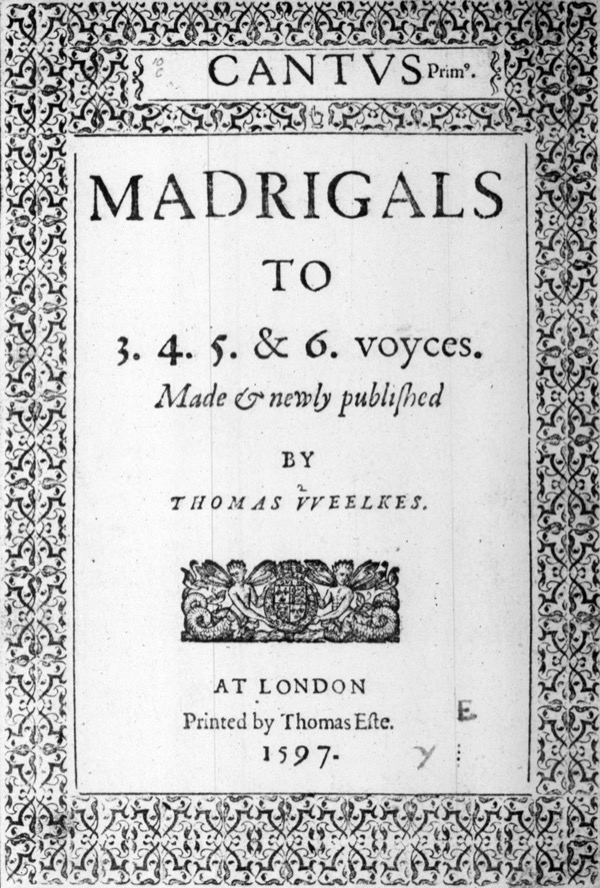
Thomas Weelkes: Madrigals to 3, 4, 5 & 6 Voyces, 1597 (title page)
We don’t have much tangible information about Weelkes’ heritage or birth. However, we do know that he was born in the Sussex countryside during the reign of Queen Elizabeth I, and that his father might have been John Weeke, the rector of Elsted.
In the event, he was baptised on 25 October 1576 in the village of Elsted, and possibly served as a chorister at Winchester College in 1583–84. He entered the service of a noble patron, Edward Darcy, and towards the end of 1598, was appointed organist of Winchester College.
He remained at the college for three or four years, and around the age of 20, in 1597, he published his first book of compositions. For scholars such as David Brown, this period produced his finest madrigals.
Thomas Weelkes: Ladie, your eye my love enforced (Purcell Consort of Voices; Grayston Burgess, cond.)
The Sound of a New Generation
Combining the Flemish style of learned polyphonic music with new Italian influences, he published two volumes in 1598 and 1600; the second, containing works for five and six voices, is one of the most important volumes in the English madrigal tradition.
Weelkes was employing cutting-edge continental trends, borrowing texts and musical ideas from an Italian collection by Salamone Rossi, published in 1589. “In other words, the young Englishman was studying the latest Italian madrigal styles and importing them into his own work.” (Paul, The Genealogist, 2025)
Weelkes’s madrigals, with their word painting, lively rhythms, and expressive chromatic notes, are often compared to those of John Wilbye. Some suggest that the two men’s personalities are reflected in the music. Wilbye appears to have been the more sombre character, with the more colourful Weelkes infusing his music with dense chromaticism and unconventional rhythmic structures.
Thomas Weelkes: “O Care, Thou Wilt Despatch Me”
Farewells & New Beginnings
Weelkes was also friendly with the madrigalist Thomas Morley, who died in 1602. Weelkes commemorated his death in a madrigal-form anthem titled “A Remembrance of my Friend Thomas Morley,” also known as “Death hath Deprived Me.” Weelkes’ madrigals were popular in the eighteenth and nineteenth centuries, and were continuously reprinted in various collections.
Weelkes maintained his duties as a college organist at Winchester, and he may have composed several sacred works. He was gaining popularity as a composer and was ready to take on a bigger role. As such, between October 1601 and October 1602, he left Winchester to join the choir of Chichester Cathedral as an organist and choirmaster.
Thomas Weelkes: All laud and praise (Gary Cooper, organ; Oxford Camerata; Jeremy Summerly, cond.)
A Cathedral Career
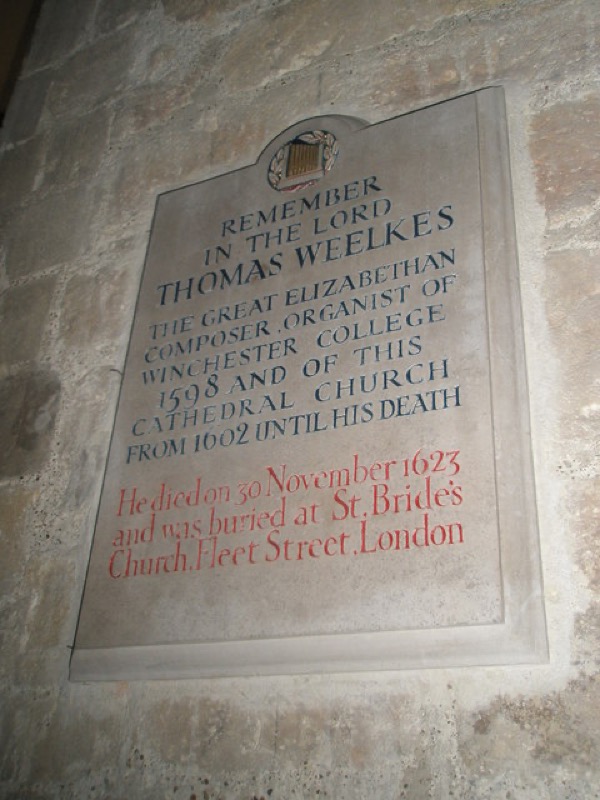
Memorial to Thomas Weelkes within the North Transept at Chichester Cathedral
“This was a significant promotion: Chichester was one of England’s historic cathedrals, with a choral foundation that required a talented musician at the helm.” (Paul, The Genealogist, 2025) His early years at Chichester were prosperous and promising, and in 1603 he married Elizabeth Sandham, daughter of a wealthy Chichester merchant.
Weelkes seems to have been comfortable, as the title-page of his fourth and last volume of madrigals of 1608 describes him as a Gentleman of the Chapel Royal. Although it is impossible to date it precisely, the vast majority of his church music appears to have been composed at Chichester.
The range of his full anthems, both in style and quality, is very wide. “In their consistent counterpoint, leisurely unfolding, more archaic approach to dissonance, and absence of internal structural relationships, these contrast sharply with the three anthems that combine an English text with a recurring Latin acclamation.” (Brown, Grove Online, 2001)
Thomas Weelkes: “When David Heard”
Anthem & Alehouses
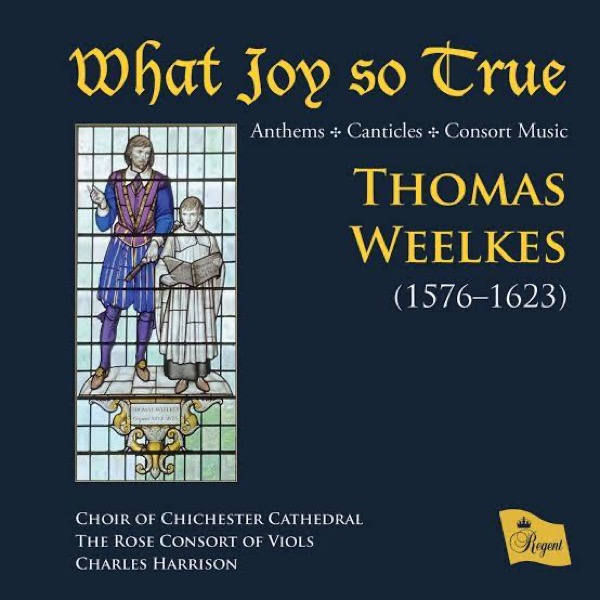
What Joy so True: Thomas Weelkes – Anthems, Canticles, Consort Music
(Choir of Chichester Cathedral; The Rose Consort of Viols; Charles Harrison)
Some suggest that Weelkes composed the full anthems for extra-liturgical, or even secular, occasions. Weelkes appears to have devoted more energy to the verse anthems, a form well suited to the limited resources of the Chichester Cathedral choir. He also composed many Anglican services, mostly for Evensong.
Weelkes seems to have been well regarded as a composer, and he did establish a network of connections with contemporary composers. If indeed he was a “Gentleman of the Chapel Royal,” he might well have mingled with Orlando Gibbons, John Bull, and Thomas Tomkins.
Yet Weelkes’ personal conduct gave cause for concern. In 1609, he was officially reprimanded for an unauthorised absence during the bishop’s visitation. As his heavy drinking and boisterous behaviour increased, he was charged with being drunk in public, and by 1616 his drunkenness was a public scandal.
Thomas Weelkes: Ninth Evening Services (Resurgam; English Cornett and Sackbut Ensemble; Mark Duley, cond.)
The Alehouse Years
He was reported to the bishop as being “noted and famed for a common drunkard and notorious swearer & blasphemer.” An unconfirmed report suggests that he was even fined for urinating on the Dean from the organ loft during Evensong.
As things spiralled out of control, Weelkes was dismissed from his post on 16 January 1617. His conduct apparently did not improve, as a 1619 report states: “Dyvers tymes & very often come so disguised eyther from the Taverne or Ale house into the quire as is muche to be lamented, for in these humoures he will bothe curse & sweare most dreadfully, & so profane the service of God … and though he hath bene often tymes admonished … to refrayne theis humors and reforme hym selfe, yett he daylye continuse the same, & is rather worse than better therein.”
Thomas Weelkes: “As Vesta was from Latmos hill descending”
A Colourful Legacy
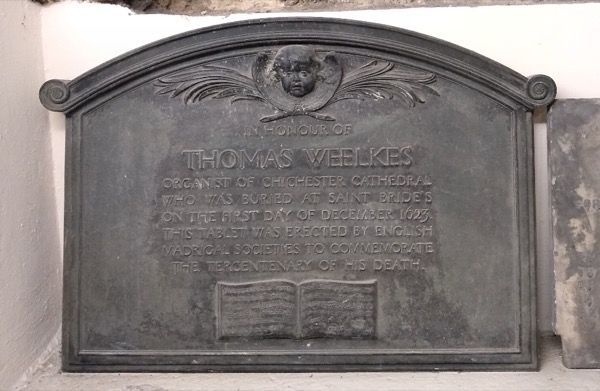
Thomas Weelkes memorial in the crypt of St Bride’s Church
Elizabeth Weelkes died in 1622, but by this time, he had been reinstated at Chichester Cathedral. Nevertheless, he spent much time in London, and in November 1623, he died in the house of a friend on 30 November 1623. He was buried on 1 December 1623 at St Bride’s Fleet Street.
A colourful historical figure, Thomas Weelkes composed sublime harmonies, and on the 400th anniversary of his death, one of his compositions was revived and performed at Charles III’s coronation. Thomas Weelkes remains one of the most colourful and compelling voices of the English madrigal.
For more of the best in classical music, sign up for our E-Newsletter