Mozart had many students over the course of his career – but some of his most gifted pupils were women.
He wrote music for them, dedicated sonatas to them, and even relied on them financially during the years he was building his reputation in Vienna.
Here are three more of the women who studied with Wolfgang Amadeus Mozart.
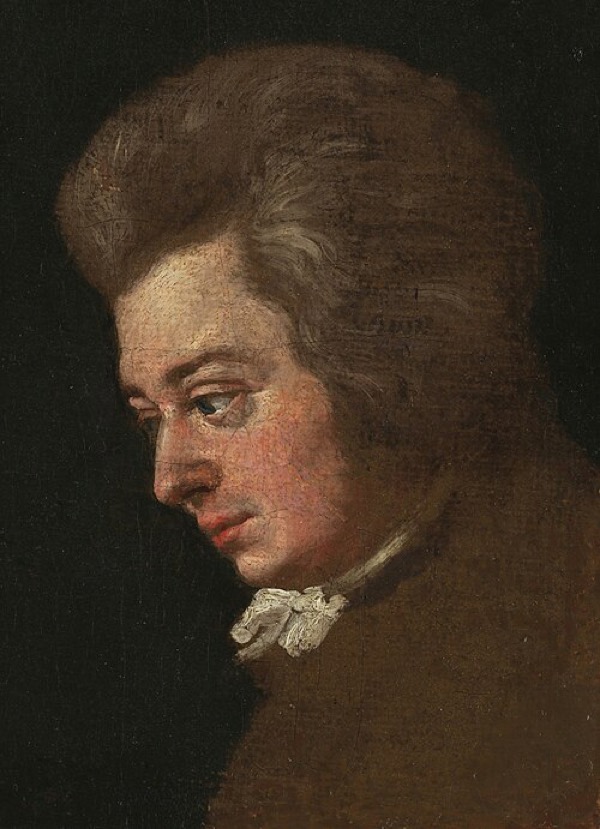
Joseph Lange: Mozart (detail), 1782
Thérèse von Trattner: The Young Wife and Mother
Thérèse was born in Vienna in November 1758 to court mathematician Joseph Anton Nagel.
When she was 18, she married a 59-year-old widower and print shop owner named Johann Thomas Trattner.
She had ten children with him, but only one daughter survived to adulthood.
In 1781, the year she turned 23, Mozart arrived in Vienna, and she began taking lessons from him.
She was one of the pupils who helped keep him afloat financially in those early months, saving him from having to return home to his father in Salzburg. Mozart even moved into a grand building owned by Trattner.
Not only was Thérèse Mozart’s student and landlord, but she also helped fund and organise three subscription concerts of his music in March 1784.
At these concerts, he performed his Piano Concertos No. 14, 15, and 16 (K. 449, 450, and 451), burnishing his reputation in Vienna.
Mozart’s Piano Concerto No. 16
In gratitude for her patronage, Mozart composed his Piano Sonata No. 14 (K. 457) and Fantasy (K 475) for her.
The sonata features this dedication: “Composed for Mrs Theresa von Trattner by her most humble servant Wolfgang Amadeus Mozart. Vienna, 14 October 1784.”
It is widely considered to be one of his most significant piano sonatas.
Mozart’s Piano Sonata No. 14
Despite the many losses she endured as a young mother, staying involved in the musical world and Mozart’s circle remained deeply important to her.
The Trattners even served as godparents of four of Mozart’s six children.
It is believed she continued taking piano lessons with Mozart until his death, and she gave concerts in her home. She died less than two years after he did, in July 1793, at the age of 35.
Franziska von Jacquin: The Teenager Who Helped Popularise the Clarinet
Franziska von Jacquin was born in October 1769 in Vienna.
Her father was a chemist, botanist, and doctor who taught at the University of Vienna and served in the royal court.
At some point in the 1780s, Mozart befriended her brother Gottfried and began teaching piano to Franziska.
Mozart seems to have thought highly of her and her work ethic. In January 1787, after he’d been teaching her for a while, he wrote to Gottfried:
“I kiss her hands 100,000 times, asking her to be really diligent on her new piano forte – but this admonition is useless, because I have to admit that I have never had a student who was so hard-working… I’m really looking forward to continuing to teach her, despite my limited ability. – Speaking of which, if she wants to come tomorrow – I’ll definitely be home by 11 o’clock.”
He’s being a bit tongue-in-cheek here (Mozart had a dry sense of humour and a high opinion of his own abilities), but it’s clear there was real respect and admiration there, too.
He even composed a piano sonata for four hands (K. 521) for her.
Mozart’s Piano Sonata for Four Hands, K. 521
He also dedicated the “Kegelstatt” Trio (K. 498) to her. Its unusual original instrumentation (viola, clarinet, and piano) suggests that it was composed with specific individuals in mind.
At the July 1786 premiere, Mozart played viola, virtuoso clarinettist Anton Stadler the clarinet, and the 16-year-old Franziska von Jacquin the piano.
This trio helped to popularise the clarinet in Vienna.
Mozart’s “Kegelstatt” Trio, K. 498
Franziska was married to a court secretary in April 1792. After this point, no record of her musical activities exists.
She died in 1850.
Josepha von Auernhammer: The Composer
Born in 1758, Josepha von Auernhammer was the eleventh of fifteen children born to Viennese secretary and financial representative Johann Michael Auernhammer and his wife Elisabeth. Josepha was one of only three siblings to survive past the age of thirty.
Her mother came from a musical family (her father had been a violinist in the imperial court), and she hired first-rate music tutors for her daughter: virtuoso pianist Georg Friedrich Richter, Bohemian composer Leopold Koželuch, and Wolfgang Amadeus Mozart.
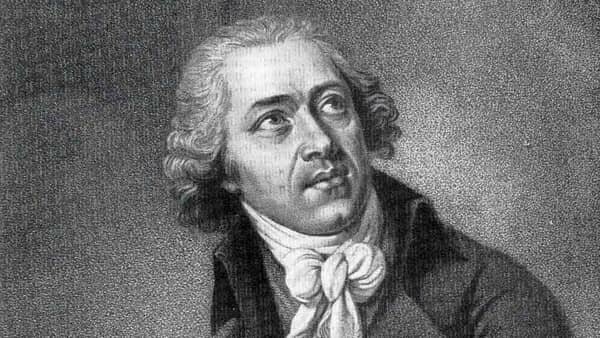
Leopold Koželuch
In June 1781, Mozart wrote in a letter that he went to her father’s home every day after dinner. He assessed that she “plays delightfully” but “lacks the genuine fine and lilting quality of cantabile; she plucks too much.”
That November, she played at a concert at her parents’ home with Mozart, where he played his Concerto in E-flat major for Two Pianos, K. 365. (She took the first part.)
Mozart: Concerto for Two Pianos KV 365 | Lucas and Arthur Jussen| WDR Orchestra | Christian Măcelaru
She also played in a performance of his Sonata for Two Pianos in D major, K. 448, which had been written for the concert.
Mozart: Sonata for Two Pianos in D, KV 448 – Lucas & Arthur Jussen
She would appear with Mozart multiple times during the 1780s and even helped him to correct the engravings of his works.
Mozart’s friend Maximilian Stadler wrote in his autobiography:
“When [Mozart] came to Vienna and had his six sonatas for piano and violin engraved by Artaria and dedicated to Auernhammer, he took me along for a rehearsal. Artaria brought the first edition; Auernhammer played the pianoforte, with Mozart accompanying on a second fortepiano placed nearby instead of the violin. I was completely delighted by the playing of the master and the pupil. I have never again in my life heard such an incomparable performance.”
She told Mozart privately that she wished to become a professional musician rather than marry.
While she did marry in 1786 (and have four children), she also continued to play the piano.
In fact, she had a musical career that lasted long after Mozart died in 1791. In 1801, she performed Beethoven‘s first piano concerto, helping to bring Mozart’s teaching to the next generation of Viennese audiences and music lovers.
She even composed – and musicologists and pianists are discovering her works today.
Her final concert was in 1813 with her daughter Marianna, who became a celebrated singer.
Josepha Auernhammer died in 1820. She remains one of the most fascinating pupils Mozart ever had, male or female.
Auernhammer’s Variations on a Theme by Mozart
Conclusion
Thérèse von Trattner, Franziska von Jacquin, and Josepha von Auernhammer each left a distinct mark on Mozart’s life and work – as patrons, performers, and muses.
Auernhammer in particular went on to a career that outlasted his by two decades, carrying his influence into the era of Beethoven and Schubert.
Their stories, and those of the three women profiled in the first article, are a reminder that Mozart’s legacy was shaped not only by the music he wrote, but by the women who played it.
For more of the best in classical music, sign up for our E-Newsletter