Over 300 years ago, in 1716, the great French harpsichordist François Couperin published his famous treatise L’Art de Toucher le Clavecin (The Art of Playing the Harpsichord). It is, by all accounts, the main Baroque text on playing the instrument, and its importance was acknowledged for decades both within and outside France.
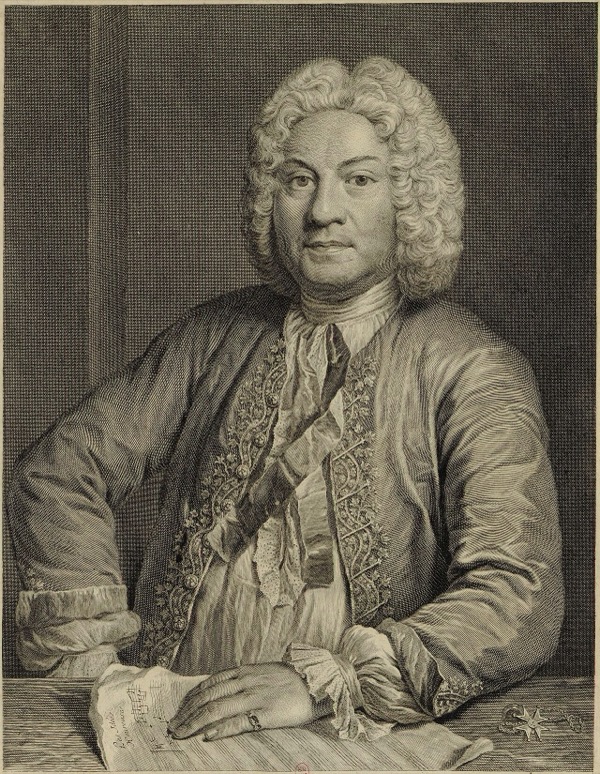
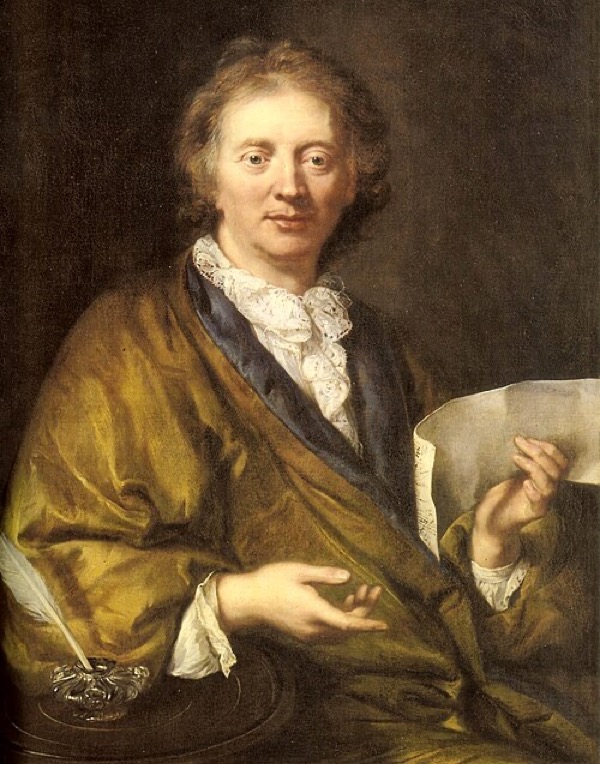
François Couperin
Couperin died on 11 September 1733 at the age of sixty-four, and the early music expert Jordi Savall suggests that Couperin was the “poet musician par excellence” who believed in “the ability of Music to express itself in prose and poetry.”
To commemorate his passing, let’s have a look at his most famous book, which contains suggestions for fingering, touch, ornamentation, and various features of keyboard technique. It also contains eight preludes and an Allemande that demonstrate his ideas about keyboard playing.
François Couperin: “Premiere Prélude” from L’art de toucher le clavecin
Teaching Good Taste
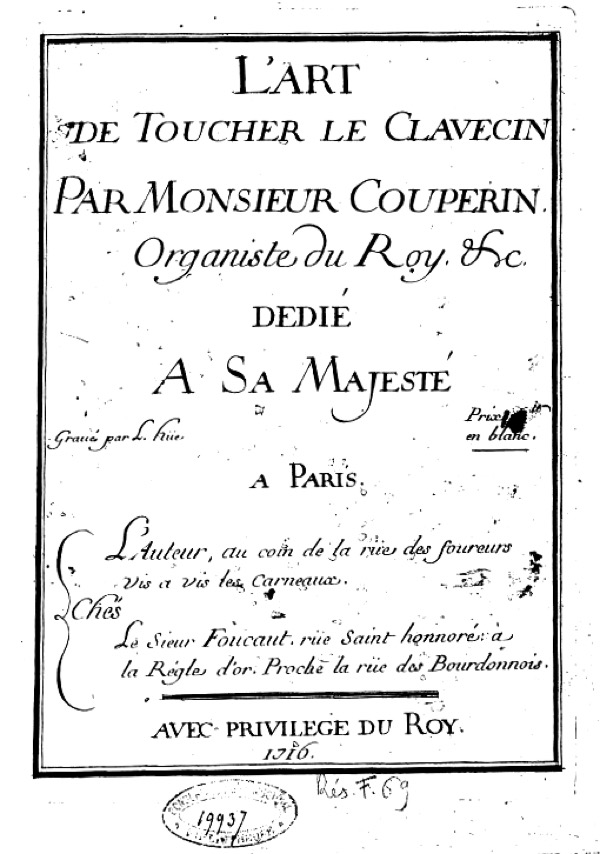
L’art de toucher le clavecin
Couperin’s reasons for writing his L’Art de toucher le Clavecin are detailed in the preface. “This instrument,” he writes, “has its own peculiarities, just as the violin has its own. If the harpsichord cannot swell its notes, if the rapid repetition of the same note does not particularly suit it, then it has other advantages: accuracy, clarity, brilliance, and its greater range.”
“Above all, one must develop a sensitive touch for the keys and always have a well-feathered instrument. However, I understand that there are people for whom this may be irrelevant, because they play equally badly on any instrument.”
Although Couperin presents his treatise as something new and unique, it belongs to a growing tradition of instrumental methods. As amateur music-making became an important part of fashionable French society, learning an instrument was considered essential to education and good taste.
François Couperin: “Prélude 6” from L’art de toucher le clavecin
When Music Learns to Speak
As Couperin suggests in his preface, the most important aesthetic idea is the comparison between musical performance and rhetoric. Reading musical notation is not the same as performing music, as it does not tell us how the music should speak. As such, the author spends much time on phrasing, punctuation, articulation, and expression.
Couperin begins with the player’s physical position and hand position. He soon turns to matters of touch, stressing “la belle souplesse” (suppleness) and the soft, flexible hands required for harpsichord playing. The search for the most perfect touch was the holy grail of harpsichordists of his time.
Feathery touch aside, Couperin demonstrates how expressive possibilities can be created through means other than simple dynamic pressure. Essentially, the performer shapes music through a subtle hierarchy of gestures and the character of individual phrases.
François Couperin: “Prélude 7” from L’art de toucher le clavecin
Grammar of Ornament
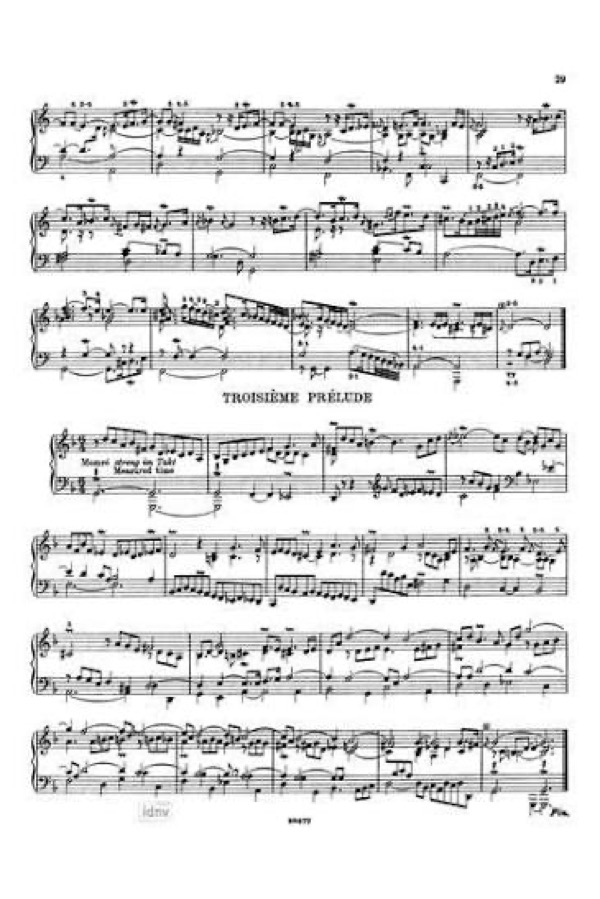
Couperin: The Art of Playing the Harpsichord
Couperin devotes considerable space to ornaments as part of the musical language. This includes the manner of fingering and execution, and his explanations demonstrate the close relationship between fingering and musical expression. The elegance of performance is inseparable from expression.
To demonstrate his didactic and theoretical ideas, Couperin included eight preludes and one Allemande. In his 1717 revision, Couperin explains why he composed the eight preludes himself. “I must not forget to explain, before finishing this little discourse, that the method entitled L’Art de toucher le clavecin, which I have just mentioned, contains, among other things, eight preludes suitable for all ages and for all kinds of hands.”
“The fingers with which they are to be played are marked there by numbers, and I have even composed these preludes expressly in all the keys of my pieces, both those of my first book and those with which this second is filled.”
François Couperin: L’art de toucher le clavecin: Prelude No. 5 in A Major (Olivier Fortin, harpsichord)
Beyond the Bar Line
François Couperin
The first prelude in C Major serves as an instruction, while No. 2 is particularly rich in ornamentation and expressive inflexion. No. 3 in G minor is darker and rhetorically charged, with No. 4 in F Major presenting a flowing and lyrical discourse. No. 5 in A Major is bright and expansive, while No. 8 becomes more concentrated.
These preludes belong to a tradition in which the music is written without conventional bar lines. As such, they accord the performer considerable freedom in determining the rhythmic flow. They are not to be taken as improvisations, but as music that is fundamentally free in form.
The inclusion of the Allemande allows Couperin to demonstrate how technique becomes musical expression. Every individual section of the treatise is now combined in a fundamental dance of the French keyboard suite. It contains everything Couperin has been discussing, and it also serves as a demonstration of the differences between French and Italian styles.
L’Art de Toucher is the most important Baroque text on playing the harpsichord, and Carl Philipp Emanuel Bach still acknowledged it in his treatise of 1753. At that time, 37 years had elapsed, and the musical world had undergone a radical change of taste and style.
For more of the best in classical music, sign up for our E-Newsletter