The Czech-Moravian composer Bohuslav Martinů died on 28 August 1959 in Liestal, Switzerland. His music remains one of the great unexplored territories of twentieth-century classical music, and it is difficult to know where to start.
Martinů’s music unmistakably belongs to the twentieth century, but he seems to be wearing several different compositional hats. To be sure, Martinů paid close attention to avant-garde cosmopolitan developments, yet his music remains deeply rooted in his Czech and Moravian identity.
Martinů explored the stylistic world of French modernism, ranging from Debussy and Roussel to Stravinsky. He was also a jazz-inflected experimentalist, and to commemorate his death on 28 August, let us put together a beginner’s listening guide to some of Martinů’s best works.
Bohuslav Martinů: Symphony No. 6 “Fantaisies symphoniques”
A Symphony Without a Map
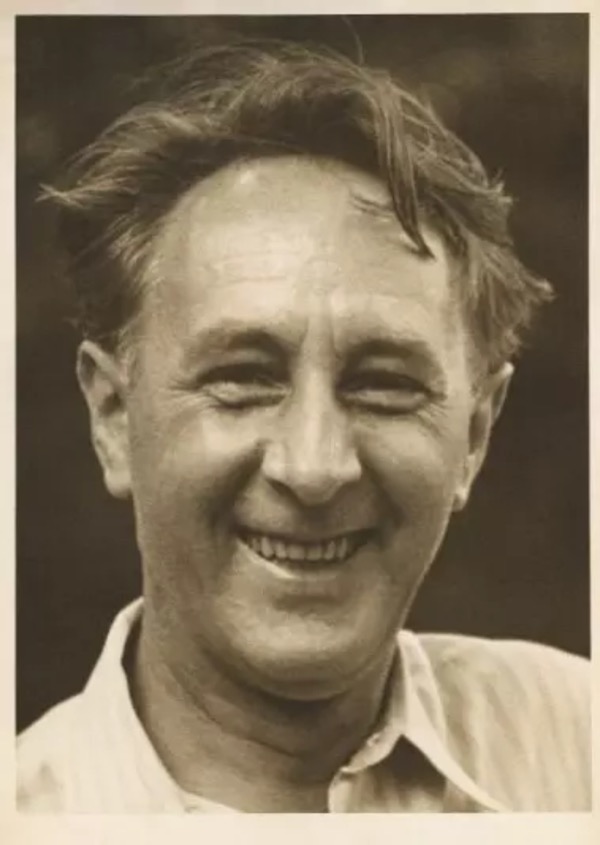
Bohuslav Martinů
If you listen to only one of Martinů’s works, I would suggest his Sixth Symphony. It was composed between 1951 and 1953, roughly around the end of his American period. It is a fantastic composition, essentially as Martinů himself tells us, “without form.”
Even the composer was unsure of what held the music together, “but it has a single line, and I have expressed something in it.” Can you believe that Martinů never explains what that “something” is all about?
To be sure, there were several very personal impulses behind this symphony as he expanded his orchestral colour and allowed musical ideas to appear, disappear, and then return in altered form.
It all starts with a single principal motif, first introduced by an unaccompanied cello after the initial murmurs. This musical idea has four notes and runs throughout the entire piece. Some commentators suggest that this idea is derived from the opening of Dvořák’s Requiem.
The “Scherzo” seems to hint at Leoš Janáček, and the third and last movements are meditations on the opening motif. What I love about this work is the idea that the orchestra is constantly discovering its own landscape.
The music feels familiar yet strange, offering a glimpse of Martinů’s mature harmonic language. And as I told you in the beginning, we find echoes of his Czech identity and French modernism.
Above all, there are flashes of brilliance, but also passages of extraordinary stillness. Woodwinds emerge from the orchestral texture; strings create shimmering backgrounds; brass suddenly transform the atmosphere. The music feels simultaneously familiar and strange, and highly personal and visionary.
Bohuslav Martinů: Double Concerto for Two String Orchestras, Piano, and Timpani
Music in the Shadow of War
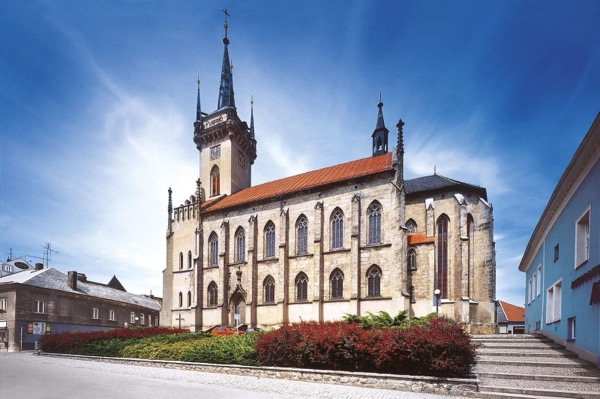
Polička Church
In his Sixth Symphony, Bohuslav Martinů looked into the future. Still, his Double Concerto of 1938 was written during the ominous political crisis that began to envelop all of Europe and the world. In his famous dedication to Paul Sacher, he writes about his “peaceful stay, filled with fear, and the danger of war.”
Martinů had been born in 1890 in the small Czech town of Polička, where his father was the town shoemaker and tower keeper. Remarkably, the young Martinů spent his first twelve years living with his family in the tower of St James’s Church.
He was never comfortable in the highly conservative musical environment of Prague, and in 1923 he moved to Paris to study with Albert Roussel. He became part of the Czech artistic community and assimilated multiple musical styles, including jazz, surrealism, and neoclassicism.
Martinů composed a series of works that mirrored the eclectic artistic environment of the French capital. Yet the Czech community, both at home and in Paris, was among the first to become aware of the worsening political situation in Europe. After all, the “Munich Agreement” of 1938 allowed Nazi Germany to annex parts of the Czechoslovak Republic, called the “Sudetenland.”
In his Double Concerto for Two String Orchestras, Piano, and Timpani, completed on the very day of the “Munich Agreement,” Martinů was developing his approach to the Baroque concerto grosso, and the intensity of expression is seldom found elsewhere in his works.
Just listen to the fiercely dynamic opening, which includes shrieks of war contrasted by lyrical sections constantly interrupted by menacing rhythms. The “Largo” is pure intensity, with plenty of sombre cellos and double basses and percussive piano for colour.
The “Finale” uses material from the previous movements, all reflecting the fury of a growing war machine. Sinister repeated piano notes and plenty of timpani involvement conclude one of Martinů’s best-known works from this period.
Bohuslav Martinů: Juliette, (Trailer, Opera Zurich)
Welcome to the World of Dreams
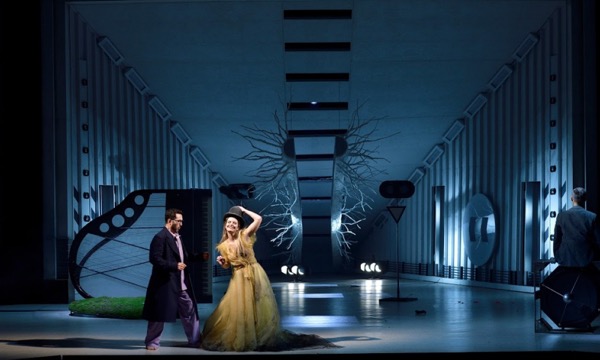
Julietta
Martinů was not merely a composer of energetic neo-classical instrumental music; he was also a surrealist dramatist of considerable imagination. And Juliette, also dating from around 1938, is probably the finest and most daring of Martinů’s sixteen operas.
The original story, entitled “Juliette ou La clé des songes” (Juliette, or the Key of Dreams), comes from the French author Georges Neveux, and Martinů saw the play in 1932. For newcomers, the appeal lies in a multi-layered narrative structure with a strange logic of dreams and in its colourful, yearning music.
Martinů wrote both the libretto and the music, which features the Parisian bookseller Michel, who is searching for Juliette in his dreams. Juliette is a girl he once spied singing from her window in a seaside holiday town.
In his dreams, he meets several characters in increasingly bizarre encounters at that seaside town, who are driven by the fact that they have no memory and can exist only in the present moment. When Michel is made mayor of the town, he murders Juliette and appeases the crowd by telling them a story.
He is mercilessly attacked, but not because of the murder, but because the story wasn’t very good. The music perfectly matches the subject of this opera about memory, even though surrealist opera is not an established genre.
Maybe the music itself is less memorable than the plot and the staging, but Martinů symphonically builds his acts from scenes, and scenes from separate numbers. In essence, the musical material is extremely episodic.
You hear snippets of melody with dashes of orchestral colour, and painfully brief chord progressions. The psychological ambiguity in the story is musically illustrated as tonal centres shift like quicksand beneath the characters; it’s all a dream anyway.
It’s a wonderful example of the diversity contained in Martinů’s music, and as a listener, one can hear the many genres from which he draws his imagination. Czech and Moravian folk songs, a good dose of impressionism, and the French jazz environment of the 1920s and 1930s.
Bohuslav Martinů: Les Fresques de Piero della Francesca
When Paintings Become Music

Piero della Francesca: Vera Croce frescoes
Bohuslav Martinů’s fascination with the visual arts produced some of his most beautiful orchestral music, including Les Fresques de Piero della Francesca, composed in 1955. This work dates from after Martinů’s return to his European roots in 1953.
At that time, Martinů was classified as an emigrant traitor by the communist government in his native Czechoslovakia, and he resettled in the south of France. Czechoslovakia had banned him from returning home, and it virtually banned all his music as well.
In the spring of 1955, Martinů took a trip to Perugia and travelled down the Tiber Valley. In Arezzo, he was deeply impressed by Piero della Francesca’s cycle of frescoes depicting the Legend of the True Cross in the choir of San Francesco.
In his orchestral work, Martinů gave voice to the majestic and icy silence of the fresco, as well as the peaceful poetry of the paintings. He was not interested in an illustrative musical depiction, but in capturing the essence and general ambience in a spacious, neo-Impressionistic orchestral language.
The opening has a gentle glow, with harp, muted strings, and horns. The violins then introduce a quasi-Baroque-sounding idea, which is contrasted by other lyrical and dramatic themes. A beautiful passage for English horn and muted strings returns the opening movement to a peaceful ending.
The “Adagio” is inspired by the sleeping Emperor Constantine, with an angel showing him a cross in the sky, promising victory over his rival, Maxentius. It all starts rather mysteriously, but the solo viola then sounds a call to battle. It concludes with a gentle interlude and a quiet ending.
The final movement brings together two of Piero della Francesca’s battle paintings. One shows Constantine defeating Maxentius with the cross in his hand, and the other depicts the defeat of the Persian king’s army, which had taken the Cross from Jerusalem. A strongly syncopated theme drives the music forward, but as the tension fades, the work comes to a peaceful close.
Bohuslav Martinů: The Kitchen Revue
A Ballet for Pots and Pans
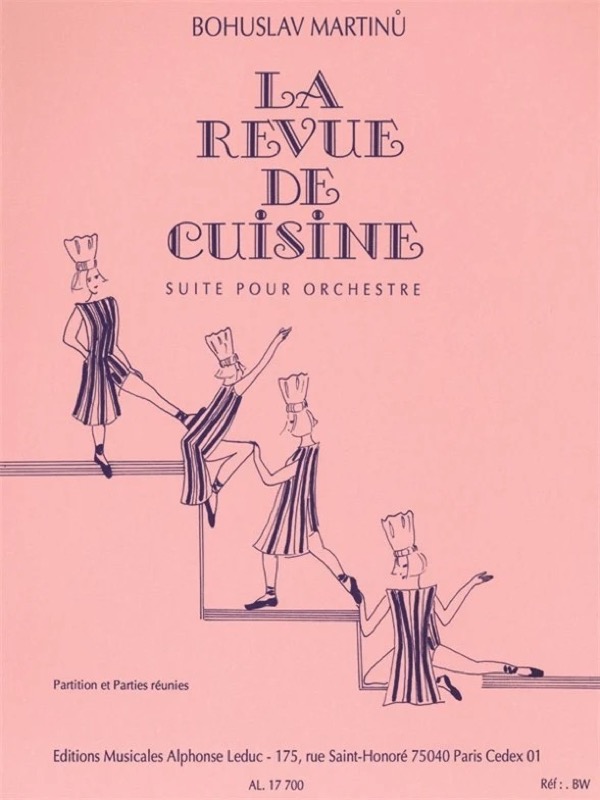
The Kitchen Revue
And now we turn to something completely different. In his one-act ballet La revue de cuisine, composed in 1927, Martinů tells us that twentieth-century classical music doesn’t have to be solemn or take itself too seriously.
Martinů considered La revue de cuisine to be one of his most successful compositions. And the plot is certainly hilarious! The forthcoming marriage between Pot and Lid is jeopardised by the adventurous Cream-beater, to whose magic Pot has succumbed.
Pot is so captivated that Lid falls off him and rolls into a corner of the kitchen. Now, Dishcloth wants to seduce Lid, but order-loving Broom challenges Dishcloth to a duel, which delights Cream-beater.
The two irritated combatants fight to the bitter end. Cream-beater makes eyes at Pot once more, but now Pot longs for Lid, who is nowhere to be found. The shadow of an enormous foot appears suddenly and, with one kick, propels Lid out of his corner. Broom leads him back to Pot, while Cream-beater and Dishcloth break out into a wild dance of joy.
The music was later arranged as a concert suite, demonstrating Martinů’s fascination with jazz and popular music during his Paris years. Imitating the rhythmic energy of modern life, it is a witty and sharply orchestrated work that is irresistibly theatrical.
The Final Journey Home
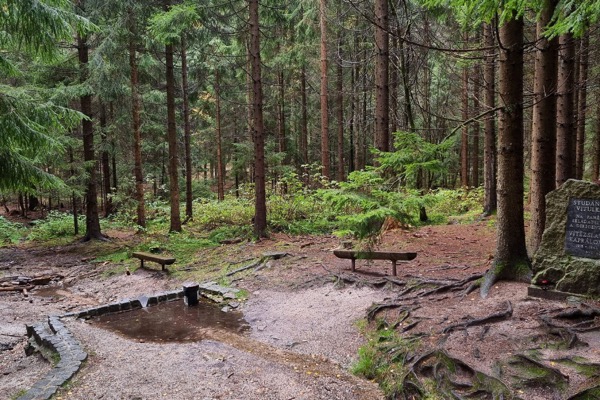
The Opening of the Wells
Let us conclude this short listening guide with the folk cantata The Opening of the Wells, composed in 1955. Set to words by the Moravian poet Miloslav Bureš, it is one of the clearest expressions of Martinů’s emotional connection to his homeland.
The subject comes from an old local custom in the Moravian Highlands, when people would clean and open the wells and springs after winter. Children always took part in this ceremony to restore the waters to flowing freely again.
For Martinů, this was a nostalgic and idealised yearning for the past and an imagined return to his childhood. This piece is highly personal and intimate, featuring vocal soloists, a narrator, a female chorus, and two violins, a viola, and a piano.
The music has an almost childlike quality, with folk-like melodies and simple rhythms alternating with instrumental exchanges and quiet reflection. You can almost hear people gathering in the countryside, and there is a wonderful sense of communal singing.
Why don’t we conclude this little listening guide by letting Martinů’s own words have the final say? “The artist is always searching for the meaning of life, his own and that of mankind, searching for the truth,” he once wrote.
“A system of uncertainty has entered our daily life. The pressures of mechanisation and uniformity to which it is subject call for protest and the artist has only one means of expressing this, by music.”
For more of the best in classical music, sign up for our E-Newsletter
Bohuslav Martinů: Otvírání studánek (The Opening of the Wells), H. 354 (Milada Čejková, soprano; Vladimír Doležal, tenor; Petr Messiereur, violin; Jan Kvapil, violin; Jan Talich Jr., viola; Stanislav Bogunia, piano; Kühn Mixed Choir; Pavel Kühn, cond.)